PHOTOBOOK REVIEWS, INTERVIEWS AND WRITE-UPS
ALONG WITH THE LATEST PHOTO-EYE NEWS

Social Media


We are packing up some of our most exciting work and heading to Santa Monica, CA for photo l.a.!

I thought I would post a little teaser to encourage you to stop by our booth (B-205) and say hello to Rixon, Vicki and myself. If you have not attended photo l.a. in the past I encourage you to do so especially as it is now in its 20th year. (Congratulations to Stephen Cohen and the Art Fairs Inc crew!) This year photo l.a. will feature work from about 55 of the finest photography galleries from all over the world.

photo-eye will be showing work by 5 gallery artists and a photographer we selected from photo-eye's online gallery the Photographer's Showcase, Collette Campbell-Jones. We will also be showing the first few publications from photo-eye Editions, including Habitat Machines by David Trautrimas, Suo Sarumawashi by Hiroshi Watanabe and Cranach Series by Carla van de Puttelaar.


Nick Brandt
Nick Brandt -- Ostrich Egg and Cheetah and Cubs

Nick Brandt was formerly trained as a filmmaker and painter, but was inspired by the love of his subject to become a still photographer. Brandt is passionate about animals of all kinds, but according to Brandt, he focuses on East African animals because "there is perhaps something more profoundly iconic, mythological even, about the animals of East Africa, as opposed to say, the Arctic or South America. There is also something incredibly emotionally stirring about the plains of Africa - the vast green rolling plains punctuated by absurdly, perfectly graphic acacia trees. My images are my elegy to a world that is steadily, tragically vanishing". --Nick Brandt
In September 2010 Brandt took his love for the animals to the next level by starting Big Life Foundation -- its mission to help conserve and protect East Africa's endangered wildlife and ecosystems. Through January 31, 2011, 20% of all Nick Brandt photograph sales through photo-eye will go to the Big Life Foundation to help protect the wildlife depicted in his images.

Click here to read our recent blog post on Brandt's Big Life Foundation.
View Brandt's work at photo-eye Gallery.


Julie Blackmon
Julie Blackmon -- High Dive and Queen
We will be showing some of the most recent images from Julie Blackmon's on going Domestic Vacations series. Blackmon has been moving forward at full force continuing to produce intelligent, visually interesting, and entertaining images utilizing family members in scenes that are inspired by classical Dutch and Flemish paintings. Blackmon's images are surreal yet ever day and contain modern day iconography, but visit classical compositions. Though I have studied all of Blackmon's images carefully I continue to discover new elements daily.

View Blackmon's work at photo-eye Gallery.


Tom Chambers
Tom Chambers -- Presumptuous Guests and Caging the Song Bird
photo-eye showed Tom Chambers' work at photo l.a. for the first time about 5 years ago. Since then Chambers has continued to move us with his fantastic compositions. This year we will show Chambers' newest work Dreaming in Reverse / Soñando Hacia Atrás.

"Sensing that little time remains to photograph the beauty of Mexico, I have created the series "Dreaming In Reverse" to express both my concern for cultural loss, as well as my appreciation for the inherent loveliness of Mexican life. Employing magic realism, an art genre used in the early twentieth century in Mexico, I have attempted to create images of Mexico which seem true and believable, but also perhaps improbable. These photomontages illustrate my dreams for the Mexican people that they are able to retain the authenticity of their culture." --Tom Chambers

Read the photo-eye Blog post on Tom Chambers' new series here.
View Chambers' work at photo-eye Gallery.


Jamey Stillings
Jamey Stillings -- Arizona View, April 28, 2009 and Aerial View, June 30, 2009

"When I first encountered the bridge at Hoover Dam in March 2009, it immediately captured my imagination. Watching the bridge's construction, especially at night, is both inspiring and magical. The photo essay, which is evolving from this initial encounter, allows me to meld photographic and aesthetic sensibilities with a reawakened sense of childhood curiosity and awe." -- Jamey Stillings

I think that it is safe to say that the bridge at Hoover Dam continued to hold Jamey Stillings' imagination beyond the end of the construction. Stillings (who lives in Santa Fe) photographed the last 30 months of the bridge's construction and prepared a 40 print exhibition which opened at the Springs Preserve in Nevada in conjunction with the opening of the bridge! This exhibit is scheduled to travel for the next two years, and Stillings has a few other ideas in the works as well. Additionally, Stillings is a Photolucida Critical Mass 2010 Book Award Finalist.

View Stillings' work at photo-eye Gallery.


Carla van de Puttelaar
Carla van de Puttelaar -- Untitled from Galateas and 2008_32 from Cranach Series
Dutch artist Carla van de Puttelaar creates beautiful timeless images of women in their natural state. According to van de Puttelaar, the images that we see in magazines are more about makeup and fashion - they are plastic, not about real beauty. For van de Puttelaar, beauty resides in the "little things," small imperfections or tiny movements. She defines this as a very human beauty. van de Puttelaar seeks to create images that capture "beauty with dignity" by focusing on distinguishing marks like small moles, imprints from lingerie lace or elastic or a slight bruise. To van de Puttelaar each portrait is, in a sense, a self-portrait as she relates to her models as a woman.

From the very first time I was introduced to van de Puttelaar's work I knew that I was looking at something very special. In the past year I have spent a great deal of time with her work. We have exhibited it at photo l.a. 2010 (and upcoming 2011), Art Chicago 2010, and Art Santa Fe 2010, produced a limited edition portfolio from her Cranach Series and her work is our current exhibition in photo-eye Gallery. In the process of getting to know van de Puttelaar and her work (via email as she is Amsterdam) I have gained a broader understanding and an even greater appreciation of her photographs. I hope that you will read my interview with van de Puttelaar and that you will enjoy our conversations

Read my conversation with Carla van de Puttelaar here.
View van de Puttelaar's work at photo-eye Gallery.


Colette Campbell-Jones
Colette Campbell-Jones -- Coal Door and English Out
Colette Campbell-Jones recently received her MFA from San Francisco Art Institute. A few years ago I reviewed her work at the Photo Alliance One World portfolio review in San Francisco. With in minutes of viewing Campbell-Jones' Stories from the Underground I knew that she was on to something very special. An exhibition of Campbell-Jones' work is currently on display at Palo Alto Center for the Arts.

"The underground imagery of the mine is profoundly mythical, an archetype associated with darkness, the unknown and the primordial. Stories from Underground reveal the strange light of a people who have emerged from the mine's conditions of incommensurable darkness, from the Abyss." --Collette Campbell-Jones.

Read the blog post on Campbell-Jones here.
View Campbell-Jones' work on the Photographer's Showcase.


We hope you'll join us to celebrate the 20th year of this prestigious international art exposition. photo l.a. is being held at the Santa Monica Civic Center located at 1855 Main Street, Santa Monica, CA. The fair dates are January 14th-17th with an opening reception on January 13th from 6-9 pm. Opening night tickets are $80 and benefit the Wallis Annenburg Photography Department at LACMA. Check out the photo l.a. website for the full schedule of events and lectures.

Please feel free to contact me should you have questions or visit the photo l.a. website.

Some of you may have noticed that we've been a little light on blog posts for the past few weeks... I can use the holidays as an excuse, and that my main co-blogger was visiting his family... but the biggest time stealer has been working on our annual Best Books feature -- which we will release next week!  This year the list of contributors is more diverse than ever -- as is the selection of books.  We're in the process of adding a sizable number of fabulous self-published and indie published books to our catalogue that we can't wait to let you know about.  We'll be highlighting books from this list over the next few weeks, sharing a little more information on them with you. Each year we are stunned to see how many amazing publications are out there just waiting to be discovered.

In the meantime, here's this year's list of contributors:

Alan Rapp 
Alec Soth
Bruno Ceschel
Alexa Becker
Colin Pantall
Elizabeth Avedon
Fabrice Wagner
George Slade
Hester Keijser
Joerg Colberg
John Gossage
Larissa Leclair
Laurence Vecten
Loring Knoblauch
Marco Delogu
Martin Parr
Michael Schmelling
Morten Andersen
Peter Sutherland
Timothy Prus & Ed Jones
Willem van Zoetendaal
Ramón Reverté
Rinko Kawauchi
Melanie McWhorter
Antone Dolezal
Anne Kelly
Todd Hido

And get your lists ready too! We'd love to hear your picks for the best books of 2010 and hope you'll share them with us in the comments section at photo-eye Magazine or here on the blog.

You can check out the lists from 2008 and 2009 at photo-eye Magazine.

Happy New Year!
The Photographer's Showcase is pleased to introduce a portfolio from Kevin Erskine: Supercell

Kevin Erskine -- Supercell Harrison Nebraska, 2009
Few things on this earth can simultaneously inspire both terror and wonder like a storm. The experience is likely universal: while one dreads the threat of danger, an on-coming storm can be hard not to watch, the raw power and unique beauty hypnotizing. Kevin Erskine captures this duality with mastery. Erskine is well acquainted with big storm, moving with is family from Illinois to a small town in Nebraska at age 10. In 1968 at age 12, Erskine witnessed his first huge storm -- a category 4 tornado. Shortly thereafter he started borrowing his father's camera to document the storms that passed through, and at age 19, when he got his first truck, he began storm chasing.

Kevin Erskine -- Lightning Bismarck North Dakota, 2006
Erskine still lives in Nebraska -- a farmer and photographer who continues to chase storms with his large format camera -- photographing the fantastic and imposing shapes of supercell storm systems, massive powerful structures, breathtaking in their terrible beauty. Leaving just enough traces of the earth in his framing, Erskine's images are a reminder of the sky's dominion over the landscape. The cloud formations dwarf anything else in the images and cast a strange light over the earth. While the lightening and the stunning cloud formations Erskine catches are impressive, it is this light and color in these images that stick with me (all done without the help of a computer). Erskine has managed to capture the elusive light and color of a storm. At no other time is the world cast in such a peculiar light -- foreboding, but beautiful and magical all the same.

Kevin Erskine -- Supercell Billings Montana, 2007
 Erskine's images are soon to be published in a forthcoming book. We'll let you know when it's available! See the book here.

View Kevin Erskine's portfolio Supercell on the Photographer's Showcase

Read the photo-eye Blog interview with Kevin Erskine here

Read Daniel W. Coburn's review of Supercell by Kevin Erskine here

For more information please contact photo-eye Gallery Associate Director Anne Kelly by email or by calling the gallery at (505) 988-5152 x202
Slow Burn, Photographs by Renee Jacobs. 
Published by Pennsylvania State University Press, 2010.
Slow Burn

Reviewed by Tom Leininger
_________________________
Renee Jacobs - Slow Burn
Photographs by Renee Jacobs.
Pennsylvania State University Press, 2010. Softcover. 151 pp., 94 black & white illustrations 2 maps, 9x8-3/4".

A coal fire started underneath Centralia, Pennsylvania in 1962. It was still burning when Renée Jacobs arrived to document life in the town in 1983. A handful of residents remain today, but the town is essentially gone.

Jacobs' book, Slow Burn: a Photodocument of Centralia, Pennsylvania was first published in 1986 by the University of Pennsylvania Press, has been republished this year by The Pennsylvania State University Press. The book is a look back to a town and time that was. Jacobs' contrasty wide-angle black and white images fit the time and the project.

Slow Burn, by Renee Jacobs. Published by Pennsylvania State University Press, 2010.
 The straightforward pictures tell the story of life in a town dealing with an unseen, but dangerous environmental catastrophe. Smoke pours out of vents in the ground and people go on. We see the carbon monoxide readings being taken. We see the people who were trying to do something about their town. We see the faces of those coping with the fire and government.

Slow Burn, by Renee Jacobs. Published by Pennsylvania State University Press, 2010.
Jacobs' focus on the life of the town yields lighter moments, but overall, it is a heavy book. It is a story of an environmental problem and the government moves slowly to help. Families and the town suffer. Eventually they move out. One of the book's strongest series of images is at the end. Joan Girolami sits in an empty living room looking out the window. She feels very small in the image, looking to the light out the window, she is surrounded by darkness in her house. Images like this are the strength of the book, and there are a number of images in the book on this level.

Slow Burn, by Renee Jacobs. Published by Pennsylvania State University Press, 2010.
Jacobs' strong storytelling ability makes this book worthwhile. The work tells of yet another environmental disaster, except this is harder to see, outside of the smoke belching vents. It is the pain and anguish on the faces of the residents of Centralia that tells the story.—Tom Leininger


Tom Leininger is a photographer and educator based in Denton, Texas. He received his MFA in photography from the University of North Texas. Prior to that he was a newspaper photographer in Indiana. His work can be found at http://tomleininger.net.
The Way of the Japanese Bath,Photographs by Mark Edward Harris. 
Published by Sashin Press, Los Angeles, 2010.

The Way of the Japanese Bath
Reviewed by Sara Terry
__________________________ 
MARK EDWARD HARRIS
The Way of the Japanese Bath
Photographs by Mark Edward Harris
Sashin Press, Los Angeles, 2009.
Hardbound. 186 pp., 91 duotone
illustrations, 8x10."


This is the second edition of Mark Edward Harris' book, which was first published in 2003. It is gorgeously produced, with all the simple elegance one associates with Japanese culture - a tipped-in photo on a cloth-bound book, secured with clasps. The end paper is a polyptych woodblock print depicting a women's public bath, made by a Japanese artist in 1868. As an object, the book itself is a work of art.

The 91 duotone images that make up the book are perfectly reproduced, and arranged in three sections - baths that are outside, baths that are inside, and after-bath rituals. Harris had a wide range to choose from in creating this work; as he notes in the foreword, there are some 20,000 thermal hot springs across the islands that make up Japan, the natural product of the same geological shifts that cause earthquakes and volcanic eruptions.

The Way of the Japanese Bath, by Mark Edward Harris. Published by Shashin Press, 2009.

Bathing is a highly prized ritual in Japan - cleansing, with soap, takes place before a bath - and Harris captures the ritualistic sense of bathing in many of his photographs, including the austere, angular photo of a woman looking out a huge, steam-fogged wall of windows, only her head and shoulders visible above the war. A disquieting sense of mystery also permeates the photo of two men bowed underneath a cascade bath, founts of water pouring down from several feet above them, as a young boy lays on his side in shallow water.

The Way of the Japanese Bath, by Mark Edward Harris. Published by Shashin Press, 2009.


The Way of the Japanese Bath, by Mark Edward Harris. Published by Shashin Press, 2009.

That said, there is something disappointing in this book. I couldn't help feeling as I went through the photos again and again, that as much as I liked some of the images, the overall work isn't really an act of discovery, or interpretation. There is a stiltedness that emerges through the pages, a sense of posing that isn't helped by the brief text that accompanies each image. Notes about "magnificent" hotel spas and "après-ski relaxation" sound a bit too much like travel brochure language, and don't offer much insight into "the way" of the Japanese bath. Perhaps the fact that the Japan National Tourist Organization provided "invaluable logistical support," according to Harris' acknowledgments, accounts for some of that uncomfortable feeling that however beautiful the images, this book feels a bit like a high-end pitch for a Japanese vacation, and not a genuine exploration of a culture.
—Sara Terry


purchase book 


Sara Terry is a former staff correspondent for the Christian Science Monitor and magazine freelance writer, Sara Terry made a mid-career transition into documentary photography in the late 1990s. Her long-term project about the aftermath of war in Bosnia -- “Aftermath: Bosnia’s Long Road to Peace” -- was published in September 2005 by Channel Photographics, and was named as one of the best photo books of the year by Photo District News. Her work has been widely exhibited, at such venues as the United Nations, the Museum of Photography in Antwerp, and the Moving Walls exhibition at the Open Society Institute. She is the founder of The Aftermath Project (www.theaftermathproject.org), a non-profit grant program which helps photographers cover the aftermath of conflict. She is currently directing and producing "Fambul Tok," a documentary about a post-conflict forgiveness and reconciliation program in Sierra Leone, which recently won a grant from the Sundance Documentary Institute. bosniaaftermath.com
Newtown Creek, Photographs by Anthony Hamboussi. 
Published by Princeton Architectural Press, 2010.

Newtown Creek

Reviewed by Alexandra Huddleston
_________________________
Anthony Hamboussi Newtown Creek
Photographs by Anthony Hamboussi
Princeton Architectural Press, New York, 2010.
Hardbound. 432 pp., 237 color and 4 black & white illustrations, 9-1/2x6-1/2".


Anthony Hamboussi's Newtown Creek: A Photographic Survey of New York's Industrial Waterway is a book of incongruous beauty. Hamboussi documents the chaotic landscape of an industrial wasteland with the eye of an obsessive collector, combining the gentle pastel washes of a seaside watercolorist with the surreal detailing of large-format photography.

This exhaustive, five-year documentation of Newtown Creek, the waterway that forms a natural border between Queens and Brooklyn, is a must have for anyone even slightly enamored with America's decaying industrial landscape. Unfortunately, at 7 by 10 inches, the book's dimensions do not enhance the subtle detail and tonality of Hamboussi's photography. However, filled with around 200 photographs of vacant lots, concrete silos, warehouses, and railway tracks -- among other favorite urban sights -- each carefully labeled with historic and cartographic information and preceded by a map of the waterway and surrounding streets, the book's format does highlight the obsessive character of Hamboussi's work. It's a quality emphasized by the calm, rigid, and balanced compositions, by the super-fine detail of large format photography, and by the chronological sequencing of the photographs. Indeed, the end comes as a shock after the viewer has been lulled by the sweet, monotonous lullaby of rain-washed concrete and shimmering, polluted seas. Five years marks the end of the book, but the corner of New York City it documents keeps changing, waiting for another set of eyes to stop its time for a few thousandths of a second.


Newtown Creek, by Anthony Hamboussi. Published by Princeton Architectural Press, 2010.

At its heart, however, this book is a meditation about nature and humankind's relation to it. Even though Newtown Creek is the subject of the book, only about half of the photographs give us a glimpse of the waterway itself. The rest show the infrastructure (or the remains) of the numerous transportation, manufacturing, sewage treatment, and warehousing industries that developed in the area, largely as a result of Newtown Creek and its role as a convenient water source, transportation route, and dumping ground. However, even in the most barren and utilitarian portions of this concrete jungle, there always appears a touch of green from some obstinate weeds or a few golden leaves gracing the stubborn trees thriving along the banks of this proposed Superfund site. Indeed, the longer Hamboussi photographs the area, the more he allows nature to grow into his project. To the gray, uniform days are added snow, rain, glimpses of blue sky, and even one shy sunset.

Newtown Creek, by Anthony Hamboussi. Published by Princeton Architectural Press, 2010.

Hamboussi's first book is a delicate and complex love affair with a section of New York City that few visitors or residents ever see. In the end, I cannot forget that Hamboussi has spent years printing his work at the International Center of Photography, just near Bryant Park. How many times must he have passed the quote by Carl G. Jung written into the mosaics on the Bryant Park subway station wall: "Nature must not win the game, but she cannot lose."—Alexandra Huddleston

purchase book 


Alexandra Huddleston is an international documentary photographer whose most recent work focuses on exploring the transformation of traditional religious practices in the 21st century. In 2007 she spent a year in Timbuktu photographing the town’s legacy of traditional Islamic scholarship, supported by a Fulbright Student Islamic Civilizations grant. Her current work explores a pilgrim’s life along the Camino de Santiago in northern Spain. Huddleston earned her MS in broadcast journalism from the Columbia University School of Journalism in 2004, and her BA in studio art and East Asian studies at Stanford University in 2001. She currently works as an adjunct professor in the photography department at the Santa Fe Community College. Huddleston’s photographs have been included in the permanent collection of the Library of Congress’ Prints and Photographs Division as well as exhibited at numerous solo and groups exhibitions around the world. 
Care of Ward 81, Photographs by Bill Diodato. 
Published by Golden Section Publishing, 2010.
Care of Ward 81
Reviewed by Rena Silverman
_________________________

Bill Diodato Care of Ward 81
Photographs and text by Bill Diodato. Foreword by Mary Ellen Mark.
Golden Section Publishing, 2010. Hardbound. 64 pp., 46 color and black & white illustrations, 10x6-1/2".

Enter Ward 81, where the walls cake and crumble down into a pile of ruins once called a floor. Ahead, three symmetrical windows reveal a day's light, made leaden by cloud or snow (or dust stuck to the glass). Above, the patchwork of a ceiling hangs like a mouth without teeth, its framework bulging from humidity and neglect.

Bill Diodato has captured empty rooms like this at a state mental hospital in Oregon, where mentally ill women dwelled in the 70s. (It is also the location where One Flew Over the Cuckoo's Nest was filmed.) The book progresses through a creative flow of colorful images. In the earlier pages, white typography pops out of the small, black frame, while the later pages have been dressed entirely in image.

The story behind Ward 81 has been considerately placed in the preface. Written by Diodato, the preface is necessary for introducing these photographs and the change that took place for the artist midway through his work. Diodato wrote that originally he blamed "Capitalist greed," as "the driving force behind the breakdown and decay of this once vital facility," Ward 81. But, after the Oregon State Legislature granted him permission to shoot the facility in 2005, Diodato's opinion changed. Based on his experience, he concluded, "...maybe this is one case where capitalist greed got lucky." The place looked so horrible, perhaps it was a good thing it closed down.

Care of Ward 81, by Bill Diodato. Published by Golden Section Publishing, 2010.
Diodato, as he notes in his book, is not the first person to explore this space. In 1976, photographer Mary Ellen Mark documented (in black and white) not only the ward, but also the women who dwelled in it. The ghosts of the women once photographed by Mark haunt Diodato's images. But, if Diodato created Care of Ward 81 in response to Mark's book, he did so in a different language. Mark documented the women, as they existed in the same space at the same time, while Diodato positioned the location as his subject, examining a space separated from its active time. Additionally, Diodato adds a hint of commercialism to his images. His bright colors offer an ironic upbeat lift to Mark's sharp, yet nostalgic, black and white imagery.

Mary Ellen Mark wrote the forward to Care of Ward 81. It is difficult to tell whether that was a good idea. On the one had, it provides book owners with a contextual reference, while humbling Diodato and brightening his personality as a photographer. On the other hand, it makes one research Mark's photographs, which have both an artistic quality and a political voice.

Care of Ward 81, by Bill Diodato. Published by Golden Section Publishing, 2010.
But, for someone who usually shoots portraits of celebrities for magazines, Diodato has done a fabulous job of putting together this book. It is very personal, and offers a younger generation a gentle reminder of the politics of mental health in the wake of a current and national medical insurance crisis.

Care of Ward 81, by Bill Diodato. Published by Golden Section Publishing, 2010.
 "Everything is so changed," wrote Mary Ellen Mark in the forward to Care of Ward 81, "Bill Diodato has transformed what was once so cold and institutional into a palette of vivid colors and textures."

The colors are lovely, but the crumbling walls and decay and political statements at the beginning of this book do not make a proper coffee table book; rather, a personal look into someone's beliefs illuminated by the tall windows and crackles and hues in Care of Ward 81.—Rena Silverman


purchase book


Rena Silverman is a freelance writer and art journalist. She has contributed to Examiner.com, the New York Art Beat, and Marie Claire magazine. You can learn more about her by going to www.renasilverman.com.


Photolucida's Critical Mass has established itself as one of the foremost photo competitions, drawing applicants world wide for the multi-round event culminating in photobooks for the top two or three winners.  Since 2005, Photolucida has produced 11 gorgeous books for emerging photographers with two more to be released this spring. The 2010 book award winners are in the process of being selected from the following six photographers: Christopher Capozziello, Natan Dvir, Justine Reyes, Jeff Rich, Pavel Maria Smejkal and Jamey Stillings.

photo-eye was fortunate enough to catch Photolucida's executive director Laura Moya at a lull between Critical Mass jurying cycles and ask a few questions about the competition, jurying process and how the Critical Mass books come to be.

_______________________________________

photo-eye:  How did Photolucida come about?

Laura Moya:  Photolucida is a bit over 10 years old - it started out as PhotoAmericas. A group of Portland photography people thought it a great idea to start a Reviews Festival in the Northwest. Critical Mass was added to the programming in 2004, and subsequently, the book publishing.

PE:  Photolucida's Critical Mass is an annual international competition where a multi staged juried process culminates into 2 or 3 photographers walking away with a book of their work. How did Photolucida come to the decision that a photobook would be the end result of the annual competition?

LM:  For photographers, to have a book published is an event that adds validity to one's career. If a publisher or organization believes enough in someone's work to publish it, this is a great affirmation!  It is something tangible that a photographer can hand to someone in varying contexts, which is a great career boost.

On the flip side, Photolucida can also send books to all the jurors who gave us their time as a way to say - "Thanks for your work jurying - see, you helped make this book possible for this person!"  And subsequently, the fact that we put the book on the desk of the 200 jurors is great marketing for the book award winner.

Maze by Celine Clanet, Color Falls Down by Priya Kambli and Guardians by Andy Freeberg
PE:  There are several stages leading up to the winners of Critical Mass -- it is almost like a track and field competition where if you can make it to the next stage, you have a little time to breath before the next race. How did you come to the decision to announce initially the top 175 finalists, then the top 50 finalists, then the six book award finalists and so on?

LM:  Yes, there are two different "heats" - and they are all determined by our programming. Jurors assign scores to each portfolio of work and our programming gives us the average of each one, and that is how we determine the 175 mark and the 50 mark. The book award finalists are not automatically the top scorers. We pull the 5 or so people from say, the top 20. Some people at the top of the list might have a book out already, or be in the process of doing a book with a publisher, or for whatever reason, not be ready for a book. Lots of people have a strong body of work with the 10 images they have submitted, and a high score for that, but that does not necessarily make for a cohesive book.

That is why we solicit proposals from a large handful of people - we want people to show us how they are ready for a book, and their vision of what they would like their book to be. So the first two stages are strictly based on numerical averages, and the last stage is determined by the board soliciting book proposals.

PE:  The announcement of the top 50 finalists is highly anticipated. I feel like the top 50 finalists have all won this prestigious competition. It is a great way for a large number of photographers to be thrust onto the international scene.
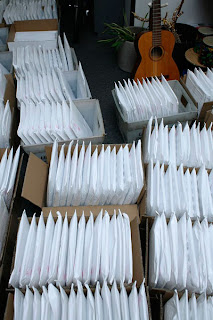
Books ready to go out to reviewers and participants
LM:  Of course they are all "winners." We really try to emphasize that Critical Mass is primarily about exposure, not just about the book award. Primarily we are trying to produce a program that will put the work of photographers into the hands of people who actually use photography in their programming. We send all the jurors a CD of the 175 entrants, so they will have a record of everyone's work in case they need a reference down the line, or want to pass the CD on to a colleague who is looking for something specific. We also send the "all entrant" CD out to all photographers who entered as a record of the event, so they can see who their peers are and what they are doing. We also have had photography professors who ask us to send them the CD and they use it as a teaching tool, and have given the CD to galleries that are trying to source work for a show. It is a nifty thing.

Some other community-building things we do with Critical Mass: as mentioned earlier, we send copies of the books, once published, to all the jurors who completed their voting. We send the books to all the photographers who entered their work, as well. So, with our last batch of 3 books, we sent out about 2,200 books out to people in 20 countries. We also give "scholarships" to a large handful of foreign photographers - people who might not be able to afford the entry fee and who are doing interesting work. We rely on our own research and the suggestions from curators from the countries. To date we have given "scholarships" to photographers from Poland, Mexico, Italy, and the Netherlands.  We also donate copies of all the Critical Mass books to over 30 Oregon public, university, community college and art school libraries. This year we also awarded gratis spots to five CM finalist photographers to our Portfolio Reviews event - so, we are glad to be extending "scholarships" in this way.

PE:  There are at least 200 jurors looking at the selected 175 finalists' work. That is such an incredible amount of exposure for these photographers. I can only imagine that this competition leads to other opportunities for those who do not make it to the final 2 or 3 who publish a photobook. Are there any success stories that come to mind for those that did not make it all the way to the publication of a book?

LM:  There are dozens of success stories - we have a page for these on our website, as well as listing them often in our blog. One note that sticks in my memory is from a few years ago, creatively written by Camille Seaman, memorable because illustrates the domino effect that Critical Mass sometimes starts.

Another fun thing to track is the names of photographers who entered Critical Mass in the early days, and think about where they are now, career-wise: Chris Jordan, Julie Blackmon, Doug DuBois, Michal Chelbin, Maggie Taylor, David Maisel.

PE:  How are the jurors selected for Critical Mass? Do you approach jurors who are interested in the end result being a photobook, or are you looking for a well-rounded jury committee that operates in many different facets of the photo world?

LM:  We look for jurors that come from all facets of the photo world, with different photographic aesthetics. Ultimately we want the majority to be people who can offer tangible opportunities, but at the same time we respect the opinion of writers and academics in the field, as well. We bring new people onto the list by doing our own research, and also asking for suggestions from both professional peers and photographers.

Boxes arrive with The Last Iceberg
PE:  Once the final few have been picked to work on publishing a photobook, how does the process evolve from there? How involved are the photographers with the publication of their book? Do the individual photographers help with the design, editing and sequencing of their book?

LM:  In the past, photographers have been totally involved in the making of their books. We offer design service, or one can choose to work with one's own. Most award winners have had a very acute sense of how they want their work sequenced, and have picked who they have wanted to write their introductions. The photographer has choice on the details of the book: font, cover and paper finish, endpaper color, etc. We have tried to keep the general aesthetic for all the books as congruent as possible, but simultaneously respected the creative wishes of the photographers, too.

PE:  This year Photolucida is partnering with Newspace Center for Photography, The Photo Center Northwest and RayKo Photo Center to exhibit the top 50 finalists in an exhibition around the Portland, Oregon area. The exhibition also revolves around Photolucida's reviews held every other year in April. How did these additional awards and benefits for the Critical Mass competition come about?

LM:  Last year we collaborated with PCNW on the EXPOSED: Critical Mass 2009 exhibit, which was curated by Andy Adams. It was such a great idea, we expanded it this year go on a little West Coast tour: Across the Divide: Critical Mass 2010 will travel to PCNW in Seattle, Newspace in Portland, and Rayko Photo Center in San Francisco. Todd Hido is curating the show, which we are super-excited about. We are also collaborating with Blue Sky Gallery on offering a solo show from the Critical Mass finalist group - they just awarded it to Mitch Dobrowner, and it will be up the month of the Reviews. We love collaborations,
working with other photography organizations with similar missions is very rewarding!

On that note, we are co-publishing one of our Critical Mass 2009 books (Alejandro Cartagena's Suburbia Mexicana) with the new imprint Daylight Books - it has been nice to combine resources and talents with them to make it happen. Alejandro's book and Birthe Pointek's The Idea of North should be available in February.

PE:  How did you get involved with Photolucida?

LM:  I was in the photography world many years ago, and then switched over to film. I worked for the Sundance Institute on a program for documentary filmmakers, and for the Northwest Film Center as their PR director.  I then produced film pieces for a creative services agency, for commercial clients and museums. Then I was asked to come back over to the photography world - the skill set was easily transferable! I have been the director here over four years.

PE:  What is your personal involvement in the Critical Mass competition as well as the Photolucida Review?

LM:  I jury the work entered in Critical Mass, and act as a support person to Tricia Hoffman, our Programs Manager, who is currently running Critical Mass. We work with our programmer closely each year, trying to improve the experience more each time for both photographers and jurors. I organize the Reviews event, as well as project-manage the publishing projects.

PE:  What is your favorite part of the process working as Executive Director of Photolucida? 

Tricia Hoffman and Laura Moya at the Lucie Awards
LM:  Foremost, bringing deserved exposure to the work of photographers! Photographers are generally a group of really good people working very hard at their craft and making a lot of sacrifices to be artists. It is a medium I truly love and I never tire of seeing how "emerging" photographers are using it. Critical Mass, the book publishing, and the Reviews event are all great conduits for this. One would guess that the completion of a book or a successful Reviews event ending makes me happy - so much work goes into each thing on the part of so many people, and I am grateful to be a conduit.

On a personal level, I enjoy being asked to write or curate little projects - I have written interview pieces for the Griffin Museum of Photography's Critic's Pick (Chris McCaw) and for Finite Foto (Lisa Law and Taj Forer). I am about to jury an exhibit of alt-process work for 23 Sandy Gallery titled photo-alchemy. Travel is a huge perk for me - in the last year I have gone to China as a curator (Desiree Edkins, Lori Vrba) and recently returned from Paris where I was invited to review at Lensculture/Fotofest.

PE:  It seems like Portland will be overwhelmed with exhibitions as well as photographers descending upon the city this coming April! How do prepare for such an event?

LM:  Yes, we will have a full-fledged "Portland Photo Month" happening with over 25 galleries showing photography in April. Plus collaborative events with PADA (Portland Art Dealer's Association) and the Portland Art Museum's Photo Council. How do we prepare for such an event? Lots of excel spreadsheets, a helpful board, a small army of volunteers, and good coffee!

_______________________________________

View the Photolucida books here.
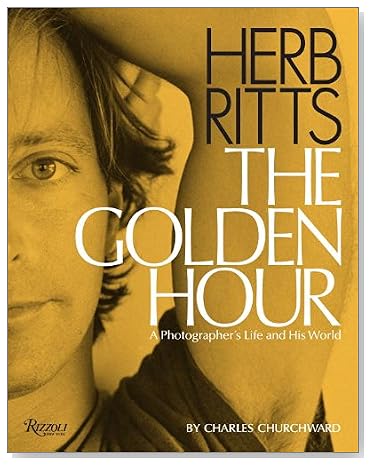
Join us tonight at Moss Outdoor at 530 South Guadalupe Street, Santa Fe, for a lecture and book signing with Charles Churchward for his new book Herb Ritts: The Golden Hour, A Photographer's Life and World. The event runs from 6-8 pm with books available for purchase supplied by photo-eye.

The Golden Hour reveals for the first time the personal aspects of Ritts’s world, work, and legacy and includes many never-before-seen photographs and scores of interviews from business associates, curators, staff, lovers, and family, such as Cindy Crawford, Elton John, Anna Wintour, Madonna, Calvin Klein, and Christopher Buckley (Ritts’s college roommate). The diverse images in the book includes shots from Ritts’s personal archive—behind the scenes at photo shoots, parties, travels, intimate portraits, and moments with friends—along with notes and contact sheets that show how ideas evolved to became his iconic images.

The December 10th Pasatiempo has a wonderful write up of the book (by Laurel Gladden) and features a Ritts photograph on the cover.  As Gladden notes, the book is an unusually vivid biography, telling the story of Ritts' life through the tales of the people who knew him best, and crafted by one of Ritts' best friends. 

Infidel, Photographs by Tim Hetherington. 
Published by Chris Boot, 2010.
Infidel

Reviewed by Ellen Rennard
_________________________
Tim Hetherington - Infidel
Photographs by Tim Hetherington. Introduction by Sebastian Junger.
Chris Boot, 2010. Softcover. 240 pp., 200 color illustrations 6x8".


Infidel, with photographs by Tim Hetherington and introductory text by Sebastian Junger, is as nearly perfect as I can imagine a book to be. Let me provide a bit of context for the way I see it. First, I came of age during the Vietnam War and was profoundly influenced by the powerful, iconic photographs of that conflict. However, my general impression of post-Vietnam photographs of Americans in combat has been that there is always something hidden or unseen; I always feel removed from the situation, peering out a tank window either literally or figuratively. I keep looking for the real thing, images that resonate as powerfully as, for example, Eddie Adams' photograph of the execution of a prisoner of war, and while I've seen some good work, I have not found what I was searching for. Until Infidel.

Infidel, by Tim Hetherington. Published by Chris Boot, 2010.
 The intimacy of Hetherington's portraits of a single US platoon stationed in the Korengal Valley, a dangerous and remote outpost in Afghanistan, cannot help but elicit an emotional response from the viewer, but beyond that, these photographs are just so damn well made, so heartfelt, so intelligent. The book looks like a journal, bound in black, a soft cover that sits in the hands like the personal story that it is. No surprise that Hetherington and Junger were there for five months - this is no fly by night project. One of the things that struck me is the maleness of what is here: it is, writes Junger, a brotherhood that is the true topic of this book. Women are entirely absent except in pictures of pin-up girls that Hetherington has shown just as they appeared: next to fly-strips and a lot of ammunition. I remember as a younger woman wondering what, exactly, went on in men's locker rooms, what they said to one another, how they behaved, and in a strange (and altogether military) way, this book supplies at least a partial answer.

Infidel, by Tim Hetherington. Published by Chris Boot, 2010
The book begins with the landscape, and then zeroes in on the men themselves quite quickly. Following Junger's hard-hitting introduction, one that works perfectly with what follows, are two pages of thumbnail portraits - like those that might appear in a high school yearbook - with the names of each man, followed by one rather amusing group shot (one soldier is yawning), and then a series of stunning portraits of individual men, both in and out of uniform. The next part, graphic illustrations of the men's tattoos, was the least interesting to me; I felt I better understood the idea of this sequence from the title of the book, the text about tattoos, and the photographs of the men's tattooed arms, chests, etc., and so found this section to take away (just a very little) from what was otherwise incredibly compelling. Since these graphics occupy just 16 pages, and since they were at least mildly interesting, it was easy to flip through them. Perhaps if I had taken more time connecting them to the portraits (since each tattoo is associated with a name), I would have liked this part better, but I didn't have the patience for that in light of the amazing photographs and text that surround them.

Infidel, by Tim Hetherington. Published by Chris Boot, 2010.

Next are details, some raw and some raunchy -- men playing cards, passing the time -- followed by photographs of combat. To me, fascinating. That way of seeing behind the walls, of feeling the experiences of these men. The surreal juxtaposition of a shadowy figure holding a weapon next to a man in uniform petting a dog - these are the contradictory elements Hetherington aimed to show. As he writes, "War is absurd yet fundamental, despicable yet beguiling, unfair yet with its own strange logic." I cannot think of another book that gets at the complexity of war as well as this one.

Infidel, by Tim Hetherington. Published by Chris Boot, 2010.
The book ends with text by some of the men, writing that illuminates exactly what is going on here, followed by incredibly tender photographs of the sleeping soldiers. Their vulnerability could not be any more visible. Finally, there are captions accompanying thumbnails of some of the previous images that take you even more deeply into some of the very particular moments that Hetherington witnessed. My friend who needs a new prescription for her reading glasses (so she told me) thought the print was a tad small in this final part, but I did not mind (my prescription is new).

I will use excerpts from this book when I teach my course on images of the Vietnam War because I think it adds something to the archive of war photography that has not been shown before: the individuality and unity of men in combat. An awesome and important book for everyone.—Ellen Rennard


Ellen Rennard is a writer, photographer, and teacher of writing and literature at Groton School in Groton, MA. She graduated from Princeton, where she wrote her thesis on images of Native Americans; she also holds an MA in English from Middlebury. Her articles and reviews have appeared in Fraction Magazine and Photovision; her photographs have appeared in numerous publications, including Black and White and Orion. Images from Rennard’s book project on The Downs at Albuquerque were nominated for a New York Photo Festival Book Award in 2009 and won first place in the 2010 Px3 People’s Choice Awards for Book Proposal and Documentary Photography. www.ellenrennard.com
Mark Menjivar - 2007
 Photographer's Showcase artist Mark Menjivar's "You Are What You Eat" series has recently been featured on NPR's The Picture Show blog.You can find the blog post here. Menjivar has been interested in the issues of hunger and our personal relationships with food. His "You Are What you Eat" series documents the interiors of refrigerators, capturing what the contain at that very moment, nothing added or removed. When viewed as a whole, these images end up being a series of portraits -- it's almost surprising how telling these interiors are of the refrigerators owners.   

You can view the series on the Photographer's Showcase here. (Make sure to click on "display caption" for each image to get the full personal description that accompanies each photograph.)


Pick up a copy of the December issue of ARTnews to see a review of Gallery artist David Trautrimas' "The Spyfrost Project." Trautrimas' most ambitious project to date, "Spyfrost"  present a series of fictional secret military installations based on Cold War architecture.  If you look closely, you can pick out some of the often household items that make up Traturimas' constructions, though a number remain mysterious, creating a wonderful tension between whimsy and the feeling that something isn't quite right.  Trautrimas' quite scenes are always more then they seem at first glance.  View Trautrimas' work at photo-eye Gallery here.
Grimaces of the Weary Village, Photographs by Rimaldis, Viksraitis. 
Published by Anya Stone/White Space Gallery, 2010.
Grimaces of the Weary Village

Reviewed by Colin Pantall
_________________________
Rimaldis Viksraitis - Grimaces of the Weary Village
Photographs by Rimaldis Viksraitis
Anya Stonelake/White Space Gallery, 2010. Softbound. 80 pp., 47 black & white illustrations 11-3/4x8-1/4".

With a goat's head here and a pig's head there, Grimaces of the Weary Village is like Old MacDonald's Farm hitting the slaughterhouse. Shot in Lithuania, it is an unglamorous portrayal of life on the farm, a series of portraits of Viksraitis' fellow villagers, people who "...bear their cross without grumbling about their lot."

Cats, dogs, ducks and chicken mix with the crutches and wheelchairs of the village's more elderly residents. Pigs are slaughtered and bicycles are fixed as the poultry wanders in and out of the numerous parties that feature in the book. And it's the parties that lie at the heart of village life, parties where smoking, drinking and a groping of breasts are the main, and perhaps the only, attraction.

Grimaces of the Weary Village, by Rimaldis Viksraitis. Published by Anya Stonelake/White Space Gallery, 2010.
In the introduction, Martin Parr writes that if he could speak Lithuanian, he would join the party. Unless Parr is more of a drinker and swinger than we all take him for, I somehow doubt that. The drinking is hard-core, a mix of vodka and various brandies, and the sex is more than a little rough around the edges with an audience of indifferent children being the norm half the time. Men with hanging breasts and folds of belly flab jump on the nearest village wife, grabbing bared breasts, their veined cheeks reddening as they struggle to keep their dangling cigarettes in their mouth. And if they don't have a woman to jump on, then they head off to the tool room/kitchen to masturbate among the chisels and the planes.

Grimaces of the Weary Village, by Rimaldis Viksraitis. Published by Anya Stonelake/White Space Gallery, 2010.
Grimaces of the Weary Village is a fabulous book of rough and ready images, printed in a rough and ready manner on what looks like inkjet paper. You get the feeling the book will fall apart pretty soon and that the colours aren't quite right, but somehow that goes with the pictures of a village life that is gone for now, but not forever.—Colin Pantall


Colin Pantall is a UK-based writer, photographer and teacher - he is currently a visiting lecturer in Documentary Photography at the University of Wales. His work has been exhibited in London, Amsterdam, Manchester and Rome and his Sofa Portraits will be published as a handmade book early next year.. Further thoughts of Colin Pantall can be found on his blog, which was listed as one of Wired.com’s favourites earlier this year.