PHOTOBOOK REVIEWS, INTERVIEWS AND WRITE-UPS
ALONG WITH THE LATEST PHOTO-EYE NEWS

Social Media

Showing posts with label Owen Kobasz. Show all posts

Book Review Rabbit / Hare Photographs by David Billet & Ian Kline Reviewed by Owen Kobasz In this book, butterflies and back hair are equally magical and mundane, as they should be. Qualities of light are equally qualities of sensibility. The human beings in the pictures gently revel in the pleasures of riding horses, or smoking cigarettes, or exposing skin to sun and air.

Rabbit / Hare. By David Billet & Ian Kline.
https://www.photoeye.com/bookstore/citation.cfm?catalog=ZJ306
Rabbit / Hare  
Photographs by David Billet & Ian Kline

Deadbeat Club, Los Angeles, CA, 2020. 
72 pp., black-and-white illustrations, 9x11".

In 2017, Pennsylvania natives David Billet and Ian Kline set out on a two-month road trip to and through Texas. Neither photographer had visited the Lone Star State before, but in this trip they sought to avoid some of the more obvious clichés that come with the region— big trucks, cowboy boots, and megachurches to name a few.

“The two of us wanted to see, as singular people and as partners, where we fit into this landscape that held so much influence to our understanding and our elders’ understanding of masculinity, America, and life.”

Although Billet and Kline are not Swiss, with the cultural differences between different regions of America, they are outsiders in a strange new land. Although potentially isolating, this status also brings the beauty of straightforward observation — pure seeing.

Rabbit / Hare. By David Billet & Ian Kline.

Paging through the book, a range of emotions arise. Solitude — a man air-boxes with himself through a full wall of mirrors that look out of place among the surrounding office supplies. Warmth is an embrace between two men under stadium lights, or maybe a dance floor — metaphorical stars. Anxiety can be seen in a single eye poking out between heavy curtains, made especially poignant by the opposing photograph of an auditorium with a ‘Stainless Banner’ confederate flag in the corner. Humor inserts itself as a shop named “Heaven’s Depot”, or the unusual pixilated cut out of a butt found on a library shelf. Between these, a woman is reborn through baptism.

Rabbit / Hare. By David Billet & Ian Kline.
Through these movements, an overwhelming feeling is that of intimacy. Even in the dark scenes (or maybe, especially the dark moments) vulnerability shines through, and with that understanding.

Now, Rabbit / Hare is at its core a road trip photobook. The cover makes this clear with a horizontal highway landscape. Car-adjacent images appear later — a kitten napping in the shade of the car’s underbelly, a songbird perfectly posed on an unwashed side mirror. Spread throughout the book, these reminders bind the series to the road.

What elevates these images, however, isn’t so much the road trip itself. Rather, it’s the ability of two photographers to provide a varied, humanist vision of a complicated region; images “where butterflies and back hair are equally magical and mundane, as they should be. Qualities of light are equally qualities of sensibility.”


Rabbit / Hare. By David Billet & Ian Kline.

http://blog.photoeye.com/search/label/Owen%20Kobasz
Owen Kobasz edits the blog & newsletter at photo-eye. He holds a BA in the liberal arts from St. John's College and takes photos in his free time.

Book Of The Week The Beautiful Flower Is the World Photographs by Jerry Hsu Reviewed by Owen Kobasz Documenting his journeys through the high and low trappings of our culture, Hsu’s work captures everything from bootleg t-shirts and bathroom stall graffiti to unexpected truths and the occasional startling moment of humanity.
https://www.photoeye.com/bookstore/citation.cfm?catalog=ZJ003
The Beautiful Flower Is the World 
Photographs by Jerry Hsu

Anthology Editions, Brooklyn, USA, 2019.
288 pp., 440 color and black-and-white illustrations, 6¾x9½x¾".

The Beautiful Flower Is the World is the most recent monograph by skateboarder-turned-photographer Jerry Hsu. Although Hsu primarily uses 35mm film, the photographs in this book were taken almost exclusively on BlackBerry cell phones. They originally appeared on his Tumblr, “NAZI GOLD,” a photo-dump of sorts for Hsu’s beautiful and bizarre snapshots.

The Beautiful Flower Is the World. By Jerry Hsu.

The Beautiful Flower Is the World. By Jerry Hsu.
The disorienting title is taken from a t-shirt which has “the Beautiful flower is the world Its Love is be beautifid flower life in the oioersot…” printed above a bedazzled rose. The nonsensical text is almost poetic. It’s weird snapshots like this, torn from the mundane, that give us pause: Who made this? Who bought it? Or, more directly, why does it exist? The following stream of photos goes on to explore the bizarre, consumerist landscape of contemporary America through a light, almost whimsical, gaze.

The book itself is overwhelming. Behind the black cover and gold text are 440 images packed into 288 glossy black pages. The images are uniformly boxed into spreads of 2 or 4 images. They are grouped thematically or juxtaposed against each other to capture an ironic dissidence. Leafing through I found myself actually laughing at times and moved by a subtle beauty at others, as I became lost in the sea of images.

The Beautiful Flower Is the World. By Jerry Hsu.
Hsu’s photographs incorporate lots of appropriated imagery. From tabloid headlines to poorly drawn graffiti, fast food menus to YouTube thumbnails. In one, a pamphlet reads “WHEN THE FUN STOPS” in all caps over a moody sunset. Below it is a Globe headline “Who Will Die Next?” Later on, a taco ad spells out “HURT” in flaming letters. Devoid of context, these snapshots chop up the city landscape into bits and pieces that highlight just how weird things are right now.

Jerry Hsu also blatantly embraces the use of brand imagery. Large red flames painted in a fast-food window. The view is just wide enough to show that the business is, in fact, a Chick-Fil-A. A Honda CR-V extravagantly painted to look like a menacing storm, breaking into a blue sky before a cheetah’s head. These outlandish scenes are actually augmented by the frame of reference provided by the brand’s inclusion. We as consumers, and what we consume, are Hsu’s subjects.

The Beautiful Flower Is the World. By Jerry Hsu.

The Beautiful Flower Is the World. By Jerry Hsu.
One of the many lingering themes is that of solitude. The first image pictures a child reading a book in a shopping cart. A busker is pictured playing the saxophone before an empty grey highway. Later, is a boy standing in the produce section with a shopping basket over his head. These photos are not necessarily depressing, but rather slow and reflective. People reading, alone or together, make frequent appearances throughout. In these moments they are in world of their own worlds. The final image is of a bridge with “Honk if you’re lonely” crudely spray-painted below it.

Mixed in with snapshots of unusual cars and offbeat church signs are also examples of serious street photography. For example, in one photograph a man is sitting below a light pole, his face and most of his body obscured by the newspaper he is reading. He has one shoe off, placed behind him. Some of Hsu’s compositions are exceptionally abstract in their use of the subject and background. One of my favorites shows a kid riding a Ripstick — he is dressed up in all black from head to toe, including a large black hat, and carrying a white bag. His shadow stretches out before him, parallel to the sidewalk, which meets the bright grass on one side and a brown wall on the other. The inclusion of these more traditional photographs highlights the variety of Hsu’s work, especially within the technical limitations of a BlackBerry Pearl 8100.

The Beautiful Flower Is the World. By Jerry Hsu.

“Technological boundaries gave the photos a charm and uniformity I wanted to figure out and explore. This book is a physical manifestation of the same impulses that inspired the blog: to transcend the limitations of terrible phone cameras, and to share the resulting images with others.” — Jerry Hsu

The Beautiful Flower Is the World. By Jerry Hsu.
The Beautiful Flower Is the World is truly a book of its time. The birth of camera phones, and then phones with relatively decent cameras, enabled Hsu to take quick snapshots anywhere, effortlessly. Tumblr then provided a place to share them. They were consequently archived, saving them from the digital abyss, as a fortunate side effect. In the afterword, Hsu reflects, “These photos were never meant to exist in a nondigital space. Ironically, I archived them more efficiently than I did my film photographs — a medium meant for material objects.” And so, the project has matured into a new thing altogether, a book.


The Beautiful Flower Is the World. By Jerry Hsu.


http://blog.photoeye.com/search/label/Owen%20Kobasz
Owen Kobasz edits the blog & newsletter at photo-eye. He holds a BA in the liberal arts from St. John's College and takes photos in his free time.

Book Of The Week The Coast Photographs and Text by Sohrab Hura Reviewed by Owen Kobasz The Coast opens with an absurd short story that leads into a sequence of images taken along the Indian coastline. While the photographs are made in real situations, the continuous removal and addition of context manipulates the line between what is a fact and what is not, in a way not unlike how new realities are increasingly being engineered today.
The Coast. By Sohrab Hura.
https://www.photoeye.com/bookstore/citation.cfm?catalog=ZH921
The Coast 
Photographs and Text by Sohrab Hura

Ugly Dog, New Dehli, India, 2019.
224 pp., color illustrations, 6¾x9". In English.

“The sound of the cage crashing to the ground tore through the house. The crow had escaped. A light came on, and on the bed Madhu tottered from left to right, trying to find her head. Her hands clasped at the smooth top of her torso, her fingers feeling for any trace of a stump of her head, before falling still for a moment and then again repeating the motion, frantically… Even now she kept forgetting that she did not have a head.”

So begins Sohrab Hura’s fourth book, The Coast. This is the first part of The Lost Head and The Bird, the short story with which the book opens. There are twelve stories in total, all of which are, in a way, the same, absurd, story. Each iteration, however, slightly tweaks the text of the previous, swapping just a few words at a time, to create a new, parallel narrative.

The Coast. By Sohrab Hura.
In the first, Madhu’s obsessive lover steals her head; in the last her distraught lover merely borrows her head. The roles of the other characters, a fortuneteller and a photographer (Hura), shift in a similar way, so that, by the final story, the only one responsible for Madhu’s misfortunes is Madhu herself. By presenting these alternate narratives, Hura highlights how the phrasing of events leads to the ‘engineering of realities’.

The following photographs come as an assault to the senses. The pages are filled with images, leaving no negative space, no time to catch your breath. Each image appears twice, so that after turning the page it repeats itself in the next spread. Sequencing the book in this way links the photos together, binding them to their neighbors in constant forward motion, building energy.

Sohrab Hura's photographs are flash heavy, unsettling, and absurd. A man’s head, sitting on a silver platter along side bright red fruit in the corner of a restaurant. In another, three boys are frozen in time. One wears a batman swimsuit and holds a chunk of cement, preparing to strike another, who is sitting on the ground with a stoic expression. A woman sheds a tear on the adjacent page. Others are gorier: thick, red blood runs down the page, dripping from a large knife onto bare feet.

The Coast. By Sohrab Hura.


“What I was trying to photograph was a pulse of the world that I was living in, here in India. That was something I could only allude to and not straitjacket down into something more definitive. Giving a straightforward explanation of the project would have removed all other possible entry points into the work. That would have negated everything the work is trying to do in the first place, which is to take the audience to a place out of doubt, because that is the situation today – we don’t know what to believe or not.”
— Sohrab Hura
The Coast. By Sohrab Hura.
Photographing the beating pulse of a nation can only be done through metaphor. The bloody, violent scenes in The Coast describe an impression of India’s recent increase in violence. Photos like the boy solemnly holding the cement to strike his friend point to the normalization of it, a terrifying idea. Other images, however, are beautiful and life-affirming.

One reoccurring theme throughout The Coast is heads. First in the story about Madhu, the headless girl, and then in the photographs people appear without heads, without bodies, or with their heads obscured or distorted. Someone’s body sitting on a light blue bed appears headless, with their left arm reaching to where their head should be. In another, a man’s head is peeking out from under a woman’s arm. His head seems disembodied, as though she is carrying it around as an accessory. Or the image of a man peaking through a fish tank; the tank distorts his face into that of a curious cyclops. Through his photographs, Hura seems to be pointing to a cause of the increased violence, namely a confusion of identity among the Indian people. People without heads, or faces, lack the most basic part of individual identity, and, instead get caught up in a great, faceless mass.

The Coast. By Sohrab Hura.
The final images show people wading into the Arabian Sea. Sohrab Hura describes the scene, “These images in the sea have been made over the years on a specific beach in Tamil Nadu, where every year – during a religious festival – people masquerade as different characters depending on what they have prayed for. They get into a trancelike frenzy in worship and they are finally carried to the sea to wash themselves of their masquerade, much like cleansing themselves of their sins.”

Following the intense imagery that came before, this section of the book offers a breath of relief. The people descend towards the dark water and dive into the sea in a place that seems separate from heaven and earth alike. The energy built up in the book before this point is finally released. According to Hura, “This stepping into the sea is a sort of a new beginning for the people, a sort of a shedding of that mask. In its metaphors, the book ends with a little more relief – one could even say hope”. And then it is just water. Bubbly, brown waves fade into the night sky; the horizon line is lost to a flash. Here, water and darkness blend into the dark abyss of the unknown.


The Coast. By Sohrab Hura.


http://blog.photoeye.com/search/label/Owen%20Kobasz
Owen Kobasz edits the blog & newsletter at photo-eye. He holds a BA in the liberal arts from St. John's College and takes photos in his free time.

Book Of The Week Not Just Your Face Honey Photographs by Stefanie Moshammer Reviewed by Owen Kobasz Not Just Your Face Honey is a photographic series by Austrian artist Stefanie Moshammer (born 1988) reflecting on the line between love and delusion. It is based on a love letter written to her in March 2014 by Troy C., a man unknown to her, which led the artist to explore questions of surveillance and stalking.
https://www.photoeye.com/bookstore/citation.cfm?catalog=DT472
Not Just Your Face Honey. By Stefanie Moshammer.
https://www.photoeye.com/bookstore/citation.cfm?catalog=DT472
Not Just Your Face Honey 
Photographs by Stefanie Moshammer

Spector Books/C/O Berlin Foundation, 2019.
144 pp., 67 illustrations, 8¾x11¼x¾".

“HELLO, HELLO the Upper Most incredible, sensational, Amazing, and Beautiful girl/woman or anything I’ve ever seen!! I knocked on your door or the house you are helping at because I was looking to say Hi to my ex-girlfriend. Forget her, I couldn’t believe my eyes and ears when you opened the door twice. Not just your face honey but your voice melted my Heart!”

These are the opening lines to a letter Stefanie Moshammer received in March 2014 from Troy C., a near stranger. The unprovoked letter followed a five-minute encounter one week earlier. Moshammer was staying in Las Vegas to shoot Vegas and She when Troy knocked on her door looking for his ex-girlfriend. Moshammer’s new series, Not Just Your Face Honey, uses abstract imagery to explore the emotions provoked by this overwhelming declaration of love.

Published by C/O Berlin in conjunction with Spector Books, the eye-catching photobook is covered in a deep green, almost reflective, vinyl fabric that changes, like a holographic card. The first pages showcase Troy’s letter — not as a text supplement, but rather, as an object. Each of the three images zooms in closer than the last, inviting the feeling — to open such a document. The letter is then broken up into fragments scattered throughout the book among Moshammer’s images, intertwining the two narratives into one, new object.

“Please, Please stay in our Beautiful, wonderful country and you can stay with me at my awesome House anytime”, reads one page. The following photographs trace a journey: A sign for Interstate 15, pointed towards Barstow, CA. The mountains. A strangely beautiful camper, mirroring the surrounding desert. Gas stations and motels. The open road. And finally, car headlights shining on a suburban house. Blurred figures walking the street.

The images are inconsistent. Some are color, others are black and white; one may take up a whole page while another is the fraction of the size. Through these images, however, a narrative is carried. In some ways it is an exploration of what Moshammer’s life would have been like had she accepted the offer, had she driven out of the state and stayed in Troy’s “Awesome” house. Troy’s words serve as the frame for Moshammer’s photographs, Moshammer’s photographs illustrate how the words may actually feel.

At no point in the series, however, is there a truly idyllic image of love. The first formal picture is a satellite image with Moshammer’s address highlighted in an orange circle, which immediately invokes the ideas of surveillance that have become especially poignant in the age of GPS smartphones. Although by accident, he does know where she lives, giving him power and altering the dynamic in any relationship to follow

The letter Moshammer received was addressed to “Austria Girl.” Stefanie Moshammer is Austria Girl, but Austria Girl isn’t just Stephanie Moshammer. The lack of a name in a document this intensely personal goes on to highlight the impersonal nature of the whole affair. Moshammer captures the impersonal nature in her portraits — they’re faceless. Faces are cropped out, covered by jackets, or intentionally blurred, leaving bodies, without identities, doing things.

Three uncovered portraits do appear towards the end. They are, however, so washed out that it’s nearly impossible to make out their facial expressions. Like ghosts viewed through very thick glass, there is nothing that you can discern about them — they could be anyone or everyone.

Not Just Your Face Honey is more than a reaction to this bizarre love letter. It uses the scattered format found in the original document to put forth a powerful exploration of love, illusion, surveillance, and identity. Throughout is an outsider view of America, through beautiful landscapes and open roads, as well as more sinister elements. “I can be your ticket to USA citizenship” — and a page of bald eagle stamps with a lone image of a woman in bubble wrap, an exotic export. Moshammer creates a narrative of impressions, inviting the viewer to follow her feelings on this bizarre occurrence.


http://blog.photoeye.com/search/label/Owen%20Kobasz
Owen Kobasz edits the blog & newsletter at photo-eye. He holds a BA in the liberal arts from St. John's College and takes photos in his free time.

Book Of The Week Red Ink Photographs by Max Pinckers Reviewed by Owen Kobasz Red Ink was commissioned by The New Yorker for the article “The Risk of Nuclear War with North Korea” by Evan Osnos, in the September 18, 2017 issue and supported by the Pulitzer Center on Crisis Reporting.
https://www.photoeye.com/bookstore/citation.cfm?catalog=ZH788
Red Ink. By Max Pinckers.
https://www.photoeye.com/bookstore/citation.cfm?catalog=ZH788
Red Ink 
Photographs by Max Pinckers

Max Pinckers, Brussels, Belgium, 2018.
180 pp., color illustrations, 6x7¾".

In 2017, Max Pinckers was commissioned, by The New Yorker, to photograph Pyongyang, North Korea’s capital city. His photographs were to be used in the article “The Risk of Nuclear War with North Korea,” written by Evan Osnos. Pinckers’ self-published title, Red Ink, now re-contextualizes them in the form of a photobook. Two texts are included, one by Osnos, and another by Slavoj Žižek.

In Evan Osnos’ short essay, “Pyongyang’s Anaconda in the Chandelier,” he describes the actual experience of traveling to North Korea: The anticipation (July 2017 was an especially tense time), the Chinese security who confiscated Max Pinckers’ main flash (forcing him to use a number of small flashes taped together for the same effect), the North Korean security who were suspicious of Osnos’ books, and then, the drama of living, breathing, and trying to work in Pyongyang. He writes:

In two decades as a journalist, I had never encountered an assignment quite like this. It was not remotely dangerous in the overt sense; nobody was shooting at anyone or threatening us. And yet, we were never sure of the ground beneath our feet.

The idea of an invisible force underlies Pinckers’ bright photographs. At first glance they are unassuming: high-flash images of people and objects. A style which, very intentionally, references the bold, artificial lighting used in advertising and propaganda. His subjects look perfect, orderly, and new. As Osnos states in his article, “Pyongyang is a city of simulated perfection, without litter or graffiti—or, for that matter, anyone in a wheelchair. Its population, of 2.9 million, has been chosen for political reliability and physical health. The city is surrounded by checkpoints that prevent ineligible citizens from entering.”

The simulation is, however, imperfect. Small things in Pinckers’ photographs remind us of the isolation experienced by North Korean citizens: curious glances from children and passersby, who have likely never seen any, or at least very few, outsiders. Even, in a different way, the absence of brands like Nike or McDonalds in a large, developed city.

There are also extremely humanizing photographs. People enjoying a nice day at the park, or an improvised picnic. A woman tending to the plants in front of her house. Kids playing in a pool. These pictures serve as a testament to the fact that people living under a regime still experience life completely; still laugh and cry.


Now, the title, Red Ink, refers to an except, “The Missing Ink,” from Welcome to the Desert of the Real by Slavoj Žižek, which is reproduced on the book’s rear flap. The first part reads:

In an old joke from the defunct German Democratic Republic, a German worker gets a job in Siberia; aware of how all mail will be read by the censors, he tells his friends: ‘Let’s establish a code: if a letter you get from me is written in ordinary blue ink, it's true; if it's written in red ink, it's false.’ After a month, his friends get the first letter, written in blue ink: ‘Everything is wonderful here: the shops are full, food is abundant, apartments are large and properly heated, cinemas show films from the West, there are many beautiful girls ready for an affair — the only thing you can’t get is red ink.’

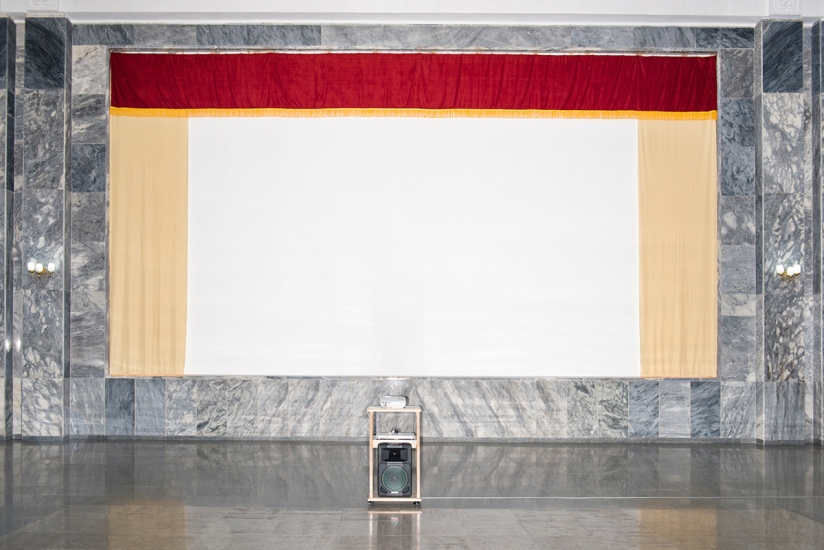
All of the text in Red Ink is written in blue ink. The pictures seem to be as well. The problem, to lack the language needed to properly express the truth, underlies a project of this nature. Documenting North Korea is a necessarily convoluted task. Max Pinckers was offered a carefully curated tour, from which he photographed the strange, the surreal, and, ultimately, the invisible. Ending with a picture of a blank screen, an empty theater, we are left with with more questions than answers.

Purchase Book


http://blog.photoeye.com/search/label/Owen%20Kobasz
Owen Kobasz edits the blog & newsletter at photo-eye. He holds a BA in the liberal arts from St. John's College and takes photos in his free time.


Book Of The Week Hot Mirror Photographs by Viviane Sassen Reviewed by Owen Kobasz Viviane Sassen is one of today's most innovative photographers and this stunning book looks back at a decade of her work, including new collages and previously unpublished photographs.
Hot Mirror. By Viviane Sassen.
https://www.photoeye.com/bookstore/citation.cfm?catalog=PX327
Hot Mirror
Photographs by Viviane Sassen

Prestel, Munich, Germany, 2018.
160 pp., 95 color and 9 black-and-white illustrations, 9½x13x½".

Formally, Hot Mirror is a mid-career retrospective. Pulling from Umbra, Flamboya, Roxane II, and more, this new book contains a survey of Vivianne Sassen’s fine art photography to date, with an emphasis on surrealism. Hot Mirror, however, doesn’t feel like a retrospective, or at least not a traditional one.

Sassen’s previous publications were single series, each bound by a concrete thesis. Hot Mirror breaks the mold by drawing a selection of her photographs from the past two decades and are revivifying them with a new context. Arranged asymmetrically and surrounded by a luxurious amount of negative space, the themes and colors are often juxtaposed, evoking a strange dreamlike feeling.

Luxaflex, from Of Mud and Lotus, 2017
The image, Luxaflex, taken from Of Mud and Lotus, shows two people twisted together. Green lines obscure their faces and bodies and the background — leaving just their arms, legs, and hair untouched. It’s as though everything has been censored save their limbs and hair, but her use of green makes it fun and playful. On the opposite page, sits Mirror Man, a much older photo from the series Flamboya. The mirror reflects a grey cinder block wall and a man stands in the gap. He is tilted forward so that his face is hidden behind the mirror. Sassen’s images allow only half to be seen, but the other half is just as important.

“I’m fascinated by what is hidden, but I think it’s fine for it to stay hidden. I don’t need to investigate everything, and that includes inside myself. So, there’s that discrepancy between revealing and concealing again,” she told Robbert Ammerlaan in an interview reproduced in Hot Mirror.

Menthe, from Flamboya, 2007
The subtle thesis of Hot Mirror is surrealism, a movement that Sassen has long referenced as one of her primary influences. In these photographs, the parts can be easily identified — they show ordinary objects, people, and places — but put together, when the viewer tries to really understand exactly what is going on, it starts to break down. There is something off, out of place, like how a dream makes sense mid-dream but becomes absurd in hindsight. But then there is the third stage — when they become beautiful.


“Surrealism is the ability to experience or look at things in a way that's unbiased, free of judgment and convention — almost like looking through the eyes of a child.” — Vivianne Sassen
Spaced throughout the book on a thinner, translucent paper, is a tale titled The Eye of the Eucalyptus Tree. Comprised of poetic text fragments, Sassen recalls memories from her childhood. Only a few lines long, each excerpt describes a moment, sensation, or family tradition — almost like snapshots from a time before the photographer carried her camera.

Fantôme, from Parasomnia, 2010
The last piece of The Eye of the Eucalyptus reads:

“I would dream of baobabs coming to life at night and running around silently. I once found a squirrel on the bottom of a dry swimming pool, by a lodge not far from the Mara River. That squirrel was a bit strange, as it sang a beautiful song about loneliness in a foreign language. When it had finished, I wanted to say thank you, but it gave me a slightly superior look and disappeared down the drain of the swimming pool.”

A confusing dream seems a fitting conclusion to Hot Mirror. Like a Max Ernst painting, the photographs and text are not meant to be clear and intuitive, especially when taken as a group. Through them, however, Sassen is outlining something difficult to describe, something that leaves poets and painters alike tonged-tied.

The book ends with a strong essay by Eleanor Clayton, which gives the reader context for understanding the development of Sassen’s work and its relationship to surrealism. Towards the end of the essay she quotes from the Manifesto of Surrealism by André Breton:
“In this dizzying race the images appear like the only guideposts of the mind. By slow degrees the mind becomes convinced of the supreme reality of these images… The mind becomes aware of the limitless expanses wherein its degrees are made manifest.”

Purchase Book


Owen Kobasz edits the blog & newsletter at photo-eye. He holds a BA in the liberal arts from St. John's College and takes photos in his free time.