PHOTOBOOK REVIEWS, INTERVIEWS AND WRITE-UPS
ALONG WITH THE LATEST PHOTO-EYE NEWS

Social Media

Showing posts with label Christopher J. Johnson. Show all posts
Book Review Image Cities Photographs by Anastasia Samoylova Reviewed by Christopher J Johnson "I bet you’ve got a favorite spot near your place if you live in a city..."

Image Cities By Anastasia Samoylova.
https://www.photoeye.com/bookstore/citation.cfm?catalog=DU603
Image Cities
Photographs by Anastasia Samoylova

Hatje Cantz, 2023. 168 pp., 100 color illustrations, 9½x11¾".

Where I live (and probably everywhere else too), the public buses frequently have banners advertising healthcare, vacation getaways, banks, engagement rings, bouquets made of fruit but meant to resemble flowers, casinos and many other things. All feature either someone smiling or else a product in a highly sanitized environment, such as a villa or a grassy field or upon a plain white background. Often groups of models convene to show that life is shared, joyous and seemingly, somehow, always takes place on a weekend or a night out. All the banners are photographic, all the people are photogenic. Advertising’s biggest sale is a life of ease, a workspace streamlined for productiveness or a world without cares, a perpetual Sunday — to this point, unless a product or service is for kids, advertisements on the side of the bus are devoid of children.

Sometimes on the bus I see people dressed for a nice event, perhaps an art opening or a recital or a night of dancing or a funeral or church. More often I see people dressed for their occupations: students, construction workers, mechanics, people who sit in cubicles or who serve food. I see mothers and grandmothers with their kids. I see people hauling their groceries. I see the homeless and drunk. I’ve seen people cry on the bus. I’ve seen people watch porn on their phones. And amidst all the passengers a host of drivers; one who even has a bald head and a ZZ Top-style beard and who seems to wear his sunglasses despite daytime or nighttime or bright skies or overcast.

The bus as chimera. The bus as corrupted prism. The bus as both the company mission statement and the reviews of a company left on Glassdoor.


Okay, so as is typical for me, we’ve gotten about 300 words in and I’ve said nothing about Image Cities, but in fact I’ve given you its essence. Image Cities by Anastasia Samoylova captures global centers from around the world. We see how advertisements in these places increasingly focus on the rich and wealthy enjoying their upper-class, spacious-living, smiles-driven lifestyles in larger-than-life banners while the middle (is this a real thing or just something that gets said) and lower classes crouch, walk, sit and work beneath them or in front of them or even install the advertisements. Many of the images are amazingly composed so that the city-dweller and the advertisement appear to be in one and the same world, one and the same plane — an incredible feat, honestly. It is little wonder that David Campany says that the artist is, “at heart a collagist.” in his text for the book.

We’ve seen this collage-like work before in her two previous books Floodzone and Floridas. However, it was not the fulcrum of those books, this maximal collage-like style; so having it take focus so sharply in Image Cities is a nice progression for Samoylova. The viewer of Image Cities should expect to become disoriented, but in a manner that the artist, I feel, is intentionally creating: a certain myopic vortex where reality becomes helplessly blurred.


The result is something like Blade Runner by Kubrick, which sounds unlikely, but there’s an interaction here between glitz and grit, between have and have not and what is and what was only ever imagined.

I have a feeling that if a casual observer, say on a bus, saw me looking through this book from several seats away they’d think I was looking at a fashion magazine filled with Gucci bags and Versace cup holders, bras and keyrings, rather than at the oppression of such things upon the scarcity of today’s hand-to-mouth realities.


What’s a takeaway here? Not too sure. Money makes the cities, makes the buildings of those cities, makes the advertisements on those buildings and only wants to see itself in all it creates despite overwhelming evidence to the contrary toward the living conditions of the average global citizen in an urban environment? Yeah, probably. My takeaway, small as it may seem, is that the bus is the microcosm, the city the macrocosm. Riding the bus you don’t see the adverts; perhaps there’s some reality to them. I wouldn’t know. As a passenger on the bus, perhaps I’m not meant to know.

Purchase Book

Read More Book Reviews


Christopher J Johnson is the recipient of The Mountain West Poetry Series first book publication prize (2016). He has written on photobooks since 2012, and has been a bookseller since 2008. He is currently the manager of photo-eye Bookstore.
Book Review Byker Photographs by Sirkka-Liisa Konttinen Reviewed by Christopher J Johnson "I bet you’ve got a favorite spot near your place if you live in a city..."

Byker By Sirkka-Liisa Konttinen.
https://www.photoeye.com/bookstore/citation.cfm?catalog=ZK221
Byker
Photographs by Sirkka-Liisa Konttinen

Dewi Lewis Publishing, 2022. 160 pp., 140 Tri-tone Plates, 10¼x11½".

I bet you’ve got a favorite spot near your place if you live in a city. Maybe it’s a bar or a café or a good friend’s front porch. Maybe it’s a table in the park where you go to play chess or cards or sit across from a familiar face and say Hmmmm to each other over a shared preference in newspapers or events papers or a monthly magazine. Maybe it’s a kitchen garden. Maybe it’s where your kid performs alongside other, familiar neighborhood kids, in a school or public amphitheater. But you’ve got one, a favorite place you can walk to, where you expect a certain kind of air to be breathed and a certain kind of sunlight to warm you and familiar people to be seen. Imagine that place one day didn’t exist, not only did it not exist, but also the front door you set out from, the walk you walked — imagine those didn’t exist either. This is the pretext, the hook and the tragedy of Byker by Sirkka-Liisa Konttinen.

The book covers a community in Newcastle that was sold for wholesale redevelopment; meaning it was all knocked down and wiped away and then rebuilt as something fresh, newly peopled, more modern, more economically span. For so many of us this idea of sudden, mass and wholesale relocation is a terrifying, but far-off-seeming thing. We don’t wake in our beds and stare at the ceiling and think that one day soon this waking view will be inaccessible, a total impossibility of time and space and sight — something lost to all future experience. Instead we think of our homes and the places we shop and the structures and the parks where we assemble community to be lasting. But that’s just our privilege assuring us that our lives are sound, placid, something we can cast a bet on; and, should we leave a house behind or if a store changes hands, that people will yet reside there, shop there, share their vacation stories and heartbreaks and whimsical asides among those structures. Well, don’t be so sure.


Byker
gives a great account of the people who lived there. Like Svetlana Alexievich in any number of her amazing historical documents, we are given the voices of the people themselves. No smart questions. No direct understanding of what prompted them into voice. Just their pure, unadulterated experiences of their beloved community, both joyous and sad and sometimes simply about work or facts or how one preferred to eat their dinner in front of the TV. The effect of this is so unignorably effective. The voices of Byker’s residents sound like our voices. Like any voices. They have dreams, regrets, sadnesses that follow them like shadows: 


Some excerpts…


“Our Dolly’s never seen him since he left her, twenty years ago. You wonder… she used to believe everything he said, and she used to think he would come back one day. She would put out his slippers beside the fire.

“Between me and you I think she would have him back.”

“A proper little grave. I used to go and visit it, but I could hear him cry, so I stopped going.”

“Creepin’ arse little bugger! Not the build to even fight, ye bugger.”

“I’m a pensioner now. I’m better off than I have been in me life. Same with the other pensioners here – you never hear one say they are hard up. Of course, if you want beer, you want cigarettes and Bingo, well you can’t have everything.”


What might stand out immediately is that these are sensitive people sharing openly and without fear. They trusted Konttinen, their longtime neighbor, in relating these stories. And she, obligingly, allowed them to talk about anything they liked, it seems — so long as it was a tale of the neighborhood. In Byker these interviews and scraps of interviews are shared alongside images of people who are not necessarily those whose words you are reading. But, it stands out that these people were talking to someone they trusted and that’s what makes the material honest and startling relatable. When paired with the pictures you see a community of people who have their hardships, but who also get a lot of joy out of their lives and their community. If you can imagine the movie Bambi ending with the death of Bambi’s mother, that’s a bit what this book is like; because engaging with it you know what looms in the future for these speakers.


Baring in mind that Byker is a reprint, I thought some of the images could have been printed better, but then I don’t know the genesis of them; perhaps they were always this way (I haven’t seen a first edition) or else time took a toll on them, who knows. It doesn’t matter. All the images are great and the sharper images are just fantastic. The work is squarely in the style of British Documentary Photography, so if you like Chris Killip or Homer Sykes, you’ll definitely like this. But if you like stories that are difficult but need to be heard; if you, like me, are always hoping to open into someone more understanding, more helpful to those around you and more able to express your sympathy, then this is crucial reading. So is Alexievich. Don’t hesitate on this one. Some books are reprinted for a reason, while others languish for a reason. Byker is a worthy document, not just in photobook scholarship, but as a project for and about us all. A totally-true parable; and one, perhaps, with greater urgency now than when it first was published.

Purchase Book

Read More Book Reviews


Christopher J Johnson is the recipient of The Mountains West Poetry Series first book publication prize (2016). He has written on photobooks since 2012, and has been a bookseller since 2008. He is currently the manager of photo-eye Bookstore.
Book Review Entre-Temps Photographs by Raymond Depardon Reviewed by Christopher J Johnson "People. Gross. Not normally my thing. People elbow to elbow, like clothes hung up in a closet. People maneuvering shopping carts around and into each other at the grocery store...People sitting inches from one another, awaiting the verdict in a courtroom. Ick!"

Entre-Temps  By Raymond Depardon.
https://www.photoeye.com/bookstore/citation.cfm?catalog=ZK237
Entre-Temps
Photographs by Raymond Depardon

Atelier EXB, 2022. In French. 140 pp., 92 black-and-white Photographs, 10¾x8½".

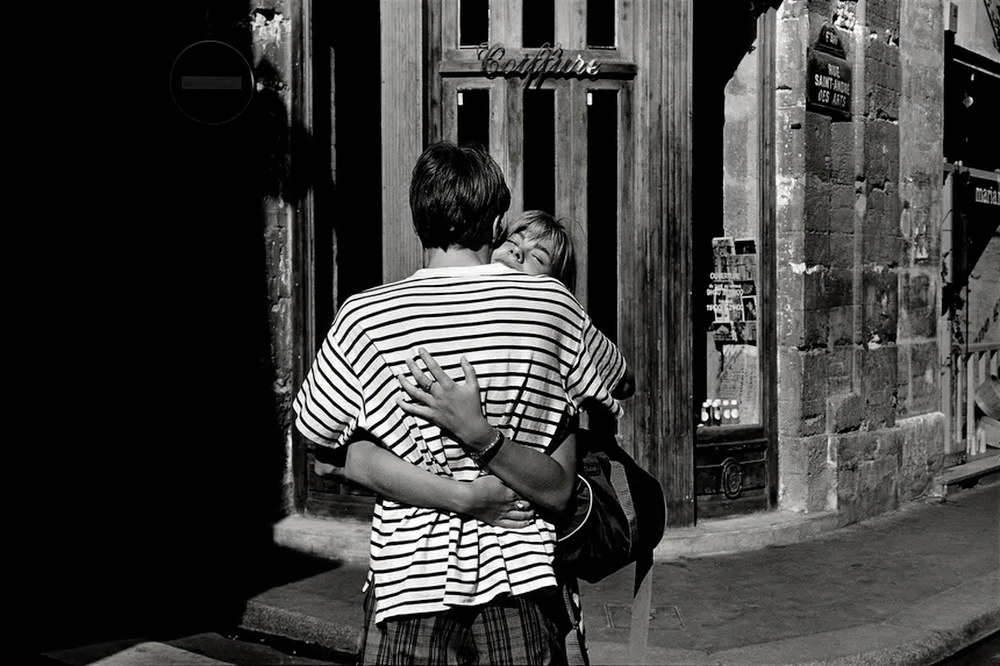
People. Gross. Not normally my thing. People elbow to elbow, like clothes hung up in a closet. People maneuvering shopping carts around and into each other at the grocery store. People trampling people underfoot to see fireworks mark a New Year — near limitless potential for personal change. People sitting inches from one another, awaiting the verdict in a courtroom. Ick! If you’re nodding your head and thinking to yourself Yes at these peevish, post-pandemic musings, then Entre-Temps (Meanwhile) by Raymond Depardon might be for you.

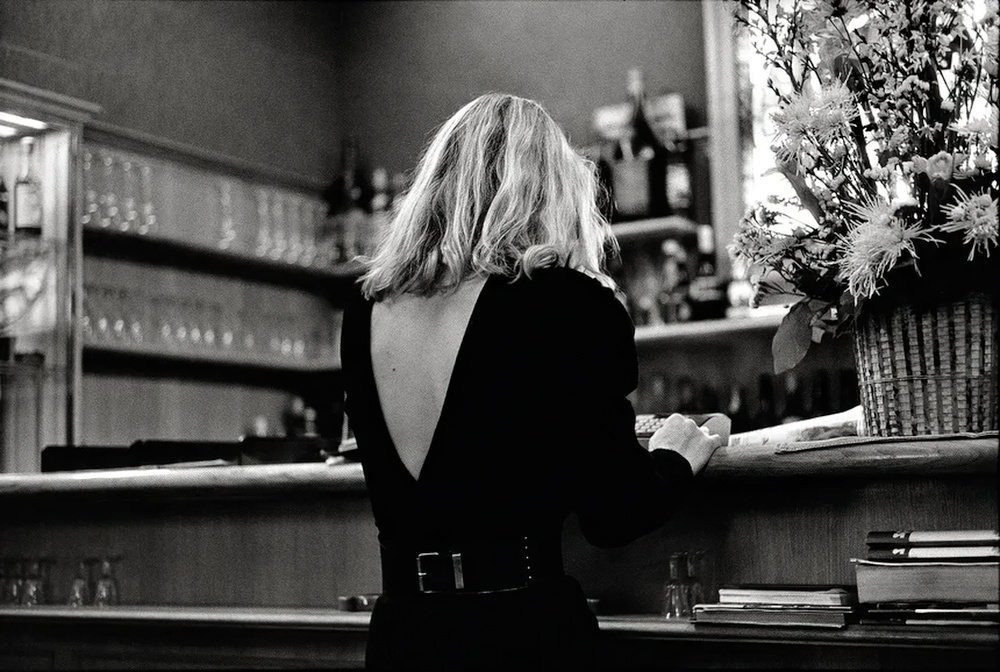
Not because it lacks people, but because the people come across like octopuses in a film documentary about octopuses; solitary: eating alone or poured upon singly by a ray of sun or in pairs or (less often) trios. They seem to swim through the daylight air — perfectly reasonable amounts of people: enjoying solo meals, small in-the-know conversations, public naps on public benches, biographies of Rimbaud — another solitary figure and sometimes pair, but never mob, “I turned silences and nights into words. What was unutterable, I wrote down. I made the whirling world stand still.” Rimbaud whispers among his exclamations in A Season in Hell. An apt quote for this book, though the words here are no words, they’re Depardon’s images. Depardon searching in Paris, a vast city of people, for a kingdom of the enclosed.


There are exceptions: the packed together dead, crowded beneath gravestones. The living pouring up from the metros on escalators or flooding along the sidewalks, their bodies like blood cells in the arteries of a metropolis. But this is always background, always far off, out of focus, as are our minds in such commutes; vegetal, automatic as the various conveyors that deliver us to our solitudes of work, duos, trios, cigarettes, nights.

There are two senses in these images that insinuate themselves to me; sense A: a photographer stepped in the photographic history of Europe (a beautiful woman crosses the street, surrounded by men barely aware of her evokes Ruth Orkin’s An American Girl in Italy by stark contrast…). Sense B: the lone, sentinel figure perceiving in themselves the lone wolf and small packs of others (a public park vivisected into little packs of one, two and three — hermetic experiences of a common ground).


I could overcrowd this review. I could pack in thoughts for one to think (is there anything worse than catching some parroting thoughts, passing them off as deep personal insights?), should they pick this book up; but I’ve no glee at the sound of myself. I’m not a professor or TikTok photobook influencer, feeding one all the right words to express their excitement to others — not a joiner. I’m a wolf. An Octopus. Rimbaud transfigured upon Rimbaud. I say only, I opened this book and there I saw myself.

Purchase Book

Read More Book Reviews


Christopher J Johnson is the recipient of The Mountains West Poetry Series first book publication prize (2016). He has written on photobooks since 2012, and has been a bookseller since 2008. He is currently the manager of photo-eye Bookstore.

Book Review Yesterday Photographs by Sal Taylor Kydd Reviewed by Christopher J Johnson "I get a lot of kitsch. I also have a horror of nepotism. Nothing should be gotten through the who-you-know; that’s how culture declines, in my opinion. Why is this relevant? I get sent a lot of kitsch, but my mania doesn’t let me keep any of it — well, almost any of it..."
https://www.photoeye.com/bookstore/citation.cfm?catalog=ZJ865
Yesterday
Photographs by Sal Taylor Kydd

Datz Press, South Korea, 2021. 56 pp.

I get a lot of kitsch. I also have a horror of nepotism. Nothing should be gotten through the who-you-know; that’s how culture declines, in my opinion. Why is this relevant? I get sent a lot of kitsch, but my mania doesn’t let me keep any of it — well, almost any of it.

When I first ordered a Sal Taylor Kydd book for the store about two years ago now, I had no idea who she was or what the work was like or how she had progressed as an artist. The first box of books I received from her had a postcard, not a print, a simple postcard of a work by her entitled, Lola in the Ferns. This was probably my 25th, 50th, or 100th postcard of the year baring an inscription to me on the back that says something like “thanks for stocking my book,” or “What a thrill to have my book in your store.” Such are the comments of these cards… Sal’s says something like that, but it’s not the words that have stuck with me — rather, it’s that singular image, Lola in the Ferns

“Lola” is a girl of about 7-12 years of age. I can no longer tell how old people are outside of a ballpark. They are simply older than me, younger than me, around my age and beyond that it’s half-decade blocks when I try to approximate an age… Her face is downcast, she parts her hair which is inextricably tangled with some fern leaves… I am not drawn to images of children, though many of my favorite photographers have been compelled to capture them, usually their own: Raymond Meeks, Ralph Eugene Meatyard, Romualdas Rakauskas — to name a few solely within the vast regions of R… But, what I am drawn to in those images is that they seem to be situated somewhere between the daily and the realm of dream, resting in the subconscious as indistinguishable one from the another. Lola in the Ferns is just this, a work as applicable to the realm of dream as it is to the realm of memory, the one resting its hand in the other so that there are no boarders between what has been experienced in waking and what has been experienced in dream, either possibility is equally likely.


And this is what has stuck with me about Kydd’s work. It’s what I see evolving in her work. The line where what is and what has been imagined (dreamed, daydreamed, fevered-out) blend together, disintegrating even the idea of the primacy of one over the other.

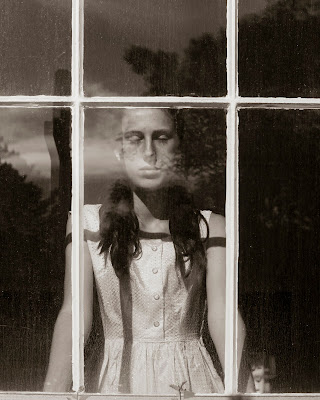
So, typical of me, I have now gotten to the fifth paragraph and have yet to mention a book and this is, after all, a book review. Yesterday, Kydd’s most recent book, is a document of the lockdown. A book of isolation in a time-period dominated by isolation. There’s been so many of these and, in retrospect, the sense of isolation is — I think — what spoke to many of us from the pages of Meeks’ ciprian honey cathedral in 2020. Isolation is, in its very nature, dream-like; it is asphyxiate, homogeneous, spacious, but tightly enclosed… Isolation has a poverty of actors. All of this is contained in Yesterday, which chronicles Kydd’s time with — of all the possible cast members — Lola, of course. Lola sitting by herself. Lola looking through the window. Lola standing in the yard, viewing something far off and out of frame… perhaps staring through the tree-line at another isolated pair of eyes, staring back at her… And the images are spacious, inky, over-exposed, tightly framed and, at times, mysteriously Modern… as in the image entitled, Watching Pins or the one called Spaces.

What Kydd has successfully created here, to my mind, is a fixed point. A unchanging and timeless time. A time capsule, even, of the pandemic. But, not in its anxiousness and jarringness, this is not the pandemic of radio buttons and phone scroll throughs and fear… This is the pandemic of slow hours and uncertain waiting. The Pandemic of empty roads. The Pandemic of being startled to hear voices in the dark. The Pandemic of permissive travel notes, that we have printed and resting on the passenger seat, but never think we’ll be called on to use because to interact would be stranger than not to interact. It is the Pandemic of birds in surplus and Nature’s reclamation.


Yesterday
is an achievement. It shows us Kydd evolving in her book form. There is a master narrative here, though its something more like Walden than Death on the Installment Plan. The narrative ambles, rather than lurches; it whispers... It is a work of tranquility. A work of silences and deep, unhurried breaths. Yesterday is a set of dream-view goggles to transpose upon your waking eyes. It is, as the narrative itself suggests (you’ll just have to get your hands on one) a window.

Some collector specs: Yesterday is a Datz book, which means it was printed in Korea. It contains a signed and numbered print and an acetate dust jacket with a beautifully printed image as the front matter, as well as an embossed back cover. My own copy is # “review” of 200. That’s a joke. But a true, and beloved joke. But, this edition is in a print run of 200 total — minus those, like mine, review copies. Meaning if you can snag a copy, you should do so — right now, because tomorrow Yesterday will be gone.

Purchase Book

Read More Book Reviews


Christopher J Johnson is the recipient of The Mountains West Poetry Series first book publication prize (2016). He has written on photobooks since 2012, and has been a bookseller since 2008. He is currently manager of photo-eye Bookstore.

Book Review The Missing Eye Photographs by Mattia Parodi & Piergiorgio Sorgetti Reviewed by Christopher J Johnson "It’s that time of year, when I search my mind – not my shelves – for the best books of the year. Why my mind, because books not shelved in my memory do not qualify. This is a difficult task, at once I must admit that what speaks to me grows like vines within the dark of my brainpan, while the same work may fail to sprout in others. There is no objective Good or Great or No-Brainer when it comes to art. I am not a Humian (David Hume); I don’t believe that taste is a thing one can cultivate to be correct — that kind of elitism appalls me..."
https://www.photoeye.com/bookstore/citation.cfm?catalog=ZJ730
The Missing Eye
Photographs by Mattia Parodi & Piergiorgio Sorgetti

Witty Books, 2021. 136 pp., 9¾x12¼".

It’s that time of year, when I search my mind — not my shelves — for the best books of the year. Why my mind, because books not shelved in my memory do not qualify.

This is a difficult task, at once I must admit that what speaks to me grows like vines within the dark of my brainpan, while the same work may fail to sprout in others. There is no objective Good or Great or No-Brainer when it comes to art. I am not a Humian (David Hume); I don’t believe that taste is a thing one can cultivate to be correct — that kind of elitism appalls me.

What is good to an individual falls like a pachinko ball through the pegs of our past experiences before slotting into the stillness of an ‘ah ha’ moment – this moment creates a spark that doesn’t just ignite in us, but it expands us toward others.

A great book, to my mind, must meet the criteria of any book; the two most fundamental of those criteria for me — does the work increase my capacity to love? Does it make me more humane and understanding toward others? There is a final criterion, the most difficult of all, does the work speak to the solitude of my singular experience of thought; that impenetrably dense darkness that transubstantiates into a light by which I can see more of the world and from which the world can see more of me.


So, I must pick a book from these living shelves of my continuous thoughts. This year, Raymond Molinar’s Polaroids increased my capacity to love, so did Fukase’s Sasuke and Meeks’ Somersault. How To Look Natural in Photos increased my sense of others, what they have suffered and what we must safeguard against to prevent such suffering in the future. These were Great Books all. But, very little has spoken to that solitary figure which is the thinker within me. There is one rather unassuming book, however, that increased the shape of me; The Missing Eye by Mattia Parodi & Piergiorgio Sorgetti from Witty Books. Its premise, “Recent studies published by the Cognitive Brain Research have demonstrated, using instruments that measure dream activity, that people blind since birth dream in images.”

I dream very little, though people tell me this isn’t true — that it can’t be. It may be better to say that I remember so few dreams, that those that do lodge themselves in my memory are enormous events in my stream of consciousness; sequences that cannot dissolve. 

The Missing Eye effortlessly creates the sense of a dream through its sequence of seemingly unrelated, though logically linked images. I am reminded of one of Andre Breton’s prose poems, it takes on the animus of a dream, “I took the escalator up to the meadow,” he tells us, among other things. Dreams work from a logic that is obscure to us, it’s 10% surface, 90% subconscious: the icebergs of our cerebral experience. Slideshows in which everything works by a logic of its own and which seems more natural, even, than the progression of our waking lives.

The Missing Eye screams to me, it screams in my eyes, but that’s a comfort. It brings back to me my experience of dreaming, as I wake each day blind to my nightly visions.

It also tries to increase our understanding of others, though this might be more problematic because who among those studied to bring us these findings (that the blind dream in images) can confirm this is their experience or anything remotely like it; for that matter who’s to say that any fan video for The Fall’s song Repetition isn’t a perfect stand-in for this possibility — or any number of Tarkovsky’s rolling montages throughout his films.

But, that goes back to the Humian failure. There’s no correct answer, but I’m willing to believe this is a usable approximation — a guide by which we can start a conversation. A way to bridge the gaps between experiences; those of the sighted, and those whose visual darkness is a cacophony of our other senses heightened. No map is perfect, all geography erodes. But this map may get me to the door of another’s mind; even if I need them to provide the final key for me. And, more than anything, I want to have that conversation. I want to increase my shape. I want to know your solitude as well as I know my own, and though I know it’s impossible I will extend to you my hand.

Purchase Book

Read More Book Reviews

Christopher J Johnson is the recipient of The Mountains West Poetry Series first book publication prize (2016). He has written on photobooks since 2012, and has been a bookseller since 2008. He is currently manager of photo-eye Bookstore.

Book Review Sasuke Photographs by Masahisa Fukase Reviewed by Christopher J Johnson "Everything she does is done with the seriousness of a grape juice stain. She’s never been to the zoo or on a train (Sasuke had experienced both). She thinks kisses are bites or that bites are kisses; I kiss her nose, she bites my nose. She has several names: Littlest, Xyla, Spidermouth — these are interchangeable, and she is just as happy to reply to one as to another..."
https://www.photoeye.com/bookstore/citation.cfm?catalog=ZJ775
Sasuke
Photographs by Masahisa Fukase

Atelier EXB, 2021. 192 pp., 7¼x10¼".

Everything she does is done with the seriousness of a grape juice stain. She’s never been to the zoo or on a train (Sasuke had experienced both). She thinks kisses are bites or that bites are kisses; I kiss her nose, she bites my nose. She has several names: Littlest, Xyla, Spidermouth — these are interchangeable, and she is just as happy to reply to one as to another.

After about 6 months Littlest never got any bigger, so she’s called Littlest. She’s got wood-hued splotches, so she’s called Xyla. Spidermouth… that name needs no explanation.

This is what it is to have a pet, in this case a cat. It’s a personality in the house. A character in your life different from other characters, but not by species — rather by choices, actions, the endearments of time and interpersonal relations, observations: joy, fury, sleepiness, and, even, sorrow, anger etc. Littlest is no laughing matter.

Character might be something built purely by interaction, just as much as it is of coding or upbringing. We seldom, if ever, speak of the ‘character’ of those who are strange to us; strangers are somehow neuter — characterless; and this is an aspect of their stranger-ness. We often imagine strangers as something easy to guess at, transparent bodies that we can see right through; while those we know are more likely to be mysterious by choices we never could have guessed them to make.

Spidermouth/Xyla/Littlest is mysterious and exact both, because she’s familiar. 


So, why ramble about a cat who is, after all, in no book whatsoever? Because I want to talk about two cats who were infuriatingly and endearingly close to the photographer who brought them up, loved them, and ultimately captured something of their spirit and of his own; are we not reflections of those with whom we have invested our time? Human or other form of animal; living or dead? I think very much that — yes, we are.  

Sasuke and Momoe. Siblings by upbringing. The book Sasuke covers both cats’ lives. We see them daringly climb to impossible heights. We see them attacking pencils. We see them yawning. We see them stuck to the window screen like an odd bat. We see them with a routine of human-inspired faces: angry, confused, sleepy, overanxious, frightened, complete passed out. Fukase, like a loving parent, captures all their moments. And, that’s just what’s curious about the series. Curious and wonderful. The cats aren’t presented like animals, but like children; their every moment a development, a movement forward, a memorable experience — an annal of the family Fukase.


We anthropomorphize our pets. We lay our emotions about them as if they will seep into their intelligence, and then demand that they exhibit aspects of our way of thinking and expressing. But, this is senseless — senseless as trying to understand anyone: dog, crow, person, or even entities like schools, communities, and companies. We see them as we are, making the choices we’d make or defying those choices and weigh them constantly against our own selves (or, perhaps, our presumed selves).

The anthropomorphizing is, I think, an effect of volume, but Fukase seems to defy this, as any parent would. This is a family album. A document of familial love. In experiencing these two cats throughout 180 pages, you can’t help but make them tiny, fury people choosing their choices, making faces based on their desires to express themselves and, maybe they are — or at least as much so as Fukase, to them, was a cat doing cat things very poorly.

I am reminded of Montaigne who I paraphrase, Do people ever appear more insane than when talking about their pets or their kids. Sasuke is a book of paternal mania. A chronicle of obsession. A printed form of talking too much. But, this is a good thing. Sasuke is two very rich character sketches. It is also, and I’ve seen so so so many of them, the best cat-as-subject photobook in memory.

Purchase Book

Read More Book Reviews


Christopher J Johnson is a poet and writer living in Santa Fe. He is the author of &luckier, from the center for literary publishing. He is currently manager of photo-eye’s Book Division.