PHOTOBOOK REVIEWS, INTERVIEWS AND WRITE-UPS
ALONG WITH THE LATEST PHOTO-EYE NEWS

Social Media

Showing posts with label Kyler Zeleny. Show all posts
Book Review Bury Me in the Back Forty Photographs by Kyler Zeleny Reviewed by Blake Andrews “When we last checked in on Kyler Zeleny, in November 2020, he had just published Crown Ditch and the Prairie Castle. The product of 10,000 miles and 4 years of road tripping, this sharply observed monograph revealed the rural Canadian heartland through a colorful blend of portraits, social landscapes, and prairie vistas..."

Bury Me in the Back Forty By Kyler Zeleny.
https://www.photoeye.com/bookstore/citation.cfm?catalog=IZ290
Bury Me in the Back Forty
Photographs by Kyler Zeleny
The Velvet Cell, Berlin, Germany, 2024. 168 pp.

When we last checked in on Kyler Zeleny, in November 2020, he had just published Crown Ditch and the Prairie Castle. The product of 10,000 miles and 4 years of road tripping, this sharply observed monograph revealed the rural Canadian heartland through a colorful blend of portraits, social landscapes, and prairie vistas.

Crown Ditch was the second volume in a planned trilogy of photobooks, following on the heels of Zeleny’s debut Out West (The Velvet Cell, 2014). That title had staked out similar territory (Alberta, Saskatchewan, and Manitoba) in methodical style: square format pictures of rural outposts captioned simply by census counts, e.g. 633, 504, 394, 108, and so on. You didn’t need the place names to get the general gist of either book. These were tiny burgs to begin with, and their populations seemed to shrink before Zeleny’s lens.

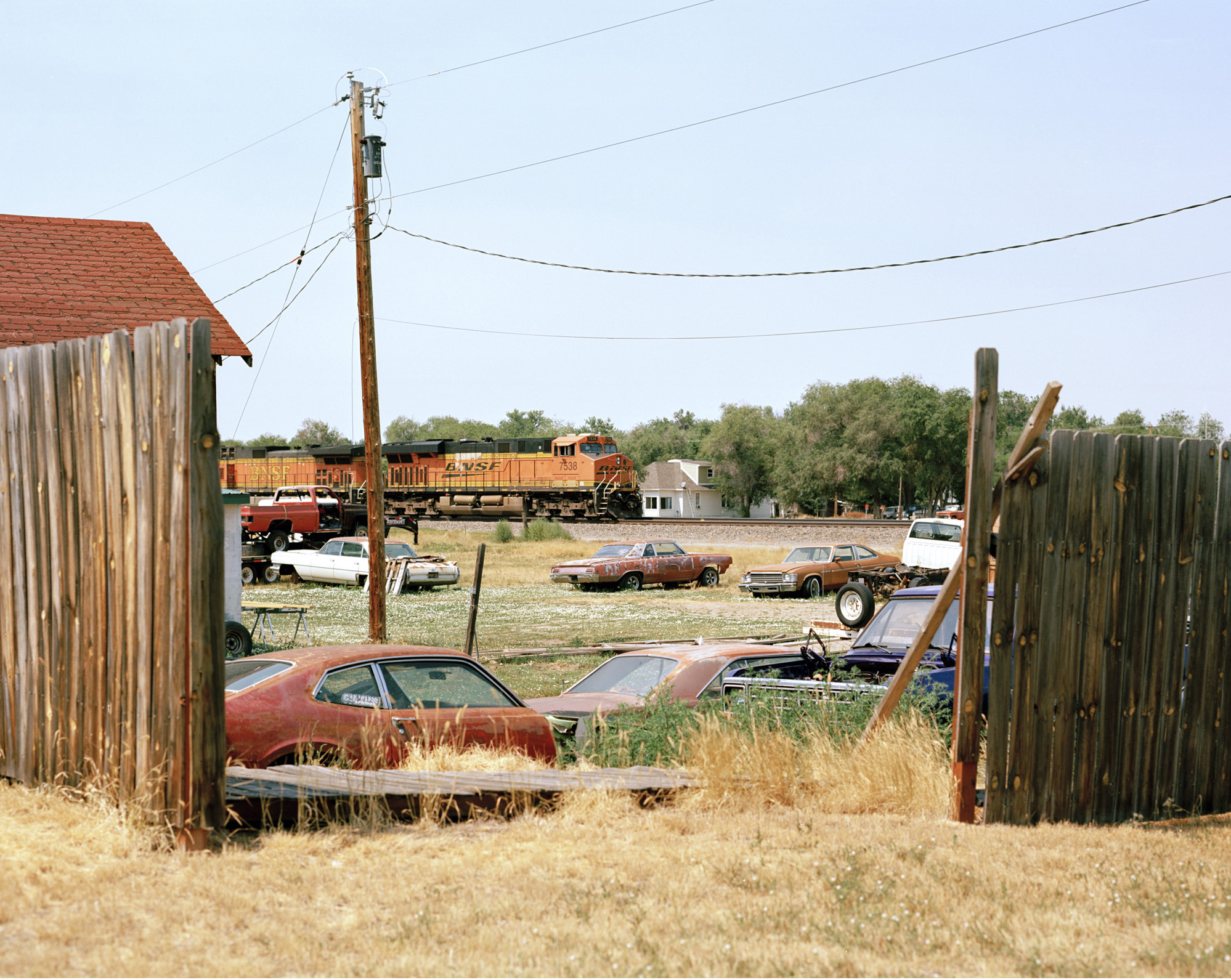
For the final book of his trilogy, Bury Me In The Back Forty, Zeleny has turned his attention to the Canadian prairie once again. This time he has zeroed in on a single location: Mundare, population ~700. This is a small town in central Alberta, first settled by Ukrainian immigrants in 1907. It proudly claims to host the world’s largest garlic sausage statue. It is also the original hometown of Kyler Zeleny. Never mind Thomas Wolfe’s warning. Zeleny can indeed go home again. He toted along his camera gear, plus an old yearbook for good measure. The resulting monograph documents some of the people and places of modern day Mundare. Better yet, it offers a window into Zeleny’s shifting curatorial style.


What do I mean by stylistic shift? Well, design-wise Bury Me In the Back Forty is markedly different than either of its predecessors. For starters, the raw physical framework is lifted directly from an earlier book, a decidedly non-artistic community history from 1980 called “Memories of Mundare”. As best I can tell, this was something like a town almanac or annual register. Its bygone happenings are reproduced as facsimile pages, renumbered and repurposed into the new tome. Zeleny provides all of this material without much explanation or context, at least initially, and it’s up to the reader to sort through the mundane Mundare minutae. A table of contents lays out the local nuts and bolts, listing such subjects as the Mundare Choir, the Mundare Fire Brigade, the school system, and various civic stalwarts and events. Taken altogether, “Memories of Mundare” is a sort of book length encyclopedia entry. It’s comprised of dense two-column text, spiced regularly with half-tone monochrome pictures, all faithfully replicated.


The old tome is well produced and squeaky clean, and it glows with civic pride. It’s a pleasant enough read. But for Zeleny’s purposes, “Memories of Mundare” is merely the first layer. Its fawning accounts become a sort of visual wallpaper, the foundation for a mélange of added photos, notes, and mementos. A color print of a friend in a bar is nice enough on its own. But it takes on new meaning when montaged atop past social gatherings. A studio shot of glazed donuts makes an intriguing contrast with posed photos of group calisthenics. Zeleny’s photos of utility poles, campers, and obscured ladders veer into experimental territory in their own right, and they’re given an absurdist jolt when juxtaposed with old news accounts.


The old pages are generally subservient, sometimes buried completely, other times lost in the experimental frenzy. After all, who needs an archival counterpoint when contemporary playthings are right at hand? Zeleny bobs and weaves between various media, interjecting cutouts (a symbol for declining rural populations?), sewn collage, crayon markings, cropping notations, and typewritten correspondence. “The result,” at least according to Velvet Cell, “is a pluralistic history of the community that embraces both official and unofficial accounts of events.”

The range of specs, styles, and approaches is impressive. Zeleny probably had a lot of fun putting this book together. But it’s hard to get a good fix on his intentions. Is Bury Me In The Back Forty meant to be a trip down memory lane (he was born in 1988, several years after “Memories Of Mundare”), a post-modern assemblage, a slice of prairie living, or avant-garde monograph? Hmmm. I’m afraid I can’t answer that question with much certainty. But rest assured, his book is entertaining. And readers will likely learn some Mundare trivia while browsing. After all the visual fireworks have closed, Zeleny’s lengthy afterword sheds some light on the subject. His essay ties together Mundare’s history with some of his own connections there. Zeleny himself has decamped for Edmonton (roughly 40 miles west of Mundare) and the rest of the town is on a similar trajectory. The story is the same throughout Canada’s rural west. Most towns face declining prospects. “The prairie party is over,” Zeleny writes. “Today the town is full of solitary drinkers, drinking from bottles that empty them.”


Although Zeleny’s essay is interesting, the tone is somewhat impersonal and academic, closer to reportage than diary. Perhaps that’s just his inner photographer speaking, hewing to straight facts? Or maybe some of the old almanac’s expository style has rubbed off? Or it could be those many years living away from Mundare, tucked in a cohort of urbane photo theorists. In any case Bury Me In The Back Forty leans smartly into the contemporary photobook zeitgeist, which has come to favor curation, editing, and design over the straight style of his debut. This is probably why it succeeds as the final volume of the trilogy. He’s come a long way from Out West, in both years and method. Bury Me In The Back Forty feels like a mark in the sand. Here I am, it announces, the third and final book. This is the impossible spot where Mundare meets photoland.

Purchase Book

Read More Book Reviews


Blake Andrews is a photographer based in Eugene, OR. He writes about photography at blakeandrews.blogspot.com.
Book Review Heroes Photographs by Karoliina Paatos Reviewed by Kyler Zeleny "I first came to know Karoliina Paatos’ through her 2016 work American Cowboy. This series comfortably sits within the contemporary Western zeitgeist, next to Lucas Foglia’s Frontcountry, Ronan Guillou’s Country Limit, and Tim Richmond’s Last Best Hiding Place. In a critical appraisal, what these works do is extend long sedimented ideals of the West — those overplayed tropes of dusty cowboys and wide horizons. This is not a critique, simply an expression of what they are and why they are beautiful..."

HeroesBy Karoliina Paatos.
https://www.photoeye.com/bookstore/citation.cfm?catalog=ZJ891
Heroes
Photographs by Karoliina Paatos

The Angry Bat, 2021. In English. Unpaged, 8¼x10¼".

I first came to know Karoliina Paatos’ through her 2016 work American Cowboy. This series comfortably sits within the contemporary Western zeitgeist, next to Lucas Foglia’s Frontcountry, Ronan Guillou’s Country Limit, and Tim Richmond’s Last Best Hiding Place. In a critical appraisal, what these works do is extend long sedimented ideals of the West — those overplayed tropes of dusty cowboys and wide horizons. This is not a critique, simply an expression of what they are and why they are beautiful.

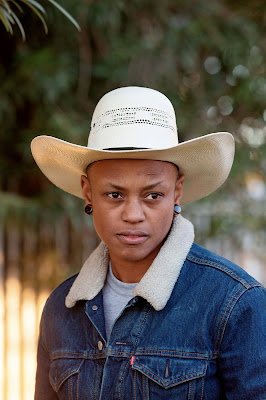
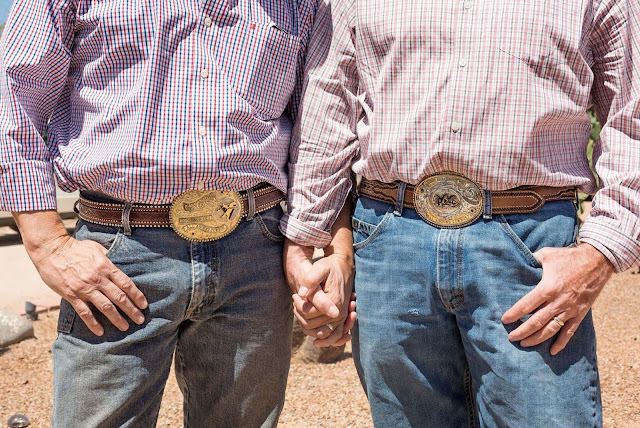
Paatos’ American Cowboy falls into the Hollywood and dime-novel inspired idea of the West. Heroes, however, avoids replicating aged ideas of the West in favour of a more nuanced expansion. The wide horizons are the same, but Paatos adds a new charater — the gay cowboy performing on his stage. The rodeo.

Heroes differs from all the aforementioned photobooks not only in focus but in form. The work is a unique collection of printed matter encased in a box set reminiscent of Old Glory. Breaking the box’s seal, we find four colour-coded and numbered booklets, a 43-page newsprint, and two 5-print accordion booklets. The newsprint provides context and a community voice through the stories of Chuck and Phil & Drew, while the foldouts act as visual bonuses, and the four booklets do the heavy lifting.


Booklet one opens with the line “It’s been an incredible journey” and goes on to illustrate a sense of movement and scene-setting not found in American Cowboy. This booklet provides an assemblage of images to introduce the rodeos and their cowboys that are to come. They also suggest that searching out the American cowboy requires work, while searching out LGBTQ cowboys requires additional attentiveness.

The booklets continue in an episodic fashion; the second provides us with a cast of characters intimately captured, often in a way that is difficult to produce without significant investment. It is evident that these are not the trappings of a stranger with a camera. To that end, Paatos is a craftsperson of exceptional caliber, and her ability to dedicate herself to the topic and her craft is admirable.

Booklet three goes on to document the events and the reciprocating community that is informally constructed around the idea of competition. There is a level of performance in this chapter that builds towards the final book, operating as preparation for the work’s pictorial and existential crescendo. It is in the fourth booklet that we see the Goffmanesque performativity of a genuine self depicted.

Cowboy culture and the Western are spaces of ritualistic and coded performativity and an essential element to understanding classic Americana. What Paatos documents is a group’s simultaneous adoption and expulsion of that understanding in favour of a fresh narrative. A narrative that provides a unique cross between pageantry, ‘shit kickers’, stirrups and rainbow flags. What this narrative allows for is a space, an arena, where people can be whole, where they can be loved, a space where individuals can simply be themselves.


The concept of the Gay Rodeo is in no way a perceptive oxymoron. The idea of a gay rodeo fits square within the world of brotherly camaraderie of responsible and mindful masculinity. Paatos shows us a subculture that challenges the idea of hyper-masculinity, a world where atypical cowboys and gender-diverse riders can share the spotlight. The project also hits on the complexity of community and place, illustrating that not every cowboy is a straight, dart smoking, whisky drinking man-of-men.

There is an archetype of course, but the fun in any archetype is proving them wrong. To that end, Heroes helps to disrupt gender and sexual normativity and it minimizes the fantastical nature of the ‘hero’ macho straight cowboy. It also offers a challenge to the heteronormativity found within rural culture in favour of one that is more layered and nuanced.

Purchase Book

Read More Book Reviews


Kyler Zeleny (1988) is a Canadian photographer, educator and author of Out West (2014), Found Polaroids (2017), and Crown Ditch & The Prairie Castle (2020). He holds a masters from Goldsmiths College, in Photography and Urban Cultures and a PhD from the joint Communication & Culture program at Ryerson and York University. His work has been exhibited internationally in twelve countries and has been featured in numerous publications including The Globe & Mail, Vice, The Washington Post, The Guardian, and The Independent. He occupies his time by exploring photography on the Canadian prairies.

Book Review Devil’s Promenade Photographs by Antone Dolezal & Lara Shipley Reviewed by Kyler Zeleny "Within the American Breadbasket exists a physiographic region called The Ozarks. Locals will tell you that within these mountains, covering sections of Oklahoma, Kansas, Arkansas and Missouri, resides the Devil. It is within the Ozarks, on a wooded gravel road, known affectionately and sinisterly as the Devil’s Promenade, that evil lurks. For decades this evil has revealed itself as a floating orb, also known as the Ozark Light or ‘spooklight’..."

Devil’s PromenadeBy Antone Dolezal & Lara Shipley.
https://www.photoeye.com/bookstore/citation.cfm?catalog=ZJ669
Devil’s Promenade
Photographs by Antone Dolezal & Lara Shipley

Overlapse, 2021. 152 pp., 104 illustrations, 6¾x9".

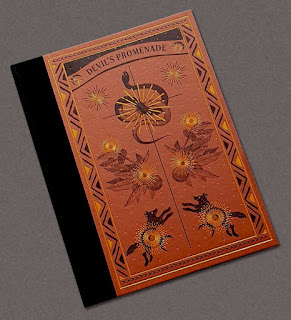
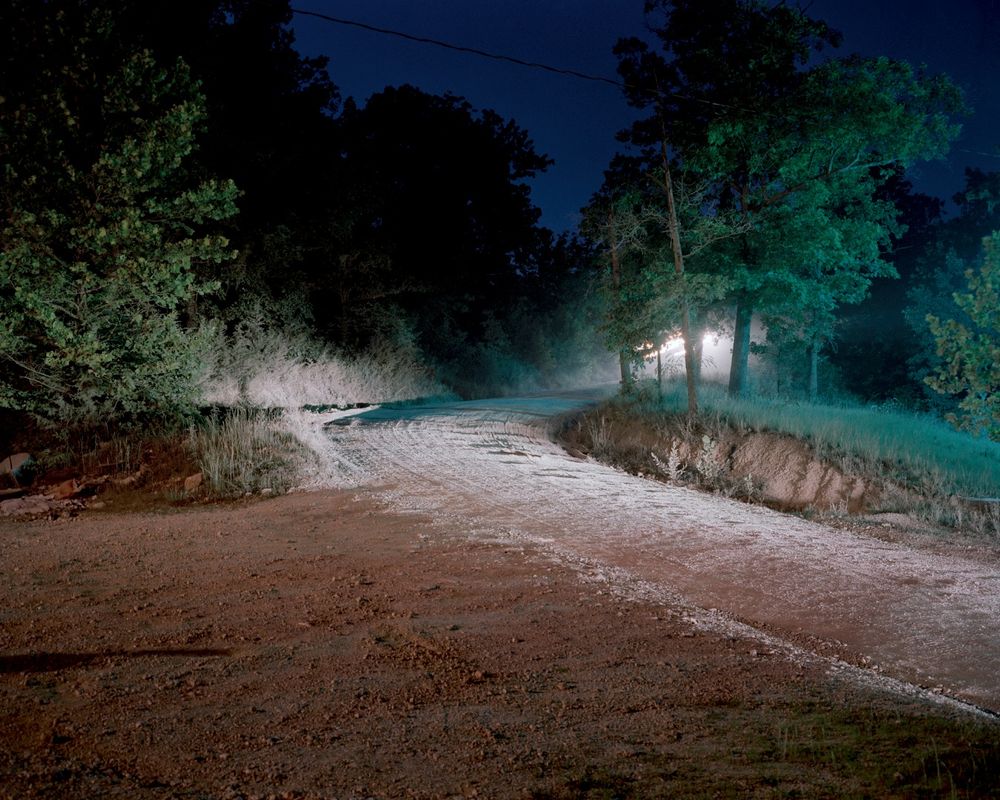
Within the American Breadbasket exists a physiographic region called The Ozarks. Locals will tell you that within these mountains, covering sections of Oklahoma, Kansas, Arkansas and Missouri, resides the Devil. It is within the Ozarks, on a wooded gravel road, known affectionately and sinisterly as the Devil’s Promenade, that evil lurks. For decades this evil has revealed itself as a floating orb, also known as the Ozark Light or ‘spooklight’.

Shipley and Dolezal tackle the folklore at the heart of this project in a fashion similar to Maria Lax’s Some Kind of Heavenly Fire, Amani Willett’s The Disappearance of Joseph Plummer, or Maja Daniels’ Elf Dalia, by applying mixed media to a form of elevated and layered storytelling.


The archival images — those blurry frames of old faces — blend well with the crisp images Shipley and Dolezal produce; a delicate dance that unfolds throughout the book. The skulls and snakes, they make sense, but some portraits at first allude… who are these faces past and present, and what is their bearing on this place, its dark undertones and these balls of light? But we must remember that there is no story of place without people. Well disguised, this is a book about the region, a narrative of rural America, told through folklore acting as a welcomed break from the plight-heavy approach of nearly all contemporary narratives on the subject.

My visual vocabulary of the Ozarks is scant, as a result, I borrow tropes from the American South — the mysticism and religious overtones that a thick brush can conjure. This isn’t much of a stretch, the European folklore that fuelled the idea of myth in Southern Appalachia has found its way to this region. Both Appalachia and the Ozarks are old frontier territories, partly enclosed and remote. Both have largely retained their bubble of wooded frontierism.

Some photobooks leave you with an idea (a rumination), others an emotion (a pathos). The best books do both. Devil’s Promenade does both. I feel structure. I feel dead eyes. I feel the wilderness swimming around my legs and towering Bois D’arc trees swaying overhead. The Ozarks are in the Mid-West, but you don’t feel it. This is something different. Elements of the occult linger and something feels off about the place.


Devil’s Promenade
speaks to an innate familiarity with the region, an emotive intrigue that also feels restrained and distanced. Like an old friend who you’ve left behind as you’ve grown, memory and fondness linger, but at the core… things have changed… you have changed. We glimpse this feeling in the portraits. They speak of a familiarity only the native sons and daughters of a region know, however, they are the derivative of closeness, they lack warmth. Intrigue is also present, a reverence for a place and time no longer wholly understood — the common outcome for those who leave and return.

The Ozarks are a hilled region, old mountains that have been ground down, offering little to the farmer, a blight on the boastful soils of America’s Breadbasket in which they firmly sit. This is a poor land for farmers, a poor land where a spectre haunts.

The orb is a hook. It is a distraction placed before us so that we may gaze upon the Ozarks and learn its unique folklore, identity, history, and struggles. The orb is intrigue, and it is metaphor. The orb is a proxy for the devil and aged fables about the devil lurking in the wild. The beast we should worry about is the one inside of us. As Lara Shipley writes, “we try to put the Devil in the woods to remove him from our bodies”.

How we interpret the orb depends on how we invite the idea of good and evil in. There are many ways to save a soul, you can bathe it in baptismal waters, you can suck out evil with a palm to one’s forehead and maybe, with the right intentions, you can gaze upon an orb on the Devil’s Promenade and feel cleansed. I also wonder, if we stopped talking about the orbs, stopped searching them out, would they disappear?

Purchase Book

Read More Book Reviews


Kyler Zeleny (1988) is a Canadian photographer, educator and author of Out West (2014), Found Polaroids (2017), and Crown Ditch & The Prairie Castle (2020). He holds a masters from Goldsmiths College, in Photography and Urban Cultures and a PhD from the joint Communication & Culture program at Ryerson and York University. His work has been exhibited internationally in twelve countries and has been featured in numerous publications including The Globe & Mail, Vice, The Washington Post, The Guardian, and The Independent. He occupies his time by exploring photography on the Canadian prairies.

Book Review A Small Guide to Homeownership Photographs by Alejandro Cartagena Reviewed by Kyler Zeleny "At its surface, A Small Guide to Homeownership is an amalgamation of related projects produced by Alejandro Cartagena in the Monterrey area of northern Mexico since 2005. The book weaves together the key elements of an expanding urban condition with all the informalities, pains and ecological follies generated from poorly-regulated growth..."

By Alejandro Cartagena.
https://www.photoeye.com/bookstore/citation.cfm?catalog=ZJ409
A Small Guide to Homeownership
Photographs by Alejandro Cartagena

The Velvet Cell, 2020. 360 pp., 6x9".

At its surface, A Small Guide to Homeownership is an amalgamation of related projects produced by Alejandro Cartagena in the Monterrey area of northern Mexico since 2005. The book weaves together the key elements of an expanding urban condition with all the informalities, pains and ecological follies generated from poorly-regulated growth.

Sinking below the surface, however, the book is an episodic journey. Our first foray into the work is through images of landscapes, which begins with the natural, and moves into fresh suburban developments in various states of completion. Onward, we are led to images of bustling offices, where clients and workers immerse themselves in life-altering calls; feelings of impatience and stoicism push against one another in equal measure. Next, we are shown the interiors of small homes made even smaller by internal clutter. From these suburban interiors, Cartegena centers us on cityscapes, environmental portraits, and cars abutted, before leading us to a series of nightscapes under a section titled ‘Bracing for Success’. Who and how we brace is uncertain.


If Cartagena is a guide, he is an absentminded one. He playfully utilizes a Dummies Guide on Homeownership to not only map out a journey for us, but also to provide a space for collisions. Cartagena’s images collide, grinding against one another while contrasting tips for hopeful homeowners. The more time I’ve spent with the work, the more I realize that the images, and the text-ridden pages they are nestled within, are not simply an inked backdrop but a conversation. A conversation similar to Christian Patterson’s Bottom of the Lake or Adam Broomberg & Oliver Chanarin’s Holy Bible, both of which build upon this emerging subgenre by appropriating common cultural texts. This is a genre that pulls from the deep-rooted history of collage and montage found in 20th Century art and film, and the ideas of Post-Photography explored most elegantly by Joan Fontcuberta in the early 21st. For Cartagena, the conversation is about action and inaction, our innate interest in bettering ourselves, and, above all else, it is about striving to meet the American Dream.


By casting his gaze upon suburban Mexico, Cartagena invites us to think about the American Dream. On the back cover, the quote “how to mortgage your future and find happiness” speaks volumes. The critical bones in my body keep asking, when was this dream viable and for who? What Cartagena shows us, while also problematizing in the process, is that there is another way to subscribe to, bite, and devour this myth.

Over the past few years, and with growing intensity, I’ve been thinking about the American Dream. About who wins and who loses, about the distance between people and their sacred ideas of success. At its core, the American Dream is a vapid exaggeration, a rugged and merry fuck-around, a culture-wide attempt at raw boosterism. Once tested, the dream breaks into a crass contradiction, a premise as simple as: for some to succeed, others must not. Those who do not succeed must try, and try again, and again, until they rise or evaporate.

It is difficult to pinpoint A Small Guide to Homeownership’s modus operandi. The work is in the form of a journey, but one that is more of a nebula than a linear progression. As a result, we are given no answers to questions that might be raised, nor are we shown a specific way of seeing, only a topic and its many tentacles. Numerous questions circulate and compete: Are we chasing the wrong dream? Have the suburbs failed in Mexico? Are we building a ‘new’ Mexico? Not all treaties, which begin with ponderings, must end with answers. Through an information overload, Cartagena makes visible a modern crisis, and the constant anxiety that exists as its background noise. Like a conductor, he uses his images as the highs and lows, a way to both soothe and extend the perplexing feeling of a heart beating too fast, of a room made small with clutter.

Purchase Book

Read More Book Reviews


Kyler Zeleny (1988) is a Canadian photographer, educator and author of Out West (2014), Found Polaroids (2017), and Crown Ditch & The Prairie Castle (2020). He holds a masters from Goldsmiths College, in Photography and Urban Cultures and a PhD from the joint Communication & Culture program at Ryerson and York University. His work has been exhibited internationally in twelve countries and has been featured in numerous publications including The Globe & Mail, Vice, The Washington Post, The Guardian, and The Independent. He occupies his time by exploring photography on the Canadian prairies.


Book Review Crown Ditch and The Prairie Castle Photographs by Kyler Zeleny Reviewed by Blake Andrews In the space of four years, Kyler Zeleny travelled the prairie lands of North America, driving over 15,000 km in the process to photograph and document their current realities.

https://www.photoeye.com/bookstore/citation.cfm?catalog=ZJ355
Crown Ditch and The Prairie Castle
Photographs by Kyler Zeleny

The Velvet Cell, Berlin, Germany, 2020. 96 pp., 8¾x10¼".

I have a soft spot for photographers who shoot their immediate surroundings. After all, who better to document a subject than someone with a deep familiarity? Once one notices how spectacular the everyday can be, there’s little need for exotic journeys. It turns out everything a photographer could want is right at hand.

For Kyler Zeleny, this realization took awhile to manifest as a project. After an idyllic childhood on a farm in Alberta —“the prairies are my spiritual home,” he remembers fondly— he was later drawn to the area as a photographic subject. But the process of shooting prairie country was more involved than a neighborhood stroll. Over the course of 4 years, Zeleny hauled his camera over 10,000 miles, tracing a spiderweb of highways across the Canadian Midwest, from Montana through northern Alberta. A map of his route can be found in his recent photobook Crown Ditch And The Prairie Castle (The Velvet Cell, 2020). It’s the second volume of what will eventually become a trilogy of photobooks about the region (the first volume, Out West, was published in 2014, and the third, Bury Me in the Back Forty, is now in progress).

Crown Ditch and The Prairie Castle. By Kyler Zeleny.

At first glance, Crown Ditch reveals a world that is perhaps unsurprising. It’s a wide, flat region crouched under booming skies and spiced with small outposts: civic buildings, bars, churches, and post-industrial ruins. The residents of this “last promised land” are a hardy breed, fond of large belt buckles, ball caps, and denim. “There is something special about the prairie spirit,” says Zeleny in a recent interview. “At its core is the idea of Frontierism and perseverance.” Zeleny has captured a measure of this resilience in his photos. Whether it’s a building, person, or empty lot, the subjects in these photographs appear fastened in place, like barnacles.

In photographic style, Crown Ditch is vaguely reminiscent of road trip classics by Stephen Shore, Joel Sternfeld, and Alec Soth. Like those predecessors, Zeleny mixes three broad subjects —geography, vernacular structures, and portraits— in roughly equal measure. And, similarly, his compositional approach favors broad perspectives and centered subjects, all shot outdoors under clear skies. If it is a somewhat filtered view of the Canadian heartland, it’s one that is executed with skill. Zeleny’s instinct for commanding vantage and horizontal spacing —for example, in photographs of Power, Montana and Drumheller, Alberta— reveals a deft sense of visual phrasing.

But comparisons to Shore, Sternfeld, or Soth raise an existential dilemma. For it’s Canada Zeleny is after, not America. “I remember when I first started photographing on the Canadian prairies,” he said in a recent interview, “people would discuss my images as if they were American simulacrum, images no different than you’d find south of the border. That made me think, how can Canadian photographers assert a unique regional sense of place if we are benchmarked against a cultural juggernaut with its own mythology, history and imagery?”

Crown Ditch and The Prairie Castle. By Kyler Zeleny.

That’s a very good question. Defining national identity is always a tall order, heightened for Zeleny by the fact that wide swaths of Northern Montana and Southern Alberta are visually similar. The sheepish apology that begins his text —“I am sorry that the Prairies are not as enticing as the American South, not as mythical as the American West.”— takes some measure toward repatriation, as does the book’s no-nonsense orderly flow. But some fuzziness remains. For better or for worse, many of these pictures might be mistaken for American scenes. Perhaps this is just the nature of beast. The 49th parallel separating the U.S. and Canada is an arbitrary boundary, and imposing its essence into photographs may be impossible.
 
Crown Ditch features some distinguishing design elements. The bold yellow cover with a tipped-in rear plate is striking. The pace of the main body is broken up by three gatefold pullouts. Each one shows a mini-series on a particular topic, one on squat shops, the next headshots, and the third shows a wide panorama of grain fields. There is a small note tucked in the middle with a delightful list of offbeat keywords, which reads like a stream of consciousness poem. One page later is another note, which shows Zeleny’s route map.

Finally comes the book’s text, which is included as a pullout booklet sleeved into the rear inside cover. Here we find Aritha van Herk’s essay Reading the Unreadable, followed by Zeleny’s diaristic anecdotes recounting his travels. His writing style is dense but friendly, and its breezy first-person sketches go down easily. Zeleny’s ruminations lend narrative form to the photographs, helping put them in the context of his road trips and the huge expanses he covered. The book ends on a nice closing note, a tipped-in photograph of a quiet cafe, perhaps the perfect spot to organize a flood of pictures and memories.

Purchase Book

Read More Book Reviews

Crown Ditch and The Prairie Castle. By Kyler Zeleny.

Blake Andrews is a photographer based in Eugene, OR. He writes about photography at blakeandrews.blogspot.com.

Book Review The Arsenic Eaters Photographs by Simon Brugner Reviewed by Kyler Zeleny With this new publication, comprised of contemporary photographs as well as archival material, Austrian photographer Simon Brugner investigates a surprisingly common historical belief that the consumption of arsenic, a deadly poison, could be beneficial to one’s health.

The Arsenic Eaters. By Simon Brugner.
https://www.photoeye.com/bookstore/citation.cfm?catalog=DT096
The Arsenic Eaters
Photographs by Simon Brugner

The Eriskay Connection, 2018. 144 pp., 150 illustrations, 8x11¾".

In The Arsenic Eaters, Simon Brugner investigates the lost historical usage of arsenic as a poor man’s cocaine, which was purported to hold numerous health benefits. Brugner’s journey takes us to the eastern slopes of the Alps where, prior to the 20th century, the practice of arsenic ingestion was common amongst lower classes. Those who survived repeated ingestions reported that the practice enhanced their physical appearance and strength.

The taboo of arsenic consumption made this subculture reclusive. Once consumed by the practice and the perceived health benefits and a ritual and tolerance developed, these Medieval-like ‘meth-heads’ were unable to stop.

The Arsenic Eaters. By Simon Brugner.

Brugner shows us a secretive and pastoral subculture, as if we’ve walked into the Austrian Alps and upon traversing the correct isolated valleys and demanding peaks, we arrived in a magical world that is both pre-industrial and bizarre.

The blending of contemporary and historical images helps further this by obscuring the temporality of the work, challenging the reader to ask, is this the present and foreign in its location, or is it past and right under us? By supplementing his own images with archival pictures, Brugner delivers a deep dive into the topic and creates a work that is complete and moving. Arsenic Eaters exposes us to a secreted existence; we are seeing fables, history, and rumours, the whispers of events that occurred but are rarely recorded.

Brugner is documenting a practice that is no longer prevalent, with little existing documentation. A controlled substance, in the form of a Medieval sin, has very little associated documentation. Furthermore, the colorful images in The Arsenic Eaters offset the monochromatic nature of the historical images to keep the pace and add tempo.

Brugner is able to do what few photographers can pull off, when he succinctly integrates text and image as a mechanism to further enhance his storytelling. One of the great tests of photobook text is if, after reading it, the viewer feels compelled to return to the book for a second, enhanced reading. This emphatically occurs in The Arsenic Eaters.

The Arsenic Eaters is a contemporary exemplar of a post-photographic project that inserts, remixes and builds upon existing ideas and narratives by using alternative documentary methods, multiple sources, and mixed-media. For instance, the use of archival and found images read as a secret dossier, further aiding the narrative when combined with Brugner’s own visual work. Post-photography is a concept best explored by Joan Fontcuberta and often appropriated by image-makers who are unfamiliar with the concept’s ideological underpinnings. The emergence of a post-photographic condition is the result of growing skepticism towards photographic realism, abundance in image-making, sharing and the turn within creative communities to embrace alternative practices as a way to problematize the way we consume images.

The Arsenic Eaters. By Simon Brugner.

Time and distance remove our ability to observe directly. Brugner was not in the Alps when Arsenic consumption was prevalent, instead his narrative must be informed by the words and records of others as he acts as a compiler to tell an arresting visual story. This does not make his telling of this story any less true. As Fontcuberta writes on objectivism, truth is an opinion and not an obstinate obsession. In a post-photographic world images are less fact than fiction, and act as poetic forces. This is the world we are daringly invited to peer into in The Arsenic Eaters where narrative ousts the true objective elements of storytelling.

The Arsenic Easters is an exceptionally well-conceived and executed example of how contemporary work and historical archives can be blended together to tell a deep and intricate story of a unique place, where a subset of the population engaged in arsenic consumption.

Purchase Book

Read More Book Reviews

The Arsenic Eaters. By Simon Brugner.


Kyler Zeleny (1988) is a Canadian photographer, educator and author of Out West (2014), Found Polaroids (2017), and Crown Ditch & The Prairie Castle (2020). He holds a masters from Goldsmiths College, in Photography and Urban Cultures and a PhD from the joint Communication & Culture program at Ryerson and York University. His work has been exhibited internationally in twelve countries and has been featured in numerous publications including The Globe & Mail, Vice, The Washington Post, The Guardian, and The Independent. He occupies his time by exploring photography on the Canadian prairies.