PHOTOBOOK REVIEWS, INTERVIEWS AND WRITE-UPS
ALONG WITH THE LATEST PHOTO-EYE NEWS

Social Media

Showing posts with label Photographer's Showcase. Show all posts
photo-eye Gallery DM Witman Index Interview Anne Kelly and DM Witman We are thrilled to introduce DM Witman and her project "Index", a series of gum bichromate photograms, to the Photographers Showcase. To provide some insight into Witman and her work, we are pleased to introduce this new work along with an interview with the artist.


#00141 Verbena hastata, 2018, Unique photogram, Rives BFK, gouache, gum arabic, kitakata, ink, 23k gold leaf, 29x23 in. framed, $1250


We are thrilled to introduce DM Witman and her project Index, a series of gum bichromate photograms, to the Photographers Showcase. To provide some insight into Witman and her work, we are pleased to introduce this new work along with an interview with the artist. In this interview, artist DM Witman and Gallery Director Anne Kelly delve into the connection between art and science, Witman's creative process, grants — and more.


Anne Kelly: Does wonder play a role in the making of your work

DM Witman: Wonder does play a part in my creative practice, in both the active and passive sense. I am someone who has a deep sense of curiosity and am constantly asking questions to help me understand the world around me. For me, the natural world abounds in wonder.

Generally, when I work, due to the nature of the materials and processes, the outcomes are not guaranteed. There is always a sense of “waiting to see what happens”. Now, that does not mean that the work is all due to magic, but there is a great deal of experimentation and being open to the results.

AK: You have degrees in both art and science. Do you feel that art and science have connective tissue?

DW: Art and science are deeply connected. Prior to the 20th century there was not as big as a distinction among interests — individuals attended the same salons to learn about new concepts, and new inventions, such as in painting, psychology, or about the human body. That has since changed and disciplinary boundaries abound. What was common then, is still common today — a sense of curiosity. Both art and science can be characterized by exploration, experimentation and discovery.  
  

#00106-2 Dryopteris spp. 2018, Unique photogram, Rives BFK, gouache, gum arabic, kitakata, ink, 23k gold leaf, 29x23 in. framed, $1250


AK: Index is a series of photograms. Can you please explain to our readers what a photogram is - and dive a bit into the chemical process and materials you have chosen to work with to create this series?

DM: A photogram is made when an object, or objects, are placed on the surface of light-sensitive materials, such as a piece of paper, or a piece of glass. Photograms can be made with many photographic processes, such as silver gelatin paper, cyanotypes, and as I have done with this series, with gum-bichromate.

With Index, I have coated large sheets of fine printmaking paper with a slurry of watercolor pigment and gum arabic mixed together with a light sensitizer. I repeated this step until the desired color and density is achieved for each sheet. Once, dried, the individual plants I collected were placed on top of the sensitized paper within a very large contact printing which would be set in the sun to expose the sensitized paper with the shape and details of the plants. Most days, I could make one to two pieces.

AK: Art often starts with a question. What question are you asking in this series?

DW: This work was born from my deeply personal experience with loss and grief. It was my attempt to grapple with a discovery about myself, that I had been experiencing grief due to ecological changes and loss, for many many months, unable to “make work. I was stuck. Collecting plants from the inter-tidal marsh along the river which I called home and have a deep connection and reverence with, was a bit of a reckoning that this place would change. And that many of the species would not tolerate the changes ahead — consistently higher water lines and higher tides, a greater salt content from Penobscot Bay, which is a few miles away. The reckoning was as much about a concern for the various plant species as it was an acknowledgment of how my actions, and those of humanity have induced these changes, for which for me, was a terrible amount of guilt. Perhaps the ultimate question for me involved an attempt to understand and process these feelings. I came to understand that I could move forward in the world, and in my life and my work, if I could make meaningful action(s). What could I do? Part of those actions meant holding space for these plants, which are often overlooked regarding conversations about the climate predicament.


#00105 Pontederia cordata. 2018, Unique photogram, Rives BFK, gouache, gum arabic, kitakata, ink, 23k gold leaf, 29x23 in. framed, $1250

AK: In your series Index, you are collecting and identifying plants that are not formally on the "endangered" list, but may be in the future. Do you see this work as a "call to action?"

DM: I certainly can see that. But for me at the time of making these objects, it was a way to both collect data and an act of memorializing the plants which are part of the way that I understand and connect to the natural world. The process allowed me to move forward to process what I was experiencing. And ultimately, a way for me to understand that I can continue in life by making meaningful actions to help the human and non-human species, no matter how small that action might seem in the scheme of it all.

AK: Do you feel that this series is in conversation with Anna Atkins' British Algee series?

DW: Anna Atkins has certainly been an influence on me as an artist. Her sensibilities and interest in botanical science, the naming of things, and sharing that with others. I’m sure she was interested in contributing to science and sharing this with others, which is I believe an intersection of the two bodies of work. However, I can only wonder if she considered that species might disappear due to human influence and impact back in the late 19th century. The works from Index are heavy, and there is a dimension to them, which is purposeful. They are objects, memorials, and of data — a baseline of a particular moment in the history of that place, along that river, at that time. And I find them beautiful.


#00105 Pontederia cordata. 2018, Unique photogram, Rives BFK, gouache, gum arabic, kitakata, ink, 23k gold leaf, 29x23 in. framed, $1250


AK: You describe yourself as a transdisciplinary artist working with photographic media, video, and installation. Do you feel your practice in each medium/media bleeds into each other — in the sense that perhaps you are working on a still photograph and it gives you an idea for a video?

DW: Absolutely. My work is driven first by concept. However, the process of making is also very important to me. I try to be open to how these explorations and expressions might manifest. These three realms of working can intertwine to create experiences for others, that are at times unexpected, and that I welcome.

AK: You have received a few grants. Do you have advice for other creatives as to how to go about getting a grant?

DW: Grants — yes! Write, apply, apply, refine by writing more, and apply again. While grants are competitive, I believe there is some element of timing. Attempt to understand what granting agencies are looking for — for example, does your particular idea or project align with the granting organization’s mission? Are they interested in funding work that has yet to begin, or projects which are deeply underway, or projects that are completed? The more you write, the better solidified and succinct your ideas become on the page. And know that for every successful grant I have received, there might be ten, twenty, or more rejections. The key is to not give up.


DM Witman is a transdisciplinary artist working at the intersection of environmental disruption and the human relationship to place in the Age of the Anthropocene.Her creative practice is deeply rooted within the effects of the climate predicament to humans and more-than-human species on this planet, employing photographic materials, video, and installation. Interviews and publications include The Guardian, BBC Culture, WIRED, Boston Globe, and Art New England. She actively exhibits her work and has been recognized with grants from the Maine Arts Commission, The Kindling Fund (a regrantor for the Warhol Foundation), The John Anson Kittredge Fund, and the Puffin Foundation. Her work has been collected by institutions such as the Museum of Fine Arts Houston and is placed within many private collections. She splits her time between the Borderlands of South Texas and Midcoast Maine.
 
DM Witman @Brenton Hamilton


*      *      *

PRINT COSTS ARE CURRENT UP TO THE TIME OF POSTING AND ARE SUBJECT TO CHANGE.

*      *      *

If you are in Santa Fe, please stop by we are open Tuesday– Saturday, from 10am- 5:30pm. 

PHOTO-EYE GALLERY
300 Rufina Circle, Unit A3, Santa Fe, NM 87507

For more information, and to reserve one of these unique works, please contact 
Gallery Director Anne Kelly
You may also call us at (505) 988-5152 x202


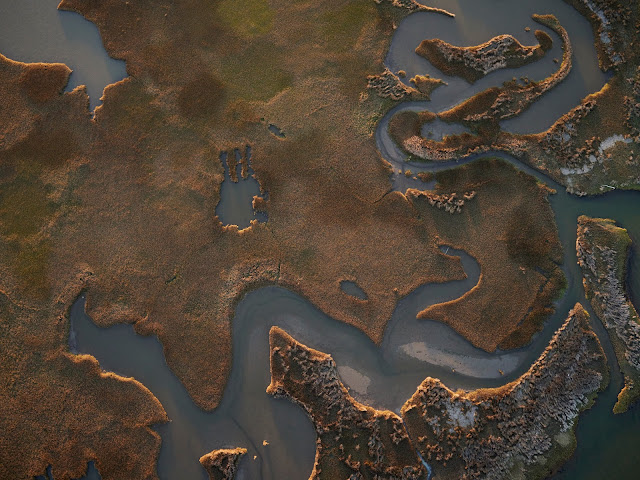
photo-eye Gallery Photographers Showcase: Ben Depp's Louisiana Jovi Esquivel photo-eye Gallery is pleased to welcome Ben Depp to the Photographer's Showcase and his series based on the wetlands on Louisiana's Gulf Coast.

Ben Depp, Jeannerette, Flooded Sugar Cane Field, 2016, Archival Pigment Print, 22½ x 30", Edition of 10, $3,000

photo-eye Gallery is delighted to welcome artist Ben Depp, and feature his arresting photographs of the Louisiana Gulf Coast, into the Photographer's Showcase

Ben Depp is an artist and National Geographic Explorer based in New Orleans, Louisiana. Much of Ben's work has been centered around environmental issues, and his ongoing work documents wetland loss and coastal erosion in Louisiana. Over the past eighty years, the Louisiana Coast has lost 2,000 square miles of wetlands. 

This week, we are sharing an interview between the artist and Gallery Associate Jovi Esquivel. The two discussed Depp's passion for documenting the changing landscape of the Gulf Coast, and the motorized paraglider Depp uses to travel throughout the coastline to capture his images. 

•    •    •

Jovi Esquivel: What is your background as a photographer, what drew you into the world of picture-making? 

Ben Depp: The magic of being able to see and connect with people and places around the world through photographs is what first drew me into the world of photography. I studied photography in college. I lived in my car during that time so that I would be able to pursue photography without the burden of debt. I then worked at a newspaper and freelanced for magazines, newspapers, and non-profits in a number of countries. I lived in Haiti for five years, which precipitated a shift in my photography to cover environmental issues. I was in Haiti when the 2010 earthquake struck, and I covered the aftermath of the earthquake, the cholera epidemic, and much political unrest. I have PTSD from some of those experiences, and making beautiful (but also meaningful) landscape photographs has been part of my healing process.

JE: Wow, it sounds like despite the trauma you experienced, you are still committed to the medium.

BD: I still believe in the power of photography to connect people to the earth and to each other. The environments I currently work in are very remote and hard to access. Through my photographs, I think people can begin to see the beauty and value of this landscape and better understand what we are losing. I think making these photographs is the most worthwhile use of my time right now.


Ben Depp, Pelicans in Scofield Bay, 2018, Archival Pigment Print, 30x40", Edition of 10, $4,000

JE: What inspired you to create your current body of work?

BD: When I moved to New Orleans in 2013, I wanted to photograph a project about Louisiana’s coast, which is the largest area of wetlands in the United States and the fastest-eroding coastline. The human impact of land loss in Louisiana has been well-documented, so I wanted to do something different. I first saw this landscape by air when flying into New Orleans on a commercial flight, and knew it was an incredible vantage point. I learned how to fly a powered paraglider and started exploring. My aerial photographs contribute to the existing body of work on Louisiana by centering the landscape.

JE: Will you share your process — how do you prepare to go out and shoot for your current project, what’s it like once you’re out making photographs?

BD: South Louisiana is flat, so to get any perspective on the landscape it helps to be able to get off the ground. To do that, I’ve been exploring the Louisiana coast by powered paraglider for eight years. A powered paraglider is maybe the world’s smallest aircraft. I wear a motor on my back with a propeller on it and have a paraglider wing overhead. I usually launch half an hour before sunrise or a couple of hours before sunset and fly for hours at a time.


With the paraglider. I can fly between 15 to 10,000 feet in the air. I enjoy flying low and slow to see all the textures and detail in the grasses, flowers, and trees below me. I rarely go out with a plan to photograph a specific place or thing. All of the magic I have found has been while spending hours exploring.

JE: Does your powered paraglider allow you to hoover in place — to allow you to compose your photograph?

BD: I wish I could hover. But, no, I’m always moving at somewhere between 15-40 miles per hour, so my process would be similar to photographing from your car window as you drive. I use a very high shutter speed to avoid motion blur, and I have to compose intuitively to try and get the composition I’m hoping for.


Ben Depp, Mayflies, 2021, Archival Pigment Print, 30x40", Edition of 10, $4,000 


Ben Depp, Grand Island, 2022, Archival Pigment Print, 30x40", Edition of 10, $4,000

Each flight is still simultaneously exhilarating and a little terrifying. One of my favorite things is to be a few hundred feet up at sunrise over the wetlands and watch the colors change in the marsh as the sun comes up.

JE: Sunrises are my favorite, this sounds glorious!


BD: I spend a lot of time camping. After exploring accessible parts of the coast for several years, I built a 19-foot wooden sailboat to access Louisiana’s remote barrier islands. I carry my powered paraglider in my sailboat, which I can sail and row to an island, where I then launch my paraglider. I’ve camped for up to a week in some of the most remote parts of South Louisiana.


Although I’ve been a photographer for almost 20 years, I’ve found my photographic voice through this project. By slowing down, spending days at a time camping, traveling slowly by sailboat, and then powered paraglider, I am seeing the natural world around me more clearly. The photographs I’m now making reflect my increased connection and sensitivity to this place.


Ben Depp, Cameron Truck, 2021, Archival Pigment Print, 30x40", Edition of 10, $4,000

•    •    •    •


Ben Depp is an artist and National Geographic Explorer based in New Orleans, Louisiana. Much of Ben’s work has centered around environmental issues and his environmental photography has been funded by the Pulitzer Center for Crisis Reporting, the Midwest Center for Investigative Reporting, the Ford Foundation, and the National Geographic Society.

Ben's ongoing work documents wetland loss and coastal erosion in Louisiana. The wetlands on Louisiana's Gulf Coast are eroding at the rate of a football field every 30 minutes. Ben's work serves as a memorial to this vanishing landscape. 

He makes aerial images by powered paraglider, which allows him hours of exploration, a low flight path, and the time-intensive search for surprising compositions. 


Print costs are current up to the time of posting and are subject to change.


If you are in Santa Fe, please stop by during gallery hours or schedule a visit HERE.

For more information, and to reserve one of these unique works, please contact photo-eye Gallery's
Gallery Director Anne Kelly or Gallery Associate Jovi Esquivel

You may also call us at (505) 988– 5152 x202


photo-eye Gallery

1300 Rufina Circle, Unit A3, Sant Fe, NM 87507
Tuesday– Saturday, from 10am– 5:30pm


photo-eye Gallery Tony Chirinos - The Beauty of the Uncommon Tool Delaney Hoffman
This week we're ecstatic to bring you work from Photographer's Showcase artist Tony Chirinos. The Beauty of the Uncommon Tool presents stunning, large-format still lifes of the otherworldly tools used in surgical operating rooms isolated from their queasy context. See what Tony has to say about his careerand learn about the extraordinary circumstances under which these images were made here!


Tony Chirinos, Volkmann Retractor, Sharp-pointed, 9x11.5", Edition of 9, $450


This week, we are thrilled to share an interview between Gallery Associate Delaney Hoffman and Tony Chirinos, Photographer's Showcase artist!

Tony Chirinos is an artist and educator based in Miami, Florida. His first monograph, The Precipice was published in 2021 by Gnomic Book in Portland, OR and is comprised of over a decade's worth of imagery made in  operating rooms and morgues around the country. photo-eye Gallery is thrilled to introduce one of three chapters from The Precipice as a full portfolio!

The Beauty of Uncommon Tools shares a name with a famous set of images from Walker Evans entitled The Beauty of the Common Tool. By isolating these strange instruments as formal objects, Chirinos helps us all to see the beauty of those things that help us stay alive. 

This conversation has been edited for length and clarity.


• 

Tony Chirinos, Volkmann Retractor, Sharp-pointed, 9x11.5", Edition of 9, $450


Delaney Hoffman (DH): So, all right, The Precipice, this new book project! It looks so good. I was so impressed when we got it in. I have a student edition on the way for myself, which I love. As somebody that's very committed to photobooks and photobook access. I love that you made a Student Edition.

Tony Chirinos (TC): Well, I told Jason from Gnomic [Books, Portland, OR] that it's very important to me that we do a Student Edition, because some students can’t afford a $50 book! But even then, every aspect of the book was thought of as some association with medicine. The Student Edition comes in a manila envelope, which is how you used to get your X-rays and reports when you went to the doctor; and even then, it's not a softcover, and it's not a hardcover. It's a no cover! It's loose! It's an extraction from the main book, so again, it's the idea of taking something out of a body and putting it somewhere else.

DH: That's cool. I like the idea of extraction a lot, and how that carries through down to the design elements. So can you tell me a little bit about your background as a photographer, how you came into the world of picture making?

TC:  How did I get into taking pictures? Well, as an art student, in ninth grade, I was really into drawing with pencil. And you know, sketchbook stuff, I wanted to be an artist. I would spend weeks if not months on just one drawing. My art teacher, who I dedicated the book to, Susan McGuire, told me at the end of ninth grade, she said, “Have you ever done photography? I think that you will love it because all of your drawings are, you know, pencil/charcoal. Right? And if you're into this black and white...” So I signed up for it. And the first role that I took, I said, “Oh my God! I can make 36 sketches of the world. And I don't have to spend months and months and months!”, because I think that's what I would do with my drawings. I wanted to make sketches of the world and document the things that I was seeing. So that's how I got into photography and I never went back to drawing.

DH: It's funny how sometimes all it takes is the right kind of assignment. You know, sometimes it just takes that person to say, “Oh, you've been doing this forever; what if you tried doing the exact opposite thing?” That can just be where so much creativity can spring from. It sounds like a lot of the way that your career has developed is through people that you've met; how did you get into the operating room to start making these pictures?

TC: So in 1984, right out of high school, I got a full ride to Miami Dade Community College, where I'm teaching right now. They gave me a bunch of money, but unfortunately, I wasn't prepared for higher education. So within the second semester, I lost my scholarship. I lost my stipend. I lost everything. After that, I looked at the classifieds section of The Miami Herald, and I just said “Okay, what can I do during the summer to make enough money so that I can pay for one semester?” And lo and behold, there was a job that sounded really interesting - an Assistant to a Biomedical Photographer, of the Department of Radiology at Miami Children's Hospital. I called the number even though my portfolio had nothing to do with medicine, nothing! I told my interviewer, the Director of Radiology, Dr. Donald Altman, “I may not have experience, but if you put me in front of anything, I will document it as accurately as possible.” And so I started learning! The most incredible experience that I've ever, ever had was when I went to the surgical room for the first time; I didn't know that all of your senses could be so exposed simultaneously. I went to photograph a 13 year old female scoliosis repair and my very first time in surgery kicked my rear end! 

DH: That's so wild, but you were assisting somebody at the time?

TC: No, no, at this time. They threw me right in! I mean, they had equipment. And I learned really quickly about ring flashes, and macro lenses, that kind of stuff.

Tony Chirinos, Abboject Injectors, 9x11.5", Edition of 9, $450


DH: Wow! Can you tell me how the role of photography (and your vision of the role of photography) developed from thinking about a roll of film as sketches at 14-15 years old, to a tool for helping you to understand and come to terms with mortality?

TC: Well, there's, there's a little bit in between there. When I wasin high school, I had a very difficult time reading and writing – I'm sure that if I'm diagnosed, I'm probably dyslexic – but for some reason, I always wanted to be a writer. Maybe because I was so bad at it, and I'm still bad at it! I found out that I could actually make pictures and sequence them in a way that actually could create stories for me. And that's when it clicked. That's when I said that's what I want to do - I want to create stories with my images.

DH: Definitely. The thing that I also really appreciate about the project as a whole is that it feels like there's so many references to photographic history. What kind of work were you looking at throughout the development of the imagery?

TC: Oh, I was looking at so much stuff! I found The work of Stanley B. Burns Archive through the photo-eye Bookstore; Burns has a book called A Morning's Work: Medical Photographs from the Burns Archive and Collection from 1843 to 1939. There are some images in there that are just beautiful. I mean, they're Rembrandt done with a camera! And I'm going, whoah! This is really powerful! I also researched Andres Serrano's morgue pictures, I looked at paintings and sculptures… Walker Evans’ series, The Beauty of The Common Tool was a big influence that you can see. I used to go to the Met a lot and look at work from around the world and took an interest in all things ethnographic. One of your questions is, which is the tool that I love the most? And so there's one…

DH: This is my favorite picture too!

Delaney and Tony chatting about their shared favorite picture, Hurd Dissector, Penfield #1

TC: Really? Cool! So some of the things happen when I was doing these tools. One of the things is that they started taking on qualities of other objects. So [Hurd Dissector, Penfield #1], for me looks very much like African sculptures I'd seen of male and female figures. And so those are the things that I was looking for, but the color was also another thing. I actually looked at the tool that was given to me and then I would consider it to be male or female. Depending on that, I would select the color that was going to be the background.

DH: Oh, interesting. So were the warmer colors gendered kind of feminine and the cooler ones more masculine?

TC: Absolutely. 

DH: And that was just from a formal art historical kind of, kind of view, it seems? 

TC: I love the formal quality of these tools that were being used at that time. You know, I had to set up everything for the first surgical case, which is at six in the morning! I had to be at work roughly around five to 5:30AM. The gentleman that was in charge of sterilizing these tools right before surgery, he would give me 30 minutes before he had to sterilize them for the doctors to use. I would run down to surgery, I would pick two or three tools, and within that 30 minute range, I had all of my equipment set up, the view camera was set up, I did the magic, and then I had to run back and give my friend the tools before surgery so that they could be sterilized! 

DH: Oh, totally, I didn't realize that these images were from 4x5 negatives! The tools look so sleek, they really come off as digital. I think in a world where we see so many people working with digital is kind of this still life thing.  

Tony Chirinos,Richard-Eastmann Retractor, 9x11.5", Edition of 9, $450


TC: Yeah! One of the things that I feel very fortunate about is that I could use some of the same tools and techniques that I learned to use as a medical photographer to create art. So these tools were laid on top of non-reflective glass, and then the glass was actually elevated anywhere between four to six inches away from the color paper. The reflection of the flash usually would be off the viewfinder. However, there are some images that have more reflection than other because without a reflection, without shadows, then there wouldn't be any three dimensionality. I just slightly brought it in. And so I was able to control it, like a movie director.

DH: Totally. And I mean, that's such a  basic lighting principle, right, the closer the farther away your subject is, from the backdrop, the less of a drop shadow, you're going to get behind that thing. How many tools did you end up shooting? I'm assuming there were many, many more images than what are available to see!

TC: Yeah, there are about 100 images from Beauty of the Uncommon Tool

DH: I'm just glad that it's kind of seeing the light of day in book form two. Yeah. What's been the general reaction? Do you think people get weird when you show them pictures about death?

TC: I mean, all of my work is about death and the vulnerability of life. Even the cockfights that photo-eye’s featured before, and the work that I'm doing now –  it's not entertainment! And it's a seven course meal, it's not fast food! If you don't want to invest the time with the work, then you're gonna' have an issue with it. If you do invest the time and really look at the work and read the tags and read the artist statement, I think that you'll know exactly where I'm coming from. I've gotten every reaction, but ultimately, the first chapter of The Precipice, is all about my religious background! The last chapter is all about me being a Catholic – the shroud, the sheets, the lighting, the ascension to Heaven, that body that's been lifted, that's floating in the air! The questions of what happens to our body and what's left behind when we're gone are important to the work. I'm very into that concept of photographs and the connection of memory. The things that get left behind are all in the photographs of our life. And that's what people remember. 

DH: Well, so what are you working on? Now? What's the current project now that this is out and published and in the world? 

TC: Well, I already made a book dummy of the Fighting Cocks series. I'm going to wait until this book gets really close to selling out so that I can start reaching out to publishers. Obviously it's going to be very controversial because of the subject matter, but if you look at the images, and you read the artist statement, you can see that this is not about the death of the roosters, this work is about being involved in a subculture. It's about the relationships of the male phallus with their extension to the other male, that is also being represented by a rooster. 

DH: Totally I love that actually. True. Yep. 

TC: So you know, it's all there! Now, I'm working with the same themes, death and vulnerability, but I'm using other imagery. Some of the new images are really layered. And some of them are tough to look at. I'm still interested in death in every aspect of it. The whole aspect of how the body stops and starts, you know, getting older...we visually can see death! As the years go on, we just don't want to accept it, our face starts getting wrinkled, and our joints start hurting. So I have been photographing the bodily surface of my mom's hands, she's in her 70s, and I photographed a friend's grandmother's hand, she's in her 80s. The hands have a lot to do with this project.


Tony Chirinos,Yankauer Suction Tube, 9x11.5", Edition of 9, $450


>> View The Beauty of the Uncommon Tool in its entirety here! << 


The Precipice by Tony Chirinos.
https://www.photoeye.com/bookstore/citation.cfm?catalog=ZJ997


The Precipice is available as a book in a standard trade edition as well as a student edition through our Bookstore!

The Precipice is the summation of nearly two decades spent working as a biomedical photographer in Miami. Chirinos threads the needle between the sometimes delicate, often brutal world of surgical intervention. The book is separated into three main bodies: surgical photographs of living subjects; vibrant typologies of exquisitely photographed tools; and the journey to the afterlife. The Precipice draws back the curtain to a world which most of us never see, where human fragility and resilience coexist in an uneasy equilibrium.


• • • • • 

 
Print costs are current up to the time of posting and are subject to change.

Tony Chirinos is a Photographer's Showcase artist.

For more information, and to purchase prints by Tony Chirinos, please contact Gallery Director Anne Kelly or Gallery Assistant Delaney Hoffman, or you may also call us at 505-988-5152 x202


photo-eye Gallery Siri Kaur - SHE TELLS ALL, Practice and Portraiture Delaney Hoffman
This week, we catch up with Photographer's Showcase artist Siri Kaur with a special interview about her project, SHE TELLS ALL. SHE TELLS ALL is a deep-dive into the marvelous emotional worlds of the witches of Los Angeles with the artist as our guide. Learn more about the series here!

Siri Kaur, Fur Flowers Diptych, 2019, Archival pigment print, 16 x 21″, Edition of 3, $2000

Photography is often described as something "magical." Usually, this is in reference to something like an image appearing in the developing chemistry of a darkroom tray or a unique lens flare, but Photographers Showcase artist Siri Kaur takes the idea of magic in photography to the next level with her project, SHE TELLS ALL.

Inspired by the level of performance that presenting as a contemporary witch demands, Siri began to photograph the witches of Los Angeles. Her work has historically been focused on the ways that identity is signified and communicated to those on the outside of insular experiences. I sat down with Siri to talk about portraiture, performance, and practice. Learn more about this fantastic artist and unique body of work below! Our interview has been edited for length and clarity.

- Delaney Hoffman, photo-eye Gallery Associate

• 

Delaney Hoffman (DH): So, SHE TELLS ALL seemingly wrapped up in 2019, are you continuing it? Or has the project just kind of come to its natural conclusion?

Siri Kaur (SK): So, pretty much my entire sort of project as an artist is about exploring different identities and different communities and also the way that those are represented visually. I was raised a Sikh. And I was raised in a commune, part of the time in Boston, part of the time in India. And then we moved to Maine in the 80s. And my parents wore white robes and my dad wore a turban. And I think that that sort of instilled in me a lifelong sense, or even sensitivity to costuming and the way that identity is represented in the way that we present ourselves to the world. It’s this very strange like, way of life that I was born into. I didn't choose that! I grew up at this very strange intersection of 1970’s rejection of cultural norms, religious norms, spirit seeking and colonialism. It’s just kind of all mashed together.

Siri Kaur, Fay, 2019, Archival pigment print, 21 x 16″, Edition of 3, $2000

DH: I was interested in talking to you a little bit about colonialism! SHE TELLS ALL presents this hugely diverse group of people practicing what look like various forms of “New Age” spirituality, and I’m not reducing these subjects to a TikTok trend but it was interesting for me as somebody that grew up on the internet. In terms of thinking about intersectionality and colonialism, how did those things work themselves into your thinking for SHE TELLS ALL, when you were conceptualizing the project? Was it something you thought about?

SK: I thought about it a lot! The way that the identity of the witch is performed visually is so cliché, and at times I will kind of operate at the intersection of cliché, truth and performance. In my celebrity impersonators work, for example, my subjects had this very strong idea of what their visual identity was and how to present themselves. The witches generally had a very strong self presentation as well. I also live in Los Angeles, which is, as we all know, the center of movie industry glamor and construction of media. I mean, all influencers live here! 

DH: Right, speaking of influencers, I need to ask you about the doll image!

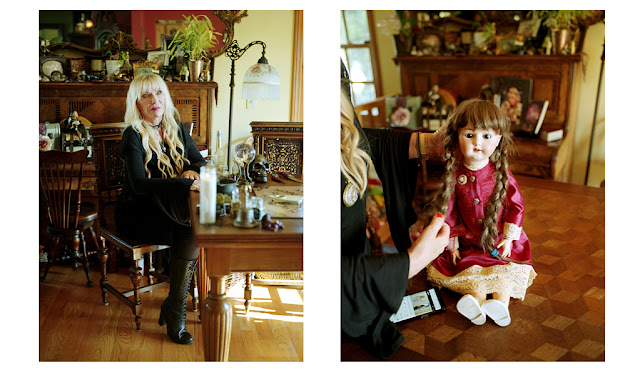
SK: So this is Patty's doll named Belle, and she's haunted. You know, I'm not necessarily a skeptic, but I'm also not necessarily a believer. I do have a lot of spirituality, but I kind of believe in a sort of essence. I'm always kind of trying to figure out what I actually believe, but Patti, for example, she believes 100% in what she's doing. You go to her house, and it's staged - it's like, everything there is what you would imagine a cliche witch’s house. Her costuming, she gets really into it and like, fully embraces that. 

Siri Kaur, Patti (L) and Belle (R), 2019, Archival pigment prints, Edition of 3, $2000

DH: That's amazing. I feel like your position as somebody that isn't quite a skeptic and not quite a believer is what makes these images a part of your portrait practice.

SK: I mean, I would say that I really am a portraitist. I have this big project I've been doing for 10 years. It's about my family, not specifically about us being Sikhs but about our sort of magical relationship with nature. It's a portrait of me, you know! It's all about how I feel about myself and my awkwardness in the world. When I photograph people, I think it's such a privilege to be given someone's, you know, body and presence to photograph, so I always try to be very respectful and I don't judge really anything. I think that I'm just fascinated. I'm always so happy to take pictures of anyone!

DH: Well I think that there's something to be said for a genuine interest and genuine relationship in that setting. Actually feeling comfortable is the only way that the subject is going to actually "perform" the way that they feel. Totally.

Siri Kaur, Helena, 2019, Archival pigment print 20, x 20″,
Edition of 3, $2400

SK: And it's like, if they're awkward, that's also fine. If that's the way they feel, I don't have a prescribed agenda ever. It's just like, I try to set up! My students have asked, "Well, how do you get these people to let you do this?" and I was like, I just asked them, you know, and then I think they're amazing! I think that you can always find people to photograph if you if you have a genuine curiosity and an open mind, I think that you can always find people to photograph. Because they'll sense that. 

DH: Can you describe your process of making a portrait?  Are there any tips and tricks that you've learned along the way with photographing strangers for this amount of time? Or do you like it prefer to build a relationship with a person first prior to photographing them?

SK: So the way that I approach a portrait is: I will think about someone or I'll have a spark of an idea of who might be good for a portrait or who could be interesting to photograph. I'll reach out to them either via Instagram, or I've seen them somewhere and I'll approach them. I'll be like, "Okay, I'm serious. I'm a portrait photographer, I would love to photograph you!" No one ever says no, honestly, I think that people love to be seen, and they usually feel good about it. Sometimes I will meet them before, I'll go to coffee with them before and I won't photograph them because, ethically, I always have a bit of guilt because I make objects and photographs and I always want to honor the person in a way that's not only translating them fully onto the film and then into a print. I'd like to talk to them a bit before I photograph them. However, that said, sometimes I'll make a portrait where I will meet the person, and I just photograph them right away. So for example, the work that you had shown up at photo-eye, Female Photographer Seeks Portrait Subjects, I would meet them first. And I would talk to them for an hour – half hour, it

depends. If they seem nervous, I'll talk to them more, and I'll kind of try to figure out, who they are, what they're interested in, how they feel about photography, what they care about. Then we'll just do the photos right away. It's really fun going somewhere new and seeing it or going into someone's home and arranging it and sort of like figuring out a way to make a portrait.

DH: Yeah, it seems like a really collaborative process for you.

SK: It really is. I, I love my subjects. I always love them. I honestly will say I don't really photograph people anymore if I don't want to spend time with them. Yeah, I used to do that a bit more. But you know, now it's like, I want to be with them, want to talk to them, to see them, and I feel like that's sort of the exchange of the sitter and the camera.


Siri Kaur, Camille, 2019, Archival pigment print, 21 x 16″, Edition of 3, $2000


• • • • • 

Print costs are current up to the time of posting and are subject to change.


For more information, and to purchase prints or books by Siri Kaur, please contact Gallery Director Anne Kelly or Gallery Assistant Delaney Hoffman, or you may also call us at 505-988-5152 x202