PHOTOBOOK REVIEWS, INTERVIEWS AND WRITE-UPS
ALONG WITH THE LATEST PHOTO-EYE NEWS

Social Media

Showing posts with label Zach Stieneker. Show all posts

Book Review Golden Apple of the Sun Photographs by Teju Cole Reviewed by Zach Stieneker "The Metropolitan Museum of Art holds in its collection a nineteenth-century Dutch silver salt spoon, captioned simply: “Dutch salt spoon, 19th century." Teju Cole, however, suggests an alternative..."

Golden Apple of the Sun. By Teju Cole.
https://www.photoeye.com/bookstore/citation.cfm?catalog=ZJ808
Golden Apple of the Sun  
Photographs by Teju Cole

MACK, London, UK, 2022. 136 pp., 7½x10".

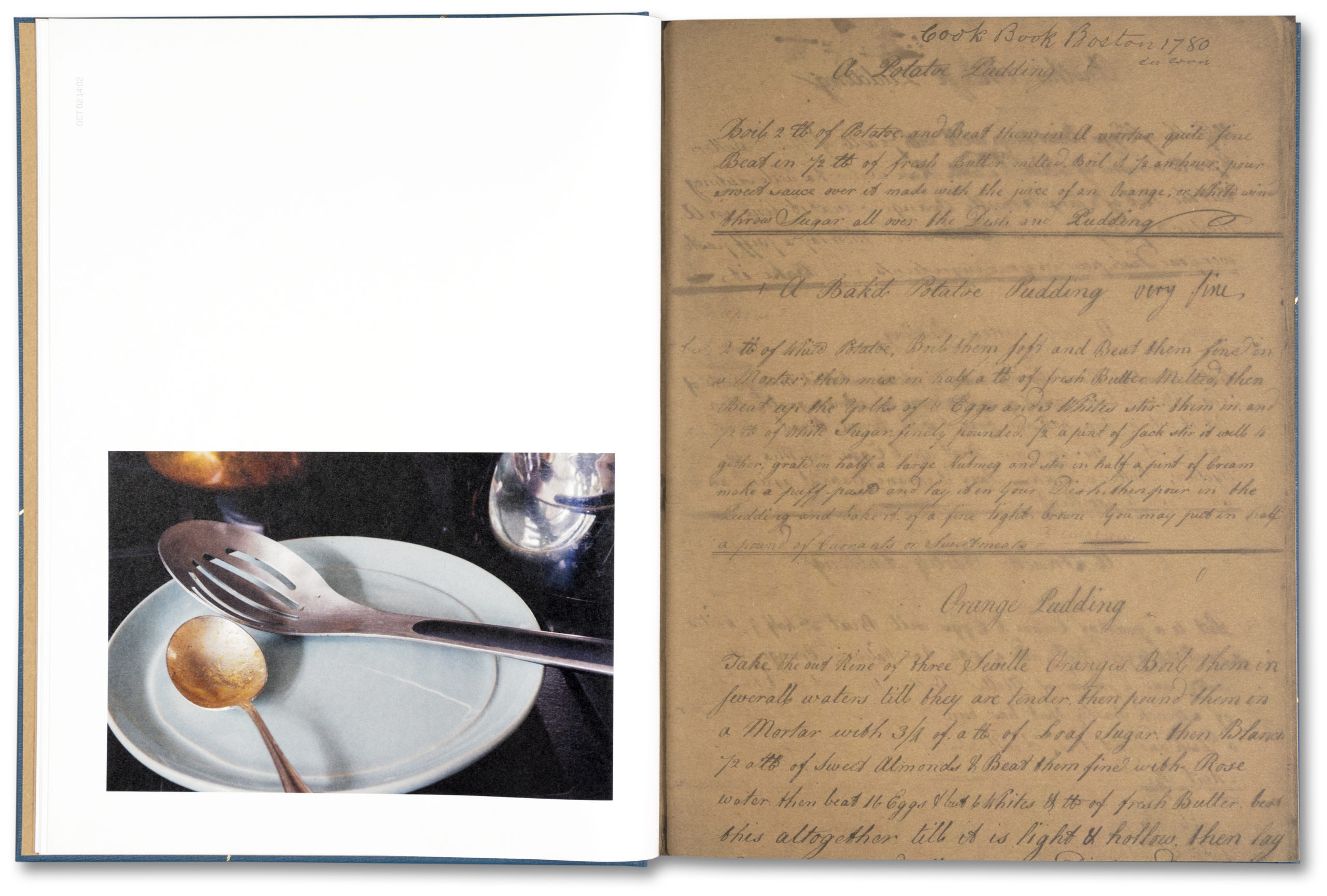
The Metropolitan Museum of Art holds in its collection a nineteenth-century Dutch silver salt spoon, captioned simply: “Dutch salt spoon, 19th century." Teju Cole, however, suggests an alternative in his expansive essay in the Golden Apple of the Sun.

"Bonaire was claimed by the Dutch in 1636 (the 'Dutch Golden Age') and turned to the harvesting of salt,” he begins. Cole goes on to describe the horrific harvesting conditions, undertaken by enslaved people at the time, including a 1831 first-person testimony. Salt harvesting continues now under the American multibillion-dollar corporation Cargill — their tagline “Making salt in paradise.” Paradise here refers to Bonaire, which remains a Dutch “possession.” Cole’s essay continues to describe how the salt made by the people of the Caribbean has been, and continues to be, used to preserve cod in Europe and New England, which is in turn exported to the Caribbean to feed the people making the salt.

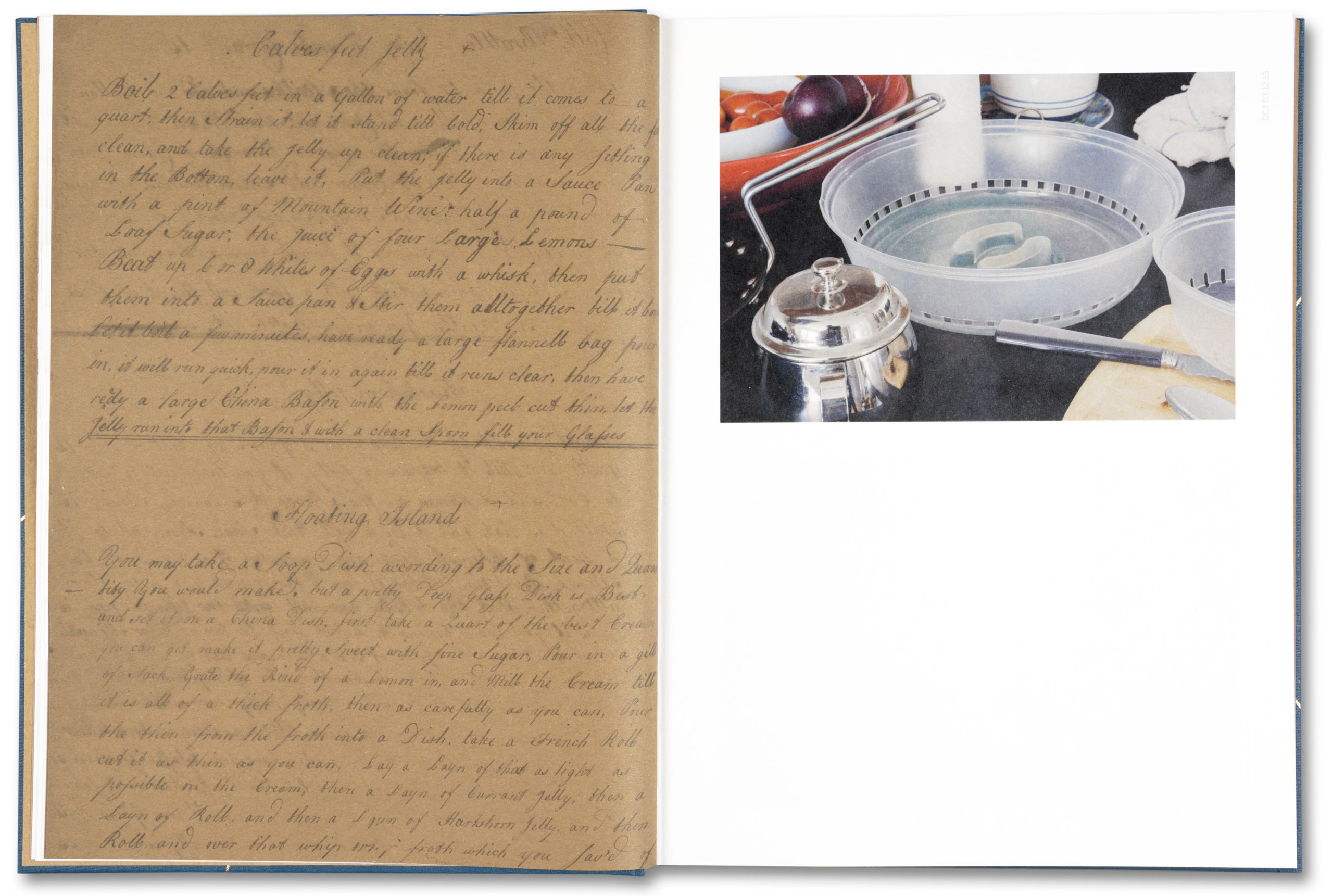
So, yes, a nineteenth-century Dutch salt spoon is pictured, but in that object are histories of colonialism and slavery, portraits of human suffering and the etiologies of staggering wealth. In that light, the preceding series of images made exclusively in Cole’s own kitchen lose their innocence. With each turn of the page, more questions arise: Who made these objects and ingredients? What did it take for them to get to where they are? Whose lives did they cost?


For Teju Cole, everything is nested in something. This is the profound suggestion of the Golden Apple of the Sun, which meditates deeply on the ways that even the most precise and constrained — one kitchen, one fraction of a second, one chance arrangement of kitchen items — reverberate with meaning.

There’s even a formal enactment of this idea in the essay: its many different threads are presented in a single, continuous block of text. It oscillates continuously between memoir , prose poem, and academic nonfiction. The essay is addressed to a nondescript “you,” and in the book’s acknowledgments Cole thanks “the many yous.” No salt spoon is just a salt spoon.

Reflecting on the artistic tradition of the still life that he is working within, Cole writes, “In our twenty-first-century lives, ordinary as our objects are, devoid of patina as they are, mass-produced as they are, they are no less charged with the mystery of everydayness as are the vessels on Chardin’s stone plinth, for they contain our hours which are as resonant to us as Chardin’s were to him.” What, then, are our hours?


The photographs in the Golden Apple of the Sun are all made within the six weeks leading up to the 2020 U.S. presidential election and the coronavirus pandemic. These are the hours that the work most acutely engages with, but part of that engagement involves the reminder that to define a moment requires a selection, that the pre-election period could just as well be thought of as the entire history of the American experiment rather than just six weeks. These are the hours that the book wonders how to mourn.

“We’re being asked to do something intolerable, to witness and understand other people’s pain, and then still move on with life,” Cole said in an interview about the work. “It’s very difficult to do, and yet it has to be done.” So we find ourselves in the kitchen, stocking and depleting it, arranging and rearranging it, day after day.

Purchase Book

Read More Book Reviews

Zach Stieneker holds a BA in English and Spanish from Emory University. Following graduation, he spent several months continuing his study of photography in Buenos Aires, Argentina.

Book Review Suburban Bus Photographs by Alejandro Cartagena Reviewed by Zach Stieneker "By this point, you’ve been wiping the sleep from your eyes for some time, but it lingers despite the cool fluorescence of the bathroom lights and the water splashed onto your face. It lingers as you are greeted by air that belongs to neither morning nor night. Indeed, you’re only certain that it’s morning due to the unrelenting alarm clock. You amble to the bus stop anyway..."

Suburban Bus. By Alejandro Cartagena.
https://www.photoeye.com/bookstore/citation.cfm?catalog=ZJ808
Suburban Bus  
Photographs by Alejandro Cartagena

The Velvet Cell, 2021.

By this point, you’ve been wiping the sleep from your eyes for some time, but it lingers despite the cool fluorescence of the bathroom lights and the water splashed onto your face. It lingers as you are greeted by air that belongs to neither morning nor night. Indeed, you’re only certain that it’s morning due to the unrelenting alarm clock. You amble to the bus stop anyway. You join the small gathering of passengers illuminated by the red-orange glow of streetlights, forming a hesitant pilgrimage — your steps reluctant but dutiful. You, alongside the other passengers, carry the few items that might help them through the day to come: bagged lunches, small backpacks, umbrellas.

It’s still dark but the bus is busy, and it will be for the rest of the way. People lift their backpacks over their heads just to squeeze through the bus’ doors when their stop finally comes. Those who boarded the bus early enough to claim a seat have fallen back into the sleep that has remained on their eyelids since waking. They trust themselves, though, as they always do, to wake up when their stop comes — the mark of persistent routine.

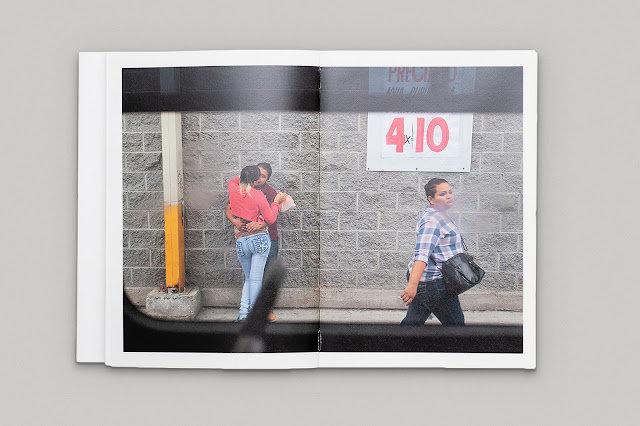
Or maybe, as Alejandro Cartagena might figure it, this is the mark of half-sleep crammed into the only sliver of the day that can accommodate it. In Cartagena’s Suburban Bus you sit alongside half-asleep passengers, frozen in time with their heads tilted and jaws slackened. The pages of Suburban Bus turn with the form of poetic enactment, composing a sequence that simulates the course of one day on just one of the bus’ many commutes. Over the course of the 300+ pages that comprise this beautiful, expansive exploration of a claustrophobic space, you are like a passenger, an observer of routine.


This particular bus connects the cities of Juárez and Monterrey, Mexico. Inside it, Ximena Peredo remarks in her accompanying essay, “we find a type of captivity, of wasted (literally) time, of seeing oneself reflected in this family of exhausted bodies, crushed from their waking at dawn, of getting in each other’s way, squeezing in tighter still to allow someone else on, to finally pushing one’s way through to get off all these bodies melting together like an unavoidable morning ritual.”

“Traveling in these precarious capsules,” Peredo continues, “without enough seats for everyone, in a total absence of safety, is a confirmation of the position these bodies occupy in the consumption society.” This positioning reflects a thematic concern of both this book and the others of Cartagena’s that it echoes, including Suburbia Mexicana (2011) and A small guide to Homeownership (2020) — namely, the tension between compression and expansion in urbanizing Mexico as it impacts the working class. As the urban environment traversed by the bus sprawls outward, and lurches upward, in the form of cookie-cutter housing developments, the spaces its population occupies are ever-diminishing. Its numbers steadily grow, its bus fleet, according to Peredo, gets steadily cut. Against this backdrop, photographs of the hands of passengers reaching directly up to the ceiling of the bus to steady themselves testify to a landscape built for humans but not humanity. Almost everyone seems exhausted.

Cartagena dedicates this work “For my family,” and that italicized clarity means to include everyone pictured in the book. He rode the route for years before he ever began to photograph it. When he did, the photographs came to transmit the sincerity borne of his singular familiarity with the contexts in which they were made — the artist is part of the family, and his images reflect that. His photographs simultaneously revere his subjects and decry the social and political circumstances that surround them: dehumanizing as these morning rituals are, he loves his family for undertaking them anyway, for their resolve to get to wherever it is they are going, day after day.

Purchase Book

Read More Book Reviews


Zach Stieneker holds a BA in English and Spanish from Emory University. Following graduation, he spent several months continuing his study of photography in Buenos Aires, Argentina.

Book Review Odds and Ends Photographs by Marie Quéau Reviewed by Zach Stieneker "Of Odds and Ends, Marie Quéau writes that she “fundamentally undertook [the] work as an obituary for our planet.” The idea is provocative. If an obituary is a notice, a public declaration of someone’s death with an accompanying biographical synopsis, the notion of creating one for the earth, sampling images from its more than four billion year history, represents a fascinating (if not extraordinarily daunting) curatorial task..."

Odds and Ends. By Marie Quéau.
https://www.photoeye.com/bookstore/citation.cfm?catalog=ZJ714
Odds and Ends  
Photographs by Marie Quéau

Area Books, 2021. 180 pp., 8¾x11".

Of Odds and Ends, Marie Quéau writes that she “fundamentally undertook [the] work as an obituary for our planet.” The idea is provocative. If an obituary is a notice, a public declaration of someone’s death with an accompanying biographical synopsis, the notion of creating one for the earth, sampling images from its more than four billion year history, represents a fascinating (if not extraordinarily daunting) curatorial task.

Filled with the smoke of still-blazing or just-extinguished fires and strewn with the detritus of decommissioned airplanes, Odds and Ends does not exactly seem to be engaged with that task; its imagery resembles a vignette more than a biography — a summary not of the planet’s whole history but rather of the period that Quéau perceives to be its ending.

The project may not have the precise character of an obituary, but it certainly feels adjacent to one. It is, without a doubt, a book about death, a visual forecast of the Anthropocene’s impending conclusion. Having spent some time with the book, though, I am left wondering: What else might this be? Who (or what) might it be mourning?


Aside from her description of the work as an obituary, Quéau has elsewhere called Odds and Ends a “poem without men.” Maybe elegy, then, might be an appropriate categorization. The book opens with an ethereal poem from Amélie Lucas-Gary that shows a protagonist named Lucie wandering a surreal and desolate Earth, detailing the types of planetary destruction that will follow in Quéau’s photographs. The language of the poem and the visual language of the photographs share a tendency toward abstraction; their linkage, in content as well as form, suggests that Lucie is the protagonist, “Who loves the crevices of this crushed world / Where disaster’s facets can be seen, / And its intense core.” Such a love for the world is what makes its smoldering worth grievance, and the book an enactment of that grief.

Elegies and obituaries both posit the vantage of retrospect — they are written, necessarily, postmortem. This is where categorizing Odds and Ends becomes more complicated, because it seems that the earth detailed in its pages is not dead but dying, not an end but an ending. In the first photograph of the book, the fire is still raging; in others, smoke still rises from the ashen silver of felled trees. The photographs stem from an in medias res orientation to the planet’s destruction, not a posthumous one. What, then, might be a classification that takes this distinction into account?

The book is populated with images of artifacts, some even with tags posted in the ground, like in the investigation of a crime scene. (These are, perhaps, the titular “odds”). Many appear to be taken from inside laboratories, including one image of human skull fragments glued together into their original shape. One arresting photograph shows a grave-shaped hole in a rock, illuminated by a halo of light. The visual quality of these images is austere and forensic, a compendium of pieces of evidence. Humans, though mostly absent, evince a presence through their gloved hands, and life surfaces in the forms of new growth, a couple of apes, and a several-page sequence of full-bleed photographs of water. Earth is persisting and renewing itself throughout the book; what seems to have been mostly extinguished is humanity. The photographs might be an effort by the remaining few to take account of the scope of the destruction and diagnose what went wrong, like an autopsy of humanity.


My effort to recategorize this book as something other than an obituary is likely me getting mired in a semantic distinction — it operates on many planes and is likely all of those possibilities at once. It is a complex but stark portrayal of where the trajectory we are on could lead us, for even if they represent an imagined future, they are photographs made with the material of what has already past. They show an ending that is already unfolding. How ubiquitous it becomes is left to us.

Purchase Book

Read More Book Reviews


Zach Stieneker holds a BA in English and Spanish from Emory University. Following graduation, he spent several months continuing his study of photography in Buenos Aires, Argentina.

Book Review Far Photographs by Ekin Küçük Reviewed by Zach Stieneker "A haiku from one of Japan’s “Great Four” masters, Issa, greets us as we lift the iridescent cover of Ekin Küçük’s Far. “In the city fields / contemplating cherry trees / strangers are like friends.” We then turn the sheer page to enter Küçük’s ink-heavy, black-and-white record of contemporary urban Japan."

Far. By Ekin Küçük.
https://www.photoeye.com/bookstore/citation.cfm?catalog=ZJ301
Far  
Photographs by Ekin Küçük

self published, 2019. 160 pp., 7½x10½".

A haiku from one of Japan’s “Great Four” masters, Issa, greets us as we lift the iridescent cover of Ekin Küçük’s Far. “In the city fields / contemplating cherry trees / strangers are like friends.” We then turn the sheer page to enter Küçük’s ink-heavy, black-and-white record of contemporary urban Japan. Framed by this epigraph, we might expect scenes of amity despite the surrounding anonymity, moments of shared experience in which strangeness blossoms into familiarity. We might expect communion.

However, the book’s many photographs of people quickly and beautifully skew these expectations. The images are often made unbeknownst to their subjects, either from behind or mediated by some layer of opacity; instead of conveying friendship, they emphasize unknowability — distance rather than intimacy.

FarBy Ekin Küçük.

The first figure, for example, faces away from the camera and occupies most of the frame as a corpulent, looming mass of shadow. A play of perspective shrinks the woman passing beside him, rendering his silhouette even more imposing. It’s a compelling image, but there is certainly no discernible sense of friendship, a common thread among the series of images to follow. As the book unfolds, the eyes of animals, both dead and alive, meet the camera’s gaze more regularly than humans.

FarBy Ekin Küçük.
Küçük’s aesthetic, with tones regularly pushed to the poles, impenetrable blacks and bleached whites, along with heavy use of grain and blur, augments the sense of inscrutability that blankets the work. In an early portrait a spectral, mask-like countenance floats over a field of darkness, identifiable as a face only by the most basic shapes and contours. Many of the images are made through barriers –– rain-streaked windows, curtains, and chainlink fences become obstructions between the photographer and her subjects. From the sidewalk, she peers into restaurants and bars. These images bespeak a familiar metropolitan reality: the uncanny simultaneity of togetherness and separation.

Importantly, the graphic qualities of the book place it within the lineage of Provoke era post-war Japanese photography and artists like Daido Moriyama. Further nuancing the book’s conception of distance, Küçük is herself Turkish, both an outsider on the streets in which she photographs and the greater artistic tradition in which she presents them. Fans of the 20th-century vanguard of Japanese street photography will likely be interested by the dialogue Far elicits as it explores similar streets in a similar style but from an outsider’s perspective.

FarBy Ekin Küçük.

In Küçük’s diaristic account, there is also a current of superficial sex charging the work with the feeling of a one-night stand: a frantic, bottled encounter between people that comes to be labeled by its finality. There’s a sampling of framed photographs of faceless female bodies; a sign that advertises “Loove 24H”; one poster of a topless woman looking over her shoulder, lowering her underwear and another of Marilyn Monroe; a suggestive pairing of white high heels and a male gaze; a glossy, nude female robot. Here, again, the space between intimacy and anonymity is liminal.

There is, however, a piercing glimpse of knowingness found in a portrait of a woman, reclined, hands behind her head, with the hint of an almost flirtatious smile waxing across her face. It feels close, like the possibility of closing a distance. A meeting, a discovery, from among the multitudes, of another cherry tree contemplator.

Purchase Book

Read More Book Reviews

FarBy Ekin Küçük.
FarBy Ekin Küçük.


Zach Stieneker holds a BA in English and Spanish from Emory University. Following graduation, he spent several months continuing his study of photography in Buenos Aires, Argentina.
Book Review Zakir Hussain Maquette Photographs by Dayanita Singh Reviewed by Zach Stieneker The book is well known as Dayanita Singh’s primary medium, one she explores to create new relationships between photography, publishing, the exhibition and the museum. But where did her passion for the book as the ideal vessel for her photos, for the stories she tells, begin? The answer lies in Zakir Hussain, a handmade maquette Singh crafted in 1986 as her first project as a graphic design student.

Zakir Hussain Maquette. By Dayanita Singh.
https://www.photoeye.com/bookstore/citation.cfm?catalog=DT575
Zakir Hussain Maquette  
Photographs by Dayanita Singh

Steidl, Gottingen, Germany, 2020. In English. 
88 pp., 94 illustrations, 8¼x9½".

“When you come to watch an Indian music concert, you come to watch a beautiful thing being created,” observes Zakir Hussain. “Sometimes you are a part of it, sometimes you are not. You enjoy the rapport, how well two people come together. How beautifully they can connect.”

In much the same way, viewing Dayanita Singh’s Zakir Hussain Maquette is to see a beautiful thing being created. As a facsimile of the artist’s original maquette, replete with penciled notes and residual glue stains, the book is presented not as a static, polished product but, rather, an artwork in the process of becoming. It is a gift that emerges from the connection between two people: Hussain, the tabla virtuoso, and Singh, a young graphic design student, poised to begin an influential and highly innovative career working in the medium of the photobook.

Zakir Hussain MaquetteBy Dayanita Singh.

In this edition of the maquette, the scanned prototype is packaged alongside a foldout poster and a reader with conversations and images of Singh’s notebooks. Collectively, these materials invite readers to engage with the book while circulating between two modes of attention: first, attention to the process of the book’s construction, and second, attention to the character study of Zakir Hussain.

Zakir Hussain MaquetteBy Dayanita Singh.
With regard to this first mode, Steidl remarks that “from the beginning [he] saw the maquette as a tool for people who are curious about how books come into being.” To that end, it begins and ends with annotated contact sheets. Faint outlines around the images give the impression of three-dimensionality — evince the original maquette’s handmade construction. Glue stains and smudges give the paper a worn quality, obscuring its newness. The images are surrounded by scrawled notes and contact sheet numbers, often scratched out and revised, rendering the history of Singh’s decision making legible. That the result we view is one out of many considered alternatives is true of any photobook, but here this idea is foregrounded. Singh’s notebooks explicitly elucidate her approaches to each aspect of the book’s design. These explanations are granular — we even learn about her choice of font size.

Singh’s photographs are dynamic, and the testimonials gathered from Hussain, along with a variety of people in his orbit, create a compelling portrait of an artist who, by his own admission, is inseparable from his art.

Zakir Hussain MaquetteBy Dayanita Singh.

Shanay Jhaveri’s included essay, “Finding Form,” explains how Singh’s instinctual approach in crafting the book’s layout emulates the improvisational character of tabla playing, meaning that Singh’s construction of the book can be seen as a search for spatial rhythm. Further, this resonance provides a link between the book’s design and its content: Zakir Hussain. Jhaveri writes that in the maquette “there is no story or plot –– simply the privilege of being with Hussain.”

At this stage of Singh’s career –– one marked by an expansive vision of what the photobook can be –– Zakir Hussain Maquette can be revisited as a singular glimpse into a mind that, as Singh expresses it, “think[s] in the book.” Contextualized as a precursor to her later “book objects”, the maquette becomes a study in origin. It’s also a guidebook, but it’s absent of didacticism, descriptive rather than prescriptive, and so, like an Indian music concert, sometimes you are part of it, and sometimes you are not. Either way, it’s an affirmation of creative potential, and it’s a beautiful thing.

Purchase Book

Read More Book Reviews

Zakir Hussain MaquetteBy Dayanita Singh.

Zach Stieneker holds a BA in English and Spanish from Emory University. Following graduation, he spent several months continuing his study of photography in Buenos Aires, Argentina.

Book Review In Dreams Photographs by Dennis Hopper Reviewed by Zach Stieneker People are the primary subjects of In Dreams, and the cast of characters extends far beyond Hopper’s family. These images hold a celebratory spirit that seems in contrast with the melancholic character of the book’s title and the images of Hopper’s family, but ultimately testifies to the way nostalgia can tightly border grieving.

https://www.photoeye.com/bookstore/citation.cfm?catalog=DT577
In Dreams. By Dennis Hopper.
https://www.photoeye.com/bookstore/citation.cfm?catalog=DT577
In Dreams  
Photographs by Dennis Hopper

Damiani, Italy, 2019. In English. 140 pp., 97 illustrations, 9¼x8".

There’s a man in a black leather jacket turning toward a stereo; there’s the click of the play button; there’s the disembodied strum of an acoustic guitar. And then there’s Roy Orbison’s voice, crooning “In Dreams” as the man in the black leather jacket silently sings along, his gleaming eyes betraying the forlorn gaze of someone staring more inward than outward.

The scene is from David Lynch’s Blue Velvet (1986), and the man is Frank Booth, played by Dennis Hopper. It represents one of the many iconic performances that famously link Hopper’s name to Hollywood. Although his work as a visual artist and photographer is lesser known, a line of books assembled from Hopper’s photographic archive, edited and designed by Michael Schmelling, testifies to the late actor’s talent in the medium. The latest, In Dreams, is conceptualized as a throughline, an effort to “connect his roles as photographer, husband, and actor” through a series of images made between 1961 and 1967.

Biker Couple, 1961. By Dennis Hopper.

This period, concurrent with a lull in Hopper’s acting career, entails the full extent of his photographic output. His abandonment of photography was as wholehearted as the fervor with which he practiced it. “I was trying to forget…” Hopper confessed in interview, “[t]he photographs represented failure to me. A painful parting from Marin (daughter) and Brooke (ex-wife), my art collection, the house that I lived in and the life that I had known for those eight years.”

That the book’s title, In Dreams, refers specifically to the Orbison ballad that entrances Frank Booth rather than the general realm of the phantasmagorical becomes particularly significant in light of Hopper’s words. In its final verses, the song transmits a similar sense of melancholia:

But just before the dawn, I awake and find you gone
I can't help it, I can't help it, if I cry
I remember that you said goodbye

It's too bad that all these things
Can only happen in my dreams
Only in dreams, in beautiful dreams

If the notion of dreams typically invokes the fantastical and enigmatic, this collection of images then resides on a different (though sometimes overlapping) plane. Dreams here are memories, hazy relics of a lost love, yearnings for a halcyon past.

Waiting for Dailies, 1961–67. By Dennis Hopper.

The book opens with an image that encapsulates this dynamic. It shows two hands –– one small, one large –– hovering above a puddle, index fingers outstretched and pointing. The hands belong to Hopper’s daughter Marin and his ex-wife, Brooke Hayward. Joined in the search for tiny fascinations, a feeling of intimate togetherness emanates from the photograph. Hopper’s presence as he crouches alongside his family feels implicit. There’s a unity that we know will not hold –– that may already be crumbling –– and so, the image becomes an emblem of Hopper’s lost, beautiful dream.

Girl in Rear-view Mirror, 1961–67. By Dennis Hopper.
David Hemmings with Lips, 1961–67. By Dennis Hopper.
We are only able to see Marin and Brooke in this photograph through their hands –– an elusiveness that they maintain throughout the collection. The only other photograph of Marin depicts her feet pressed against the back of a car seat; we see her metonymically. Brooke, meanwhile, returns as a weary grocery shopper, a small photograph in an oval frame, a model in a backyard photoshoot, and an out-of-focus lover. In none of these images, however, does she seem to concede herself to the camera –– rather, she is figured with a certain evasiveness. Such unknowability reflects the fogging and fracturing that experiences undergo as they become increasingly distant memories. They can always be recalled, but never in the completeness of the moments from which the photographs were extracted.

People are the primary subjects of In Dreams, and the cast of characters extends far beyond Hopper’s family. Depicting a pantheon of 1960s notability, the book reads in part as a catalog of the actor’s celebrity milieu. These images hold a celebratory spirit that seems incongruent with the melancholic character of the book’s title and the images of Hopper’s family, but ultimately testifies to the way nostalgia can tightly border grieving.

In Dreams is a portrait of a phase in Dennis Hopper’s life. It’s one very particular phase in one very particular life. Its emotional contours, however, may not be so particular. Lost painfully or peacefully, it’s a poignant reminder that each completed phase of our lives will become another of our beautiful dreams.

Purchase Book

Read More Book Reviews

Jane Fonda (with garter), 1965. By Dennis Hopper.


Zach Stieneker holds a BA in English and Spanish from Emory University. Following graduation, he spent several months continuing his study of photography in Buenos Aires, Argentina.