PHOTOBOOK REVIEWS, INTERVIEWS AND WRITE-UPS
ALONG WITH THE LATEST PHOTO-EYE NEWS

Social Media

Showing posts with label Odette England. Show all posts
Book Review Something Else, Something Other Florida Strawberries
Photographs by Anthony Blasko
Reviewed by Odette England "Start with fun facts about strawberries. The fear of strawberries is fragariaphobia. Strawberries are members of the rose family. They come in many colors other than red. They have eight copies of seven chromosomes. They don’t continue to ripen after picking. And Belgium has a museum dedicated to them..."

Florida Strawberries. By Anthony Blasko.
https://www.photoeye.com/bookstore/citation.cfm?catalog=ZK158
Florida Strawberries
Photographs by Anthony Blasko

STANLEY/BARKER, London, UK 2022. 120 pp., 11¾x9".

Start with fun facts about strawberries. The fear of strawberries is fragariaphobia. Strawberries are members of the rose family. They come in many colors other than red. They have eight copies of seven chromosomes. They don’t continue to ripen after picking. And Belgium has a museum dedicated to them.

Fun’s over. Let’s talk understated elegance in photobooks.
Those fun facts are harder to find.

Maybe it’s because I’ve seen too many photobooks masquerading as something else, something other. Trying to be clever with unnecessary design. Unnecessariness, period. This book — Florida Strawberries by Anthony Blasko, published by Stanley Barker — is not that book. This book takes its cue from the humble strawberry. It is fresh and ripe and deliciously simple. The only hints of design whimsy appear outside the book, like the ‘seeds’ of the strawberry itself (called achenes, inside which is the actual strawberry seed). The front and back covers feature hand-painted fruits by Shaun Morris. And the book comes wrapped in disposable, takeout-style wax paper packaging that I can’t bear to recycle, it’s too darn cute.

Unobtrusive white borders frame most of the full-color images. When I say color, I don’t mean regular everyday color. Nor Eggleston, Ho, Greenberg, Cousins, Aldridge or even Kodachrome color. Blasko favors the color of a warm squishy hug. Freckled face-plant into a melty cream cake color, soaked in one-too-many strawberry slushies color, sugar-rush sunset fairy floss color. The color Sherwin Williams might call “All The Fun of The Fair.” Even the endpapers look like Pantone 1788C Strawberry.


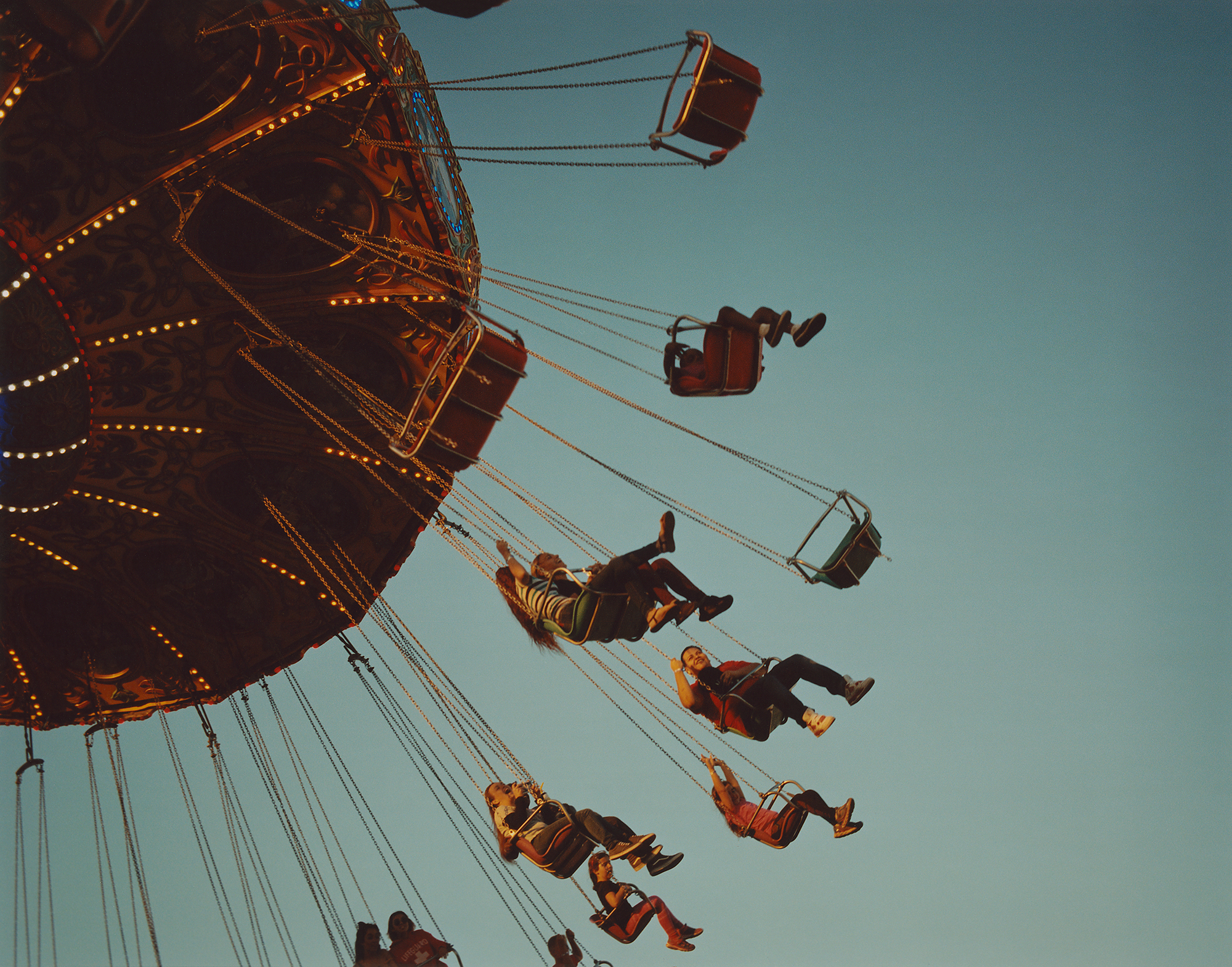
The complexity of this book is strewn in the pictures, which Blasko has made at the annual Strawberry Festival in Plant City, Florida since 2013. Except for a six-year hiatus during and after World War II, the event has run since 1930. For eleven days, people from all over gather for attractions, parades, entertainment and of course enjoying strawberries in ways you never thought appealing or possible. It is this intoxicating combination of people, place and time Blasko focuses on.

All the photographs are made in strawberry-stained late afternoon light. They are heavy on the ROY. Red shirts, orange drinks, wedding bands, goldfish. There are lots of lotsas. Lotsa red and strawberry-colored hair. Lotsa kids. Lotsa exposed skin. Lotsa indirect portraits, of people not knowing they were being looked at. People photographed from the side or from behind. People watching people. I imagine Blasko bumper-car-bumping his way through the crowd looking for the ding-ding-ding pictures. Lusting the light.

I grew up attending two local county fairs, the sounds and smells of which persist. I mention this because despite the visceral joy and excitement, what I remember most are the unsmiling faces. Yes, there was screaming and sirens, clapping and balloons popping, the relentless heckling of carnival workers. But there was also a sense of sadness, distraction and longing. Fairs have a way of transforming reality into something else, something other. Something mysterious but also menacing and risky, all the while giving off vibes of simpler, happier, safer times. It is this paradox that photography too is good at, and that Blasko elicits with his camera. The squinting, watching, waiting, chomping, wriggling, head-tilting and draping. Fairgoers devouring corn dogs with ketchup and show rides on repeat but without the overt rapture. Going to see and going to be seen.


For all the action and bewilderment these photographs imply, they unfold in slow motion. The light hypnotizes. The shadows lull. There is an undertow of disconnection. It is as if Blasko wants to lure us to the gates, fill us up until we’re tired or sick or our ears and feet hurt, and then, only as we’re walking to our cars, look over our shoulders and get a bout of the warm fuzzies from seeing the Ferris wheel still turning. Knowing that the fair is still fair. We go without questions, we leave without answers. We socialize and learn and enjoy. And, if we’re lucky, get reminded that less is more, and to stop and smell the roses. Or in this case strawberries.

Purchase Book

Read More Book Reviews


Odette England 
is a photographer and writer based in Providence, Rhode Island and New York. Her work has been shown in more than 100 museums, galleries, and exhibition spaces worldwide. She has two photobooks out this year: Dairy Character, winner of the 2021 Light Work Book Award; and Past Paper Present Marks: Responding to Rauschenberg, her collaboration with Jennifer Garza-Cuen, which received a $5,000 Rauschenberg Publication Grant.
Book Review The Quarry Photographs by Madeleine Morlet. Short story by Vivian Ewing. Reviewed by Odette England "The Quarry refers to both place and victim. It’s not a photobook as such, rather, a newspaper, and it contains less pictures than one might expect from either. There are a sweet sixteen of them, around which wraps the story of teenage girls who return home a week apart for their first summer break from college..."

The Quarry. By Madeleine Morlet & Vivian Ewing.
https://www.photoeye.com/bookstore/citation.cfm?catalog=TT189
The Quarry
Photographs by Madeleine Morlet
Short story by Vivian Ewing


Self-published, 2022. In English. 20 pp., 13.75x20".

Quarry. A large, deep open-air hole from which slate, limestone or granite is extracted through digging or blasting. It’s also a word used to describe prey, the aim of an attack.

The Quarry refers to both place and victim. It’s not a photobook as such, rather, a newspaper, and it contains less pictures than one might expect from either. There are a sweet sixteen of them, around which wraps the story of teenage girls who return home a week apart for their first summer break from college. But the pictures are not sweet and nor is the story. They are dark and light and beautiful and tragic. Photographer Madeleine Morlet and writer Vivian Ewing twist elements of myth-making, murder ballads, psychological horror and romance novel in broadsheet form, a shrewd choice as broadsheets tend to be more solemn and less sensationalist than tabloids.

Morlet depicts with rigor and love the community of young friends who live in the picturesque but ominous coastal Maine landscape to which she relocated from London in 2017. Even without Ewing’s words, divided into nine sections and which I only read after several weeks of looking, Morlet’s pictures feel weighted with rocks. They are implications, and what heightens their effect on me is the extreme care taken in pairing and sequencing. The pairs are like besties, any flaws or differences serving to make each other stronger. The images, all color and made during the summer of 2021, appear meticulously crafted while maintaining an innocent snapshot quality. Sometimes the best photographs are like having good fashion sense: it looks effortless but is almost insanely hard. It’s not about having the coolest equipment or a big budget, it’s about being an expert and generous observer.


When I ask Morlet about the work she describes “feeling a kinship with the adolescent experience” and writes of “domestic departure and return.” I dwell on domestic, the idea of the local and internality but also family. I learn that Morlet and Ewing, who completed her undergraduate studies in Maine, came to know each other through this project, collaborating for six months and talking almost weekly.

More than half the photographs are close range or taken from atypical angles, either low to the ground, or looking up, along or through something. Faces and especially eyes are often protected, blurred or concealed. Though our eyes are wondrous things, they have limits as do photographs, and when we can’t see our brain steps in and fills in the blanks. That’s what I found compelling about The Quarry: I was continuously anticipating what I would see or feel next. Where parts of images are obstructed through shielding or cropping, I still had a specific expectation of what the ‘story’ would look like in the end (I was wrong). Morlet’s lush photographs are like a collection of stills from a coming-of-age movie trailer. They tempt, like the quarry and its abandoned equipment and intense cold water Ewing writes about. Morlet herself describes them as “a call and response to Vivian’s writing” which “permeated my thoughts…and brought an element of fiction to the experience of capturing my subjects as themselves.”


The photographs don’t look like the ones printed in my local newspaper that I used to clip and stick to my walls — Morlet’s are finer — but as she points out, it’s less common practice now. Teenagers favor scrolling over buying newspapers or magazines, something I think about in noticing the two images with cell phones in The Quarry. But technology and contemporary life are present: false eyelashes, vaping, Reeboks, nose rings, a Subaru, a padlock-as-pendant and a letter bead necklace that spells out O-W-N quiver octaves below the trees, flowers, ropes and siding that dot the landscape around the quarry.

Every town has a place of legend and danger. Often it involves water. Think of all the books, songs or films you know where water is the backdrop for an atmospheric thriller. What makes The Quarry special is how Morlet and Ewing mine the aches and dreads of being a teenage girl and merge them with the exquisiteness of desire and freedom and the costs thereof. Their use of water as both character and characteristic. And the undercurrent of the pictures suggesting that what we can’t see can’t hurt us.

Purchase Book

Read More Book Reviews


Odette England 
is a photographer and writer based in Providence, Rhode Island and New York. Her work has been shown in more than 100 museums, galleries, and exhibition spaces worldwide. She has two photobooks out this year: Dairy Character, winner of the 2021 Light Work Book Award; and Past Paper Present Marks: Responding to Rauschenberg, her collaboration with Jennifer Garza-Cuen, which received a $5,000 Rauschenberg Publication Grant.
Book Review OK, NO RESPONSE Edited by Aaron Stern and Lucy Helton Reviewed by Odette England "I’m sitting at our dining table typing an email and only partly tuned in to my daughter watching We Bare Bears on Hulu. The unmistakable sound of a dial-up modem in the episode she’s watching zaps me back to being twenty-five years old..."

OK, NO RESPONSE. By Aaron Stern and Lucy Helton.
https://www.photoeye.com/bookstore/citation.cfm?catalog=TT189
OK, NO RESPONSE
Edited by Aaron Stern and Lucy Helton

Twin Palms Publishers, Santa Fe, NM, USA, 2021. 192 p pp., 140 four-color plates, 9½x12½".

I’m sitting at our dining table typing an email and only partly tuned in to my daughter watching We Bare Bears on Hulu. The unmistakable sound of a dial-up modem in the episode she’s watching zaps me back to being twenty-five years old. I’m picking oats from a stale bran muffin in an Internet cafĂ© near London’s Paddington Station, waiting to connect with my parents in Australia. My daughter covers her ears at the screechy noise. I laugh and begin a story of Once Upon a Time there were no laptops or Wi-Fi or streaming services. Once Upon a Time there were these things called d-e-s-k-t-o-p-s and big-ass cell phones that didn’t fit in your back pocket. And their good friend the facsimile machine was Once Upon a Time THE tech of the moment, a helpful device that turned the business world upside down. Remember the sound they made? How frustrating it was when they didn’t connect?

OK, NO RESPONSE, edited by Lucy Helton and Aaron Stern, revisits this invention through the faxed images of twenty artists. The sewn soft-cover at-size book contains 140 images in all their grainy glitchy glory. The project started with Lucy and Aaron exchanging pictures in spring 2020 as a way of staying in touch as the covid-19 pandemic gained momentum. Then they began inviting others to submit work to their analog thermal fax machine.

Fax machines allow you to send an exact paper-based copy of text or images by converting their light and dark parts into electrical signals. You feed an original document into the machine which processes the content and then sends it through a telephone line to another fax machine that turns the signals back into printed pages. Though less common in offices now, fax machines are still used in accounting, law and medical administration.

Image by Gabby Laurent.

At a time when many of us were not OK and longing for connection, I imagine this project was a welcome visual diversion, especially for the editors on the receiving end of some great pictures. It’s a simple and clever concept, using a machine like a camera to reinterpret photographs. In the book’s front-matter it states the artists are “like-minded”. What makes them so? Like-minded stylistically, aesthetically? Or in their desire to “connect in isolation”? It goes on to say that each body of work is different and though this is true, the fax machine’s treatment of the images also smooths and homogenizes them. So much so that you could have told me this was the work of just five photographers and, visually, I’d have no reason to doubt you. Details that might show a photographer’s style are obliterated through highlighting the lint and fuzz of a reductive process.

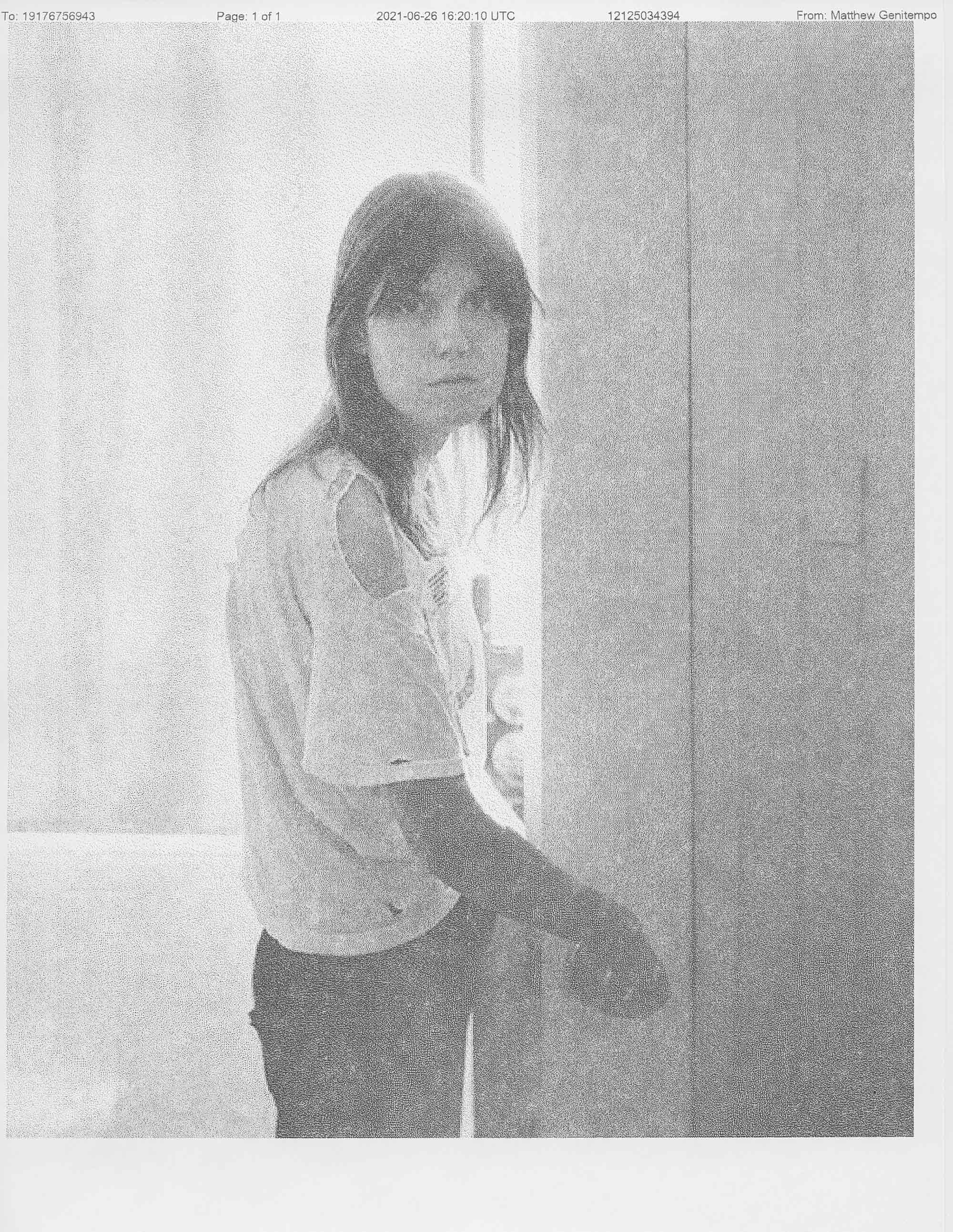
The photographs are grouped by artist but not in alphabetical order nor by date received. The layout is formal, a mix of full-page and half-page images with the occasional over-the-gutter spread. There is a variety of subject matter: landscapes, portraits, cars, animals, birds, bikes, powerlines, and open roads. The ones that stand out to me incorporate text or bear transmission errors. Examples include an image of a statue by Aaron Stern where the text strings repeat down the page, severing the statue at the neck and hips. Some of Gabby Laurent’s images of a person tripping in the street have red stripes (indicating the fax machine is running out of ink or toner) that match beautifully with the content. A photograph of a hand across a face by Matthew Genitempo recurs on the page as if a manual winder has failed to advance the film correctly. Images bearing signs of the times like NO SONGS (Jeremy Everett), SERVICE (Bryan Schutmaat) and Time is Running Out (Christian Patterson) act as perforations. As does Fryd Frydendahl’s repeating image of a young boy, faxed twice presumably to address banding defects.

Image by Pixy Liao.

At the start of the book, after the title and list of participating artists, is a copy of a fax journal dated March 18, 1994, 8.24am. It lists 35 individual transmissions with their start time, usage time, number of pages, and result. It is here that the book’s title appears to hark. Most of the transmissions are ‘OK’ with two listed as ‘NO RESPONSE’. I took a moment to research what made March 18 1994 significant. Among other data points, the number one song that week was ‘The Sign’ by Ace of Base in the USA and ‘Without You’ by Mariah Carey in the UK. A bittersweet coincidence if ever there was.

This project is a contemporary form of fax art, the first of which transmitted in 1980 as “a means of mediating distances”. Many of us in the spring of 2020 and since have used Zoom, Skype, and various apps not only to talk to each other but to see each other. Via a fax machine, artists from different places, of different backgrounds, interpreted their worlds for us to see and read. Where this project shines is in image selection and sequencing. And, in bookish aspects like the paper stock which feels like fax paper (though thicker and better quality). Even the font, the use of all capitals, the introductory page headers, all reference the fax machine.

Image by Matthew Genitempo.

Coming to the end of OK NO RESPONSE it occurs to me that ‘no response’ is also a type of response, one of the most potent. Sometimes we forget to respond to someone. At other times, it’s deliberate. Sometimes we don’t know what to say or where to look. Sometimes we simply don’t know. It is in contrast to the term COPY THAT, often used in military speak, which means that we’ve heard and understood the message. OK NO RESPONSE highlights that the way we react to varying situations is OK, and how others respond — or not — is outside our control. And that photography, which is all about control, could do with us letting go from time to time.

Purchase Book

Read More Book Reviews

Image by Christian Filardo.


Odette England 
is a photographer and writer based in Providence, Rhode Island and New York. Her work has been shown in more than 100 museums, galleries, and exhibition spaces worldwide. She has two photobooks out this year: Dairy Character, winner of the 2021 Light Work Book Award; and Past Paper Present Marks: Responding to Rauschenberg, her collaboration with Jennifer Garza-Cuen, which received a $5,000 Rauschenberg Publication Grant.
Book Review Son Photographs by Christopher Anderson Reviewed by Odette England "I wanted a boy. My husband wanted a girl. We have a girl. I can’t believe I ever wanted a boy..."

Son by Christopher Anderson.
https://www.photoeye.com/bookstore/citation.cfm?catalog=ZJ820
Son
Photographs by Christopher Anderson

STANLEY/BARKER, London, UK, 2021. 160 pp., 80 color illustrations, 8¾x9¾".

I wanted a boy. My husband wanted a girl. We have a girl. I can’t believe I ever wanted a boy.

My reasons for wanting a boy are not as interesting as why we tend to say ‘boy’ or ‘girl’ rather than I want a son or I want a daughter. It could be because there’s a stronger personal attachment to the word ‘son’ than ‘boy’. ‘Son’ feels more human, more real.

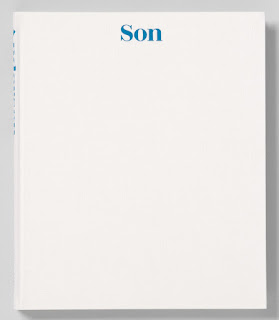
I have many new thoughts about photographing children and photobooks generally thanks to Christopher Anderson’s Son. Starting with the cloth cover, the position of the word ‘son’ at the top in petrol blue where the sun would be at high noon. I learn that Anderson, the only word on the book’s spine, which also ends in ‘son’ means ‘Son of Andrew’, derived from the Greek name Andreas meaning man or manly. I also notice that Anderson uses ‘son’ rather than his son’s name, Atlas. What a title to grow into! He’s got the whole world in his name.

Those of you who are parents might recall the first moment you saw and held your child. I hadn’t considered that when we meet them, they are a stranger to us and us to them. Nor had I considered that when we gift a child a name, what they are called is very different to their certified relationship to us. Which makes ‘son’ as a fact, idea, inference and photobook title a shrewd choice. How well do we know, can we ever claim to know, our children? The camera, in this case held by Anderson, adds both comfort and complication to the question. I say this as someone who has photographed her daughter since birth, watching her change and grow through a glass rectangle.


Son
, published by Stanley/Barker, comprises 80 color-rich images made between 2013 and 2021. This edition expands the original version published in 2013, a “second chapter” of the story. Many aspects stand out to me within the first twenty-five images. That any discussion about a son also involves a mother and grandfather, among other family members. That the sun, the only star and central body of our solar system, is a prevalent sub-character (and, an analogy for son). That as we age we become hyperaware of our death and that of our children. That we take many more photographs of our first child than their siblings, and far fewer of aging family, especially if they have a serious illness. And that we’re all a son or daughter to someone, somewhere, at some point.

The images offer a variety of distances between photographer and subject. They reveal time through seasons, light, vacations, reflections and clothing. There are interior and exterior views. We see where Atlas lives, sits, plays, eats, sleeps, swims and showers. We see his toys, pets, friends and hobbies. We see him accept, reject and ignore the camera. We see him being in the world, looking at the world, sometimes eyeing his father. We see him but we don’t know him like his father does. I wonder to what extent Atlas recognizes himself in these photographs of love and admiration. I also wonder which image is the last one we ‘see’ of Anderson’s father.

This book is about more than childhood, parenthood or life or death alone. It is about responsibility, sincerity, legacy and a dash or two of regret. I say this because about halfway through the book Anderson shares with us a letter he writes to Atlas after “a fuss about your homework”. I’m going to resist the temptation to copy the letter here in full though I do have questions about it. Did Anderson handwrite it to Atlas? How was it given to him (if indeed it was)? Is it shared in the book with us as-is, without editing or rewriting? The penmanship is magical and Anderson offers a remarkably concise explanation for the how and why of his photographs. And then ties it up with the neat bow of “I love you to the moon and back”.


Anderson makes photographing family look easy, unhurried and naĂŻve, which is a positive quality. It’s very hard to do, even harder to do well. There is no objectivity here, no neutral gaze, and thank goodness. There are also few images (or few obvious images) of all those messy truths like arguments, tantrums, piles of dishes, diapers or dirty clothes. There are fewer still that depict major milestones at which we’d take out our cameras or phones, like birthday parties. It’s Anderson’s unforced eye capturing the roles of father, son, photographer, husband and friend that make this book so potent. Son is a star around which many a photobook could do with orbiting.

Purchase Book

Read More Book Reviews


Odette England 
is a photographer and writer based in Providence, Rhode Island and New York. Her work has been shown in more than 100 museums, galleries, and exhibition spaces worldwide. She has two photobooks out this year: Dairy Character, winner of the 2021 Light Work Book Award; and Past Paper Present Marks: Responding to Rauschenberg, her collaboration with Jennifer Garza-Cuen, which received a $5,000 Rauschenberg Publication Grant.
Book Review Passenger Photographs by Martin Bogren Reviewed by Odette England "For some ‘passenger’ is a word associated with travel, adventure, wayfarers, hitchhikers, pilots and pilgrims. For others, it’s anxiety-inducing. Seatbelts. Emergency exits. Sweat. Some people prefer to drive, even insist on it. I waver depending on the circumstance. If I’m photographing I prefer to look, my feet up on the car dash, the window down enough to flutter the stray fronds of blonde above my ears. I like knowing I’m seeing things the driver cannot, feeling things the driver cannot..."

Passenger by Martin Bogren.
https://www.photoeye.com/bookstore/citation.cfm?catalog=ZJ834
Passenger
Photographs by Martin Bogren

La Main Donne, France, 2021. 92 pp., 50 color and duotone illustrations, 7¼x10¼".

For some ‘passenger’ is a word associated with travel, adventure, wayfarers, hitchhikers, pilots and pilgrims. For others, it’s anxiety-inducing. Seatbelts. Emergency exits. Sweat. Some people prefer to drive, even insist on it. I waver depending on the circumstance. If I’m photographing I prefer to look, my feet up on the car dash, the window down enough to flutter the stray fronds of blonde above my ears. I like knowing I’m seeing things the driver cannot, feeling things the driver cannot.

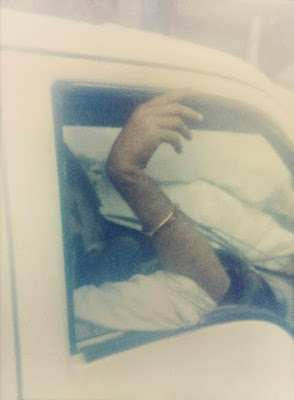
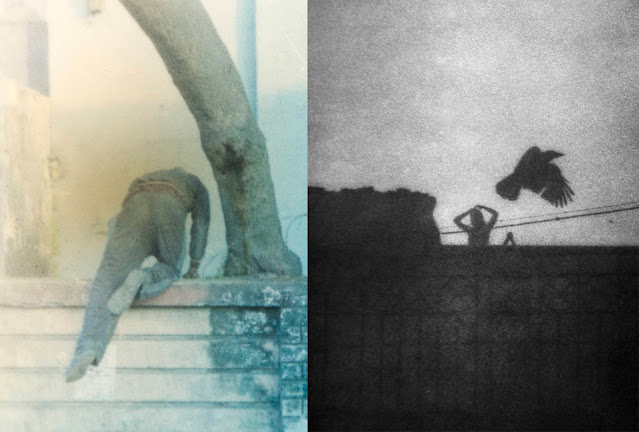
Passenger by the Swedish photographer Martin Bogren is not a photobook you pass through like a small town on your way to the city. Published by Editions Lamaindonne, it is Bogren’s tenth book. It comprises fifty photographs taken in Kolkata (formerly Calcutta), the capital of India’s West Bengal state, during three winters from 2018 to 2020. This is a book for a longer linger, like that place you stopped at years ago that still holds a piece of you. It’s a book of blur and grain, loose light and shy shadows that make it seem like life is passing you by at the speed of photography.

If you enjoy clear, sharp, formal, frontal photographs this book may not appeal. Bogren prefers haze, patina, silhouettes, twinning, glares and many shades of grey. Not everything that Bogren points his camera at is immediately recognizable. At times, he is awkwardly or bluntly close, at others wistfully distant.


Kolkata is a large and vibrant city of contrasts and contradictions. Bogren overlooks the large and vibrant in favor of the latter. He embraces contrast both through technique and metaphor. His images show bodies climbing, resting, embracing, reaching or waiting. Jackdaws making eye contact with people and each other. Shoes, hats and hangers waiting for action. Absence of the female body in this book is palpable. In Bogren’s words, “what came to me after a while was a story about men, boys, old men, kids and youths, all in a quite sad and solitude context [sic] in the lack of women or female energies.”

Bogren’s images are out-in-the-open secrets that might otherwise go unnoticed. They remind me of those in Nancy Rexroth’s Iowa, published in 1977, taken in southeastern Ohio with a toy camera. They share similar aesthetics and a sense of being everywhere and nowhere at once. Both photographers turn place into a sequence of emotional states. The pacing of the images emphasizes their psychological quotient.

When we’re a passenger, our body occupies another body, that of a vehicle. When we photograph, the camera is a body we ‘drive’ and control. Yet a single photograph can surprise by asserting influence and control over us. It can transport us and take us for quite a ride. There are two images I had to know more about, and Bogren kindly shared with me the details in an email exchange. The first is a black-and-white image taken in the morning at a railway station. It depicts a body waiting to be removed and thus covered. The second is the remains of a clay sculpture-idol at the edge of a river. The day I am writing this review, on the front page of The New York Times is a photograph of the body of a Russian soldier near Kharkiv, Ukraine. Much has been written about the tensions, paradoxes and accountabilities of looking and seeing bodies. I highlight these images because regardless of treatment — in Bogren’s case with seductive soft focus — it’s essential to be an informed, ethical and constructive viewer of images of all bodies (whether alive or deceased). Which takes me back to being a passenger and how for some, it’s uncomfortable because they feel vulnerable and exposed. We have a responsibility to be so much more than passengers in all that we look at, and all that we photograph.


I can’t think of the word ‘passenger’ without thinking of the singer Iggy Pop. I think of him now in context of Bogren (whose first book The Cardigans, Been It was published in 1996 after several years touring with the band). Both artists composing on-the-spot, Pop in the studio, Bogren on the streets of Kolkata. Let’s take a ride and see what’s mine, whirrs Pop. This applies to Bogren’s work. No photograph we take is ever ours alone. Whenever we photograph we intrude and we must question not only if we’re doing it with respect and grace but why we are photographing at all. I am the passenger, I stay under glass. Bogren is a passenger, looking through the glass of his lens while also free from it. What does he see? Take a ride with Passenger and look.

Purchase Book

Read More Book Reviews


Odette England 
is a photographer and writer based in Providence, Rhode Island and New York. Her work has been shown in more than 100 museums, galleries, and exhibition spaces worldwide. She has two photobooks out this year: Dairy Character, winner of the 2021 Light Work Book Award; and Past Paper Present Marks: Responding to Rauschenberg, her collaboration with Jennifer Garza-Cuen, which received a $5,000 Rauschenberg Publication Grant.
Book Review Dairy Character Photographs & Text by Odette England Reviewed by Brian Arnold "In Dairy Character, by Odette England published with Saint Lucy’s Books, the artist probes similar metaphors as she reflects on her own childhood spent on a dairy farm in Australia. The book offers an experimental approach to photography while providing text for a personal story about social power, repression, rebellion, and self-actualization..."

Dairy Character. By Odette England.
https://www.photoeye.com/bookstore/citation.cfm?catalog=ZJ909
Dairy Character
Photographs & Text by Odette England

Saint Lucy Books, US, 2021. 188 pp.

“Dairy farmers wanted female calves from their annually pregnant heifers. These calves, The Glorious Girls, were tendered with care and, as soon as they were stable on their hooves, photographed by men; men only. Dad documented every female calf born on his farm using his Polaroid camera. The calf, always front and center, always looking her best.... Bull calves were a disappointment. Unwanted and unworthy of photography...In contrast, farmers wanted their regularly pregnant wives to give them sons, to work on the farm and inherit its land and herds. Daughters, pretty distractions, were inconvenient.”

“Mum cooked, I helped. Conforming behavior. Mum didn’t so much as teach me as she did ‘perform woman.’ I was expected to take notice, note The Obligations, follow her lead. Which wasn’t her lead at all. Mum was being led, down the proverbial garden path, around the show-ring, led by an invisible rope that I didn’t know existed until years after leaving the farm. She was tied, tied to the farm as wife.”


— Odette England, Dairy Character


In his brilliant novel The Hamlet, William Faulkner describes a scene in which Ike Snopes, the “idiot,” tries to have sex with a cow. Ike, described as a “man-child,” had already imagined a romantic relationship with the cow throughout the book before he tried to consummate his love in a scene that Faulkner depicts as equally tragic, hilarious, compassionate, poetic, and gorgeous. As it develops, Ike’s libidinous intentions are thwarted when the cow shits all over him. In the astute, modernist imagination of Faulkner the scene takes on mythic proportions, and he uses it as a way to decode power structures and gender roles in the American South. In Faulkner’s mind all of us are some form of Ike or the heifer, our expectations for life always thwarted by imposed expectations, roles and our sexuality.

In Dairy Character, by Odette England published with Saint Lucy’s Books, the artist probes similar metaphors as she reflects on her own childhood spent on a dairy farm in Australia. The book offers an experimental approach to photography while providing text for a personal story about social power, repression, rebellion, and self-actualization.

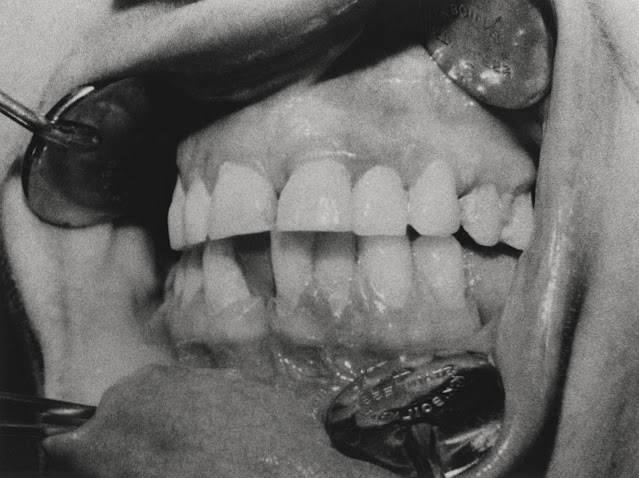
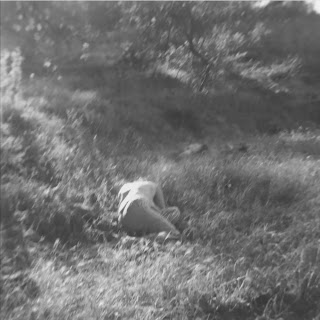
There are essentially three different types of photographs England utilizes for developing her narrative: Her own pictures, made with an exceptional black-and-white palette, are a mixture of close-up photographs an androgynous looking child’s skin and those she made on trips back to the family farm. She also includes archival photos and snapshots made during her childhood, both family pictures and Polaroids made by her father to document the farm. Most surprisingly, she inserts crudely processed photographs from an old manual published to help dairy farmers — enlargements of udders and other body parts. Similarly, the book itself is divided into three distinct sections, in a sort of A-B-A structure, with a section of photographs, followed by a written narrative in which England provides a recounting of her childhood through fragments of letters from her mother juxtaposed with her own reminiscence about life on the farm, and finally another selection of photographs.

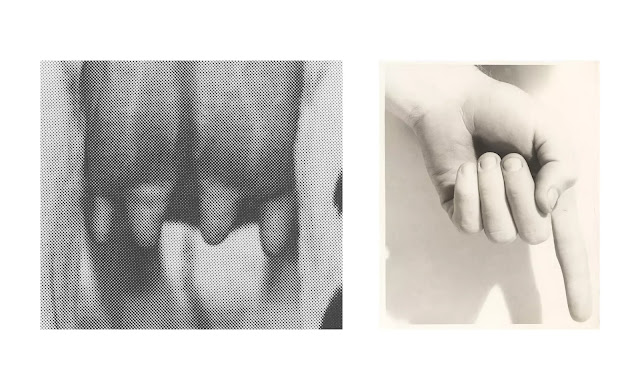
In her first book, Keeper of the Hearth: Picturing Roland Barth’s Unseen Photograph, England demonstrated tremendous strength through her sensitivity in juxtaposing images. Typically combined to highlight formal or compositional similarities, she evokes complex questions and ideas by placing pictures side-by-side, coaxing new meaning from the images. A clinched hand with a finger pointing has tremendous visual similarities with a cow’s udder, the exposed wires of a ceiling light similar to a girl’s hair cascading down her back, or a shadow across a child’s chest like a bird’s wings in flight. Each of these juxtapositions help articulate an essential part of England’s narrative about conflicts involving gender identity, cultural expectations and self-determination.

Throughout her text, England talks about the role photography played within her family and life on the farm, hinting as to why she found a voice with the medium. For her father, the camera was a way to document The Girls, the heifers he prized as his legacy and livelihood. For her mum, it was a way to document family life, and also why she is always absent from the pictures, an important metaphor in England’s narrative: “She is the working photographer, the front-of-the-of-house, the cook — never the chef — the waitress, the dishwasher. Her presence is there in other ways, other ways made visible to her camera. Without these ways, mum is lost to memory. Lost to labor. Lost to wife.” Recognizing these patterns and the power of photography, England found a new space in between these predetermined roles, taking control of the camera to define her own presence (in resistance to her mother’s absence), and to define her own gender identity (in response to the patriarch’s expectations).

England uses text very much like she does photographs, juxtaposing fragments to piece together larger ideas. The bulk of the text section is composed by short recollections of England looking back on her childhood. These recollections are short, and typically focus on patterns and expectations presented to her as a child — clearly delineating the expectations of men and women on the family farm — while also emphasizing roles each of them played in her family drama. Her father oversaw The Girls and the family’s economic livelihood, while her mother kept the home and raised the children.
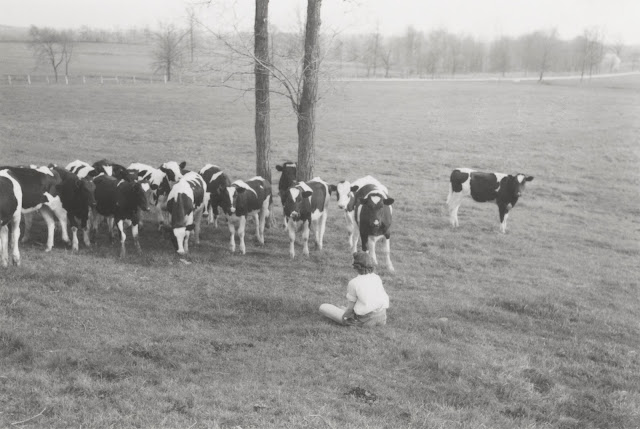

Within these memories, England articulates a conflict she felt about all this early in life, constantly labeling her own behavior as “conforming” or “nonconforming.” Interspersed among these childhood recollections are letters, presumedly sent to England by her mother but always signed “Mum & Dad.” The inclusion of these letters cements the basic ideas at the heart of the narrative, reminding her of the duties, hierarchies, and expectations that shaped her early life, all defined by her sexual body.
The design of the book is simple and effective. The cover images beautifully anticipate the narrative to come, with the front showing a detail of human skin, folded and creased like a contorted body, while the back shows a disembodied hand squeezing a cow’s hide, together pointing out awkward, utilitarian, and commodified bodies. The book uses two different colors of paper to add the flow of the narrative, the two large sections of photographs printed on a bright white stock and the text on a pale pink. This use of color seems obvious in creating a narrative about gender, but also refers to a childhood memory in which England wanted to paint her bedroom a lovely shade of pink. I must confess to finding this use of paper the least successful part of the book, Odette’s narrative is much too good to use such a simply conceived metaphor.
In recent years, Odette England has revealed herself as an extremely versatile, ambitious, and interesting artist, a force to be reckoned with in contemporary photography. Her three recent books — Keeper of the Hearth: Picturing Roland Barth’s Unseen Photograph, Dairy Character, and Past Paper//Present Marks: Responding to Rauschenberg — all demonstrate different approaches to photography, and all have tremendous visual acĂșmen. Dairy Character is the most overtly autobiographical of these works (though all art is autobiographical). It relates the story of a woman of enormous character and strength, who has overcome backwards expectations on a path to self-realization, while also reminding us of the tremendous power of photography as a tool for creating and subverting expectations.

Purchase Book

Read More Book Reviews


Brian Arnold
is a photographer, writer, and translator based in Ithaca, NY. He has taught and exhibited his work around the world and published books with Oxford University Press, Cornell University, and Afterhours Books. Brian is a two-time MacDowell Fellow and in 2014 received a grant from the Henry Luce Foundation/American Institute for Indonesian Studies.