PHOTOBOOK REVIEWS, INTERVIEWS AND WRITE-UPS
ALONG WITH THE LATEST PHOTO-EYE NEWS

Social Media

Showing posts with label Brian Arnold. Show all posts
Book Review Weegee: Society of the Spectacle Photographs by Weegee Reviewed by Brian Arnold "Currently on view at the ICP in New York is Weegee: Society of the Spectacle (Jan. 23-May 05, 2025). Incredibly, this is the 6th exhibition dedicated to gruff tabloid photographer; this is in part due to a recent donation to the museum of Weegee’s work by his partner Wilma Wilcox. I haven’t seen the show, but the catalog, published by Thames & Hudson, offers an interesting survey of the curiously unique vision of Weegee..."

https://www.photoeye.com/bookstore/citation.cfm?catalog=TH182
Weegee: Society of the Spectacle
Photographs by Weegee
Thames & Hudson, London, United Kingdom, 2025. 208 pp., 130 black-and-white illustrations, 8¼x10½x1".

"I was stuck, you see, because I didn’t want to do sort of a normal English broken German accent thing, so on the set was a little photographer from New York, a very cute little fellow called Weegee. You must have heard of him. And he had a little voice…And I got an idea…I put a German accent on top of that, and I suddenly got…him into Dr. Strangelove. So really, it’s Weegee."

— Peter Sellers

Currently on view at the ICP in New York is Weegee: Society of the Spectacle (Jan. 23-May 05, 2025). Incredibly, this is the 6th exhibition dedicated to gruff tabloid photographer; this is in part due to a recent donation to the museum of Weegee’s work by his partner Wilma Wilcox. I haven’t seen the show, but the catalog, published by Thames & Hudson, offers an interesting survey of the curiously unique vision of Weegee.

Born in 1899 in the Austro-Hungarian city of Lemberg (today part of Ukraine), Usher Fellig emigrated to the United States in 1913. Upon entry, his name was changed to Arthur Fellig. After teaching himself the basics of photography on his own, Fellig started his professional career as a photographer in 1918, working as both a darkroom technician and a reporter. The work he became most known for began around 1935, when he was a full-time freelance photojournalist. It was around this time he changed his name to Weegee, a homonym for Ouija, because as a reporter he claimed to be clairvoyant, always knowing just where to be as the action started. Working primarily for a leftist-leaning tabloid called PM Weekly, the photographer created an entirely unique archive of crime and other activities in New York City from Prohibition and through World War II.


His news photography might best be described as proto-noir, reportage from the streets of America’s biggest city that looked like stills from the greatest film noir (is it just me, or did Weegee look a little like Edward G. Robinson?), made over a decade before Hollywood co-opted the style. Pioneering the use of flash, the photographer created a unique view of the streets with harsh lighting and deep blacks, making life in New York appear like an existential abyss. Never defining himself as political, Weegee nevertheless created a powerful vision about class in America by frequently giving voice to working-class life in the city. The PM Weekly did define itself as a progressive magazine, a label the photographer denied, but then again, he was also connected to Sid Grossman and the Photo League (where he had his first exhibition). All this work coalesced into his first monograph published in 1945, Naked City, a relentless and raw look at New York composed with over 230 pictures.


Not long after Naked City, Weegee moved to Los Angeles and started what is now referred to as his second period as a photographer. It’s easy to imagine that the work he did in New York took a huge toll — witnessing so much pain and tragedy can never be easy, combined with the demands of running all his own production and business must have been exhausting. In California, he took his pictures in an entirely different direction and focused more on using the darkroom to define his pictures. He photographed many famous people of the day — Ronald Reagan, Mao Tse Tung, and Jackie Kennedy among them — and printed them by projecting the negatives through warped or frosted pieces of glass, prisms, and even condensers from his enlargers, making them all appear as slightly surreal caricatures (apparently Szarkowski hated this work and saw it as a joke, a complete waste of the photographer’s talent).


Weegee: Society of the Spectacle
is an accessible book that offers a clear, engaging introduction to Weegee’s work, not prioritizing the New York years over California. The pictures are divided into neat, thematic chapters, pointing to major trends and periods in the photographer’s career, each introduced by a quote by Weegee accompanied with a short passage explaining the selection. The contributors include Clement Cheroux, Cynthia Young, Isabelle Bonnet, and David Campany. Cheroux introduces the book and exhibition by presenting the idea that Weegee’s work anticipated Guy Debord and the Situationists International, the French artists that emerged in the 1960s. Like the SI, Weegee challenged our understanding of what cities represent, and, like Debord, understood the importance of the media in defining the urban condition (it’s likely Weegee and Debord never heard of one another). Bonet, a specialist in crime photography, offers insight into the emergence of crime scene photography, both regarding the tabloids and the development of forensic investigation techniques. Campany acknowledges the last major body of work Weegee developed while working on the set of Dr. Strangelove. Director Stanley Kubrick met Weegee early in his career; before he went to Hollywood, he worked as a news photographer in New York City. Kubrick loved Weegee’s work, even noted it as an essential influence, and felt it would be interesting to have him on set. He gave Weegee a unique role, he had already hired two other photographers to provide the studio production stills so the master was allowed to do as he pleased. Kubrick thought the harsh style Weegee developed would be refreshing compared to the more slick and polished pictures the studio wanted. And apparently the photographer really hit it off with Peter Sellers, even influencing the actor’s interpretation of the film’s main character, the Nazi scientist advising the Pentagon on nuclear strategy.


Weegee: Society of the Spectacle
provides a great introduction to the legendary photographer’s work. If one is really into collecting photobooks, there are certainly better examples of Weegee’s to be had (primarily Naked City, there are multiple printings of this book), but Society of the Spectacle offers a comprehensive, approachable overview of the photographer’s work, and thus it seems it was really intended as a souvenir for the exhibition rather than as a unique expression of the photographer’s work.

Purchase Book

Read More Book Reviews


xxx

Brian Arnold
is a photographer, writer, and translator based in Ithaca, NY. He has taught and exhibited his work around the world and published books, including A History of Photography in Indonesia, with Oxford University Press, Cornell University, Amsterdam University, and Afterhours Books. Brian is a two-time MacDowell Fellow and in 2014 received a grant from the Henry Luce Foundation/American Institute for Indonesian Studies.
Book Review Record 2 Photographs by Daido Moriyama Reviewed by Brian Arnold "The first book I got by Daido Moriyama was '71 New York, published by Andrew Roth and PPP Editions in 2002. This was a great introduction to the photographer’s work — the size and density of a brick, the book is a relentless barrage of photographic dissonance showing a life on the brink..."

Record 2 by Daido Moriyama.
https://www.photoeye.com/bookstore/citation.cfm?catalog=TH167
Record 2
Photographs by Daido Moriyama
Thames & Hudson, London, United Kingdom, 2024. 352 pp., 270 illustrations, 8¼x11".

The first book I got by Daido Moriyama was '71 New York, published by Andrew Roth and PPP Editions in 2002. This was a great introduction to the photographer’s work — the size and density of a brick, the book is a relentless barrage of photographic dissonance showing a life on the brink. The rich, grainy black-and-white pictures describe a hunter on the prowl — not for game, but for an understanding of the phenomenology of being and day-to-day life in New York. The pictures also struck me as the work of an outlaw; the first time I paged through '71 New York, I felt I could smell the whiskey, cigarettes, and hypo. When Moriyama went to New York in 1971, he didn’t speak English, and spent his days just as you would imagine, making hundreds of pictures of life on the streets. He must have stayed up all night processing his pictures, because he also made a series of books of his daily musings, xeroxing his darkroom prints to make cheap and crude reproductions, bound collections of photographs (though I might prefer anti-photographs) that he gave away to people he met during his stay. PPP Editions revisited these pictures, making a beautifully produced book that epitomizes Moriyama’s vision.

The second Moriyama book I got was Memories of a Dog (Nazraeli Press, 2004), a collection of essays the photographer wrote in the 1980s for Asahi Camera, a series he conceived as a regular contributor to the magazine. Each issue Moriyama provided short text/image documents that portrayed his wanderings across Japan. The essays were largely written on his train rides before and after the shoots, juxtaposed with pictures made on location. Memories of a Dog shares just the essays, understanding that they are great pieces of photographic literature in and of themselves. Indeed, I was surprised the first time I read it because I was imaging something rough like his pictures, but instead found some deep, reflective thinking about the nature of photography, place, and memory.


I still consider both these books among my favorites today; from the beginning I’ve loved the raw, anti-photography sentiment in ’71 New York — really all his early work — and the surprisingly reflective, patient, and articulate voice found in Memories of a Dog. Together they show what I’ve learned most from Moriyama, to pursue photography in a way that is raw, relentless, and aggravated, like an assault but tempered by a reflective and emotional intelligence.


The new book from Thames & Hudson, Record 2, reproduces a series of self-published magazines called Record that Moriyama produced between 2016-2020, issues #31-50. Each issue starts with a short piece of writing and is then followed by pictures that represent the time between the publications. In many ways, Record 2 represents so much of what I’ve come to love about the photographer’s work — dark and gritty pictures made with insatiable hunger. This compendium is beautifully produced — bound with a slipcase, the pages are rich, glossy black-and-white images, each one offering another complex, passionate photograph. I remember seeing some of the original printings of Record at Dashwood, so feel confident in saying the Thames & Hudson edition provides a lovely interpretation of the work. It is made with the same glossy production values, bound in a way that makes it a substantial, definitive archive of the artist’s work, but still represents the quick and urgent feel that embodied the xeroxes in New York City. That feel, the sense of urgency, is a lovely characteristic of Moriyama’s work, and it is an achievement to make such a prestigious, highly-produced monograph that maintains that sensibility.


My favorite part of Record 2 is the writing. The pictures are superlative, no doubt, but there is something so rigid and stylistic about Moriyama’s approach. The short texts, however, have an informal, conversational appeal, like he’s talking to you on the train. In them we witness Moriyama reflecting on ideas developed during his friendship with Takuma Nakahira; things he learned from Bruce Davidson, Eikoh Hosoi, Nobuyoshi Araki, and Eraserhead; the COVID lockdown; and receiving the Hasselblad Award. These things clarify Moriyama’s achievement for me; he was a street photographer who made Winogrand look lazy, constantly making pictures in a dark gritty manner while watching life unfold on the streets of Japan from post-war reconstruction through the ambitious expansion of the 1970s, its emergence as a global economic force in the 1990s, and into the age of data. Throughout it all, he maintained a restless, independent voice, and created a photographic vision that feels as raw as The Ramones and as wise as Zen.


Thames & Hudson is creating a multivolume series chronicling Record. I’ve only seen this second installment, but I am eager for more. If you really want to explore Moriyama’s writing, I still recommend Memories of a Dog, and if you are new to his work, I’d really encourage you to find his earlier books. Nevertheless, Record 2 is another testament to the mastery and depth of the photographer’s work and accomplishments.

Purchase Book

Read More Book Reviews


Brian Arnold
is a photographer, writer, and translator based in Ithaca, NY. He has taught and exhibited his work around the world and published books, including A History of Photography in Indonesia, with Oxford University Press, Cornell University, Amsterdam University, and Afterhours Books. Brian is a two-time MacDowell Fellow and in 2014 received a grant from the Henry Luce Foundation/American Institute for Indonesian Studies.
Book Review Sons of the Living Photographs by Bryan Schutmaat Reviewed by Brian Arnold "There are some things about this man that I feel that I know, but it’s hard to say since I’m not given much context for the photograph. There is no date, location or name. It shows a white(ish) man seated on a sidewalk, his sandaled feet spilling out into the gutter. He leans back against a shuttered building, plywood and corrugated tin covering the windows..."

Sons of the Living by Bryan Schutmaat.
https://www.photoeye.com/bookstore/citation.cfm?catalog=ZK627
Sons of the Living
Photographs by Bryan Schutmaat
Trespasser, Austin, TX, 2024. 188 pp., 90 tritone plates on uncoated paper, 11¾x14¾".

        But when I pass through the pearly gate
        Will my gown be gold instead?
        Or just a red clay robe with red clay wings
        And a red clay halo for my head?

                                                    — Gillian Welch

There are some things about this man that I feel that I know, but it’s hard to say since I’m not given much context for the photograph. There is no date, location or name. It shows a white(ish) man seated on a sidewalk, his sandaled feet spilling out into the gutter. He leans back against a shuttered building, plywood and corrugated tin covering the windows. His body sits effortlessly, looking both powerful and relaxed. He’s a hardworking man with rich golden skin, and it feels clear he’s earned his living in the desert landscape of the American Southwest — a deep, dark complexion cultivated under a relentless sun and layers of red sand. Despite his obvious strength, he also looks very awkward. His crown is a pale, Aryan complexion, kept white and clean by the Stetson he wore out in the field. He reminds me of John Grady Cole, the protagonist in the brilliant Cormac McCarthy novel All the Pretty Horses. To be clear, I remember American landscape painter Richard Thompson once telling me what the film adaptation got wrong; Richard was convinced that John Grady Cole, the handsome and romantic hero, would have a tan line from his hat around the circumference of his head on account of him riding the southwest deserts for weeks, always wearing his dirty and sweat-stained hat. It’s a little less picturesque than Matt Damon’s portrayal of the character, but it might also provide an important metaphor for understanding John Grady, crowned with a halo made from the unforgiving desert sands.


I found this photograph in Sons of the Living, the new, much adored book from Bryan Schutmaat and Trespasser Books. Sons of the Living is a richly visualized, harsh and romantic story about the people and landscapes found in the deserts of the American West. I’ve never really been to Texas — Schutmaat’s homeland and muse — but I have spent a lot of time in the backcountry of Colorado, Utah, and New Mexico, so think I have good feel for the people and places he photographed. The deserts of the American Southwest are as gorgeous as they are brutal, full of red hills, sage brush, ancient canyons, powerful oil and mineral industries, and an unlikely assortment of outsiders lost along its highways. Schutmaat continues to work in black-and-white, view camera photography, and does not shy away from portraying his deep love for traditional depictions of the region. Indeed, many of his photographs feel like deliberate references to masterpieces by Timothy O’Sullivan, Laura Gilpin, Georgia O’Keefe, and Robert Adams. I would describe Sons of the Living as a loving, tragic, and poetic rendition of the last American frontier, a harsh and broken landscape full gorgeous views and broken dreams.


Schutmaat builds his narrative by mixing photographs of desert vistas (many focusing on highways and trains — both essential for understanding westward expansion) with portraits of people he met during his travels. The landscape photographs are very classical — a train trestle spanning a river gap, the elegant curve of a highway traversing the rolling hills, and storms brewing along a distant horizon (beautifully reminiscent of some platinum pictures by Laura Gilpin) — and clearly articulate the place. The portraits offer an interesting cross-section of characters — workers, drifters, outlaws, and mystics — all revealed as desperate seekers on a lost highway, depicted with remarkable clarity and empathy. Together these pictures present a haunting perspective on the American frontier in the 21st century, Manifest Destiny when the oil wells are dying and the mines abandoned.


To better understand Schutmaat’s photos, I again want to circle back to Cormac McCarthy. I know it’s bad timing to evoke McCarthy, after the recent articles in Vanity Fair and the New York Times, but like Willa Cather and Robert Adams, I think of him as one of the great artists of the American West. This time I want to reference his character Billy Purnam, the protagonist of The Crossing, the brilliant sequel to All the Pretty Horses. The Crossing is ultimately a novel about living with trauma. Early in the story, Billy befriends a wild wolf by nursing her back to health. McCarthy creates the feeling that this is the most nurturing and loving relationship Billy has known, making it so incredibly devastating when he kills her himself, shooting her in the head after she loses a brutal dog fight. Soul beaten, Billy spends the rest of the novel riding horseback along the Texas-Mexico border, following a string of chance encounters with mystics and drifters who teach the wounded man how to live with trauma. When I page through the pictures in Sons of the Living, I feel a similar narrative to those found in McCarthy’s novels — a story about a poet, loner, and outlaw at home among the wanderers of the desert Southwest.

Purchase Book

Read More Book Reviews


Brian Arnold
is a photographer, writer, and translator based in Ithaca, NY. He has taught and exhibited his work around the world and published books, including A History of Photography in Indonesia, with Oxford University Press, Cornell University, Amsterdam University, and Afterhours Books. Brian is a two-time MacDowell Fellow and in 2014 received a grant from the Henry Luce Foundation/American Institute for Indonesian Studies.
Book Review Manifest | Thirteen Colonies Photographs by Wendel A. White Reviewed by Brian Arnold "Thinking about Zora Neale Hurston is a great entry for looking at the new work by photographer and academic Wendel A. White, Manifest: Thirteen Colonies. Like Hurston, Wendel developed his work with both the discipline and insight of an academic anthropologist and the skill and wisdom of an artist (some histories are better told in metaphors)..."

Manifest | Thirteen Colonies. By Wendel A. White.
https://www.photoeye.com/bookstore/citation.cfm?catalog=RB005
Manifest | Thirteen Colonies
Photographs by Wendel A. White
Radius Books, Santa Fe, NM, 2024. 298 pp., 235 images, 9½x11¾".

“Ah was wid dem white chillun so much till Ah didn’t know Ah wuzn’t white till Ah was round six years old. Wouldn’t have found out then, but a man come long takin’ pictures and without askin’ anybody, Shelby, dat was the old boy, he told him to take us. Round a week later de man brought de picture for Mis’ Whasburn to see and pay him…

“So when we looked at de picture and everybody got pointed out there wasn’t nobody left except a real dark little girl with long hair standing by Eleanor. Dat’s where Ah wuz s’posed to be, but Ah couldn’t recognize dat dark chile as me. So Ah ast,’where is me? Ah don’t see me?’

“Everybody laughed…Mis Nellie, de Mama of de cillun who come back after her husband dead, she pointed to de dark one and, ‘Dat’s you Alphabet, don’t you know yo’ ownself?’

“Dey used to call me Alphabet ‘cause so many people had done named me different names. Ah looked at the picture a long time and seen it was mah dress and mah hair so Ah said:

“’Aw, aw! Ah’m colored!’

“Den dey all laughed real hard. But before Ah seen de picture Ah thought Ah wuz just like de rest.”

— Zora Neale Hurston, Their Eyes Were Watching God

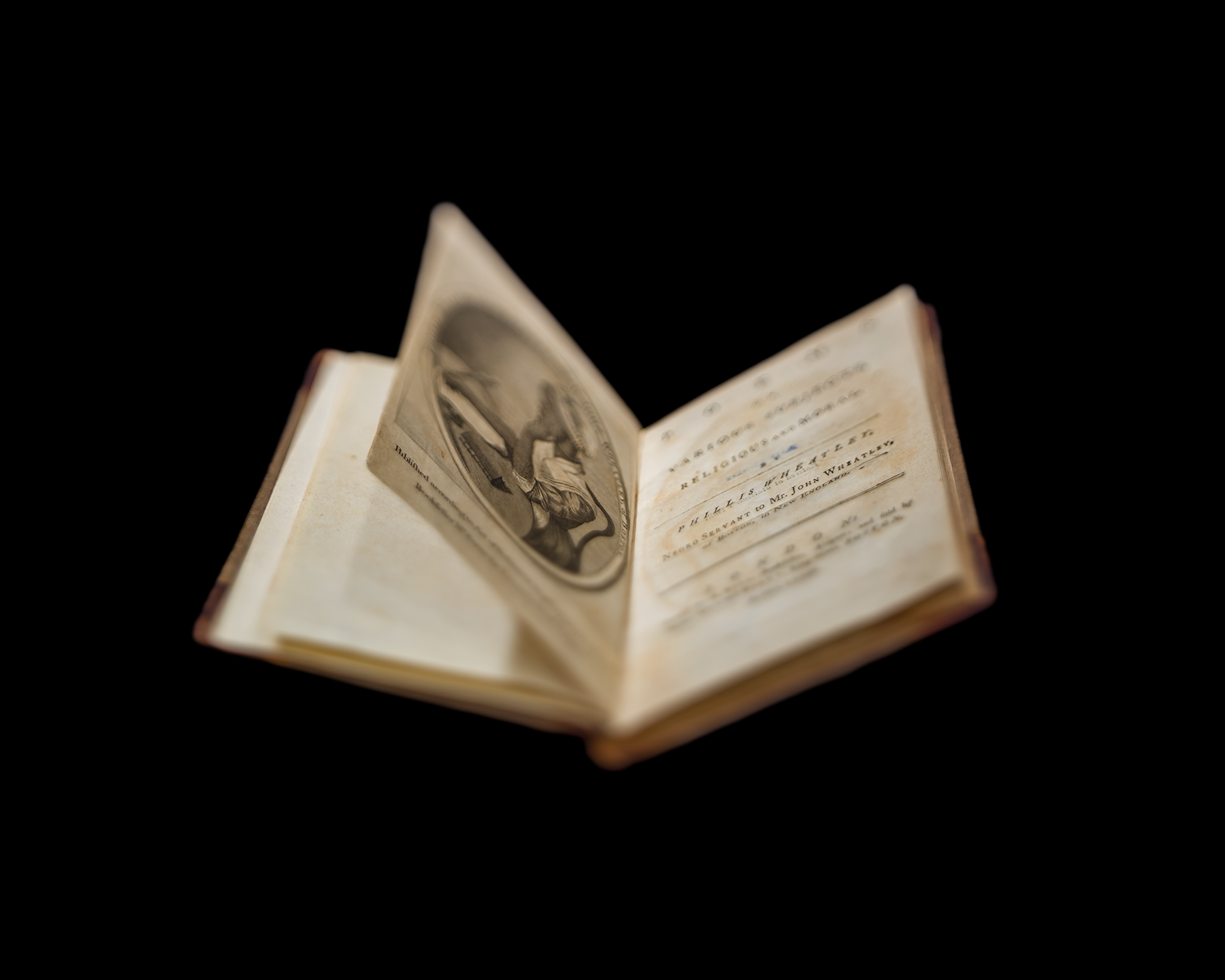
Memoir and poems of Phillis Wheatley, a native African and slave, 1834. Library of Virginia, Richmond, VA. By Wendel A. White

It’s safe to say Their Eyes Were Watching God by Zora Neale Hurston is a major literary accomplishment, a work whose merits are well understood and defined within the traditions of American literature. Despite that, I think Hurston is an underacknowledged writer and intellectual. After studying at Howard University, she received a scholarship to study Anthropology at Barnard with acclaimed professor Franz Boas. This was unprecedented, given that she started her graduate studies in 1925. After Barnard, in 1928, she continued her graduate studies at Columbia University, where she developed her field work on folklore in South Florida. In addition to her groundbreaking field work, Hurston also channeled a great deal of her anthropological studies into her art. Their Eyes Were Watching God was revelatory in so many ways, including her phonetic use of the colloquial language of former slave communities in the American South.

Baby Dolls, Kenneth and Mamie Clark, Smithsonian National Museum of African American History and Culture, Washington, DC, 2016. By Wendel A. White.

Thinking about Zora Neale Hurston is a great entry for looking at the new work by photographer and academic Wendel A. White, Manifest: Thirteen Colonies. Like Hurston, Wendel developed his work with both the discipline and insight of an academic anthropologist and the skill and wisdom of an artist (some histories are better told in metaphors). Manifest, both an exhibition at the Harvard Peabody Museum of Archaeology and Ethnology and a new publication with Radius Books, is a collection of photographs made in the archives of institutions found in the original 13 American colonies — New Hampshire, Massachusetts, Rhode Island, Connecticut, New York, New Jersey, Pennsylvania, Delaware, Maryland, Virginia, North Carolina, South Carolina, and Georgia. The photographs document the histories of slavery and racism as represented in collections and vaults across these states (plus Washington D.C.), and include early photographs of African Americans, slave collars and shackles, Civil Rights era paraphernalia, locks of hair, books, slave ledgers, combs, and simple tools. The pictures are composed with a rigid formalism, using some of the most basic elements of photography to create rich visual expressions and metaphors. The result is an incredible ethnology, full of clear descriptions of unique and telling objects, and created with a profound love of photography.

Tabletop Voting Machine, 1955. Delaware Historical Society, Wilmington, DE. By Wendel White

Published by Radius Books, the monograph Manifest: Thirteen Colonies is luscious. The pictures are printed glossy, but on matte black pages. The production shows a great attention to detail, with rich black tones (essential for this book) but without sacrificing luminance. It also includes essays by Ilisa Barbash, a curator of visual anthropology at Harvard; Cheryl Finley, an Art Historian at Cornell; Leigh Raiford, a professor of African American Studies at UC Berkeley; and White himself. Also reproduced are conversations with Deborah Willis, Brenda Dione Tindal, and White. These contributions are essential because they clearly situate White within a pantheon of elite academics and curators, those in positions that define history. They also help to fully articulate the significance of the archives and institutions that helped define race in the United States. The text, all printed on a soft, white paper, breaks the book into clear, digestible sections while also helping to guide our understanding of the pictures.

I do believe it is important to note the academic nature of Manifest: Thirteen Colonies, not as a qualitative assessment, but to better understand the intentions and visual vocabulary found in the photographs. This is also a clear distinction from Hurston, who deliberately developed her work in a more vernacular language. White instead presents his photographs with a rigid approach to studio photography, using basic attributes like light, depth of field, and an ambiguous, empty space to define his pictures.

Ambrotype of Frederick Douglass, Smithsonian National Museum of African American History and Culture, Washington, DC. By Wendel A. White

The cited passage from Their Eyes Were Watching God can offer deeper insights into White’s photographs and the archives where he found them. Hurston describes an incredible phenomenon that anyone working in photography must reconcile at some point (I believe a real study of the photographic history means looking at colonialism and slavery, both issues rooted in the early practice of the medium and too often ignored); photographs don’t show us difference, they create it. White’s voice is much more academic than Hurston’s, but still developed from the same idea. By working so proficiently within the institutional paradigm, he is able to document and undermine it, utilizing a new authority to tell stories and histories about the institutions that propagated and archived slavery, racism, and hegemony.

Purchase Book

Read More Book Reviews


Brian Arnold
is a photographer, writer, and translator based in Ithaca, NY. He has taught and exhibited his work around the world and published books, including A History of Photography in Indonesia, with Oxford University Press, Cornell University, Amsterdam University, and Afterhours Books. Brian is a two-time MacDowell Fellow and in 2014 received a grant from the Henry Luce Foundation/American Institute for Indonesian Studies.
Book Review För Photographs by Agnieszka Sosnowska Reviewed by Brian Arnold "One of my favorites in Robert Adams’s first book of essays, Beauty in Photography, is a piece called “Making Art New.” It’s a funny and playful essay written after paging through the latest copy of Artforum delivered to his front door in rural Colorado..."

För. By Agnieszka Sosnowska.
https://www.photoeye.com/bookstore/citation.cfm?catalog=ZK585
För
Photographs by Agnieszka Sosnowska
Trespasser, Austin, TX, 2024. 88 pp., 47 tritone plates, 11x13½".

“There is no progress in art, any more than there is in making love.”
— Man Ray

One of my favorites in Robert Adams’s first book of essays, Beauty in Photography, is a piece called “Making Art New.” It’s a funny and playful essay written after paging through the latest copy of Artforum delivered to his front door in rural Colorado. Adams ultimately feels that what defines new, at least by the magazine’s standards, feels a bit like a Sears Roebuck catalog selling the latest washer and dryer set. Contemporary art, Artforum tries to persuade him, is just like the newest mechanical technologies offering experience and luxury unlike anything before it; the latest trends in post-performancism are no different than the magic of this year’s wrinkle guard1. This way of thinking leads Adams to some important questions. What does new mean in art? What is the distinction between new and novel? Shouldn’t art aspire to a truth greater than novelty? Answering these questions, he concludes something different, and that the only “contemporary” that matters in art is whether it speaks to the current situation. Would anybody question that Shakespeare’s insights don’t still reflect on our societies and behaviors today? I do fundamentally agree with Adams; quality in art is not a metric based on technology or appearances but is really about the creator’s ability to reflect on the essential joys and struggles of life, to render truths that seem essential to our being and in a way that evokes empathy from its audience. Perhaps it is easiest to think of it this way: anyone falling in love for the first time is experiencing love as if it has never been experienced before, and thus it is a tale that never grows old.


When I spend time with För, the lovely new publication of photographs by Agnieszka Sosnowska published by Trespasser Books, it is easy for me to imagine the photographer taking similar inspiration from Adams’s essay. För is a laconic book, mostly pictures with very minimal text and presented in a clear and concise manner. The photographs are made with Graflex 4x5 (there are a couple of exceptions), and all in a classical, documentary style. The pictures in För, however, tell a rich story about love and pain, joy and loss, and are executed with emotional clarity and technical precision, rooted in a deeply personal connection to photography. Simply designed photographs made with traditional black-and-white values, Sosnowska demonstrates, can still convey the most essential attributes of being human today, which is ultimately what led me back to Adams. Her approach couldn’t be simpler — photograph the people and places she calls home with an equal affection for her subjects as she has for making photographs. Through the course of För, we see a small selection of people (presumedly family) leading a humble, pastoral life in the stark, harsh tundra of East Iceland. The pictures are simply developed but rigorously seen, and presented with a rich, open, and inviting black-and-white palette. The place she describes is harsh — I can almost feel the biting winds — but also full of warmth and love, days occupied by the beauty of vast landscapes, horses, imaginative children, and warm baths.


Given the minimal information offered in För, I did some inquiry into Sosnowska and learned she was born in Poland and lived most of her early life in Boston before settling in Iceland. The pictures in För are from her current home, or at least as what I understand as such, an unnamed place in East Iceland photographed between 2001-2021. I find this significant because when I look at Sosnowska’s photographs, it’s not only easy for me to see her tattered and highlighted copy of Beauty in Photography somewhere close by, but I can also imagine her as something of an exile, a stranger in a strange land where no place feels totally like home. Herein, I think, is the real impact of Sosnowska’s pictures — clear, affectionate photographs driven by a profound personal emptiness. Throughout För, there is an incredible tension between connection and isolation, a balancing act between loneliness and love.


Implied, I think, in Adams’s conclusions in “Making Art New” is patience. Anybody reading Shakespeare for the first time knows it’s not easy, and you must take the time to really understand his complex understanding of language and storytelling. Thinking of this photographically, I remember Frank Gohlke once telling me that if you make 7 good pictures in a year you should consider it a success. In the age of social media, we’ve totally lost sight of this, but composed over 20-years, För is a brilliant example of what can happen when you think of photographs this meticulously. Towards the end of “Making Art New,” Adams quotes both Man Ray — that idea that making love can only evolve so much — but also shares a lovely idea from American poet Robert Frost: “Poetry is like love. It begins in delight and ends in wisdom.” Any lasting love requires rigor and patience, and in my mind these ideas lead quickly to wisdom and empathy.

Purchase Book

Read More Book Reviews

1. Beauty in Photography was first published in 1981; the cover story in Artforum in October 1981 was “Post-Performancism” by Douglas Davis.


Brian Arnold
is a photographer, writer, and translator based in Ithaca, NY. He has taught and exhibited his work around the world and published books, including A History of Photography in Indonesia, with Oxford University Press, Cornell University, Amsterdam University, and Afterhours Books. Brian is a two-time MacDowell Fellow and in 2014 received a grant from the Henry Luce Foundation/American Institute for Indonesian Studies.