PHOTOBOOK REVIEWS, INTERVIEWS AND WRITE-UPS
ALONG WITH THE LATEST PHOTO-EYE NEWS

Social Media

Showing posts with label Blake Andrews. Show all posts
Book Review Sealskin Photographs by Jeff Dworsky Reviewed by Blake Andrews “In unsettled times like the present, we tend to see the past through rose colored glasses. Jeff Dworsky’s new monograph is a case in point. Sealskin is an idyllic view of his formative years..."

Sealskin by Jeff Dworsky
https://www.photoeye.com/bookstore/citation.cfm?catalog=ZK687
Sealskin
Photographs by Jeff Dworsky
Charcoal Press, Ohio, USA, 2024. 110 pp., 10x13".

In unsettled times like the present, we tend to see the past through rose colored glasses. Jeff Dworsky’s new monograph is a case in point. Sealskin is an idyllic view of his formative years. It’s kicked off with two serene images, a photo of a pink sea horizon looking east at dawn—rose colored, literally— followed by a candlelit portrait of Dworsky’s wife. Both photos are shot on Kodachrome 64 film, and the warm glow of slide transparency sends the reader wistfully back in time. That would be Maine circa 1980 in this case. But these pictures could be mistaken for the 1880s or earlier.

The time warp continues after the title page, with a passage from an old mariner’s fable about women morphing into seals. Its mythological hints are foreboding, its subtext unspoken: enjoy Eden while it lasts. As we plunge deeper into bygone Maine, our antediluvian antennas are tuned. Dworsky meets the moment with one rustic scene after another. Photos of a quaint harbor, fishing equipment, and weathered shingles epitomize daily village chores. These are the old ways, as practiced on the rugged Maine coast near Dworsky’s home. People are present on occasion, but they’re minor figures dwarfed by the landscape. Nature bats last here, at least until a reclining nude resets the mood. It’s Dworsky’s wife again, who appears in Sealskin more often naked than clothed. Defiantly unsealed, you might say.


Some supplemental backstory is helpful here, since none is included in the book. Young Jeff Dworsky originally settled in Maine as a teenager in 1971, a high school dropout from urban Massachusetts. He met his wife soon after, and they made their home on York Island. Dworsky worked as a fisherman in nearby Stonington, and together they raised a family in a Maine off-grid paradise. As described in the lyrical cadence of Charcoal Press, “he dug a well. Built a boat. Planted a garden. Set foundation stones. Built a house. Built traps. Raised sheep. He fathered three children.” Oh yes, there was one more activity. He routinely photographed his young family.


All was good until the late 1980s, when the Penobscot Bay region began to become gentrified by a moneyed class of new settlers. “I saw the Stonington I loved disappearing,” Dworsky remembers. His rose colored glasses were acting up. What was a simple young fisherman to do? He began to photograph his immediate world, hoping to memorialize it before it became too altered. He covered all the local towns, and within a few years he was shooting magazine assignments. Eventually, he ceased photographing Stonington in 1993, and retired from fishing in 2015. At some point, he separated from his wife and she left the island, her Selkie destiny fulfilled.


Throw this archive in a photobook stew, hit blend, and you get Sealskin. From an editing standpoint, it’s a mermaid of sorts, blending two congruent bodies of work: family pictures and social documentary. With no captions or dates to distinguish the strands, they weave together rather seamlessly. Domestic bliss blurs with harbor life, as pregnancy, birth, and toddlerhood alternate with lobster pots, oceanscapes, and crusty characters. The mix would be more jarring if the pictures did not feel apiece. But they do. For one thing, everything is viewed through the rearview mirror, and thus kept at arm’s length. It also helps that the book is shot with Kodachrome palette. The film’s amber glow is a unifying feature, soaking Sealskin in a calming radiance. Rub your fingers along the faux-leather cover and you’ll be lulled into reverie. All is well in the world. Or at least it was forty years ago.


If you’ve kept up with Charcoal Press, Sealskin’s central themes will be familiar. Jesse Lenz has played with old world motifs before. In fact, those rose-colored glasses are something of a Charcoal trademark, rooted directly in Lenz’s own life. His books The Seraphim and The Locusts capture various adventures on his family farm in rural Ohio, in circumstances much like old coastal Maine. Kids test themselves against the elements, wildlife is a constant presence, and earnest yeomen make their livelihood from the land, all set in a rural paradise. Charcoal’s Echo Mask, Gandras, and Dormant Season riff on similar themes, and Sealskin slots well into the catalog. “Jeff Dworsky embodies my ideal of an artist,” writes Lenz, “someone obsessed with living their life and making pictures as the byproduct.”


No one would doubt Dworsky’s work ethic. But it’s an open question how tightly the byproduct was crammed to fit the brief. “This one’s really Jesse’s book,” says Dworsky. “He can do whatever he wants, and that’s fine. But I’m going to do my own [expletive] books.” Hmm. Perhaps those are just the grumblings of a cantankerous fisherman? Dworsky doesn’t say what future books he has in mind, or how they might be edited differently, or who the publisher might be. As for the one at hand, it’s a pleasant time warp containing several stunning images. Compiled into a monograph with nostalgic and fabulist spin, Sealskin’s rose colored view might be just the tonic for our unsettled era.

Purchase Book

Read More Book Reviews


Blake Andrews is a photographer based in Eugene, OR. He writes about photography at blakeandrews.blogspot.com.
Book Review Failing Photographs by Mike Brodie Reviewed by Blake Andrews “While browsing his latest book Failing, my imagination turns to Mike Brodie in the initial stages of editing. Approaching forty, he’s got a lot of miles under his belt, most of them documented in photos. As he sifts through decades of various prints, his editing task is monumental..."

Failing by Mike Brodie.
https://www.photoeye.com/bookstore/citation.cfm?catalog=DU900
Failing
Photographs by Mike Brodie
Twin Palms Publishers, Santa Fe, NM, 2024. 412 pp., 193 four-color plates printed on uncoated paper, 8½x11".

While browsing his latest book Failing, my imagination turns to Mike Brodie in the initial stages of editing. Approaching forty, he’s got a lot of miles under his belt, most of them documented in photos. As he sifts through decades of various prints, his editing task is monumental. Luckily, he has some help in the form of an angel on one shoulder and a devil on the other. He picks up a print and contemplates. Hmm. The angel and the devil both whisper advice into his ear. He makes a judgment, puts the print into the Yes pile or the No pile, and then moves on to the next one.

I’m happy to report that Failing’s Yes pile was sizable. Almost 200 photos made the final cut, creating a book nearly two inches thick. As the title suggests, the devil on Brodie’s shoulder ultimately vanquished the angel. Perhaps that was an inevitable outcome for someone who approaches both photography and life as a sui generis outsider. Living a vagabond lifestyle, social conventions and niceties tend to feel less pressing. And after the somewhat genial mood of his recent publications Tones of Dirt and Bone and Polaroid Kid, perhaps Brodie felt the time had come to unleash his inner demons.

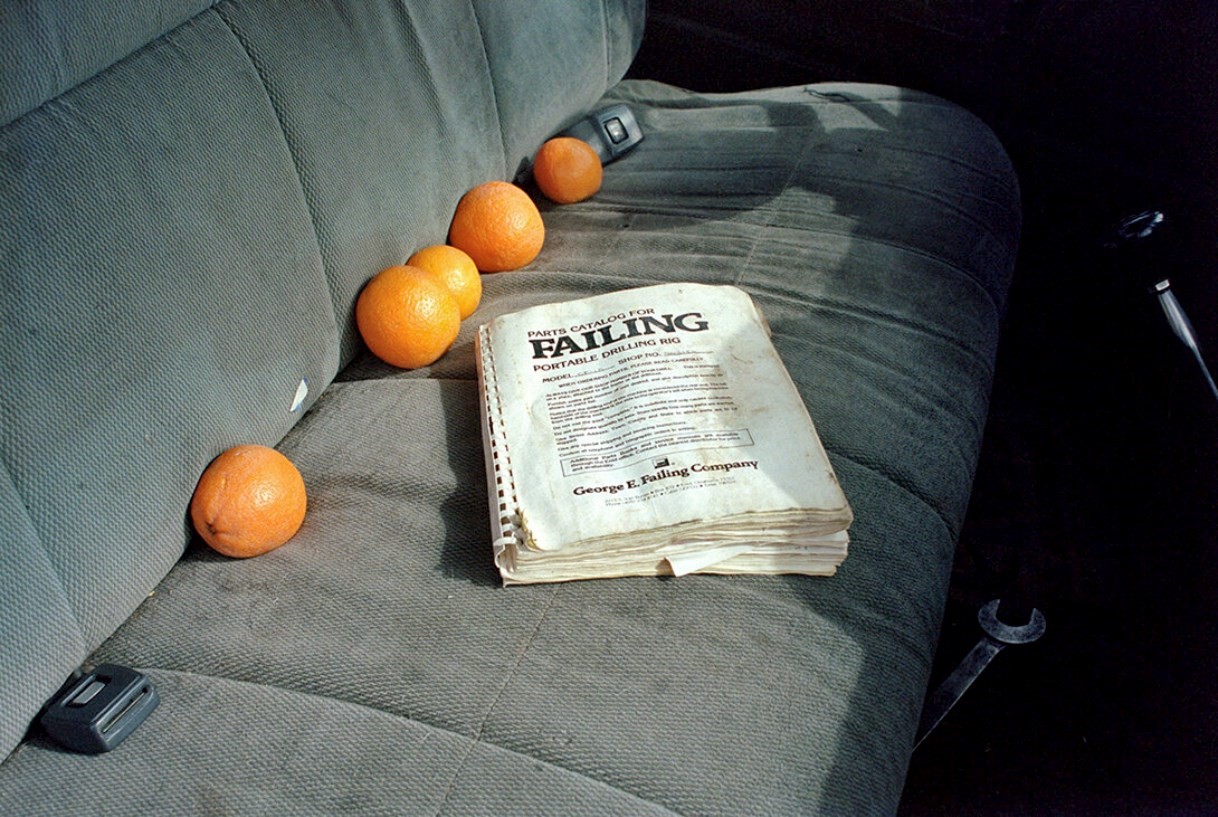
The result is his grimmest book to date. “Here is the flip side of the American dream, seen from within.” That’s how Twin Palms describes Failing, and they’re not wrong. Whereas A Period of Juvenile Prosperity merely hinted at darker currents, this one plunges headfirst into the deep end. The photos are by turns raunchy, crude, disheartening, passionate, filthy, and occasionally hilarious. I should add that they are also consistently interesting. If it’s any consolation to the angel, the book takes a while to claim its namesake (adapted from a photo of the George E. Failing drilling parts catalog which appears near the midpoint). For a short while in fact, the sequence seems headed away from failure. Then, like so many photographic truths, the effect is revealed as a mirage.


Brodie’s epic adventures are segmented into three chapters: The Beginning, The Middle, and The End, in rough order of declining fortune. Throw in a King James typeface and liturgical preface, and this dense tome assumes a near Biblical quality. Before Brodie’s fall from grace comes an image of innocence, in the form of two lambs nuzzling in a pen. What could be cuter? This initial photo is followed by more benign material, e.g. a McDonald’s meal with friends, a man jumping for joy under a rainbow, a baby snake, Brodie’s lovely wife Celeste, and their new home under construction in Nevada. Hitchhikers hop aboard smiling, while nature’s bounty is ripe for the picking. Even a potentially ominous array of shotguns shells is photographically defanged in soft amber twilight.


It seems life is good. But don’t get too comfy. The Middle chapter establishes a darker mood immediately with a photo descriptively captioned Makeup and Meth. There’s probably no quicker exile from the garden than that combo. The Middle soon spirals through even bleaker imagery by way of a burning truck, a dead dog in a box, Brodie’s divorce (represented by a discolored broccoli flower), and a previously intact moth, now photographed in pieces. An impressive double spread photo of a massive derailment offers a summary judgement of where this train is headed: belly up and busted. By the time Brodie shows us a bent heroin spoon and then his erect penis tucked into a steering wheel, we’re mostly past the shock stage. But still left wondering, who’s the dick driving this thing? And is anyone watching the road? Within a few photos comes an answer of sorts: a cloud of black diesel exhaust spewing into the sky. Any angels in the vicinity have long since scattered.


If the reader can’t imagine Failing getting more vulgar, the bottom falls out in the last (and longest) chapter. The End opens in explicit form with a bloody heart on a piece of cardboard. Has Brodie’s gone missing perhaps? How else would he present photos of a house fire, dead jackrabbit, staph infection, and used needles with such equanimity? Captured on a phone screen, the needles become a sharp verdict on Instagram, one suffocating addiction shared on another.

And then, well, it just gets worse. A dead chicken, anyone? How about a cat crawling with maggots, a pair of old dentures on the floor, or the filthiest toilet you’ve ever seen? A computer desk stacked with guns, white powder, and Monster cans? A used tampon on the ground? A quick trick in a dirty alley? A Playboy model covered in shit? The sequence passes through death and decay, with deceased roommate, dog, homeless man, and daughter in quick succession. All capped by — a true Biblical miracle — a pregnancy?! The growing belly in the photo belongs to Mia Justice Smith, Brodie’s former lover and travel companion. Tragically, she lost the baby and then her own life, in short order. The book is partially dedicated in her memory, with a considerate plug for Shatterproof addiction treatment.


The pregnant photo comes near the end. Perhaps it’s meant as a hopeful beacon, to signal salvation after a book of repeated failings. A nice thought, but it seems too little too late. It’s just a finger in the dike here, staunching a sea of depravities. Taken in sum, Failing is brutal. It rivals Joel-Peter Witkin for debauchery, and Dash Snow for hedonistic nihilism. But there’s good news: As with those two photo stalwarts, we cannot look away. If these various pictures hang on the verge of failing, they’re also damned good.

There are a few running motifs which help pace the book, and keep Failure moving forward. Every few dozen pages, the primary photo sequence pauses for a few full-bleed spreads of travelogue imagery. Many of these images are motion blurred, showing roads and fields in passing. Life moves fast. You have to grab it by the horns, or perhaps by the highway shoulder. Then it’s back into the main current.


Reiterated subjects create another layer of connective tissue. Brodie photographs the same subject over time, for example a baseball in progressively deteriorating circumstances, or his own grimy hand holding common objects. The Winnemuca Hotel is photographed intact, and then being torn apart. In another sequence, a childhood bedroom is rephotographed over the course of several months. As with the full-page spreads, the clock is ticking. Though this be madness, it seems to infer, yet there is method in’t.


That brings me to the great irony of Failing. The inside joke of this book, of course, is that Brodie is not failing. He’s seen more of backroads America than most other artists put together. He’s a prolific photographer, a former Instagram phenom, the author of four respected photobooks, a diesel mechanic, and one of the more sincere souls in the Machiavellian world of fine art. All while following his own muse. He’s an achiever, in other words. Based on initial word of mouth, Failing seems likely to enhance that reputation. Despite its coarse subject matter — or maybe because of it? — the book is a minor hit in certain art circles. If the critical reaction sustains, it should help cement Brodie as a success.

Purchase Book

Read More Book Reviews


Blake Andrews is a photographer based in Eugene, OR. He writes about photography at blakeandrews.blogspot.com.
Book Review Berlin on a Dog’s Night Photographs by Gundula Schulze Eldowy Reviewed by Blake Andrews “It’s been over thirty years since the reunification of East and West Germany. But some major GDR photographers are still woefully under-recognized in the West. Gundula Schulze Eldowy is a prime example..."

Berlin on a Dog’s Night by Gundula Schulze Eldowy.
https://www.photoeye.com/bookstore/citation.cfm?catalog=DU859
Berlin on a Dog’s Night
Photographs by Gundula Schulze Eldowy
Spector Books, 2024. 340 pp., 320 illustrations, 8½x10¾x1¼".

It’s been over thirty years since the reunification of East and West Germany. But some major GDR photographers are still woefully under-recognized in the West. Gundula Schulze Eldowy is a prime example. Born in Erfurt in 1954, her career roughly straddled the forty-year lifespan of East Germany, before continuing into the present via Japan, Moscow, Turkey, New York, Bolivia, and other destinations. Even today as a septuagenarian, she remains a globetrotting whirlwind who has never stopped moving. Wiki lists her current residence as “Berlin and Peru”. Did I mention she once discovered an unknown shaft in the Great Pyramid of Egypt? Or that she is an accomplished poet? Or befriended Robert Frank in the 1980s?

Schulze Eldowy’s restless spirit manifested from an early age. After settling in East Berlin in 1972, she traveled extensively behind the Iron Curtain during the seventies, a camera always at her side. Gradually her energies galvanized around her adopted home city, where she probed the local alleys, evenings, and residents. Her gritty b/w photographs of Berlin’s underbelly were eventually compiled into the multi-year project Berlin in einer Hundenacht, which translates to English as Berlin on a Dog’s Night.


Published as a book in 2011 by Lehmstedt Verlag, Berlin on a Dog’s Night made a minor splash in America and Europe. It remains her signature work, and if you know her photos at all, it is likely through this monograph. Unfortunately, as happens too often with first edition photobooks, it has fallen out of print and become relatively hard to find. Meanwhile, a belated wave of interest in GDR photographers has been gaining steam, cresting at Rencontres d'Arles with the group exhibition Restless Bodies: East German Photography 1980-1989, curated by Sonia Voss in 2019. Gundula Schulze Eldowy was one of several legendary elders included, along with Ulrich Wüst, Gabriele Stötzer, Ute Mahler, and many more.

The timing feels ripe for rediscovery, and Spector has jumped on the moment with a new edition of Berlin on a Dog’s Night. It’s a handsome grey hardback, dense with more than 300 pages of b/w photos. The fusty original cover image has been replaced with bold yellow lettering, and the original contents supplemented with dozens of extra photos. In addition to Berlin on a Dog’s Night, there are short selections from other projects. We’ll get to those in a moment, but first the title series, which occupies the first 2/3 of the book.


Berlin on a Dog’s Night
was a wide ranging series of photos shot between 1977-1990. As sequenced in the book, the dates are jumbled into a timeless trail of broken scenes. Like a stray hound, Schulze Eldowy poked her nose just about everywhere. One photo captures anguished kids huddled on a sidewalk. Another shows a messy domestic interior. Street portraits in passing capture pedestrians looking back at Schulze Eldowy with befuddled stares, hair mussed, shirts untucked. Photos of coke-bottle glasses, clotheslines, and litter blend with brick facades and overgrown lots for layers of squalor. It’s a dog’s eye view of Berlin indeed, and a grimy feral mutt at that.


During the Cold War, the GDR was proudly keen to show its good side to the world. Schulze Eldowy did not fit the state’s aims, and the German Stasi sometimes put roadblocks in her way. But Schulze Eldowy persisted. In fact she may have gone a step overboard in subverting the GDR’s self mythology. Did East Berlin actually look this shabby in real life? Perhaps not. But if she took artistic license, the ends justified the means. Every picture supported her singular and poetic vision. Add a filter of grainy monochrome on flat matte pages, and this book encapsulates the dull routine of life in the former Iron Curtain better than any other photobook.


I’ve mentioned Schulze Eldowy’s restless spirit, and it seems she was usually juggling a few things at once. Overlapping with the 70s-80s timeline of Berlin on a Dog’s Night were various other photo projects including The Wind Fills Itself With Water, Nude Portraits, Work, and Tamerlan. Samplings of each one are included here, with 10 or 20 photos per series. From this limited selection it’s hard to discern how extensive these projects were, if they deserved their own books (none were published as monographs), or if they were mere side projects. My guess is the former. If there isn’t quite enough material for a proper analysis, there’s certainly enough to spark curiosity. Each of the extra chapters tantalizes with strong photography. They include wonderfully strange nudes, industrial labor scenes, and an intimate view of an aging friend. They may range in subject, but their honest vulnerability jibes perfectly with the title project’s unsettling overtones. The book’s design helps integrate everything into a whole, dispensing with chapter headings so that one series bleeds into the next. (Captions and series titles are reserved for a double spread near the beginning.)


Schulze Eldowy’s photos are descriptive and powerful. They’d be enough on their own for a dynamite book. The good news is they’re packaged here with an added bonus. A delightful introductory essay by Schulze Eldowy recounts some of her life story, with anecdotes about photography, friends, and adventures in blunt language. It’s a fantastic piece of first-person prose, informative, intimate, and memoiristic, a proper match for the pictures. Together they make the new Berlin on a Dog’s Night a treat. Hopefully this book will introduce Schulze Eldowy’s work to new audiences and a new generation. I’m happy to count myself among the freshly converted.

Purchase Book

Read More Book Reviews


Blake Andrews is a photographer based in Eugene, OR. He writes about photography at blakeandrews.blogspot.com.
Book Review Falkland Road Photographs by Mary Ellen Mark Reviewed by Blake Andrews “Falkland Road is not an enjoyable book. That might be an odd statement to begin a book review, but it’s my frank opinion. Subtitled “Prostitutes of Bombay”, Mary Ellen Mark’s classic monograph assaults the reader with a series of brutal transactions..."

Falkland Road by Mary Ellen Mark.
https://www.photoeye.com/bookstore/citation.cfm?catalog=ZK445
Falkland Road
Photographs by Mary Ellen Mark
Steidl, Gottingen, Germany, 2024. 132 pp., 76 images, 11¼x12¾x¾".

Falkland Road is not an enjoyable book. That might be an odd statement to begin a book review, but it’s my frank opinion. Subtitled “Prostitutes of Bombay”, Mary Ellen Mark’s classic monograph assaults the reader with a series of brutal transactions. Young women practice the world’s oldest profession in dingy rooms, fending off an onslaught of horny men, disturbing power dynamics, and grimy conditions. Spend as long as you want putting lipstick on these scenes. It won’t soften the grubby squalor of Mumbai’s red-light district circa 1978.

If the book leaves you unsettled, Mary Ellen Mark is already one step ahead of you. She intended Falkland Road as an exposé to speak truth to power. Photographs can do that on occasion—especially true in the pre-Internet magazine heyday—but only if they’re not sugar coated. Mark applied this maxim to Falkland Road, which became an early foundation for a career built on raw documentary revelation. Most of her later work took the form of black-and-white photography. Falkland Road was a rare foray into color. On the occasion of its recent reprinting, its palette and clarity help distinguish the book as a landmark.


Falkland Road’s
first inklings began during Mark’s first trip to India in 1968. She found herself a young stranger in a strange land. She was mesmerized by the titular streets many brothels, but her tentative attempts to photograph them were initially rebuffed. When she returned in 1978—fresh on the heels of her Magnum induction—she was better prepared. “I had no idea if I could do this, but I knew I had to try” she explains in the introduction. She hung around with local prostitutes day after day. “Some of the women thought I was crazy, but a few were surprised by my interest and acceptance of them. And slowly, very slowly, I began to make friends.” From these fitful beginnings, the project gradually extended for four months, from October 1978 to January 1979.


Mark sets the book’s resolute mood with an establishing shot of Falkland Road. It’s an evening exterior view of Bombay’s brothels, taking up most of a two-page spread. Women advertise their services to the street, safely ensconced in open-air rooms behind barred windows. Whether they are being protected or confined is open to interpretation. Mary Ellen Mark’s introduction follows—her essay and captions manifest a sharp writing talent able to match her photo chops—before she dives into the nitty gritty.


The book descends in force. We see photos of women primping and gathering for the upcoming work shift. They gather like school girls, some toting kids or wash buckets. Gradually they’re joined by customers. Anything goes here. Gender bending, domination, toys, and parlor tricks are gently hinted. Anticipation blurs into dusky hues. Couples gawk, cuddle, and get it on, all shot with perfunctory non-judgment. Some photos are quite explicit. Yet none feel especially salacious. These are closer to NatGeo than Penthouse. Whatever the scene or person, Mark is right in the mix, her camera hovering nearby, often with flash in hand. One wonders by what black magic she gained such intimate access, or how she managed to document exotic carnality with such cool remove.


In the wrong hands, sex scenes in a distant country might be easily exoticized. They could be cordoned and emotionally defused if not edited and sequenced with care. Mark maintains a full contact press—with both reader and photo subject—by interweaving portraiture with the more traditional documentary photos. She connects with subjects and receives vulnerable eye contact in return. Some gazes are snatched during nightly duties. Some are quiet poses. One by one, a series of working women take a moment to peer back into her camera. On occasion she catches Johns doing the same. The expressions are typically blank or bemused, not exactly innocent but still hard to pigeonhole. In any case, once they enter the reader’s mind, none of these portraits are easily displaced.


When Falkland Road was originally published in 1981 by Thames and Hudson, it was widely feted as a photographic classic. It was clear that Mark had laid down a marker, but it came with a few hiccups. Color photobooks were technically limited at the time, and the production was flawed with color casts and imperfect scans. Publishing technology has come a long ways since, not to mention place names. E.g. Bombay is now Mumbai.

In 2005 Steidl reprinted Falkland Road with added photographs and improved tonality. That was a step forward, but the 2023 version is even better. Mark’s original Kodachrome slides have been freshly rescanned and printed by Steidl. The colors are rich and contrasty, able at last to meet the raw power of Mark’s subject matter. I won’t say the combination is pleasant. Falkland Road will never be enjoyable to read, and it might sit some time between viewings. But even if it gathers dust on the shelf, it’s a essential component in any documentary photobook library.

Purchase Book

Read More Book Reviews


Blake Andrews is a photographer based in Eugene, OR. He writes about photography at blakeandrews.blogspot.com.
Book Review Dogbreath Photographs by Matthew Genitempo Reviewed by Blake Andrews “Matthew Genitempo’s method has always relied on intuition. He approaches photo projects with no clear finish line in mind. Instead he settles in somewhere and pokes around, secure in the faith that his gut will lead him to photographs..."

Dogbreath by Matthew Genitempo.
https://www.photoeye.com/bookstore/citation.cfm?catalog=ZK614
Dogbreath
Photographs by Matthew Genitempo
Trespasser, Austin, 2024. 108 pp., 55 tritone plates, 11½x15".

Matthew Genitempo’s method has always relied on intuition. He approaches photo projects with no clear finish line in mind. Instead he settles in somewhere and pokes around, secure in the faith that his gut will lead him to photographs. Gradually he learns the lay of the land and meets a few locals. One thing leads to another. Acquaintances string together, rhythms flex, and passing moments deepen into portrait sessions. After a while he’s got a book.

This process served Genitempo well for his 2019 debut monograph Jasper, set in the Ozark Mountains, and the 2022 follow-up Mother of Dogs, based in Marfa, Texas. So it’s not surprising he would use the same method for the successor. His third book, Dogbreath, finds him wandering the nether regions of Tucson, Arizona. The project actually predates Mother of Dogs, but its production timeline was scrambled by Covid and some personal moves. Still, he never lost the thread. Somewhere along the way his Tucson photos became entwined with a series of old television screenshots. The resulting hybrid feels both contemporary and wistful.

One more thing: Dogbreath is huge. At 15 inches in height, it sprawls like Tucson. The oversized tome comes in a random selection of three cover tints. It may not be suited for conventional bookshelves, but its wide pages provide a nice laboratory for varied layouts. Monochrome photos come in mixed sizes. Placements bounce around the pages, generally hewing to center. They’re sequenced one or two per spread, like saguaros across the mesa.


Dogbreath
describes a sun scorched, forlorn place. It is by turns spacious, chain linked, rocky, and guarded by dogs. On occasion Genitempo’s camera alights on a bored looking adolescent boy. These bedraggled characters offer animated relief from the bleak landscape, but just barely. Many look parched and put upon themselves, as if they might melt back into a nearby gravel wash or rock wall. Their mood is blank, almost reptilian, and not entirely different than the characters in Jasper. Did Genitempo catch Tucson during the mid-summer doldrums? Or else in the deep sloth of winter? Or perhaps this is just his natural portrait voice? With no captions or supporting information, the precise ingredients aren’t clear. But it’s certain you won’t find Dogbreath hyped at the local travel bureau.


Like his search process, Genitempo’s compositional style is also rooted in intuition. Unlike his Trespasser stable mate Bryan Schutmaat — whose photos tend toward classical motifs — Genitempo comes at the reader from unlikely angles. He typically captures subjects from the side or obscured by foreground, and he crops with dissonant zeal. In one photo, a stop sign octagon is chopped off at the legs. In another, the edge of a boy’s portrait runs right through his eyeball. The gap behind a small house runs awkwardly through some unfocused foreground, perhaps spider webs or branches? In a shot of a convenience store, the bottom quarter of the frame is devoted to a misplaced boulder.


What exactly is going on here? Considered on their own, any of these examples might seem like careless mistakes. But after seeing Genitempo doing it time and again, they take on voice and currency. If his vision is slightly skewed, that’s fine. He’s just trespassing to a different drummer. Not so easy to do in a world swimming in photographs.

The photos are occasionally interspersed with typewritten texts. They refer to a boy named Dove, to whom the book is dedicated. He is interested in guns, copper, and turning a quick buck. Each passage offers a brief peek into his world, but the messages are cryptic and it’s unclear if Dove is a subject in the book, or how exactly he relates to the photographs. He might be a Tucson local, an invented character, or a figure from Genitempo’s screenshots. As with Jasper and Mother of Dogs, the narrative is murky — maybe even disjointed? — but it somehow holds together. Dove propels the reader through the Tucson underbelly. Depending on the day or mood, it might be rock hard, or warm and fuzzy like a TV screen.


As with all Trespasser books, Dogbreath is beautifully printed and bound. The text passages are a perfect facsimile of an old manual typewriter. The photo reproductions are richly layered on matte paper, with tones clustered in the middle ranges. Heck, even the glitchy old screenshots look lush and attractive. The whole thing almost belongs on a book-making pedestal. It’s the latest testament to this young publisher’s acumen, whose production chops seem to grow with each title. If Trespasser’s finery operates in inverse relation to its prosaic subjects, well, intuition makes for strange bedfellows.

Purchase Book

Read More Book Reviews


Blake Andrews is a photographer based in Eugene, OR. He writes about photography at blakeandrews.blogspot.com.