PHOTOBOOK REVIEWS, INTERVIEWS AND WRITE-UPS
ALONG WITH THE LATEST PHOTO-EYE NEWS

Social Media

Showing posts with label Charcoal Press. Show all posts
Book Review Sealskin Photographs by Jeff Dworsky Reviewed by Blake Andrews “In unsettled times like the present, we tend to see the past through rose colored glasses. Jeff Dworsky’s new monograph is a case in point. Sealskin is an idyllic view of his formative years..."

Sealskin by Jeff Dworsky
https://www.photoeye.com/bookstore/citation.cfm?catalog=ZK687
Sealskin
Photographs by Jeff Dworsky
Charcoal Press, Ohio, USA, 2024. 110 pp., 10x13".

In unsettled times like the present, we tend to see the past through rose colored glasses. Jeff Dworsky’s new monograph is a case in point. Sealskin is an idyllic view of his formative years. It’s kicked off with two serene images, a photo of a pink sea horizon looking east at dawn—rose colored, literally— followed by a candlelit portrait of Dworsky’s wife. Both photos are shot on Kodachrome 64 film, and the warm glow of slide transparency sends the reader wistfully back in time. That would be Maine circa 1980 in this case. But these pictures could be mistaken for the 1880s or earlier.

The time warp continues after the title page, with a passage from an old mariner’s fable about women morphing into seals. Its mythological hints are foreboding, its subtext unspoken: enjoy Eden while it lasts. As we plunge deeper into bygone Maine, our antediluvian antennas are tuned. Dworsky meets the moment with one rustic scene after another. Photos of a quaint harbor, fishing equipment, and weathered shingles epitomize daily village chores. These are the old ways, as practiced on the rugged Maine coast near Dworsky’s home. People are present on occasion, but they’re minor figures dwarfed by the landscape. Nature bats last here, at least until a reclining nude resets the mood. It’s Dworsky’s wife again, who appears in Sealskin more often naked than clothed. Defiantly unsealed, you might say.


Some supplemental backstory is helpful here, since none is included in the book. Young Jeff Dworsky originally settled in Maine as a teenager in 1971, a high school dropout from urban Massachusetts. He met his wife soon after, and they made their home on York Island. Dworsky worked as a fisherman in nearby Stonington, and together they raised a family in a Maine off-grid paradise. As described in the lyrical cadence of Charcoal Press, “he dug a well. Built a boat. Planted a garden. Set foundation stones. Built a house. Built traps. Raised sheep. He fathered three children.” Oh yes, there was one more activity. He routinely photographed his young family.


All was good until the late 1980s, when the Penobscot Bay region began to become gentrified by a moneyed class of new settlers. “I saw the Stonington I loved disappearing,” Dworsky remembers. His rose colored glasses were acting up. What was a simple young fisherman to do? He began to photograph his immediate world, hoping to memorialize it before it became too altered. He covered all the local towns, and within a few years he was shooting magazine assignments. Eventually, he ceased photographing Stonington in 1993, and retired from fishing in 2015. At some point, he separated from his wife and she left the island, her Selkie destiny fulfilled.


Throw this archive in a photobook stew, hit blend, and you get Sealskin. From an editing standpoint, it’s a mermaid of sorts, blending two congruent bodies of work: family pictures and social documentary. With no captions or dates to distinguish the strands, they weave together rather seamlessly. Domestic bliss blurs with harbor life, as pregnancy, birth, and toddlerhood alternate with lobster pots, oceanscapes, and crusty characters. The mix would be more jarring if the pictures did not feel apiece. But they do. For one thing, everything is viewed through the rearview mirror, and thus kept at arm’s length. It also helps that the book is shot with Kodachrome palette. The film’s amber glow is a unifying feature, soaking Sealskin in a calming radiance. Rub your fingers along the faux-leather cover and you’ll be lulled into reverie. All is well in the world. Or at least it was forty years ago.


If you’ve kept up with Charcoal Press, Sealskin’s central themes will be familiar. Jesse Lenz has played with old world motifs before. In fact, those rose-colored glasses are something of a Charcoal trademark, rooted directly in Lenz’s own life. His books The Seraphim and The Locusts capture various adventures on his family farm in rural Ohio, in circumstances much like old coastal Maine. Kids test themselves against the elements, wildlife is a constant presence, and earnest yeomen make their livelihood from the land, all set in a rural paradise. Charcoal’s Echo Mask, Gandras, and Dormant Season riff on similar themes, and Sealskin slots well into the catalog. “Jeff Dworsky embodies my ideal of an artist,” writes Lenz, “someone obsessed with living their life and making pictures as the byproduct.”


No one would doubt Dworsky’s work ethic. But it’s an open question how tightly the byproduct was crammed to fit the brief. “This one’s really Jesse’s book,” says Dworsky. “He can do whatever he wants, and that’s fine. But I’m going to do my own [expletive] books.” Hmm. Perhaps those are just the grumblings of a cantankerous fisherman? Dworsky doesn’t say what future books he has in mind, or how they might be edited differently, or who the publisher might be. As for the one at hand, it’s a pleasant time warp containing several stunning images. Compiled into a monograph with nostalgic and fabulist spin, Sealskin’s rose colored view might be just the tonic for our unsettled era.

Purchase Book

Read More Book Reviews


Blake Andrews is a photographer based in Eugene, OR. He writes about photography at blakeandrews.blogspot.com.

Book Review The Seraphim Photographs by Jesse Lenz Reviewed by George Slade "While reading The Seraphim I was struck by a sense of contingency and transition. All the life of Jesse Lenz’s family farm is seen in flow. The inevitable future is often foretold, yet the particulars of life in the moment are vividly compelling..."
The Seraphim. By Jesse Lenz.
https://www.photoeye.com/bookstore/citation.cfm?catalog=ZK512
The Seraphim
Photographs by Jesse Lenz

Charcoal Press, 2024. 144 pp., 9¾x12¼".

While reading The Seraphim I was struck by a sense of contingency and transition. All the life of Jesse Lenz’s family farm is seen in flow. The inevitable future is often foretold, yet the particulars of life in the moment are vividly compelling.

Let’s start at the end. The book’s last plate literally depicts the end of a life. Tracks in a few inches of snow tell the story of a small creature and a winged predator meeting in a very brief, one-sided battle. The victor left its feather prints in the snow, fringing a triangular depression where its talons seized the abruptly not-hopping rodent. Though the participants are no longer visible, this is as clear a narrative and as succinct a conclusion as a book can possibly offer. The moment between life and death is summarized in these traces.

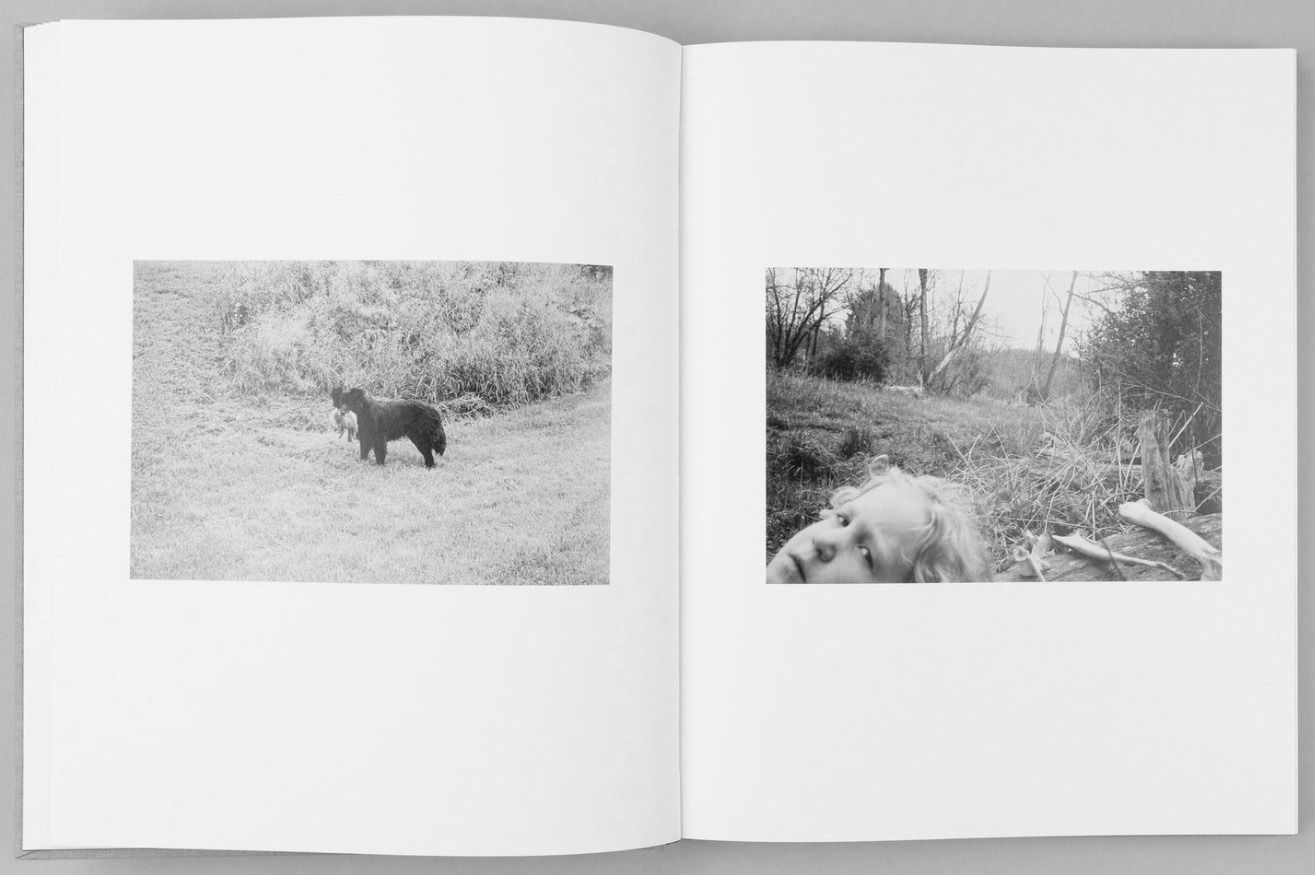
The Seraphim is an extended contemplation of veils. There are numerous meditations on death. Animals of various species are seen dead (trigger warning), while humans are more subtly placed along the living end of the continuum. There is an exuberant boy band playing on one page while another image peers down on a younger child laid out next to Minnie Mouse. There’s something funereal and fantastic about the moment, as both figures wear the same benign grin. Another child (the second of a pair of twins) is seen entering the world wearing a veil, freshly delivered from the womb enwrapped in the amniotic caul, a rare and portentous occurrence in childbirth.


A couple of voracious praying mantises appear, one caught mid-monarch in a scene that is simultaneously biblical, comic, and horrific. Lenz retains dead creatures to teach his children about the continuum of life, offering evidence of the other side of the veil. Contingency is ever present; life is a series of chance operations.

The seraphim are a high order of angels, often associated with purity and light. There is ample suggestion in these photographs that humans and animals inhabit the realm. Children float in a tub and fly against the background of a rural idyll. One scene of a boy with his face in the sun is positively transporting, though the fact that his feet rest in moving water makes it incongruously earthbound. Owls populate the pages of Lenz’s book. Owls that have allowed themselves to be seen, peering from branches and cavities in trees, caught against skies that glow through the leafy canopies. Owls that serve as memento mori, brought home to provide evidence of life’s unstoppable journey toward death.


Lenz doesn’t dwell in myth or archetype. There is one awkward archer who might, in a stretch, be measured against Chiron, Diana, or William Tell. There are any number of innocents, from human babies — one who snoozes with a stuffed (toy) owl — to bunnies and raccoons. A hefty snake slithers out of a tree trunk, though it offers no apple.

The most bounteous crop seems to be a harvest of mushrooms, morels if my insufficiently trained mycologist eye doesn’t deceive me. Here’s another potential veil between light and dark; I would have to trust that Lenz and his pickers know what they’re gathering.


The photographer is a canny narrator who is expanding his skills as his long-term project evolves. (This is the second book in a planned series of seven extending over three decades.) He is increasingly using motion pictures, shooting 16mm film to produce a parallel visual chronicle. When reproduced in the book, the films overtly announce themselves, showing sprocket holes and adjoining frames. By integrating the notions of movement and elapsing time Lenz is exploring another transitional space and deepening our consciousness of photographic representation.

Overall, a quality of fluidity suffuses The Seraphim. All of the elements are mingling, moving from the first book’s skillful compendium of well-seen moments towards a more organic, contingent embrace of this unique and universal mise en scène in central Ohio.

Purchase Book

Read More Book Reviews


George Slade, aka re:photographica, is a writer and photography historian based in Minnesota's Twin Cities. He is also the founder and director of the non-profit organization TC Photo. georgeslade.photo/

Image c/o Randall Slavin