PHOTOBOOK REVIEWS, INTERVIEWS AND WRITE-UPS
ALONG WITH THE LATEST PHOTO-EYE NEWS

Social Media

Showing posts with label New York. Show all posts
Book Review Weegee: Society of the Spectacle Photographs by Weegee Reviewed by Brian Arnold "Currently on view at the ICP in New York is Weegee: Society of the Spectacle (Jan. 23-May 05, 2025). Incredibly, this is the 6th exhibition dedicated to gruff tabloid photographer; this is in part due to a recent donation to the museum of Weegee’s work by his partner Wilma Wilcox. I haven’t seen the show, but the catalog, published by Thames & Hudson, offers an interesting survey of the curiously unique vision of Weegee..."

https://www.photoeye.com/bookstore/citation.cfm?catalog=TH182
Weegee: Society of the Spectacle
Photographs by Weegee
Thames & Hudson, London, United Kingdom, 2025. 208 pp., 130 black-and-white illustrations, 8¼x10½x1".

"I was stuck, you see, because I didn’t want to do sort of a normal English broken German accent thing, so on the set was a little photographer from New York, a very cute little fellow called Weegee. You must have heard of him. And he had a little voice…And I got an idea…I put a German accent on top of that, and I suddenly got…him into Dr. Strangelove. So really, it’s Weegee."

— Peter Sellers

Currently on view at the ICP in New York is Weegee: Society of the Spectacle (Jan. 23-May 05, 2025). Incredibly, this is the 6th exhibition dedicated to gruff tabloid photographer; this is in part due to a recent donation to the museum of Weegee’s work by his partner Wilma Wilcox. I haven’t seen the show, but the catalog, published by Thames & Hudson, offers an interesting survey of the curiously unique vision of Weegee.

Born in 1899 in the Austro-Hungarian city of Lemberg (today part of Ukraine), Usher Fellig emigrated to the United States in 1913. Upon entry, his name was changed to Arthur Fellig. After teaching himself the basics of photography on his own, Fellig started his professional career as a photographer in 1918, working as both a darkroom technician and a reporter. The work he became most known for began around 1935, when he was a full-time freelance photojournalist. It was around this time he changed his name to Weegee, a homonym for Ouija, because as a reporter he claimed to be clairvoyant, always knowing just where to be as the action started. Working primarily for a leftist-leaning tabloid called PM Weekly, the photographer created an entirely unique archive of crime and other activities in New York City from Prohibition and through World War II.


His news photography might best be described as proto-noir, reportage from the streets of America’s biggest city that looked like stills from the greatest film noir (is it just me, or did Weegee look a little like Edward G. Robinson?), made over a decade before Hollywood co-opted the style. Pioneering the use of flash, the photographer created a unique view of the streets with harsh lighting and deep blacks, making life in New York appear like an existential abyss. Never defining himself as political, Weegee nevertheless created a powerful vision about class in America by frequently giving voice to working-class life in the city. The PM Weekly did define itself as a progressive magazine, a label the photographer denied, but then again, he was also connected to Sid Grossman and the Photo League (where he had his first exhibition). All this work coalesced into his first monograph published in 1945, Naked City, a relentless and raw look at New York composed with over 230 pictures.


Not long after Naked City, Weegee moved to Los Angeles and started what is now referred to as his second period as a photographer. It’s easy to imagine that the work he did in New York took a huge toll — witnessing so much pain and tragedy can never be easy, combined with the demands of running all his own production and business must have been exhausting. In California, he took his pictures in an entirely different direction and focused more on using the darkroom to define his pictures. He photographed many famous people of the day — Ronald Reagan, Mao Tse Tung, and Jackie Kennedy among them — and printed them by projecting the negatives through warped or frosted pieces of glass, prisms, and even condensers from his enlargers, making them all appear as slightly surreal caricatures (apparently Szarkowski hated this work and saw it as a joke, a complete waste of the photographer’s talent).


Weegee: Society of the Spectacle
is an accessible book that offers a clear, engaging introduction to Weegee’s work, not prioritizing the New York years over California. The pictures are divided into neat, thematic chapters, pointing to major trends and periods in the photographer’s career, each introduced by a quote by Weegee accompanied with a short passage explaining the selection. The contributors include Clement Cheroux, Cynthia Young, Isabelle Bonnet, and David Campany. Cheroux introduces the book and exhibition by presenting the idea that Weegee’s work anticipated Guy Debord and the Situationists International, the French artists that emerged in the 1960s. Like the SI, Weegee challenged our understanding of what cities represent, and, like Debord, understood the importance of the media in defining the urban condition (it’s likely Weegee and Debord never heard of one another). Bonet, a specialist in crime photography, offers insight into the emergence of crime scene photography, both regarding the tabloids and the development of forensic investigation techniques. Campany acknowledges the last major body of work Weegee developed while working on the set of Dr. Strangelove. Director Stanley Kubrick met Weegee early in his career; before he went to Hollywood, he worked as a news photographer in New York City. Kubrick loved Weegee’s work, even noted it as an essential influence, and felt it would be interesting to have him on set. He gave Weegee a unique role, he had already hired two other photographers to provide the studio production stills so the master was allowed to do as he pleased. Kubrick thought the harsh style Weegee developed would be refreshing compared to the more slick and polished pictures the studio wanted. And apparently the photographer really hit it off with Peter Sellers, even influencing the actor’s interpretation of the film’s main character, the Nazi scientist advising the Pentagon on nuclear strategy.


Weegee: Society of the Spectacle
provides a great introduction to the legendary photographer’s work. If one is really into collecting photobooks, there are certainly better examples of Weegee’s to be had (primarily Naked City, there are multiple printings of this book), but Society of the Spectacle offers a comprehensive, approachable overview of the photographer’s work, and thus it seems it was really intended as a souvenir for the exhibition rather than as a unique expression of the photographer’s work.

Purchase Book

Read More Book Reviews


xxx

Brian Arnold
is a photographer, writer, and translator based in Ithaca, NY. He has taught and exhibited his work around the world and published books, including A History of Photography in Indonesia, with Oxford University Press, Cornell University, Amsterdam University, and Afterhours Books. Brian is a two-time MacDowell Fellow and in 2014 received a grant from the Henry Luce Foundation/American Institute for Indonesian Studies.
Book Review Loisaida Photographs by Tria Giovan Reviewed by Blake Andrews “As the coronavirus pandemic winds down, it’s an opportune moment to highlight the positive aftermath. What’s that you say? Positive? What?"

Loisaida. By Tria Giovan.
https://www.photoeye.com/bookstore/citation.cfm?catalog=DU517
Loisaida
Photographs by Tria Giovan
Damiani, 2023. 96 pp., 77 illustrations, 8¼x11½x½".

As the coronavirus pandemic winds down, it’s an opportune moment to highlight the positive aftermath. What’s that you say? Positive? Wha…? Yes, I realize that the plague years have been horrible in many respects. But for housebound artists they offered a rare chance to hit pause, recalibrate, and pivot. Photographers of all stripes took advantage, and in the past year or so we’ve begun to see a viral explosion of pandemic-generated photobooks. These include recent photos of the disease’s impact, and also past work finally given time to resurface.

Tria Giovan’s Loisaida fits the latter category. For almost forty years after she made them, these remarkable photos were tucked away in storage. It’s a depressingly familiar scenario when it comes to film archives. Gary Stochl, Vivian Maier, and April Dawn Alison are merely a few examples. In Giovan’s case, the pandemic was the ticket to rediscovery. Stuck at home in 2020, she finally found time to dig into her old New York photos. A few years of editing, scanning, and sequencing later and voilà: Loisaida the hardback.


“Loisaida” is a Spanglish term for Manhattan’s Lower East Side (LES), an onomatopoeic nickname bequeathed by the local Puerto Rican community. Giovan moved to the neighborhood in 1984. She was 23, photography degree fresh in hand, ready to tackle the world. “The Lower East Side was as gritty, authentic, and humble as it was exotic, vibrant, and colorful,” she remembers. She settled at 29 Clinton, on the corner of Stanton Street, in a third-floor flat. Several photos in Loisaida show exterior views from her apartment. Aiming out the window she captured her fire escape, the urban fabric beyond, and multiple frames of the street corner below. Clinton/Stanton was an ever-revolving stage, and she had a bird’s eye view. One day the corner hosted a boxing ring, another day it was occupied by pushcart vendors. Another moment might reveal a glut of bad parking jobs or a shifting knot of pedestrians. Taken collectively these corner photos offer a snapshot of LES life in flux. The neighborhood was a traditional melting pot for immigrants. It was dynamic and bustling, the antithesis of future pandemic shutdowns. For a young and energetic photographer like Giovan, it was an inexhaustible cornucopia.


To her credit, Giovan was flexible photographically. As might be expected from a public documentarian in Manhattan, much of Loisaida can be loosely classified as street photography. A scene of a child sitting with toys on a bench must have been captured in a fleeting instant, yet Giovan positioned the postures and objects with care. This photo and several like it prove her deft touch in shifting situations. Bystanders and shoppers were typical subjects, often captured in passing against city backdrops. But Giovan didn’t require people. Sometimes a simple facade or shadow was enough. She was fascinated by signage, ironwork, doorframes, and the thousands of other small details that give the LES its vernacular charm.

Some corners she shot head-on, for example a gorgeous frame of melting snow fronting repeated shop window posters. This picture and several others have a stately, static quality. If they exude the formal contemplation of view camera photos, that’s a misconception. Loisaida was shot on foot with small and medium format cameras. “I didn’t overthink it, I just went out and responded instinctively to my environment,” she said in a recent interview. “The trick is to be completely present, to look in your peripheries, to not hesitate. It’s like a muscle or a reflex, you know, the more you use it, the more refined and defined it becomes.”


Since this is a book of older color work, the palette is naturally filmy. Pictures are imbued with undertones of amber and cyan, some venturing—sometimes too far?—into one or the other end of the spectrum. Secondary shades of orange and green provide mood lighting. The delicate tints are faithfully preserved in Damiani’s reproductions. Analog colors play off each other like Astaire and Rogers, with partners typically matched across the spread. For example, the benched boy mentioned above is paired with a photo of an old car in the same dark teal. Reds march with reds, magenta with magenta, and so on. All are buttressed by a grounding layer of grey/cyan concrete, while the book’s landscape format gently prods the viewer along the block.


Looking at Loisaida now with four decades of hindsight, the scenes seem exotic and remote. It’s not just the colors, but the fashions, car models, and demographics too. All have shifted radically since the 1980s. If the photos feel alien, Giovan was an outsider. She was a recent LES transplant when she made these photos, and she represented a cultural shift. She was a recent BFA graduate in a working-class neighborhood, a beacon of impending gentrification, and a fish out of water. “I wandered the streets photographing as if in a foreign land,” she recalls.

That wide-eyed curiosity is part of what makes these photographs special. It lends them an outside observer quality, as if peering in on an urban diorama. They could almost pass for New Topographics remove, but Giovan’s photos have a humanity and sensitivity which is missing from that scene. “A lot of what people associate with that era and that area is the punk rock and the graffiti,” she writes. “I feel like this book takes it somewhere else, somewhere softer.”

Purchase Book

Read More Book Reviews


Blake Andrews is a photographer based in Eugene, OR. He writes about photography at blakeandrews.blogspot.com.
Book Review The Unseen Saul Leiter Photographs by Saul Leiter Reviewed by Blake Andrews “Saul Leiter felt ambivalent about fame during his lifetime, seemingly content to wile away his years in blissful obscurity. But his posthumous legacy has been a much different story..."

The Unseen Saul Leiter By Saul Leiter.
https://www.photoeye.com/bookstore/citation.cfm?catalog=DU392
The Unseen Saul Leiter
Photographs by Saul Leiter

D.A.P., 2022. 160 pp., 75 color illustrations, 8½x11".

Saul Leiter felt ambivalent about fame during his lifetime, seemingly content to wile away his years in blissful obscurity. But his posthumous legacy has been a much different story. The flame of recognition, first kindled in 2006 with his breakout hit Early Color, has become a bonfire in the 16 years since, raging past his 2013 death to establish him in the photo firmament. Various curations have poured forth since. He was the subject of a 2013 documentary biofilm. photo-eye’s site currently lists 17 monographs of his work and a few more about his apartment. All have been gas on the fire for fans and collectors, provoking not just impressions but questions. But who was this singular artist? What makes his pictures so appealing? And have we yet reached a point of Leiter saturation?

Before you answer that last question, you might want to take a look at The Unseen Saul Leiter. His most recent monograph — but almost certainly not the last — collects 76 slide photos from Leiter’s peak shooting years in New York City, 1948-1966. It’s curated by two people who know his work quite well, the wife/husband team of Margit Erb and Michael Parillo. Erb befriended Leiter just out of college in 1996 through her work at Howard Greenberg Gallery. In subsequent years she helped Leiter organize, store, edit and promote his archive before eventually creating The Saul Leiter Foundation to perform those tasks in perpetuity. She is the current foundation director. Parillo is her assistant.


This couple is as familiar with Leiter’s photos as anyone, and they enjoy ready access to them through the Foundation. That said, the back catalog is huge and unwieldy. Even for Erb and Parillo, it houses secrets among the ~60,000 slides in various boxes. Leiter’s life was intertwined with these containers. They lined his living quarters as he scraped together freelance jobs between artistic endeavors. It was hard enough to keep his pictures safely stored out of harm’s way. Organizing them into a book or show took another level of chutzpah, which he did not achieve until his last years. Even then, it was a small dent in the curatorial puzzle.

Leiter’s unfinished business forms the premise of this book. With the help of Elena Skarke, a German student using his archive as PhD material, Erb and Parillo commenced serious crate digging. Previous books had attempted something similar, but this time the focus was on Leiter’s early slides. He shot them mid-century on various film stocks, Ascochrome, Kodachrome or Ektachrome. They were then mounted in metal, plastic or paper carriers, and stuffed into storage with loosely categorized labels. One box was called “Boats New York”. Another was the “Personal Park Series”. There were boxes for “Workers” and “Street” and one suggestively labeled “Mix”, and so on.


These boxes collected in Leiter’s latter years in a smallish apartment/studio in the East Village stuffed to the gills with art, now the home of the SLF. The book brings his physical environment to the reader immediately, with an opening image of a slide projecting pictures against the apartment wall. We then see boxes and rows of old photographs, followed by a view through the window to its interior, and a contents page laid over an architectural diagram of his studio. The message is clear: this is a book rooted in place, and his home is an entry point to his head space. He spent many hours in these environs, and the opening sequence captures something of what it felt like to be there. Viewed now in the pandemic-era of home confinement, they take on added urgency.

Looking through his tiny digs stuffed with pictures, it must have been quite a chore for Leiter to cart them around Manhattan. He shuffled between living quarters from time to time. He may have discarded other items in the course of these moves, but never his life’s work. They have a very personal character, and Erb asked herself about the propriety of posthumous curation. “I wondered if I was crossing a line…was I meddling?” She and Parillo were on their own. The Unseen Saul Leiter is one of few monographs with no input from Leiter. Its curation might diverge from earlier books but if so, the soul of Leiter remains. Design and edit are subsumed by the power of his pictures.


These take place outside the apartment, of course, on the streets of Manhattan, and they are wonderful. Many photographers have prowled the same grounds, especially during Leiter’s post-war heyday. But his style is distinctive. In fact, Leiter is one of just a handful in history whose New York street work is immediately recognizable in just one or two frames. This might be attributable in part to the tools du jour. Shooting slide film in low light meant open apertures and long exposures, and the singular cast of old chromes colors all of Leiter’s work. But his work possesses a je ne sais quoi that transcends materials.

Reproduced in this handsome book on solid black backgrounds, familiar hallmarks appear in force. Leiter’s shallow depth of field, moody lighting, neon signs and habitual framing through glass or obstacles, his keen nose for serendipity. For a street shooter, he was atypically nonconfrontational. He rarely addressed any subject from a direct frontal vantage. It was always askance, into, adjacent or behind. The cover shot is a prime example, a moving figure shot from distance in dim light, the street lit up by a car’s rear blinker. This picture also captures Leiter’s unusual tendency for verticals, exaggerated to nice effect in the vertical format book. Other pictures range around the city, spanning about twenty years through Manhattan, Harlem, Central Park and the Village. Pedestrians, sedans and street signs pass through various weather. All are reshuffled in the book, seemingly at random, into three new “boxes”. If their curatorial logic isn’t exactly clear, at least they provide nice chapter breaks for essays by Erb and Parillo, in which they discuss the logistical challenges of editing old pictures, Leiter as a color pioneer and production details.


If you’ve browsed or bought previous Leiter monographs, you may be wondering what is new here, and if it’s enough to justify another book. Photographically speaking, this book is more affirmation than expansion. Beyond the fact these are slides, its pictures fit the pre-existing oeuvre seamlessly. There’s nothing here that wouldn’t slot unnoticed into Early Color or Forever Saul Leiter, and Leiter stalwarts will find few new insights. But all of that may well be immaterial. The Unseen Saul Leiter reconfirms — for the umpteenth time? — Leiter’s quiet mastery, and with a photographer of this caliber, that may well be enough. There are 76 new pictures, all well-sifted and considered, with nary a dud in the bunch, and at least a dozen outright bangers. All are previously unseen until now. Their publication is a gift to anyone generally who enjoys strong street work. For Leiter die-hards and completists, it will be required reading.

Purchase Book

Read More Book Reviews


Blake Andrews is a photographer based in Eugene, OR. He writes about photography at blakeandrews.blogspot.com.
Book Review Darrel Ellis Photographs by Darrel Ellis Reviewed by Brian Arnold "Before Ellis was born, his father was beaten to death by two police officers (in the 1980s there would be no question of accountability). His father was also an avid photographer, and eventually all his negatives and equipment were given to Darrel..."

https://www.photoeye.com/bookstore/citation.cfm?catalog=DU381
Darrel Ellis
Photographs by Darrel Ellis

Visual AIDS, New York, USA, 2022. In English. 208 pp., 9½x11".

"Studying the work of Darrel Ellis is like witnessing the eruption of an inner life, multiple lives captured through one work of art." 
— Tiana Reid

In 1987, the United States houses of Congress passed the Helms AIDS Amendments. These amendments were created to prohibit the use of any federal funds to provide HIV/AIDS education, information, or prevention materials, and any information or activities that could be perceived as condoning homosexual activities. I grew up in the 1980s and lost a family member to the AIDS epidemic. I remember many conservative leaders calling AIDS “gay cancer,” and bumper stickers that read things like Thank God for AIDS and Kill a Queer for Christ. There is no denying that HIV/AIDS was a divisive issue during the 1980s — like Roe v. Wade or gun control today — with a clear majority of conservative leaders not only feeling the government had no obligation to educate or protect the population from the infection, but even actively promoting the belief that the virus was God’s way of punishing gays for their sinful choices.

During the 1980s, I also grew up in a city surrounded by an extremely violent African American gang war, between the Crips and the Bloods, and I saw firsthand black neighborhoods forgotten by the city and run as open drug markets. Drive-by shootings and assassinations were commonplace. My public high school was in the middle of this violence. The police were a daily presence. At one point, I even witnessed a gang related shooting on the front steps of the school. As a white man I won’t pretend that I can understand what it means to grow up Black in America, but I can say that I had a clear window into the violence and pain eroding their communities at that time.


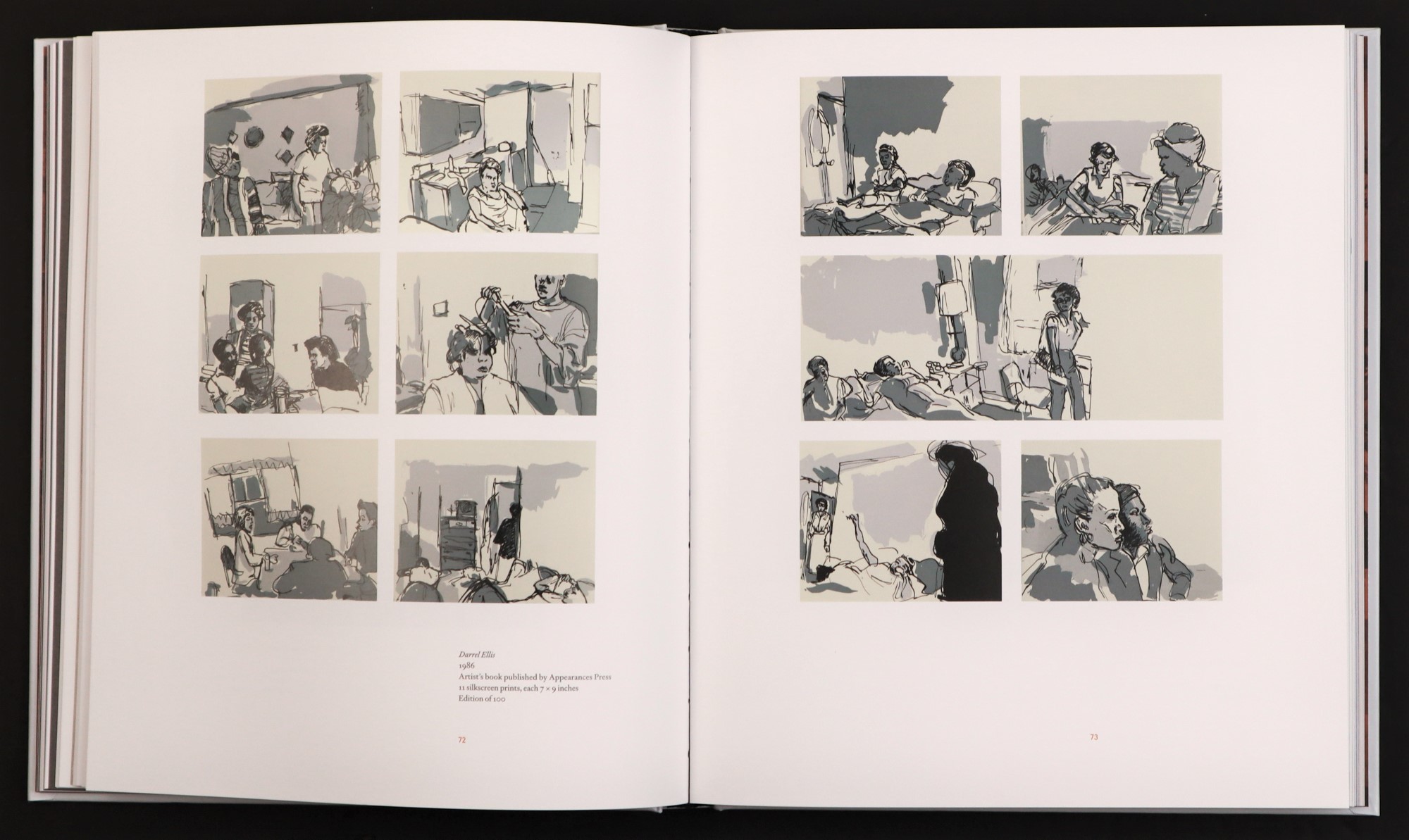
Looking back at these experiences, it seems that to be black, gay and HIV positive was to embody some of the key cultural conflicts of the day, representing essential moral questions about community, compassion, identity, and mortality. Living with all these labels, I imagine, could only lead to deep personal conflict, fueling anger and acute feelings of isolation. Artist Darrel Ellis was all these things, a gay black man born in New York in 1958 who died of AIDS complications 34 years later, on 4 April 1992. Before Ellis was born, his father was beaten to death by two police officers (in the 1980s there would be no question of accountability). His father was also an avid photographer, and eventually all his negatives and equipment were given to Darrel. These photographs became the foundation of his studio practice, providing the resources for a remarkable meditation on family and identity, now documented in the great new book published by Visual AIDS, Darrel Ellis. The book is richly illustrated with photographs, drawings, and paintings by the artist, as well as a curated collection of critical and biographical essays, interviews, and roundtable discussions that collectively help contextualize and humanize his unique contributions as an artist.

I must confess I knew nothing about Ellis before opening this book, although I did recognize his face. Both Peter Hujar and Robert Mapplethorpe made photographs of Ellis, portrayed clearly by both with compassion and as a kindred spirit, as an artist and member of the gay community in New York City (the roundtable discussion printed in the book does question this, however, and suggests that these photographs were driven by a white gaze). As a gay black in the 1980s, Ellis’s life seemed destined for tragedy — similar in some ways to both Hujar and Mapplethorpe — and yet, somehow, he left behind an incredibly sensitive, humble, beautiful, and curious body of work, one that fuses traditional techniques in drawing and painting with experimental approaches to photography and darkroom practice. I find it interesting that his drawings and paintings demonstrate a great photographic sensitivity — the majority of this work is created in monotone, and clearly derived from photographs (Ellis has a famous self-portrait based on Mapplethorpe’s portrait) — while his photographs are based on a unique and experimental approach to the darkroom, offering confusing and interesting images based on material experimentation. The book also contains numerous quotes from Ellis’s journals, with passages like this pointing to his philosophies of materiality and experimentation: “Material must be used [.] We are matter, but we must use it to convey reality [,] that which is beyond our present physical consciousness [,] our limitations.”


There are two primary threads at play in Ellis’s work, self-portraits and pictures based on family snapshots. Within these is also the repeating motif of identities under erasure: faces that appear distorted, obscured, hidden, or even obliterated. Whether the result of gestural abstractions found his drawings and paintings, or the darkroom distortions utilized in his photographs, faces in Ellis’s work are usually indiscernible, removed or opaque. Referencing family snapshots, these images reflect incredible ideas about family and memory, and also offer a remarkable metaphor for Black life in the United States during the 1980s. Curiously enough, Ellis’s self-portraits offer an exception, and are really the only works in his oeuvre in which a face or an identity appear clearly composed and tangible. Looking at these works together, his self-portraits juxtaposed with the obscured faces of his family and friends, reveals a tremendous personal and cultural conflict, identities forgotten and abandoned, and yet also a self grasping for individual definition and self-determination. Another cited passage from Ellis’s journal, in which he ruminates on his process of obscuring figures and memories, offers a lovely summary: “I feel strongly that deconstructing is all right. But what’s more important is reconstructing. It’s very cerebral work, very mental work, and, in a way, very soulful work.”

Ellis’s photographs are curious and take a bit of time to understand. These pictures are all reworkings of his father’s negatives. To make his new work with these negatives, Ellis projected them onto three dimensional forms — layers of blocks, circles, or non-geometric plaster configurations — which are then rephotographed. Ellis would position his camera at an angle, so his finished images are often elongated, receding across the printed page, creating yet another layer of distortion (the book provides a great explanation for how he made this work, complete with illustrations detailing his process). Ellis would take these negatives to a lab for development and to have a new, inter-negative produced (photographing the projected negative would result in a positive image) and then use these to make his own prints. The resulting images are obscured and confusing, with blocks and geometric shapes dividing the image into new layers and unrecognizable faces and events, with the position of his camera creating bizarre angles that make the image appear to be receding into space or melting onto the photographic paper.


In Ellis’s own words, “The forms I use to project upon are all different, and the negative, when it interacts with the form that I’m projecting upon, causes certain kinds of distortion. Some of the forms I use are round, some are rectangular, some are biomorphic. That one straight photographic image representing people and a picnic — I project that image on this geometrical shaped form and you get a totally different image than if I project it on something that’s more biomorphic. They’re all different, the photos; they’re like regeneration, regenerated. From one you get many. And that works as a metaphor for family.”

Artist Allen Frame, a close friend who took responsibility for Ellis’s estate after his death in 1992, offers a slightly different perspective on this work, “He used geometric forms — circles, squares, and horizontal bars — to obliterate central parts of the image, creating mysterious symbols that suggest both discord and harmony,” and he goes on to say, “The overlaying geometric forms act as an aggressive intervention, yet help resolve and complete compositions that, unlike his father’s, are vaguely defined.”


Quietly, Ellis emerged as an accomplished artist with an interesting educational background and important acknowledgements from his peers. During most of his productive years, he worked as a security guard at the Museum of Modern Art (even using his ID badge as source material for his photographic work), which Ellis cites as an essential part of his own artistic education and philosophies; he considered himself unique among Black artists of his day, fully entrenched and a part of the European traditions that filled the galleries at MoMA. He also worked in a residency program at PS1 and participated in the Whitney Independent Study Program in 1981. In 1989, his work was included in the seminal exhibition organized by Nan Goldin in response to the AIDS crisis, Witness: Against Our Vanishing. Shortly after his death, Peter Galassi included his photographic work in New Photography 8, alongside artists Dieter Applet (an extremely interesting pairing with Ellis), Ellen Brooks, Dennis Farber, Robert Flynt, Mary Miss, Gunduala Schulze, and Toshio Shibata. His work was also included in Deborah Willis’s important history of black photographers, Reflections in Black: A History of Black Photographers.


If you are unfamiliar with Visual AIDS, the publisher of Darrel Ellis, it is worth learning more about them. Found in 1988, Visual AIDS is a contemporary arts organization committed to raising AIDS awareness and creating dialogue around HIV issues today. They produce unique and interesting exhibitions, public forums, and publications. They are committed to representing visual artists living and working with HIV/AIDS today, and to preserving, archiving, and honoring the work of artists active during the height of the epidemic. In the wake of the Black Lives Matter movement and another viral crisis, Darrel Ellis is an extremely timely and important publication, and provides an interesting look at artist who died before his vision was fully realized, but nevertheless left behind unique and challenging visual investigations about race, identity, and morality. The book provides a great introduction to the work done by Visual AIDS and has left me curious to see more from the organization.

Purchase Book

Read More Book Reviews


Brian Arnold
is a photographer, writer, and translator based in Ithaca, NY. He has taught and exhibited his work around the world and published books with Oxford University Press, Cornell University, and Afterhours Books. Brian is a two-time MacDowell Fellow and in 2014 received a grant from the Henry Luce Foundation/American Institute for Indonesian Studies.