PHOTOBOOK REVIEWS, INTERVIEWS AND WRITE-UPS
ALONG WITH THE LATEST PHOTO-EYE NEWS

Social Media

Showing posts with label Germany. Show all posts
Book Review The Presence of Something Past Photographs by Ulrich Wüst Reviewed by Arturo Soto "The paper retrospective The Presence of Something Past is a significant effort to disseminate the work of German photographer Ulrich Wüst beyond Europe..."

https://www.photoeye.com/bookstore/citation.cfm?catalog=DT839
The Presence of Something Past
Photographs by Ulrich Wüst

Kerber, Germany, 2022. 320 pp., 100 colored and 416 duplex, 8¼x10½".

The paper retrospective The Presence of Something Past is a significant effort to disseminate the work of German photographer Ulrich Wüst beyond Europe. Edited by Gary Van Zante, curator of Architecture and Design at MIT, the book is a late addition to the 2015 exhibition Public and Private: East Germany in Photographs by Ulrich Wüst at the Chrysler Museum of Art. As such, the book is a hybrid of a catalog and a monograph, something to keep in mind when reading Van Zante’s comprehensive (and profusely annotated) texts. His introduction offers a biographical sketch of the artist, expounding on the sociopolitical conditions under which Wüst produced the work in the German Democratic Republic (GDR). As a former urban planner, the bulk of Wüst’s work explores the schism between the representation of urban spaces and how they reflect that defunct state’s moral, economic and political values.   

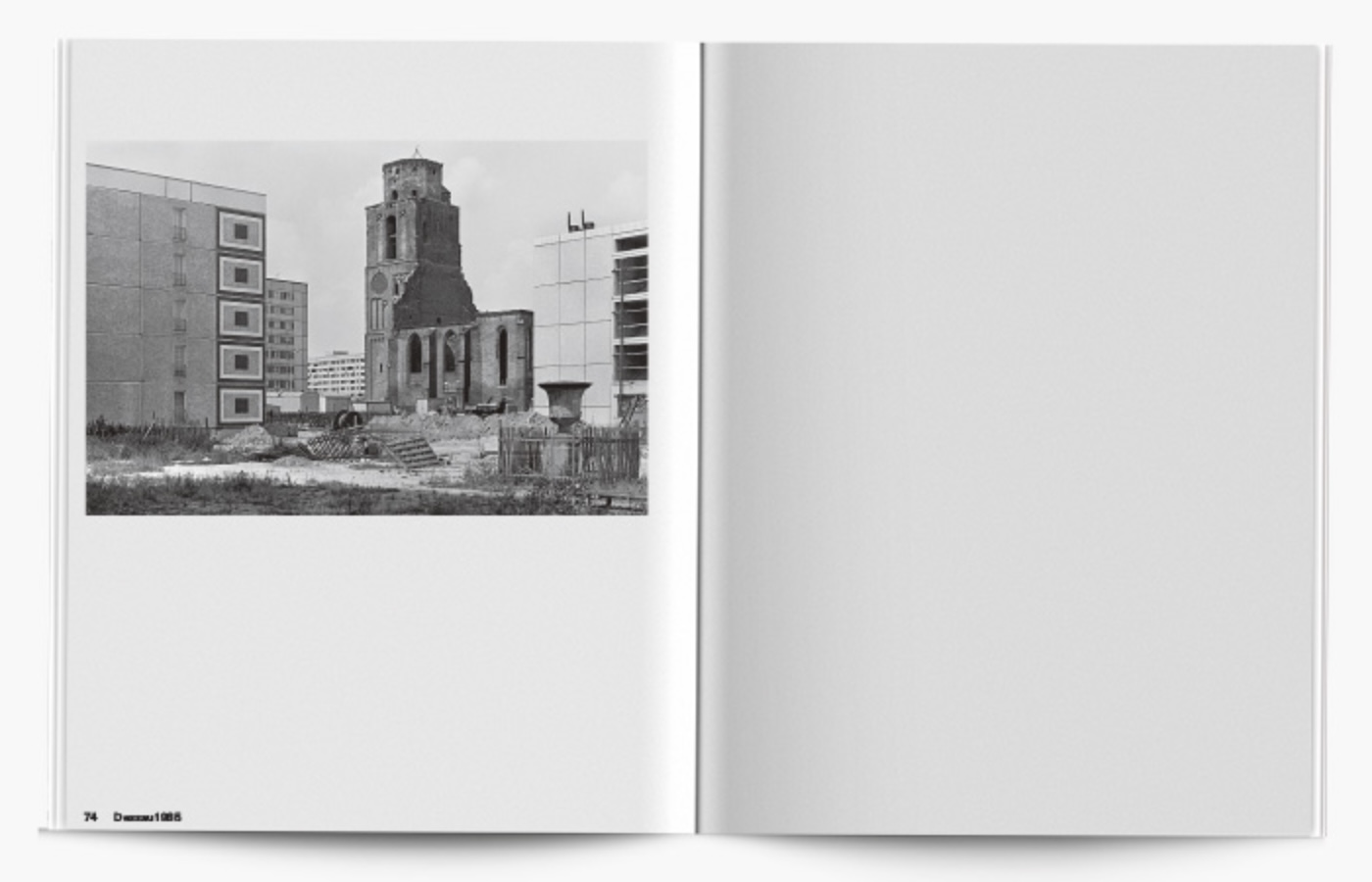
A deeper engagement with the images is facilitated by Van Zante’s analysis of Wüst’s series, providing insight into his creative process. Throughout his career, Wüst assembled handmade leporello books with images from his archive. Each chapter in The Presence of Something Past shows a selection of spreads to give a sense of the work’s length and complexity (Wüst is prolific, and several of his leporellos contain hundreds of images). When he made the photographs, many of the scenes he focused on would have seemed obvious to those around him. Yet, there is much to take away from his precise compositions, from a diversity of architectural styles to evidence of the political practice of ‘correcting’ history by changing street names (the shelf life of some heroes can be very unpredictable). Many of his pictures depict the status quo through public sculptures or street furniture. For instance, in one of his photographs of Rostock, the sculpture of a family seems to fit indisputably with the new Plattenbau in the background. But the values these two elements stand for — family, progress, equality — are not neutral, and the benefit of hindsight allows us to register the volatility of their semantic status. Wüst’s talent was to recognize how problematic that assumption of neutrality was, making a picture that itself appears neutral by way of its technique and point of view.   


Wüst’s compositions harmoniously interweave form and content. Yet, his curiosity covered such a wide range of buildings and spaces — particularly in early series like the influential Cityscapes (1979-85) — that it is up to us to decipher whether he selected a site because of the visual structure he would enforce upon the scene or because of the histories embedded in the sites themselves. This sense of indeterminacy is also evident in his recurrent strategy of featuring ample foregrounds, which, on the one hand, literally leave more room for thought, and on the other, relate to urban theories by critics like Ignasi de Solà-Morales or Jane Jacobs that argue for the productivity of in-between spaces to promote a self-regulated civic life. On a more technical note, two aspects separate Wüst from his West German contemporaries: his use of a 35mm camera (which he treated like a view camera) and his disposition to photograph under various lighting conditions. These particularities stand in contradistinction with the working methodologies of the artists associated with the Kunstakademie Düsseldorf (Bernd and Hilla Becher, Thomas Struth, Candida Höfer, etc.).  


Because of Wüst’s preferred subject matter, it’s tempting to think of him as Michael Schmidt’s doppelgänger (they even photographed the Wall on opposite ends; Schmidt in Kreuzberg and Wüst in Prenzlauer Berg). While their work shares an understanding of the transcendence of public spaces as a reflection of societal changes, their difference lies in their sensibilities towards the political connotations of photography’s aesthetics. Wüst’s images have a richer tonal range and more traditional compositions, characteristics that amount to a less fatalistic worldview. Conversely, Schmidt was convinced that aestheticizing reality was sentimental and politically suspect. Wüst — not necessarily in reaction to Schmidt’s work, although he was aware of it — problematizes the notion that any aestheticization of the GDR is immediately propaganda. Wüst, in other words, is less prescriptive than Schmidt, as he doesn’t push for specific ethical or political interpretations of the places he depicted. Instead, his deadpan aesthetic allows the pictures to remain ambiguous and aesthetically pleasing, as in the picture of the famous Marx bust in Chemnitz, which is neither critical of the regime nor laudatory of its ideology.   


Talking about freedom in the GDR is often glossed over because it contradicts the standard narratives of oppression, but the fact that Wüst’s work exists proves that some personal liberties could be negotiated or contrived. This tension is more closely captured in his works that don’t focus on the urban landscape. In the series Visitors (1986-90), Wüst documented the wide network of artists, family and friends that visited his studio. Since many of them progressively fled the GDR, the images can be taken as a personal index of the impact of repression. Other works, such as Wiegmann Legacy (1991-92), a visual inventory of objects from the GDR era found in a summer home, exemplifies the concept of Ostalgie — the feeling of nostalgia for the fallen regime — and how it became synonymous with the struggle to adapt to a new life (a tragicomic treatment of which can be seen in the 2003 film Good Bye, Lenin!). Wüst’s work elucidates how difficult it was for artists to uphold their aesthetic vision while circumventing official censorship. Nevertheless, it’s hard to shake the feeling that, like all great photographers of places, he seems to have photographed with a future audience in mind. The psychological effects of ideology can often be hard to visualize and, in today’s largely homogenized world, even harder to apprehend. The Presence of Something Past is a fantastic overview of Wüst’s work and an opportunity to appreciate how he avoided the expected notes of cynicism and nihilism in his examination of a country that doesn’t exist anymore. 

Purchase Book

Read More Book Reviews


Arturo Soto is a Mexican photographer and writer. He has published the photobooks In the Heat (2018) and A Certain Logic of Expectations (2021). Soto holds a PhD in Fine Art from the University of Oxford, and postgraduate degrees in photography and art history from the School of Visual Arts in New York and University College London.
Book Review Stadtbilder Cityscapes 1979–1985
Photographs by Ulrich Wüst
Reviewed by Blake Andrews “These milestones have come after a long, low-key career in the trenches of photoland, during which his profile raised barely a blip outside of Germany. If he’s been overlooked by the international photo community, that’s just fine with Wüst..."

Stadtbilder By Ulrich Wüst.
https://www.photoeye.com/bookstore/citation.cfm?catalog=ZJ932
Stadtbilder
Cityscapes 1979–1985
Photographs by Ulrich Wüst


Hartmann Books, Germany, 2021. German/English. 160 pp., 105 Illustrations, 7¾x10¼".

At age 73, Ulrich Wüst’s star is on the rise. On the heels of his first-ever U.S. show in 2016, he was included the following year in Documenta 14, where “his atmospheric black-and-white images of abandoned East German cityscapes at the heights of Brezhnev-era stasis foreshadow the inevitable end of the Deutsche Demokratische Republik.” In 2019 this series was included in the compendium The Freedom Within Us. Now he has followed it up with a monograph. Stadtbilder, designed and released by Hartmann Books, collects cityscapes of the former East Germany between 1979 and 1985.

These milestones have come after a long, low-key career in the trenches of photoland, during which his profile raised barely a blip outside of Germany. If he’s been overlooked by the international photo community, that’s just fine with Wüst. His commentary on the art world (as relayed in Stadtbilder) is telling: “I became aware of how strange it was, and I felt quite comfortable about not having to join in this dance.” Even before arriving at that judgement, he took his sweet time settling on the “weird hobby” of photography.


Born in 1949 in Magdeburg, Wüst studied architecture and civil engineering at Bauhaus in Weimar, then worked as a city planner and a photo editor. He tinkered with his own photography but it wasn’t until 1984 that he took the plunge into it full-time. By then he was already well into shooting the photos which would form Stadtbilder. The complete book, which wound up including the original series plus 50 added photos, documents various East German cityscapes roughly a decade before reunification. By Wüst’s measure, it’s a visual study of Germany’s environmental “psychotype”.

Stadtbilder captures the German Democratic Republic in vernacular limbo. It had emerged from the wreckage of WWII, and was largely rebuilt and reinhabited. But in some respects, the country had come out of the frying pan and into the fire, as the Soviet Iron Curtain cast a grey pall throughout. Wüst’s frames are decidedly uncheery. He did not often photograph people, so there are no human smiles to brighten up the frames. In their stead, stern marble busts of Marx and Lenin are set against brutalist architecture and post-war ruins. A stifled dreary mood pervades amid signs of a past that can never quite be forgotten. 


Wüst visited many East German cities, typically on magazine assignments where he might shoot his own outtakes in addition to whatever was commissioned. He usually carried a single 35 mm film SLR and 50 mm lens, which he handheld in landscape format. This setup — “my ridiculous equipment”, as he calls it — was an unusual and somewhat idiosyncratic choice for static cityscapes, even back in the heyday of small format film cameras. But it suited him fine. He became intimately familiar with his equipment, and it became a near bodily extension.

Wüst approached most street scenes head-on, camera leveled, paying close attention to verticals. He generally aimed broadside at facades, curbs, and other traces of the built environment. Several photos in Stadtbilder are spiced with open roadways receding to the horizon, their frames knit with fencing, statuettes, and industrial adornments. All have a blunt descriptive power that falls somewhere in the aesthetic neighborhood of Lewis Baltz, Joachim Schmidt or Stephen Shore (just don’t compare him to the Bechers and their “unremarkable compositions”). “Wüst is the phenotypical observer”, comments Matthias Flügge in the opening essay, “turning even the most inconspicuous street corner into an incident transcending futility.”


Stadtbilder
might be a mere visual memento if approached as pure documentary. But its photos are pushed beyond contemporaries through clever twists. Time and time again Wüst injects witty layering and visual confusion, all enhanced by the homogenizing effects of greyscale monochrome. In a photo of Leipzig 1982, for example, trees, cars, and brick blend into a 2D chiaroscuro. A shot of Berlin 1982 performs a similar trick with window frames, utility poles, and distant apartments, their forms dancing to an ambiguous rhythm. Photos of Karl-Marx-Stadt 1982, Magdeburg 1982, and Dresden 1985 repeat the magic. Wüst is irredeemably playful. Wherever he looks the buildings blend into puzzle pieces. He just can’t help himself, it seems. Thankfully he’s in good company. Luminaries like Lee Friedlander and Gerry Johansson face the same existential crisis every time out, with equally beguiling results. Why do forms line up just so? Won’t the world ever settle down into stasis? For a photographer of cityscapes, these are good problems to have.


As with Friedlander and Johansson, dense visual textures are typically encoded in tight prints. The book is modestly sized, and its reproductions are scaled down even further to fit horizontally, perhaps 6 inches across. Thankfully the small enlargements don’t detract from the power of Stadtbilder. With several dozen bantam photos, there’s no use pixel-peeping. It’s more fun to flip the page and lose yourself browsing. The hardback binding features full-extension cardstock covers running flush with the internal pages, an elegant design touch. In addition to the informative essay by Matthias Flügge, the book features a recent interview of Wüst conducted by Katia Reich (all texts are in both German and English). The wily master comes across as playful and intelligent, a diligent observer who has always pursued his own dogged path. With Stadtbilder, photoland can finally see what Wüst has been up to all these years.

Purchase Book

Read More Book Reviews


Blake Andrews is a photographer based in Eugene, OR. He writes about photography at blakeandrews.blogspot.com.