


 |
Cross Road Blues by Oli Kellett.
 |
Oli Kellett
Nazraeli Press, 2024. 68 pp., 28 four-color plates, 14x11½".
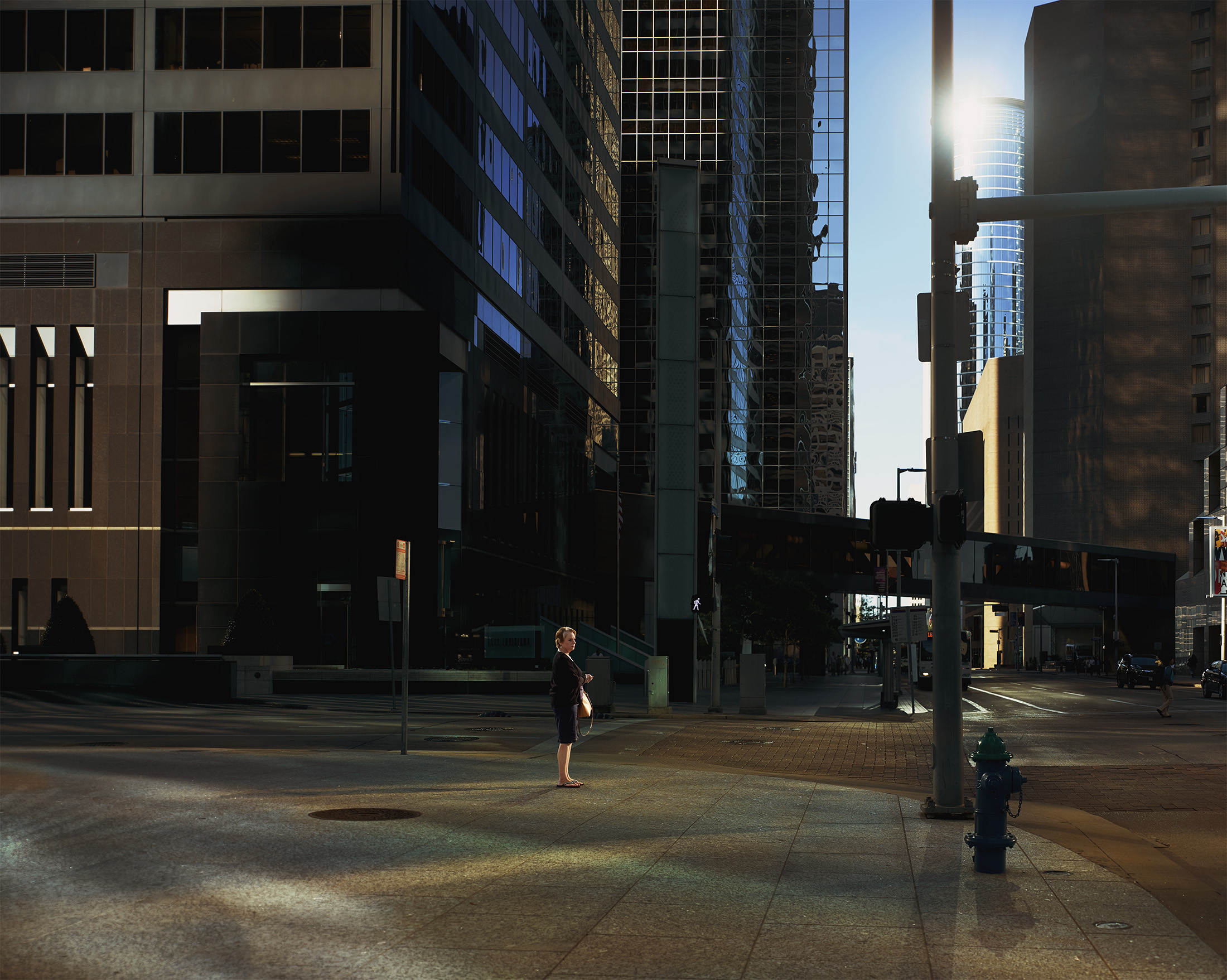
Oli Kellett’s Cross Road Blues is a meticulously crafted series of photographs shot over four years in major American cities (Los Angeles, Boston, Chicago, Atlanta, etc.) with a few additions from around the world thrown in the mix (Mexico City, Madrid, London, and Rio de Janeiro). Kellett’s version of street photography is crisp and dramatically lit, albeit produced with a high-end digital camera on a tripod. About half of the pictures present a view from a high vantage point, highlighting Kellett’s aim to convey how urban environments often create a sense of oppression.
The project, titled after the famous blues song by Robert Johnson, aspires to intertwine philosophy and visuality, positing the action of crossing the road as a metaphor. This line of thinking is effectively unpacked in the introduction by the philosopher Nigel Warburton in terms of Sartrean freedom, determinism, libertarianism, and contingency, although he also considers the gestures people make before crossing the road as indicative of their relationship with the environment. For instance, the book concludes with a person pointing his finger to the sky, echoing the famous gesture by Plato in Raphael’s The School of Athens.
 |
The exhibition prints of this series are up to 60 x 75 inches in size, inviting viewers to immerse themselves in their details. Following the same logic, the size of the book encourages a close and prolonged look at the pictures. In this sense, Cross Road Blues, comprised of only twenty-eight photographs, can be described as a portfolio photobook, which is a way to describe bodies of work conceived for the wall rather than for a print publication. In terms of trim and design, the book adheres to Nazraeli’s trademark style, keeping everything as simple and elegant as possible.
Still, the images are interesting beyond the gestures they show and their high resolution. I find the work to be at its most provocative as a representation of a particular kind of American city (the fact that not every metropolis in the country has a dwarfing scale might sound obvious, but it’s not a distinction Kellett or Warburton make). In many of these scenes, concrete, steel, and glass come across as silent subjugators that people don’t notice anymore. I see Kellett’s selection of cities as being intrinsically related to his preconceptions about the US. Figuring out Kellett’s relation to American mythology (using the term in the broadest sense) is a legitimate area of inquiry, and, at least to me, the most emblematic aspect of the series.
 |
 |
Precisely because of his interest in the cultural specificities of American cities, it is a surprise that Kellett included pictures of other places, which interferes with reading the work as a political reflection of the country. Kellett states that “it scarcely matters where or when the images were made. The step each person is about to take seems far more momentous than simply crossing a street.” His only criterion for choosing the locations was that they showed “a nondescript urban space” (he felt places like New Orleans had too much personality for his purposes). While geographical specificity may not matter as much when looking at individual pictures, it is essential when analyzing a series as a book, where relations amongst images are not only encouraged but inevitable.
Then, there is the fact that the concept of non-descript urban spaces is an illusion. The pictures in Cross Road Blues represent Kellett’s subjective vision of the US, even if the pictures give the appearance of neutrality. It’s telling how Kellett remarks the passage of time as an important theme, which is an aspect of the work we cannot see (he spent “a thousand hours” waiting for the right moment to photograph) but dedicates little attention to the sociopolitical specificities of the urban environment that fascinate him, which is an aspect that we can see.
 |
In this sense, and given the prominence of the pictures’ formal qualities, one of the book’s main propositions is how the scenes reveal a photographic way of looking at the world. This distinct perception is manifested in Kellett’s use of underexposure. Our eyes would have perceived these scenes differently if we had stood next to him when he made the pictures. As such, the project’s cinematic flair is the opposite of naturalistic documentary photography that strives to underline its veracity. Watching Kellett’s promotional video for the book, where we see him make one of the series’ trademark images, can help us understand how different and unspectacular the scene looked to the naked eye.
 |
While Cross Road Blues is visually stunning, some might find the book too brief, contrived, or monotonous. Yet I kept returning to its images, not because they were weighty metaphors about personal destiny and freedom, but because of the details that envelop those people about to cross the street. The book may not aspire to be a systematic reflection on the politics of urban design or urban policies, but it can be taken as a point of departure to think about how our uses of space produce social relations (think, for example, of those people coming together for a brief moment and what that says about city life, national culture, fashion, etc.). This is not a minor point. The more critical our seeing becomes, the clearer we can be about the kind of cities we want — and at least according to theorists like Henri Lefebvre — deserve.
Purchase Book
Read More Book Reviews
 |
 |
 |


