Book Of The Week Transcendental Concord Photographs by Lisa McCarty Reviewed by Rowan Sinclair-Gregg Through this project, which involved equal parts photographing, walking and reading, North Carolina–based photographer Lisa McCarty pays homage to the Transcendental movement and its ideals by making images that bear witness to its philosophy through the landscape that nourished it.
Photographs by Lisa McCarty.
Text by Rebecca Norris Webb & Kirsten Rian.
Radius Books, Santa Fe, New Mexico, USA, 2018.
124 pp., 50 color illustrations, 8x10"
Lisa McCarty spent one year photographing the Transcendental sites of Concord, Massachusetts. The result is
Transcendental Concord, a clothbound book filled with revelatory photographs and interspersed with McCarty’s own marked texts. We encounter the words of Louisa May Alcott, Ralph Waldo Emerson, Henry David Thoreau as well as the sites that witnessed them.
Though this book is a homage to Transcendentalism, its images are not a literal, unchanging monument to the past. This is because McCarty’s process is transcendental. She is transcendental in her walking, observing, and integration of camera movement, as well as her allowance for variability in both technique and light. There is intention without affectedness, openness without carelessness.
 |
| Window into the Concord School of Philosophy |
The first text included in
Transcendental Concord is a snapshot of Emerson’s introduction to
Nature:
Our age is retrospective. It builds the sepulchers of the fathers. It writes biographies, histories, and criticism. The foregoing generations beheld God and nature face to face, we through their eyes. Why should we not also enjoy an original relation to the universe? Why should not we have a poetry and philosophy of insight and not of tradition, and a religion by revelation to us, and not the history of theirs?
 |
| Introduction to Nature by Ralph Waldo Emerson |
Arguably, the Transcendentalists achieved these aims. They created their own values, shared their own insights, wrote their own books, left their own legacy. Now, we look
back upon the Transcendentalists just as they looked back upon those
before them. Emerson’s passage became a sort of touchstone in my reading
and viewing of
Transcendental Concord. I wondered: how might one pay homage to a past movement like Transcendentalism, without losing the spirit of the newness it so valued?
Emerson’s call for
newness is very much alive, but the sites of Transcendentalism, at first glance, can feel strictly historical. Having grown up in Concord, I am familiar with McCarty’s subject matter: Orchard House, The Old Manse, Sleepy Hollow Cemetery. These places always felt distant and old, built by people long dead.
 |
| Louisa May Alcott’s Desk, Orchard House |
I was familiar with McCarty’s subject matter, but I was also struck by its ability to feel new. The rough image, the general picture of these sites remained the same, but the newness was in the particulars: the details born of variability in season, technique, movement and light. Streaks of light appear on the surface of leaf littered Walden Pond, and upon the portraits of Emerson and Thoreau at Orchard House. Light emanates,
populates McCarty’s images. Wispy, thick, cloudy light. The unexpected crops up in nearly every photograph, through some detail: an image of a window is cast upon the meadow of Thoreau farm, light eats up half the scene on the path to Emerson’s house, Louisa May Alcott’s desk is doubled.
“Knowing this and with my personal aim to always unify form and content, it was crucial for me to develop a method for photographing the birthplace of Transcendentalism that mirrored the philosophy itself.”
 |
| Walden Woods, Autumn |
McCarty chooses her settings carefully, delineated by the frame of her camera: a section of grass, a grave, a window, a solitary leaf in the snow; but she did not choose how the light might hit, how a speck of dust might come out all blue and green, or how a picture might appear to be doubly exposed. Her process is marked by what is revealed in photography, not only in what is chosen. Beyond playing homage to the past, McCarty’s images reinvigorate the memory of the Transcendentalists. And the places where they wrote, walked and spoke are brought newly alive.
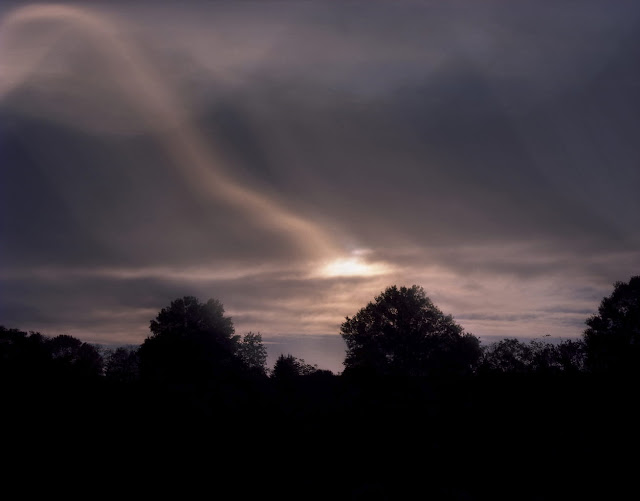 |
| Sunset, Walden Woods |
McCarty speaks of her last visit to the Sleepy Hollow Cemetery in conversation with Kirsten Rian:
But on my last trip I had the impulse to photograph the ground in front of Emerson’s tombstone. I made both a long exposure to see what an overexposed image would look like and then a “standard” timed and light balanced exposure. And on the “standard” exposure I received the image [that made it into my book]. It looks like a double exposure, with half of the image in focus depicting the ground at the gravesite and on the other half of the image depicts streaks of light and foliage emanating from the ground. Neither exposure I made on that day was a double, but that is the picture I received. It is a more fitting depiction of Emerson’s grave than any of the photos I made there, but I can’t explain how it happened.
 |
| Walden Pond, Autumn |
And her experience of a completely unexpected outcome, in life living and art making, written now and presently, is tied to Emerson’s words some 182 years ago:
“Crossing a bare common, in snow puddles, at twilight, under a clouded sky, without having in my thoughts any occurrence of special good fortune, I have enjoyed a perfect exhilaration.”
Rowan Sinclair-Gregg is a recent graduate of St. John’s College, she has spent the past few months interning at non-profit publishing house Radius Books. You can email her at Rsinclairgregg@gmail.com.


