PHOTOBOOK REVIEWS, INTERVIEWS AND WRITE-UPS
ALONG WITH THE LATEST PHOTO-EYE NEWS

Social Media

Showing posts sorted by relevance for query Nick Brandt. Sort by date Show all posts

photo-eye Gallery Opening Friday June 10th – Nick Brandt: Inherit the Dust photo-eye Gallery is excited to announce Inherit the Dust, an exhibition of black-and-white panoramic photographs by Nick Brandt opening Friday June 10th and continuing through July 23rd, 2016.

Wasteland with Elephant, 2015 – © Nick Brandt

INHERIT THE DUST
Photographs by Nick Brandt

Opening June 10th, 5–7 PM

photo-eye Gallery
541 S. Guadalupe St, Santa Fe, NM 87501
Exhibition continues through July 23rd, 2016

ABOUT THE EXHIBITION
photo-eye Gallery is excited to announce Inherit the Dust, an exhibition of black-and-white panoramic photographs by Nick Brandt opening Friday June 10th and continuing through July 23rd, 2016.

Alleyway with Chimpanzee, 2014 – © Nick Brandt

ABOUT THE ARTIST
Born and raised in England, Nick Brandt has worked exclusively in East Africa since 2001. Brandt’s trilogy, On This Earth, A Shadow Falls, Across the Ravaged Land, eulogized the continent’s disappearing landscape and wildlife in stirring, monumental animal portraits. Each portion of the trilogy has been published as a best-selling monograph. Brandt’s work has been exhibited widely internationally, including Salo Art Museum, Finland; Preus National Museum of Photography, Oslo, Norway; Maier Museum of Art, Lynchburg, Virginia, and Hangaram Art Museum, Seoul, South Korea. In 2011, Fotografiska Museum, Stockholm, Sweden, hosted the artist’s first major solo museum exhibition. Nick Brandt currently lives and works in the mountains of Southern California.

ABOUT THE ARTWORK
Three years after the conclusion of his trilogy On This Earth, A Shadow Falls, Across the Ravaged Land, Nick Brandt returns to East Africa to photograph the escalating changes to the continent’s environment. In a series of epic panoramas, Brandt records the impact of man in places where animals used to roam, but no longer do. Brandt erects a life-size panel of one of his animal portrait photographs on location, setting them in landscapes of explosive urban development, factories, wastelands and quarries. Human life and work continue within the frame with the people oblivious to the presence of the panels and the animals featured in them, creatures who are now no more than ghosts in these areas. The interactions between the animals depicted on the panels and the scenes that surround them are striking; some animals appear to be suffering through this new reality alongside the humans, while others appear to survey the destroyed landscapes in lament of the land they once inhabited. By the end, we see that animals are not the sole victims in this out of control world.

Quarry with Lion, 2014 – © Nick Brandt

PRAISE FOR INHERIT THE DUST
“The wasted lands in Inherit the Dust were once golden savannah, sprinkled with acacia trees, where elephants, big cats and rhinos roamed. These now dystopian landscapes – as Nick Brandt’s unvarnished, harrowing but stunning work reveals — brings us face to face with a crisis, both social and environmental, demanding the renewal of humanity itself.”
— Kathryn Bigelow, Film Director, The Hurt Locker


"In Inherit the Dust… Nick Brandt’s astonishing panoramas are a jolting combination of beauty, decay, and admonishment. The result is an eloquent and complex 'J’accuse,' for the people are as victimized by 'development' as the animals are.

The breadth, detail, and incongruity of Brandt’s panoramas suggest a collision between Bruegel and an apocalypse in waiting."
— Vicki Goldberg, Art Critic, Author


View Inherit the Dust 

For additional information, and to purchase prints, please contact Gallery Director Anne Kelly at 505.988.5152 x 121 or anne@photoeye.com.


photo-eye Gallery Introducing: Nick Brandt's Inherit the Dust Nick Brandt has been making images in East Africa for more than 15 years. In that time the British-born, California-based artist has become a conservation activist for the continent, seeking to bring awareness of the massive changes caused by accelerated urban expansion and industrialization.His latest series, Inherit the Dust, is the artist's most dynamic, emotional, and important work to date.

Quarry with Lion, 2014 – © Nick Brandt

Nick Brandt has been making images in East Africa for more than 15 years. In that time the British-born, California-based artist has become a conservation activist for the continent, seeking to bring awareness of the massive changes caused by accelerated urban expansion and industrialization. His latest series, Inherit the Dust, is the artist's most dynamic, emotional, and important work to date. photo-eye Gallery is proud to feature this work in an exhibition opening Friday June 10th and continuing through July 23rd, 2016.
Across the Ravaged Land. Photographs by Nick Brandt. Abrams, 2013.
We are pleased to announce signed copies of Nick Brandt's newest book Across the Ravaged Land will arrive in September 2013.

Across the Ravaged Land is the third and final volume in Nick Brandt's trilogy of books documenting the disappearing natural world and animals of East Africa. Combined with the titles of Brandt's first two books, this book reveals the title of the completed trilogy: "On This Earth, A Shadow Falls Across The Ravaged Land."

Across the Ravaged Land offers a darker vision of the world that Brandt has been photographing for the last decade, a world still filled with a stunning beauty, but now tragically tainted and quickly disappearing at the hands of man.

Portrait of Elephant on Bare Earth, Amboseli 2011 -- Nick Brandt

For the first time, humans also make an appearance in photographs such as the cover image of a crouched ranger supporting the weight of two giant tusks of an elephant killed by poachers. One series of photographs features hunters' trophies placed back in the epic landscapes where once these animals roamed. Another series of photographs features perfectly preserved creatures calcified by the salts of a Rift Valley soda lake. In both instances, the animals appear strangely alive and sentient in death, appearing to be posing for their portraits.

Brandt sums up his photographic odyssey in two essays that speak to his commitment to the hard work of conservation and photography as a medium for expressing moral truths.

Lion Trophy, Chyulu Hills, 2012 -- Nick Brandt

Nick Brandt photographs exclusively in Africa, where since 2001 he has been working on a last testament to its wild animals and wild places. Brandt’s work has been widely exhibited in the United States and Europe. In 2010, he founded Big Life Foundation to help preserve critical ecosystems in Kenya and Tanzania. Born and raised in England, he lives in the mountains of Southern California.

More information about the book Across the Ravaged Land including price, description and bibliographical info can be found by clicking the title. Order Brandt's artist edition On this Earth, A Shadow Falls with images from the first two projects in the trilogy here.

Nick Brandt will be releasing new work from the series Across the Ravaged Land in September 2013. To be included in the announcement for Nick Brandt's new work, please contact Anne Kelly. View his other portfolios here.

photo-eye Gallery Selected Works - Nick Brandt and James Hajicek & Carol Panaro-Smith photo-eye Gallery's current exhibit titled Selected Works is a group show of photographic prints highlighting the diverse styles and subject matter embraced by photo-eye Gallery artists. This week we feature Nick Brandt and James Hajicek & Carol Panaro-Smith.

Selected Works is a group show of photographic prints currently on view at photo-eye Gallery highlighting the diverse styles and subject matter embraced by our represented artists. For the next few weeks, covering the duration of the exhibition, we are engaging the featured artists about their photographs inviting them to tell the stories behind their images.

In this Selected Works segment we reached out to gallery artists Nick Brandt and James Hajicek and Carol Panaro-Smith for some background details concerning their exhibition images.  Nick Brandt bears witness to an emotional scene while James and Carol complete a decade long investigation.


photo-eye Gallery From the Flat Files: Platinum Recording - Prints by Kevin O'Connell, James Pitts, & Nick Brandt “The prince of all media” — is how Alfred Stieglitz once referred to the platinum printing process. Indeed, platinum printing lives up to this moniker as it is one of the oldest, most refined, and stable of all black and white procedures in photographic history. Here at photo-eye Gallery we are proud to represent a few photographers who print with this noble metal including: James Pitts, Kevin O’Connell, and Nick Brandt.

Nick Brandt – Ostrich Egg Abandoned, Amboseli, 2007
28x36 inch Platinum Print

“The prince of all media” — is how Alfred Stieglitz, Photo-Secessionist and founder of Camera Work, once referred to the platinum printing process. Indeed, platinum printing lives up to this moniker as it is one of the oldest, most refined, and stable of all black and white procedures in photographic history.
photo-eye Gallery is pleased to announce an important opportunity to purchase Nick Brandt photographs while also making a donation to help protect the wildlife depicted in his images. Through January 31, 2011, 20% of all Nick Brandt photograph sales through photo-eye will go to the Big Life Foundation, started by Brandt in September 2010 to help conserve and protect East Africa’s endangered wildlife and ecosystems.

Please view Brandt’s work on our website at http://www.photoeye.com/nickbrandt

Nick Brandt states below why your support is so important.

Elephant Drinking, Amboseli, 2007. Killed by Poachers, 2009. © Nick Brandt.

The caption beneath the photograph above explains it all.

In a very short space of time, most of the large-tusked elephants featured in my books have been killed by poachers for their ivory.

Just in the last five months, many of Amboseli's last remaining amazing big bull elephants have been slaughtered. In the last few weeks alone, eight have been discovered killed, some with tusks so small you realize that none are safe any more. And these elephants are just the ones that we know about.

Since 2008, there has been a huge increase in demand from China and the Far East for ivory, and as a result, elephants are being wiped out at an alarming rate. The numbers are apocalyptic: it's estimated that as many as 35,000 elephants are being poached a year, that's 10% of the entire population of Africa's elephants each year. As things currently stand, it's no longer a matter of if a big-tusked elephant is killed, but when.

And it's not just elephants. The lions are being poisoned at an incredible rate too. It's become so bad that there are next to no lions left outside the national parks. Giraffes being killed at a faster rate for bush meat, and there are even contracts out on zebras, as their skins are the latest fad in Asia.

In the extraordinary Amboseli ecosystem, a trans-border area of Kenya and Tanzania, up until now, there has been very little in the way of protection. Our first major undertaking is a broad-scale anti-poaching operation for the Amboseli ecosystem. As of this moment in time and running for two months, Big Life Foundation now has, on both the Kenyan and Tanzanian sides:

- Seven anti-poaching camps built or modified and expanded, each manned by eight scouts/rangers.
- Two more camps that will be built and running by the end of January, bringing the total to nine.
- Seven anti-poaching patrol vehicles for all the camps.
- A team of new rangers and scouts, platoon commanders and training instructor hired. Over the next month or two, the Tanzanian rangers will be armed and trained up to full efficiency.
- Prosecution officers employed for both sides of the border to follow through on all arrests, making sure that the criminals receive necessary justice.
- The Kenya Wildlife Service will also shortly receive another fully equipped Land Cruiser for a patrolling Wildlife Protection Unit of eight armed rangers.
- A large network of informers on both sides of the border. This is critical to our success, and to preventing the killing of all species.
- The co-purchase of a Microlight plane for monitoring and surveillance.

But given the sheer level of poaching to suppress and overcome, and the size of the wilderness area we are protecting—over two million acres—we need to double the anti-poaching camps, with accompanying patrol vehicles and equipment.

Once this level of infrastructure is in place—160 rangers and scouts in eighteen camps, with aerial support above, tracker dogs and informer network support on the ground—we feel that we will then radically reduce the poaching of ALL animals in this extraordinary ecosystem.

It's a great start, but so much more is needed. We are operating with urgency because we know that we don't have time to wait.

We're hoping that once we get the poaching under control in Amboseli, we can target the issues long term, and further afield across East Africa. There is so much to be done to protect some of Africa's most magnificent wild animals from being all but wiped out in the very near future.

But we can only do this with financial support. Please help by donating to Big Life.

To learn about what we are already doing, and what we are going to be doing with your help, please visit our website:
http://www.biglifeafrica.org

Your support is crucial to our success and is greatly appreciated.

-Nick Brandt


Elephants Walking Through Grass, Amboseli, 2008, Leading Matriarch Killed by Poachers 2009 © Nick Brandt
Elephant with Half-Ear, Amboseli, July 2010. Killed by Poachers August 2010. © Nick Brandt

For more information about tax deductions and ordering photographs contact Anne Kelly, Associate Gallery Director at anne@photoeye.com or 505.988.5152 x121

If at this time you cannot support this important cause, perhaps you know someone who might be able to help. If so, please share this blog post with them.

Many thanks for your time and consideration. Warm wishes for the holiday season!

Rixon Reed, Director
Anne Kelly, Associate Director
photo-eye Gallery 505.988.5152 x121

______________________________

 View Nick Brandt's images at photo-eye Gallery here.

View books by Nick Brandt here.

photo-eye Gallery Nick Brandt - Behind the Photo: Elephant with Exploding Dust, Amboseli, 2004 In early May, Nick Brandt began posting the stories behind his beautiful and evocative portraits of African animals to his Facebook page. Brandt has graciously given us permission to reproduce them on photo-eye Blog. This week, Elephant with Exploding Dust, Amboseli, 2004.
In early May, Nick Brandt began posting the stories behind his beautiful and evocative portraits of African animals to his Facebook page. Brandt has graciously given us permission to reproduce them on photo-eye Blog.

Elephant With Exploding Dust, Amboseli, 2004 — Nick Brandt


photo-eye Gallery Nick Brandt - Behind the Photo: Ranger with Tusks of Killed Elephant, Amboseli 2011 In early May, Nick Brandt began posting the stories behind his beautiful and evocative portraits of African animals to his Facebook page. Brandt has graciously given us permission to reproduce them on photo-eye Blog. This week, Ranger with Tusks of Killed Elephant, Amboseli 2011.
In early May, Nick Brandt began posting the stories behind his beautiful and evocative portraits of African animals to his Facebook page. Brandt has graciously given us permission to reproduce them on photo-eye Blog.

Ranger with Tusks of Killed Elephant, Amboseli 2011 — Nick Brandt

photo-eye Gallery Nick Brandt - Behind the Photo: Giraffes in Evening Light, Maasai Mara, 2006 In May 2014, Nick Brandt began posting the stories behind his beautiful and evocative portraits of African animals to his Facebook page. Brandt has graciously given us permission to reproduce them on photo-eye Blog. This week, Giraffes in Evening Light, Maasai Mara, 2006.
In May of 2014, Nick Brandt began posting the stories behind his beautiful and evocative portraits of African animals to his Facebook page. Brandt has graciously given us permission to reproduce them on photo-eye Blog.

Giraffes In Evening Light, Maasai Mara, 2006 — Nick Brandt


photo-eye Gallery Nick Brandt - Behind the Photo: Lion Before Storm II - Sitting Profile, Maasai Mara, 2006 In early May, Nick Brandt began posting the stories behind his beautiful and evocative portraits of African animals to his Facebook page. Brandt has graciously given us permission to reproduce them on photo-eye Blog. This week, Lion Before Storm II - Sitting Profile, Maasai Mara, 2006.
In early May, Nick Brandt began posting the stories behind his beautiful and evocative portraits of African animals to his Facebook page. Brandt has graciously given us permission to reproduce them on photo-eye Blog.

Lion Before Storm II - Sitting Profile, Maasai Mara, 2006 — Nick Brandt

photo-eye Gallery Nick Brandt - Behind the Photo: Petrified Bat, Lake Natron, 2012 In early May, Nick Brandt began posting the stories behind his beautiful and evocative portraits of African animals to his Facebook page. Brandt has graciously given us permission to reproduce them on photo-eye Blog. This week, Petrified Bat, Lake Natron, 2012.
In May of 2014, Nick Brandt began posting the stories behind his beautiful and evocative portraits of African animals to his Facebook page. Brandt has graciously given us permission to reproduce them on photo-eye Blog.


photo-eye Gallery Nick Brandt - Behind the Photo: Gorilla On Rock, Parc Des Volcans, 2008 In early May, Nick Brandt began posting the stories behind his beautiful and evocative portraits of African animals to his Facebook page. Brandt has graciously given us permission to reproduce them on photo-eye Blog. This week, Gorilla On Rock, Parc Des Volcans, 2008.

In early May, Nick Brandt began posting the stories behind his beautiful and evocative portraits of African animals to his Facebook page. Brandt has graciously given us permission to reproduce them on photo-eye Blog.

Gorilla on Rock, Parc des Volcans 2008 — Nick Brandt

photo-eye Gallery Nick Brandt - Behind the Photo: Elephant Drinking, Amboseli, 2007 In early May, Nick Brandt began posting the stories behind his beautiful and evocative portraits of African animals to his Facebook page. Brandt has graciously given us permission to reproduce them on photo-eye Blog. This week, Elephant Drinking, Amboseli, 2007.
In early May, Nick Brandt began posting the stories behind his beautiful and evocative portraits of African animals to his Facebook page. Brandt has graciously given us permission to reproduce them on photo-eye Blog.

Elephant Drinking, Amboseli, 2007 — Nick Brandt

photo-eye Gallery Nick Brandt - Behind the Photo: Cheetah and Cubs Lying on Rock, Serengeti, 2007 In early May, Nick Brandt began posting the stories behind his beautiful and evocative portraits of African animals to his Facebook page. Brandt has graciously given us permission to reproduce them on photo-eye Blog. This week, Cheetah and Cubs Lying on Rock, Serengeti, 2007.
In early May, Nick Brandt began posting the stories behind his beautiful and evocative portraits of African animals to his Facebook page. Brandt has graciously given us permission to reproduce them on photo-eye Blog.

Cheetah & Cubs Lying on Rock, Serengeti, 2007 — Nick Brandt

photo-eye Gallery Nick Brandt - Behind the Photo: Petrified Fish Eagle, Lake Natron, 2012 In early May, Nick Brandt began posting the stories behind his beautiful and evocative portraits of African animals to his Facebook page. Brandt has graciously given us permission to reproduce them on photo-eye Blog. This week, Petrified Fish Eagle, Lake Natron, 2012.
In early May, Nick Brandt began posting the stories behind his beautiful and evocative portraits of African animals to his Facebook page. Brandt has graciously given us permission to reproduce them on photo-eye Blog.

Petrified Fish Eagle, Lake Natron, 2012 — Nick Brandt

photo-eye Gallery Nick Brandt - Behind the Photo: Wildebeest Arc, Maasai Mara, 2006 In early May, Nick Brandt began posting the stories behind his beautiful and evocative portraits of African animals to his Facebook page. Brandt has graciously given us permission to reproduce them on photo-eye Blog. This week, Wildebeest Arc, Maasai Mara, 2006.
In early May, Nick Brandt began posting the stories behind his beautiful and evocative portraits of African animals to his Facebook page. Brandt has graciously given us permission to reproduce them on photo-eye Blog.

Wildebeest Arc, Maasai Mara, 2006 — Nick Brandt
Ranger with Tusks of Killed Elephant, Amboseli 2011 by Nick Brandt

Exhibition runs Friday, September 27th through November 2013. 
Opening & Artist Reception Friday, September 27th, 5-7 pm
photo-eye Gallery is located at 376-A Garcia Street, Santa Fe, NM 87501


photo-eye Gallery is pleased to announce an exhibition of photographs by Nick Brandt. The exhibition celebrates the first release of new work by Brandt in two years and a new book, Across the Ravaged Land, published by Abrams and due in September.

Portrait of Elephant on Bare Earth, Amboseli 2011 by Nick Brandt
Across the Ravaged Land is the third and final volume in Nick Brandt's trilogy of books documenting the disappearing natural world and animals of East Africa. Combined with the titles of Brandt's first two books, this book reveals the title of the completed trilogy: "On This Earth, A Shadow Falls Across The Ravaged Land."

Across the Ravaged Land offers a darker vision of the world that Brandt has been photographing for the last decade, a world still filled with a stunning beauty, but now tragically tainted and quickly disappearing at the hands of man.

For the first time, humans also make an appearance in photographs such as the cover image of a crouched ranger supporting the weight of two giant tusks of an elephant killed by poachers. One series of photographs features hunters' trophies placed back in the epic landscapes where once these animals roamed. Another series of photographs features perfectly preserved creatures calcified by the salts of a Rift Valley soda lake. In both instances, the animals appear strangely alive and sentient in death, appearing to be posing for their portraits.

Nick Brandt photographs exclusively in Africa, where since 2001 he has been working on a last testament to its wild animals and wild places. Brandt’s work has been widely exhibited in the United States and Europe. In 2010, he founded Big Life Foundation to help preserve critical ecosystems in Kenya and Tanzania. Born and raised in England, he lives in the mountains of Southern California.


For more information please contact Anne Kelly at 505-988-5159 x 121 or anne@photoeye.com
  photo-eye Gallery   The Day May Break, Chapter Two: An Interview with Nick Brandt    photo-eye Gallery       Gallery Director Anne Kelly and represented artist Nick Brandt discusses the evolution of his artistic vision, tracing its trajectory from his early days in Africa to his recent explorations in Bolivia.
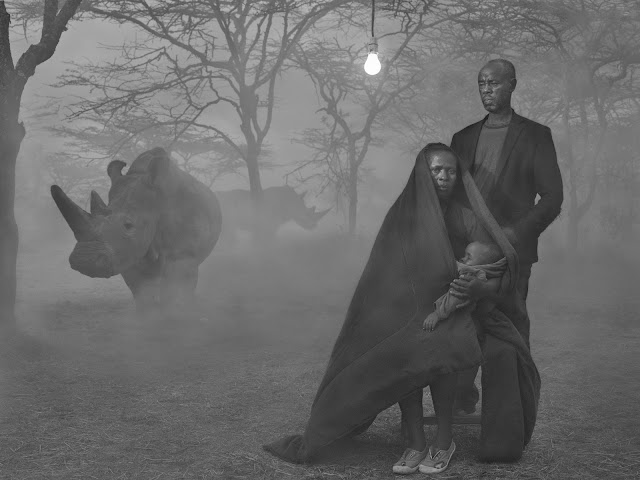
Nick Brandt, Alice, Stanley and Najin, Kenya, 2020

Nick Brandt, an accomplished artist known for his stunning photographs of Africa, has embarked on a remarkable journey spanning over two decades. His latest project, The Day May Break, a global series, takes him beyond the borders of Africa to Bolivia. With the release of his new book, The Day May Break, Chapter Two, Brandt's career reaches a significant milestone, offering a chance to reflect on his artistic evolution and delve deeper into his current works.

In a captivating interview with photo-eye Gallery Director Anne Kelly, Brandt discusses the evolution of his artistic vision, tracing its trajectory from his early days in Africa to his recent explorations in Bolivia. Their conversation also highlights Brandt's influential conservation organization, Big Life Foundation, which has made a profound difference in preserving wildlife habitats in one of Africa's key ecosystems. 

The interview delves into Brandt's global series, which addresses urgent environmental concerns, particularly climate change. Through his mesmerizing photographs, Brandt captures the awe-inspiring beauty of the natural world while emphasizing its vulnerability to human-induced threats.

This interview and the release of Brandt's new book offer a unique and celebratory opportunity to appreciate the legacy of an extraordinary artist, immerse ourselves in his artistic journey and achievements, and contemplate the promising directions that lie ahead for Nick Brandt's illustrious career.
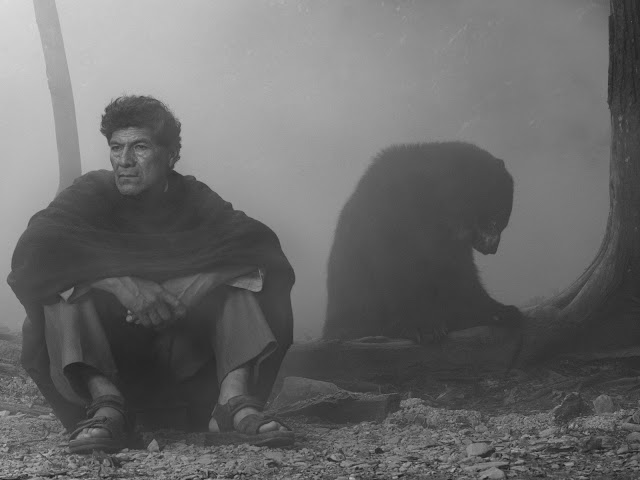

Nick Brandt, Lucio and Tarkus, Bolivia, 2022

Anne Kelly: Over 20 years ago you started photographing in Africa, this began with what grew into a trilogy of monumental portraits of East African Animals. Conservation was the goal from day one, but the trilogy was just the beginning. The time spent in Africa photographing was the direct path to the creation of your conservation organization Big Life Foundation—followed by several other call-for-action projects, including Inherit the Dust and This Empty World, leading to the multi-part global series that you are working on today. Would you have anticipated the trajectory of your work when you started photographing in Africa 20 years ago?
Nick Brandt: Good question. I don’t think I would have anticipated this trajectory back at the beginning, but that is an answer I am not happy about. I feel that I spent far too many years on the early work. I really only finally found my voice in 2014 with Inherit the Dust and from there, work that I feel is much more complex and ambitious than the early work.

Nick Brandt, Jame with People in Fog, Bolivia, 2022

AK: Your current series, The Day May Break, calls attention to climate change and environmental destruction globally. The images are made in carefully selected sanctuaries and your subjects are survivors, both human and animal. The humans have lost their homes and or livelihoods, and the rescued animals can’t be introduced back into the wild. In this series animals and humans are photographed together in the same frame and seen as equal. Please go into the transition from Inherit the Dust and This Empty World, to your current work.
NB: With every series, you can see people becoming more and more prominent in the photos. With The Day May Break, I went much further again. This was because this series (finally) addressed climate change. And with its direct impact on humans—especially those in poor rural areas of countries, with their low carbon emissions, bear the least responsibility—this concept grew out of that. So this series conceptually developed out of the desire to address climate change and to find a way to show both the most vulnerable humans and animals sharing the same fate. 

Nick Brandt, Lineth and Kini, Bolivia, 2022

AK: While your new works look at some difficult topics, hope is magnified in the new work.  Please expand.
NB: All these people and animals have been through trauma and dramatic hardships. But they survived. They are all still alive. And so in that, there is still hope and possibility.  It’s as the title of the series, The Day May Break, implies– The earth could shatter, or dawn still comes.
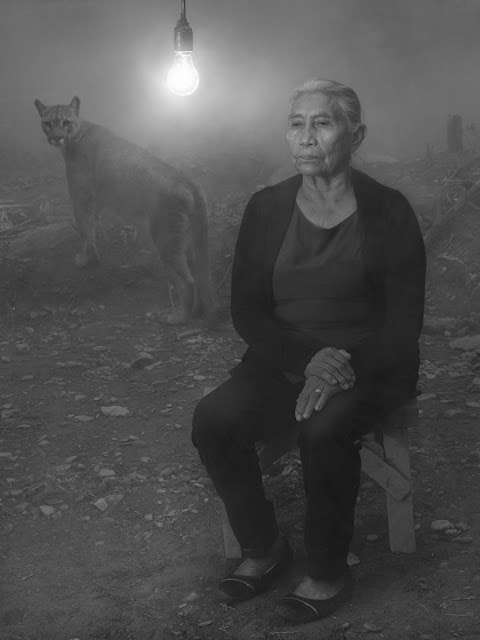
Nick Brandt, Juana and Nayra, Bolivia, 2022

AK: After working with animals in the wild for the early years, I imagine that the process of working with animals that are habituated to humans is a very different experience. Beyond the obvious, how does working with sanctuary animals compare to working in the wild?
NB: Thanks to their wonderful caretakers, many of the animals are so habituated to humans that they are very relaxed and with a little encouragement in the form of a mulberry leaf here, a carrot, or a nut there, hit their marks with impressive regularity. But regardless, one thing does not change—my photographing animals as sentient creatures, creatures that I view no different than humans. So I wait for those indefinable moments when they appear to present themselves for their portraits.

AK: Let's talk about your method of working. All of the images from the series On This Earth Trilogy were shot in the African wild - quietly watching and waiting for the right moment, and typically for long periods. Inherit the Dust, Empty World, and The Day May Break are high-production projects that involve a bit more control. However with these projects, after the scene is set, you take off your "director hat" and go back to patiently watching and waiting for "the moment". Why does that method of working appeal to you?
NB: I like working very loosely. I feel that what happens in real life is superior to what I might pre-script in my head, although of course, yes I do pre-visualize some photos, like for example, Richard and Sky, with Richard up a tall ladder so that his head and the giraffe's head (Sky) are a similar height in frame.
  
But during The Day May Break photo sessions, I frequently swapped out people with each respective animal until it felt like somehow, emotionally, the right combination. I like seeing what unexpected serendipity might unfold. For me, it was like a kind of photographic jazz.

Even in the earlier projects, it’s very loose. In Inherit the Dust, for example, the life-size portraits on panels were set in place in each location, and then I stayed there long enough that the local people were no longer interested that I was there and just went about their lives. At the start of that project, I had tried hiring people and shouted action but it was just terrible and I quickly realized I would get better results just letting the local people do their thing. Besides waiting for clouds, those photos were just a kind of elaborate street photography.

AK: Chapter Two was photographed in a sanctuary in Bolivia—this was your first significant project outside of Africa. Why did you select Bolivia specifically?
NB: The original plan had been to go to Brazil, which for the last five years, under eco-terrorist thank-god-former President Bolsonaro, has become the poster child for the apocalyptic ever-escalating destruction of the Amazon rainforest.

However, in Brazil, there were only a few habituated species in each sanctuary and those sanctuaries were spread out the length and breadth of the vast country. This would have necessitated many days of flying and driving between each: expensive, wasteful, and likely created the need to find a new crew in each new area that we visited.

Fortunately, to Brazil’s west, in Bolivia, is the home of Senda Verde Animal Sanctuary. Senda Verde is not just a wonderful animal sanctuary and non-profit organization, but also practically speaking, it is home to rescued members of almost all of the key South American species. This meant that I was able to photograph the entire Chapter Two part of the project in this one location. They’re wonderful people working on a tiny budget and despite that, never turn away a reduced animal, from bears down to birds and baby monkeys.
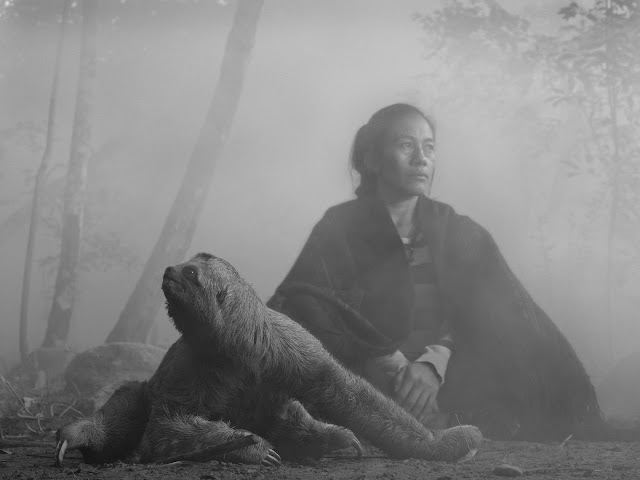
Nick Brandt, Ruth and Zosa, Bolivia, 2022

AK: A percentage of proceeds from print sales go to the people and sanctuaries that you are photographing at. I know that this has already made a big difference. Please share a few stories about this.
NB: The impact of those proceeds has had the most impact in Kenya and Zimbabwe because, at this point, that work has been out for 1 1/2 years. Regardless of who is the subject of each photo, the proceeds have been evenly divided among the people on a biannual basis, a kind of royalty payment. But in addition, certain buyers have donated a further amount to the people featured in the actual prints that they bought.

As a result, three of the young girls have their education paid for for the next six years; several couples have been able to start their own businesses after having their lives ruined by the impacts of climate change, and homes or parts of homes have been rebuilt that were destroyed by floods and cyclones.

AK: Some viewers (mistakenly) assume that the photos from The Day May Break are composites, which they are not. It is important to you that people understand that the image is made "in camera”. Why is this method of working important to you?
NB: Yes, there seems to be widespread thinking these days that anything visually unexpected or apparently hard to execute must have been photoshopped into creation - or god help us now - A.I generated. I could make my life much easier, and save a ton of time and thus money if I went the Photoshop route, but there is so much more aesthetic and emotional integrity to these portraits when the people and animals are photographed together, at the same time in the same frame. If I just stitched two separate elements together, it would never be as organic, as surprising. A photo like Kuda and Sky II, where Sky the giraffe unexpectedly leans down over Kuda as she sits at a table, I would never have dreamed that up.
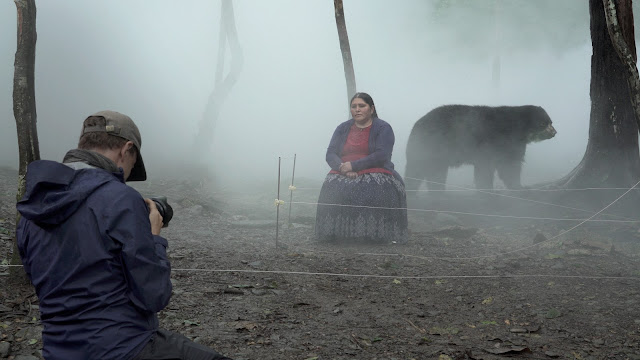
The Day May Break, Chapter Two, Nick Brandt photographing Carmen and Tarkus

AK: The subjects in your images are typically not looking directly into the camera, they seem to be in their own world and are seemingly unaware of your presence. In the case that the subjects are looking in your general direction, it is almost as though they are looking through you or over your shoulder. I imagine that this is a result of your method of working, but I sense that there is more to it. Please expand.
NB: As a kind of an aside, the humans and animals are deliberately never looking at each other. They share the same frame, of course, sharing the same universe, but remain disconnected from one another.

Meanwhile, there are the young girls, the future & to generalize massively, the more empathetic of the sexes (noting that there are the Marjorie Taylor Greenes, Lauren Bohberts, and Amy Coney Barretts of the world to contradict that). They usually look the strongest the most determined and defiant, looking directly into the camera.

In Marisol’s defiant look, I am reminded of Greta Thunberg. This planet urgently needs a million Gretas. If one young girl can start alone with just a placard on a street in Stockholm, so can we all.
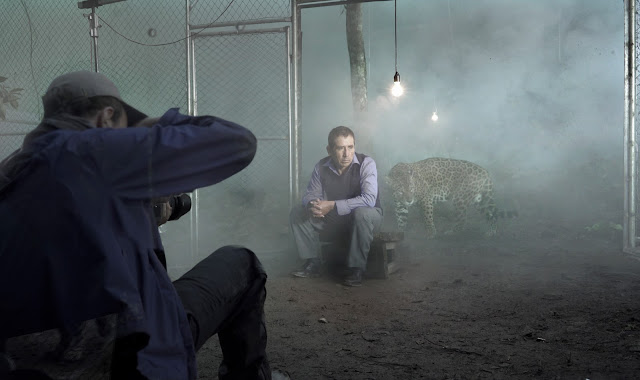
The Day May Break, Chapter Two, Nick Brandt Photographing Luis and Hernak

AK: What has been the largest technical challenge shooting the new work?
NB: As so often in my work, the largest technical challenge is caused by the wrong kind of weather. So, on The Day May Break, Chapter One, I went in the rainy season, as I so often do, not just to take advantage of cloud cover, always my preferred aesthetic, but also to have enough moisture in the air for the water-based fog machines that we used to work effectively.

When you have weeks of baking, bone-dry heat and winds, and cloudless skies, the fog coming out of the machines evaporates almost immediately. So for two weeks in Zimbabwe, we were only able to photograph for thiry minutes before sunrise and thirty minutes after sunset.
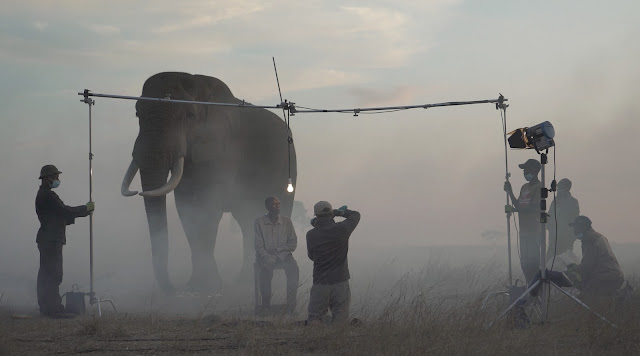
The Day May Break, Chapter Two, Nick Brandt photographing Mathew and Mak

AK: You note in your book that this is a Carbon Neutral project. Please expand on the actions that you are taking.
NB: I feel that if I make a project that is significantly about climate change, the project itself needs to be carbon neutral. So as imperfect as the system of Carbon credit is, I paid for carbon credits equivalent to all the fuel consumption from transport, generators, etc. from my shoot toward an African reforestation program. 

AK: Let's talk about the process of making books, you have published a few, do you have advice for someone that is considering publishing their first?
NB: For me, publishing a book is invaluable. It can generate publicity about your work in so much more effective way than having no book. No one in the media knows or cares whether your print run is 500 or 10,000 - the book exists. And if it’s well printed, it acts as a very useful portfolio. To me, it’s worth doing even if you have to put in your own money, which is increasingly inevitable. In these days of social media, print runs have dropped dramatically, so it’s pretty hard to make any kind of profit.
  
Once you have a publisher, do everything you can to not cave in to compromise. Every time I have done it –to not appear difficult, to not want to be unpopular– I have ended up in earlier years with poor results and deeply regretted that I did not push harder with my concerns. Visual creators live and die by how our work is presented (this is why for me, Instagram is so inadequate - visually complex detailed imagery reduced to this depressing minuscule size on a phone, and in the hands of others, often randomly cropped.

AK: In the back of the book, you have included the personal stories of each animal and person involved in the project.  Who was responsible for locating all of the humans that participated and recording their stories?
NB: For many weeks in advance, researchers went out across the country, especially in Zimbabwe and Bolivia, looking for and meeting people who had stories to tell of lives devastated by climate change. Once chosen by me from their photos and stories, they then traveled to the sanctuaries and conservancies to be photographed with the animals.

AK: The text in your recent book, The Day May Break, Chapter Two, is written to the reader/readers of the future. I know that text isn't written to me specifically, but it feels inclusive and engaging, as opposed to text that is written "at" the reader.  I like that.
NB: Well, I guess because I fervently believe that all of us can do something. As I wrote in the essay: 
“We need to all become good ancestors. We need to adopt a way of life that reduces the environmental impact that our actions will have on those billions of unborn yet to come. Can we show that we care about the humans and animals and trees that we will never live to see?”

AK: What is next?
NB: I just returned from photographing Chapter Three of The Day May Break in Fiji. All being well, this will be released in September, with the book to hopefully follow in 2024.


The Day May Break, Chapter Two by Nick Brandt

>>Purchase Book <<


Signed copies are available!

About the Limited Editions:
Four Limited Edition Prints are available in editions of 25 each, signed and numbered on a label affixed verso on a beautiful matte, archival paper.

Each print is presented in a handsome display folder with the print easily removable for framing. A signed copy of The Day May Break: Chapter Two is included with each print.
(8⅝ x 11½" image on 9⅝ x 12½" matte paper. Edition of 25, each.)

Clockwise, from top left: Carmen and Zosa II, Jame and People in Fog, Lucio and Chascas, and Lineth and Kini


*      *      *

If you are in Santa Fe, please stop by during gallery hours or schedule a Virtual Visit HERE.


For more information, and to reserve one of these unique, extraordinary new works,
please contact photo-eye Gallery Director Anne Kelly or Gallery Associate Jovi Esquivel.


photo-eye Gallery

1300 Rufina Circle, Unit A3, Santa Fe, NM 87507
Tuesday– Saturday, from 10am– 5:30pm

You may also call us at (505) 988- 5152 x202


photo-eye Gallery Nick Brandt - Behind the Photo: WASTELAND WITH ELEPHANT, 2015 In this Behind the Photo segment, Nick Brandt describes the creation of Wasteland with Elephant, the signature image from his new series Inherit the Dust.
In this Behind the Photo segment, Nick Brandt describes the creation of Wasteland with Elephant, the signature image from his new series Inherit the Dust. In his own words, Brandt expands on the scene’s characters and context including details about the elephant, the area, and the human inhabitants. Inherit the Dust is currently on view at photo-eye Gallery through July 23rd, 2016.

Wasteland with Elephant, 2015 – © Nick Brandt

photo-eye Gallery Nick Brandt - Behind the Photo: UNDERPASS WITH ELEPHANTS, 2015 (Lean Back, Your Life is On Track) In this Behind the Photo segment, Nick Brandt describes his intentions while creating Underpass with Elephants, 2015 (Lean Back, Your Life is On Track), one of the most compelling images from his latest series Inherit the Dust.
In this Behind the Photo segment, Nick Brandt describes his intentions behind Underpass with Elephants, 2015 (Lean Back, Your Life is On Track), perhaps the most compelling image from his latest series Inherit the Dust. In his own words, Brandt expands on the transformative power of context and the loss of mankind's connection to nature. Inherit the Dust is currently on view at photo-eye Gallery through July 23rd, 2016.

Underpass with Elephants, 2015 (Lean Back, Your Life is On Track) – © Nick Brandt