PHOTOBOOK REVIEWS, INTERVIEWS AND WRITE-UPS
ALONG WITH THE LATEST PHOTO-EYE NEWS

Social Media

Showing posts with label Alessandra Sanguinetti. Show all posts
Book Review Some Say Ice Photographs by Alessandra Sanguinetti Reviewed by Brian Arnold "Singh has developed a life’s work based on a deep reverence for books and has pioneered new understandings of what they can be by exploring all their layers — as objects and artifacts, as metaphysical entities, as narrative vessels and as performance pieces..."

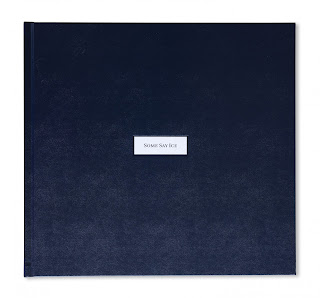
Some Say Ice By Alessandra Sanguinetti.
https://www.photoeye.com/bookstore/citation.cfm?catalog=ZK132
Some Say Ice
Photographs by Alessandra Sanguinetti

MACK, London, UK, 2022. In English. 148 pp., photographs, 11x12".

In The Photobook: A History Vol. 2, Gerry Badger and Martin Parr describe the 1973 book by historian Michael Lesy, Wisconsin Death Trip, as being

"Ahead of its time, not because it was a published collection of nineteenth-century vernacular photographs....but because of Lesy’s attitude to his material. He looked upon the photographs of Charles Van Schaick, taken between 1890 and 1910 in the town of Black River Falls, Wisconsin, in a way that predicted postmodernism. To say that he viewed them skeptically would be overstating the case, but he certainly did not take them at face value, and he treated them proactively rather than reactively – that is, as a creative resource."

The book is now an essential part of photobook history, revered as a sort of cult classic. Wisconsin Death Trip is a romantic story that Badger and Parr go on to compare to Steichen’s The Family of Man, I’m So Happy by Heiferman and Kismaric, and Portraits and Dreams by Wendy Ewald. These books were all developed by their authors working with collections or archives of photographs, rather than a more typical photobook with the author in charge of a camera, though Wisconsin Death Trip is unique in the sort of ownership the curator assumed in defining the meaning of the pictures.


If you are unfamiliar with the book, it started as a master’s degree project of Lesy’s while a student of American History at the University of Wisconsin. Perusing the archives of the Wisconsin Historical Society, Lesy stumbled upon some glass plate negatives made by Charles Van Schaick, a collection of 8,000 photographs made in Black River Falls, Wisconsin between 1895-1940. Lesy went on to pursue a PhD in American History at Rutgers University, and two hundred of these pictures were again included in his doctoral thesis. Wisconsin Death Trip grew out of his graduate work, and again developed using Van Schaick’s pictures, this time distilling the collection down to 130 pictures. To complete the book, Lesy paired the photographs with different historical documents pulled from newspapers and other sources. These documents describe various crimes, misdemeanors and tragedies in Black River Falls and its neighboring communities, and combined with Van Schaick’s photographs, Lesy created a historical narrative of a region in deep despair and with a film noir-like feel. I like to think of Wisconsin Death Trip as being similar to In Cold Blood by Truman Capote, who described his book as a nonfiction novel. Looking at it this way, we can better understand the assertion that Wisconsin Death Trip predicted postmodernism.


Over 40 years later, Magnum photographer Alessandra Sanguinetti returned to Black River Falls to photograph the region the way she saw it, referring to Wisconsin Death Trip as a primary influence when she was first embracing photography as a young woman in Bueno Aries. Sanguinetti returned decades later armed with a much more sophisticated vision than Lesy or Van Schaick, but like its predecessor, Some Say Ice is an instant classic. Unlike Lesy, Sanguinetti made her own photographs, and they reveal a tremendous visual sophistication. The design and production of Some Say Ice are traditional, simple and rich. All in black-and-white, each spread is just one picture, and guides us through a meditation on Middle America. Going through the book can feel intoxicating, as page after page you see pictures that so beautifully mix photographic technique with a curious approach to psychology, equally as enigmatic as it is flawless. Washington Post critic Kenneth Dickerman compares Some Say Ice to an A24 film, an apt comparison that I think describes a similar reading to the pictures — somehow confoundingly bleak and beautiful, harsh and compassionate.

Like Wisconsin Death Trip, Sanguinetti’s book is a dark romance about Middle American disillusionment and despair. She isn’t as grounded in the photographic vernacular as Lesy, though the book does reference vernacular photographic traditions (I love the group portraits of the young girls — the Black River Fall Varsity Girls Basketball Team and the Catholic School). Instead, she brings incredible visual skills, full of a masterful understanding of lighting, tonality and sequencing, to create a narrative that is quintessentially American, and yet somehow made new and inventive again. Like any good photobook about America, this one is puzzled together with the same tropes, metaphors and symbols — God, guns, new frontiers, deeply held secrets and a curiously humble beauty.


Despite these praises for Some Say Ice, I will confess to being a little disappointed by this book. If you are familiar with the wonderful early books by Sanguinetti, On the Sixth Day and The Adventures of Guille and Belinda and The Enigmatic Meaning of Their Dreams, these are much richer with humility, affection, and deeper connection with a place, and as a result they represent much greater feelings of compassion and affirmation. Some Say Ice feels cooler and more aloof, as though developed with a much more conceptual framework (perhaps something like Lesy), ultimately embracing a clinical and distant perspective. Her early books have a wonderful naivety — the discovery we witness in the girls photographed in The Adventures of Guille and Belinda parallel the photographer’s discoveries — and Some Say Ice is anything but naïve. Nevertheless, the book is tightly edited, with each photograph demonstrating a superlative visual and technical aptitude.

Purchase Book

Read More Book Reviews


Brian Arnold
is a photographer, writer, and translator based in Ithaca, NY. He has taught and exhibited his work around the world and published books with Oxford University Press, Cornell University, and Afterhours Books. Brian is a two-time MacDowell Fellow and in 2014 received a grant from the Henry Luce Foundation/American Institute for Indonesian Studies.
Book Review The Adventures of Guille and Belinda and The Enigmatic Meaning of Their Dreams Photographs by Alessandra Sanguinetti Reviewed by Laura Larson "Alesandra Sanguinetti’s The Adventures of Guille and Belinda and The Enigmatic Meaning of Their Dreams, originally published in 2010, has now been reissued by Mack Books. The book is the first of an anticipated three-volume set dedicated to her two-decade strong project about the Argentinian cousins, Belinda and Guille. A devotional to female friendship, Sanguinetti witnesses the girls in childhood and early adolescence, charting the imminence of adulthood in their everyday..."

By Alessandra Sanguinetti.
https://www.photoeye.com/bookstore/citation.cfm?catalog=ZJ618
The Adventures of Guille and Belinda and The Enigmatic Meaning of Their Dreams
Photographs by Alessandra Sanguinetti

MACK, London, England, 2020. 120 pp., 11x11".

Alesandra Sanguinetti’s The Adventures of Guille and Belinda and The Enigmatic Meaning of Their Dreams, originally published in 2010, has now been reissued by Mack Books. The book is the first of an anticipated three-volume set dedicated to her two-decade strong project about the Argentinian cousins, Belinda and Guille. A devotional to female friendship, Sanguinetti witnesses the girls in childhood and early adolescence, charting the imminence of adulthood in their everyday.

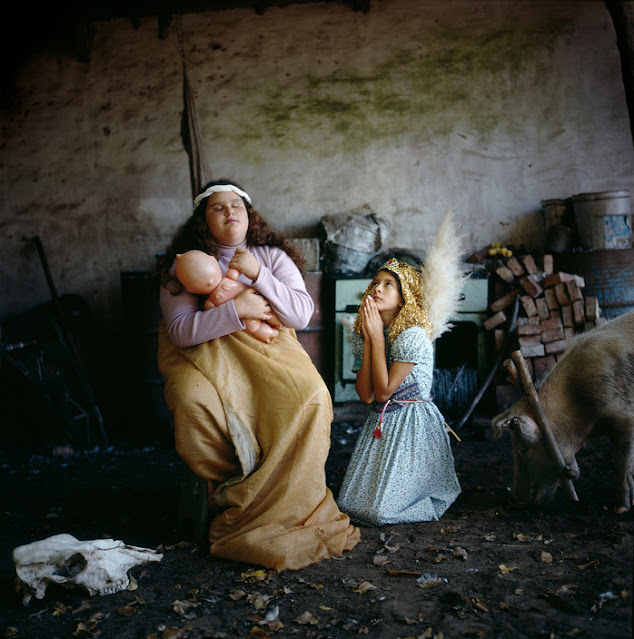
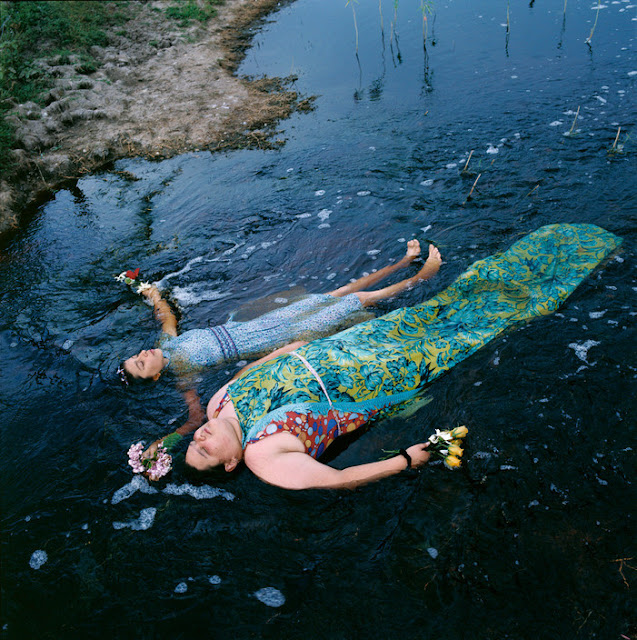
Sanguinetti elaborates on the documentary premise of the durational project with her collaborative approach to working with Beli and Guille. The girls would improvise on different narrative cues. In some, they enact the anticipated stories of (heteronormative) womanhood: romance, marriage, pregnancy. Biblical iconography informs their playacting too — a nativity scene, a dead Christ — nodding to the country’s Catholic dominant society. These dramas, refracted through the sensibilities of the girls, stage a feedback loop of play, culture, and fantasy, set within the backdrop of Argentinian farm life, a powerful third character of their dream life. Beli and Guille are charismatic performers, full of verve, humor, and vulnerability. Sanguinetti depicts their intimacy with warmth and tenderness alongside the richly observed details of their domestic landscape: family, animals (they are everywhere), and the farm.


Their roots in home and land are brilliantly depicted in a pair of images. Guille bathes in a metal bathtub in the yard, surrounded by ducks, a single chicken, and a dog. An elderly woman holds a fistful of her long hair, the strand forming a line with the grandmother’s arm. An uninterrupted stream of water, another line, flows from a pipe that juts into the upper left corner of the frame. In the next image, Beli and a man stand in a field, facing one another, holding a thin length of ribbon stretched between them. Lines of attachment unfold through touch.

Looking at these pictures, I was reminded of a game I played with my daughter when she was a baby. We held opposite ends of a Slinky. I would walk away, stretching the toy as far as it could go. Hold on, don’t let go, I said before I would walk back to her. I always come back.


A peek on Sanguinetti’s Instagram reveals a video of Belinda and Guille carrying out a funeral ceremony. Beli, playing the role of the priest, recites the prayer; Guille, the only attendant, weeps. Suddenly, they erupt into giggles, puncturing the solemnity of the play. There is no grave, just two girls riffing off one another. The photograph of this scene shows a smiling Beli watching Guille’s convincing, if scenery-chewing, enactment of grief.

Do you remember when you realized for the first time you would die?

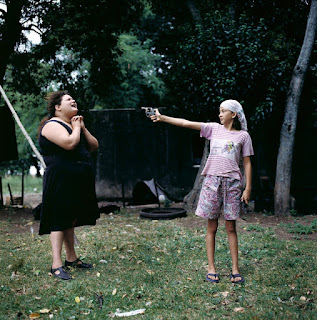
Death is a prosaic presence in the book, a familiar companion in the rhythm of their days. The girls watch the skinning of a cow. Later, Beli delicately peels the viscera off its head. Early in the book, we see Guille gently stretching the wings of a rooster in the kitchen. Later, she carries a dead chicken by its feet through a field. I wondered if it was kin to the rooster. Brutality filters into their play. The girls stage scenes of melodramatic violence, riffing on the gestures of tabloids and Hollywood movies. Beli points a toy pistol under her chin, her head lifted towards the sky while Guille, hands on her hips, watches her suicide reflected in a puddle, seemingly unmoved. In another image, Beli turns the pistol on Guille who appears to beg for mercy, hands clasped in prayer. It’s her turn to look up at the sky.

What haunts the long-term documentary project is the life expectancy of its subjects, the understanding they will die too. This is the melancholic chord of the work, knowledge held in tension with these vital portraits. I want to make a claim here that this is the gaze of a parent, a set of eyes that knows well the expanses and limits of a life and how it can, and can’t, be rendered in a photograph. She generously reserves as much as she shares, honoring the girls’ intrinsic mysteries. Sanguinetti’s photographs are prisms, multiplying and layering time: the textures of the quotidian, its roots in family and land, and the imagined joys and sorrows of the girls’ futures.

Purchase Book

Read More Book Reviews


Laura Larson
is a photographer, writer, and teacher based in Columbus, OH. She's exhibited her work extensively, at such venues as Art in General, Bronx Museum of the Arts, Centre Pompidou, Columbus Museum of Art, Metropolitan Museum of Art, Museum of Fine Arts, Houston, SFCamerawork, and Wexner Center for the Arts and is held in the collections of Allen Memorial Art Museum, Deutsche Bank, Margulies Collection, Metropolitan Museum of Art, Microsoft, Museum of Fine Arts, Houston, New York Public Library, and Whitney Museum of American Art. Hidden Mother (Saint Lucy Books, 2017), her first book, was shortlisted for the Aperture-Paris Photo First Photo Book Prize. Larson is currently at work on a new book, City of Incurable Women (forthcoming from Saint Lucy Books) and a collaborative book with writer Christine Hume, All the                                                               Women I Know.