PHOTOBOOK REVIEWS, INTERVIEWS AND WRITE-UPS
ALONG WITH THE LATEST PHOTO-EYE NEWS

Social Media

Showing posts with label Laura Larson. Show all posts
Book Review Al Rio / To the River Photographs by Zoe Leonard Reviewed by Laura Larson "Zoe Leonard’s two-volume project, To the River, opens with a sequence of color photographs of the turbulent surface of the Río Bravo/Rio Grande..."

Al Rio / To the River. By Zoe Leonard.
https://www.photoeye.com/bookstore/citation.cfm?catalog=DU066
Al Rio / To the River
Photographs by Zoe Leonard

Hatje Cantz/MUDAM, Luxembourg, Belgium, Luxembough, 2021. 592 pp., 350 color illustrations, 9x11".

Zoe Leonard’s two-volume project, To the River, opens with a sequence of color photographs of the turbulent surface of the Río Bravo/Rio Grande. Air bubbles mark its current, yet the river impersonates flesh with its corpulent folds. The close-range framing of its waters, eliminating all contextual information of place, feels both intimate and immense. Waters that can carry a body and consume one. The book catalogs a selection of the project’s approximately 500 gelatin silver prints and fifty C-prints. Produced over four years, Leonard followed and recorded the river’s course with attention to the tributaries of geological, historical, and imperial time. To The River’s second volume, edited by Tim Johnson, assembles writings from artists, poets, and scholars on the river’s history, borderland culture and environmental issues — companion texts that flow alongside and through Leonard’s archive.

The river is designated the Rio Grande in the U.S., meaning ‘big river’ while in Mexico, it’s known as Río Bravo, ‘wild river,’ a name evoking its temperament. This ancient, unruly waterway was taken as a border during the U.S.’s geopolitical expansion in the 19th century and remains a weaponized site of the political debates around immigration policy. Leonard’s photographs quietly trace the river’s approximate 1,900-mile length through an array of terrains. She zooms in on foliage then pulls back — landscapes and horizon lines materialize. Highways line the river and bridges cross it. The river fills the frame then is dwarfed by mountains. Its entropic force is corralled by engineering, narrowed and redirected through concrete beds that transform it into a trickle. Floods. Along its banks, I see farms, development, homeless encampments. On the ground, she gazes up at birds in the sky. And helicopters. Surveying topography and traffic from above, she inhabits the perspective of the drone.


Everywhere: the architecture of the border. Chain link fences give way to monumental walls and their on-going construction. Leonard soberly documents these violent barricades. In a suite of three images, its vertical pylons are echoed in a white picket fence in the foreground. A sign strung up on its façade, WE BUILD THE WALL, announcing the organization that solicited millions of dollars to build private sections of the Trump Wall. (Its founder, Brian Kolfage, was convicted of fraud. Steve Bannon, its Advisory Board Chair, was pardoned by Trump.)

These landscapes yield evidence of its human history, although figures are rarely depicted. There are tangles of barbed wire torn down like bodies lying prostrate on the ground, lines of tire tracks in the dust, the remnants of the border patrol. Humble memorials to the people who died crossing the border. When bodies do appear, they are typically at a distance. There’s an understanding of their place in the environment and formal reserve decisively refuses the racist idioms of immigration reporting. A family swimming in the river is a reminder that the river is also a site of play and community. This is a living document — paradoxically, a voluminous snapshot of faceted time. Often, Leonard works in sequences to track the movements of water, humans, and the state. I see an affection for 19th century photography in these sequences — the desire to see clearly, born of a belief in photography’s power of witness.


Leonard attends to her subject with care — all that the river touches is a detail to behold. There’s cumulative precision in this lyrical atlas, slow knowledge that takes the river’s history as a guide. To The River’s politics are as much felt as declared. Leonard subverts the single lens reflex camera’s association with the iconic to produce an expansive and embodied space of witness. There’s urgency and humility in the work, eschewing the deadlock of Democratic-Republican debate, that invites the reader to consider geologic time alongside the human impact of the border crisis.

Purchase Book

Read More Book Reviews


Laura Larson
is a photographer, writer, and teacher based in Columbus, OH. She's exhibited her work extensively, at such venues as Art in General, Bronx Museum of the Arts, Centre Pompidou, Columbus Museum of Art, Metropolitan Museum of Art, Museum of Fine Arts, Houston, SFCamerawork, and Wexner Center for the Arts and is held in the collections of Allen Memorial Art Museum, Deutsche Bank, Margulies Collection, Metropolitan Museum of Art, Microsoft, Museum of Fine Arts, Houston, New York Public Library, and Whitney Museum of American Art. Hidden Mother (Saint Lucy Books, 2017), her first book, was shortlisted for the Aperture-Paris Photo First Photo Book Prize. Larson is currently at work on a new book, City of Incurable Women (forthcoming from Saint Lucy Books) and a collaborative book with writer Christine Hume, All the                                                               Women I Know.
Book Review Heliotropo 37 Photographs by Graciela Iturbide Reviewed by Laura Larson "Organized by the Fondacion Cartier pour l’art contemporain, Heliotropo 37 presents an overview of Graciela Iturbide’s prolific career. The book catalogs her best-known projects including Los Que Viven en la Arena (Those Who Live in the Sand), a series..."

By Graciela Iturbide.
https://www.photoeye.com/bookstore/citation.cfm?catalog=DU331
Heliotropo 37
Photographs by Graciela Iturbide

Fondation Cartier pour l'art contemporain, 2022. 304 pp., 250 illustrations, 9¼x11½".

Organized by the Fondacion Cartier pour l’art contemporain, Heliotropo 37 presents an overview of Graciela Iturbide’s prolific career. The book catalogs her best-known projects including Los Que Viven en la Arena (Those Who Live in the Sand), a series of the Indigenous Seri people living in the Sonora Desert; Juchitán (The Women of Juchitán), which focuses on the female-centered Zapotec culture of Oaxaca; and Naturata (Nature), photographs of Jardín Botánica de Oaxaca. In addition, the Fondacion commissioned a series of photographs produced in Tecali, a village close to Puebla in Mexico. In a departure from her signature black-and-white, Iturbide photographed alabaster and onyx slabs in color during the process of mining and polishing the stones. The images of these immense forms, strangely poised between the organic and the man-made, act as an introduction. Heliotropo 37 takes its title from her studio address in Mexico City, a structure designed by her son, the architect Mauricio Rocha. Photographed by Pablo López Luz, the building is an adamantly private space; its edifice is constructed of solid brick and its interiors blend the domestic with the trappings of a studio. It’s fitting that this survey is housed within a structure that reads as a character study, a portrait in absentia.


The book is ostensibly organized in sections that represent these distinct projects, yet its editing departs from partitioning of subject to generously alight into the shared spaces between. As such, two distinct pulls structure the book’s sequencing — the desire to bestow order to her catalog and to find an editorial form for her searching gaze; a rebellious and welcome impulse against the chronological. Iturbide is attuned to cultural detail — there’s an anthropological tug to her work — but her gaze seeks the ineffable.

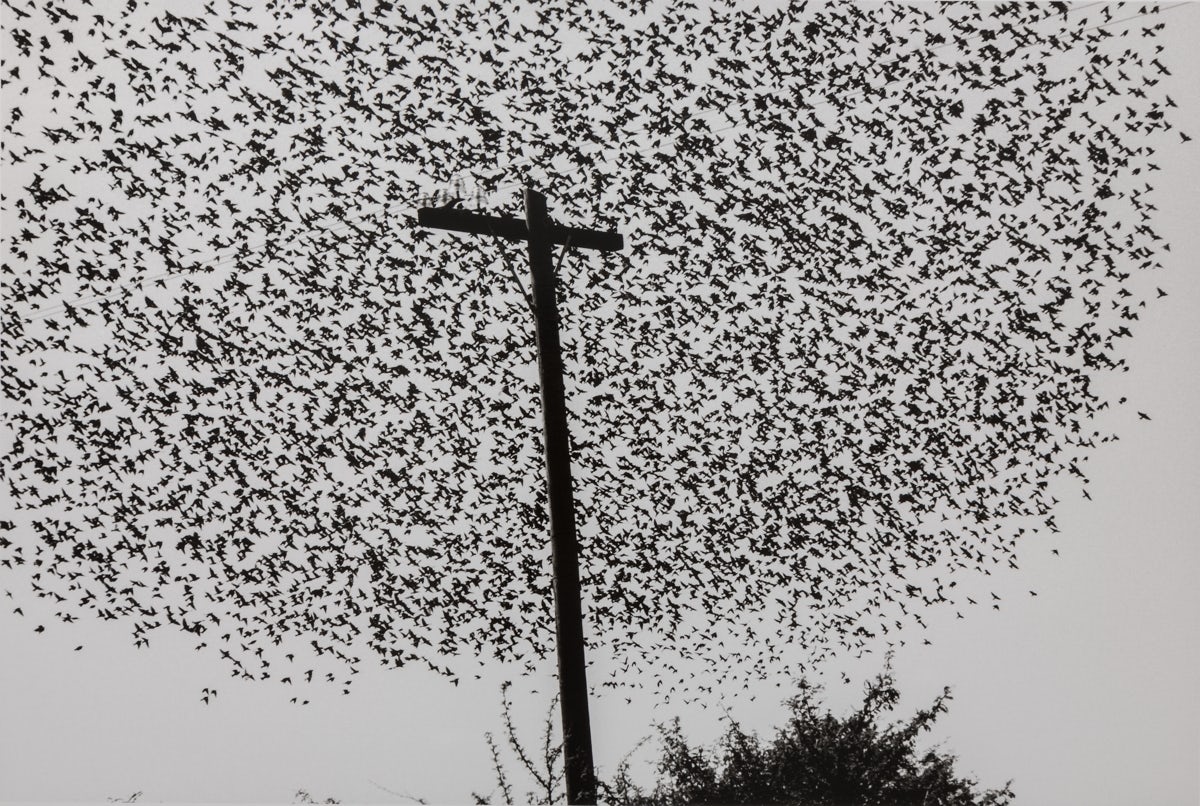
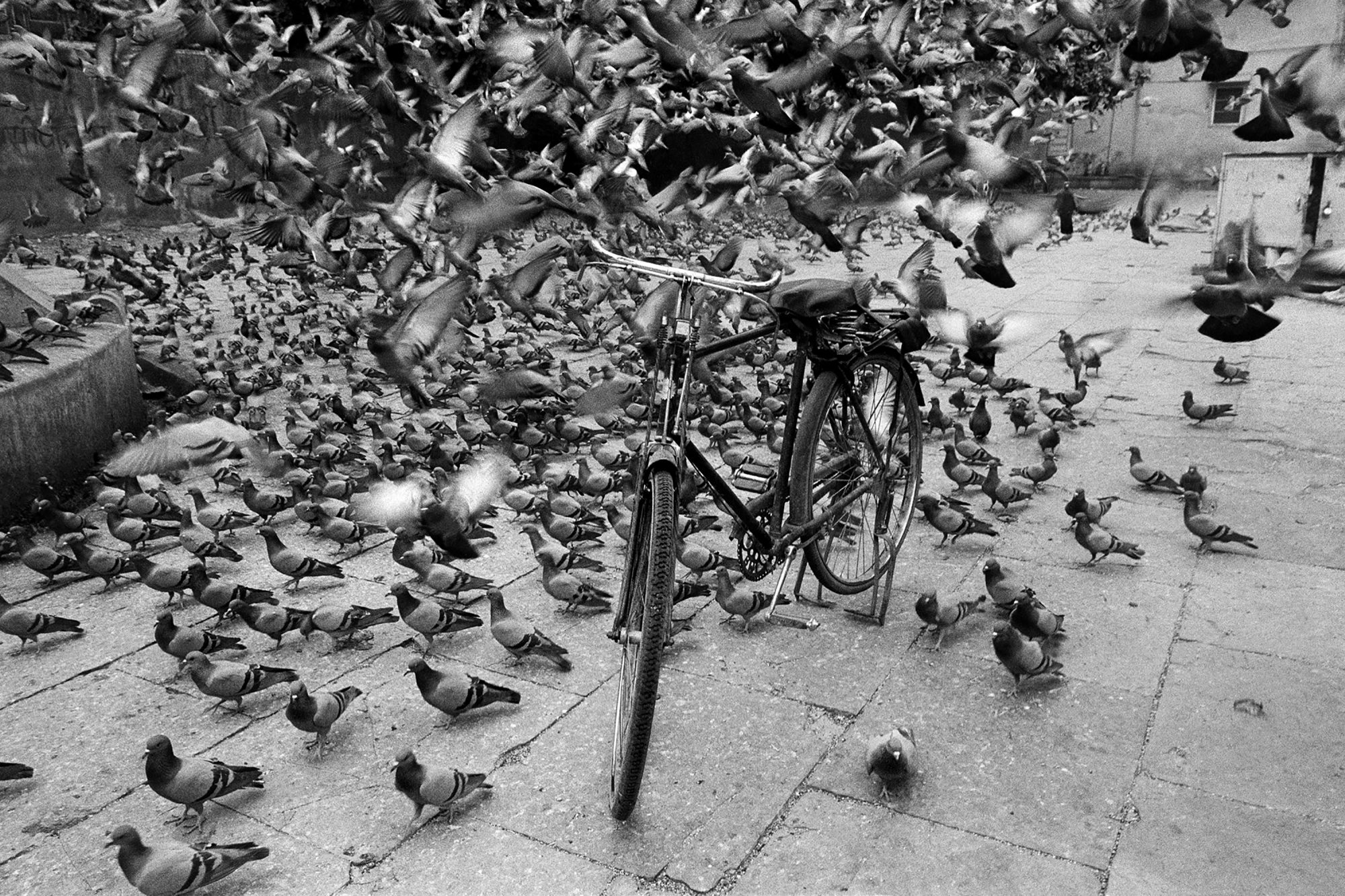
Birds glide through Iturbide’s photographs, an animating line through the book — swarming, swooping, floating, piercing the sky. In Pájaros (Nueva Delhi, India, 1998), a man with a bandaged head and cane in hand walks through a trash-strewn landscape. He is dwarfed by a swarm hovering over him, like a crowded thought bubble. Three birds fly triangulated over a group of four, earth-bound dogs (three with question mark tails!) in Perros perdidos (Rajastán, India, 1998), fusing earth and sky, substance and shadow. In a pair of images, Pájaros en el poste de luz and Árbol de pájaros (Both Carretera a Guanajuato, México, 1990), clouds of birds bloom over a telephone line and tree respectively, as if born from these other forms.


These aerial silhouettes connect to another enduring theme, the shroud and the mask, summoning Iturbide’s preoccupation with mortality. She moves easily between documentation, as seen in the recurring imagery of Day of the Dead masks and their ritual uses, to veiling as a figurative strategy. Even objects receive this melancholic attention: a sedan covered in a flowered bedsheet, a block of ice draped in a dark towel, the cacti of Jardín Botánica swathed in newspaper. This strategy takes its most dramatic form in her use of animals as masks. ¿Ojos para volar? (Coyoacán, México, 1991) shows Iturbide’s head reclined back, positioning two birds whose heads align with her eyes. The head of the bird on the right optically fuses with her eye in a gesture of blinding, its skull shadows as an empty socket. In another self-portrait, she holds a small fish over her mouth, pulling it close to the contour of her face, as she looks off-camera. (Pachuca, México, 1995)

In an interview with TK, Iturbide says: “Everything in life is connected: your pain and your imagination, which can help you forget reality. What you are living is connected to what you dream about, and what you dream about is connected to what you do, and photographs remain lasting reminders of this.” Iturbide’s capacious gaze offers matter and metaphor, seeing the mythological in the detail of experience and Heliotropo 37 gives flight to her grounded and spiritual sensibility.

Purchase Book

Read More Book Reviews


Laura Larson
is a photographer, writer, and teacher based in Columbus, OH. She's exhibited her work extensively, at such venues as Art in General, Bronx Museum of the Arts, Centre Pompidou, Columbus Museum of Art, Metropolitan Museum of Art, Museum of Fine Arts, Houston, SFCamerawork, and Wexner Center for the Arts and is held in the collections of Allen Memorial Art Museum, Deutsche Bank, Margulies Collection, Metropolitan Museum of Art, Microsoft, Museum of Fine Arts, Houston, New York Public Library, and Whitney Museum of American Art. Hidden Mother (Saint Lucy Books, 2017), her first book, was shortlisted for the Aperture-Paris Photo First Photo Book Prize. Larson is currently at work on a new book, City of Incurable Women (forthcoming from Saint Lucy Books) and a collaborative book with writer Christine Hume, All the                                                               Women I Know.
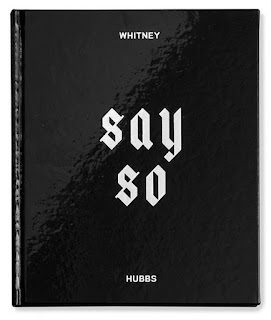
Book Review Say So Photographs by Whitney Hubbs Reviewed by Laura Larson "Whitney Hubbs’ Say So catalogs a ruminative and goofy series of self-portraits made in 2019 and 2020. Produced with a 4x5 view camera, the photographs abandon the master class mentality of large-format practice for a messy and private performance of desire and identity..."

Say So
By Whitney Hubbs.
https://www.photoeye.com/bookstore/citation.cfm?catalog=DU207
Say So
Photographs by Whitney Hubbs

SPBH Editions, 2021. 64 pp., 24 illustrations, 9½x11½x½".

Whitney Hubbs’ Say So catalogs a ruminative and goofy series of self-portraits made in 2019 and 2020. Produced with a 4x5 view camera, the photographs abandon the master class mentality of large-format practice for a messy and private performance of desire and identity. The photographs are staged in the artist’s studio with its trappings all squarely in the frame — nothing is concealed. I’m very much aware I’m in a site of construction and contingency: plywood sawhorse, cinder blocks, buckets, vinyl drop cloths repurposed as backdrops, duct tape everywhere. In this atmosphere, Hubbs auditions the accessories and gestures of amateur pornography with an eye on how they rely on the constituent fiction of female availability. She pretends to deep throat a 2 x 4 and straddles a tall, thin houseplant. She pours water down the front of her body — a studio experiment in girls gone wild. Both a medium and a comedian, she channels and disarms porn’s conventions.

Subject and object, Hubbs is a guileless contortionist who looks back at her camera. In the first image of the book, she’s adorned in a black, lace bodysuit, her sleepy eyes peering through a gas mask. The heels of her black boots are perched on top of cinder blocks and her thighs are spread. (I want to note that Hubbs owns many pairs of black boots — workwear, not the sexy variety.) The heel of her right boot presses into the black rubber bulb of the shutter release. I like how the studio equipment becomes a sex toy in this scene, holding tension. Hubbs holds a Chipotle tin bowl lid in front of her crotch, folded slightly to impersonate a vulva — female genitalia as fast food. In Plate 15, Hubbs faces the camera, seated in a metal folding chair, and holds two fake breasts over her own. At first glance, I thought her arms were doubles too until I recognized her tattoos. It’s like she’s proliferating, growing multiple appendages. Milk pours from her tensed mouth, running down the center of her chest. It leaks from beneath the fake boobs and cascades down the length of her torso, soaking her black lace underwear and the crotch of her acid-wash jeans. Mother’s milk, wet pussy: Hubbs collapses the false divide between the maternal and sexual body and it’s LOL funny. Witness Plate 8 for emoji humor. Wearing a python print jumpsuit, Hubbs stands facing the camera, stretching the band of taupe pantyhose over her belly with two tennis balls and an eggplant held taut at her crotch. There’s a run in her stocking creeping down her leg.


Hubbs’s comic delivery is sharp, but she’s got different stakes in the game. She’s not interested in punchlines or pratfalls or the gag of substituting her real body within porn’s airbrushed tableaux. Case in point: there are no money shots in the book, no humiliations of surrender. Her performance trades the animation that fuels slapstick, which relies on making yourself the butt of the joke, for something else. Her photographs tap the energy of longing and fury meeting the relentless forces that rigidly police and punish the agency of female sexuality. I can feel this gravity in these photographs, the undertow of fatigue, a commonplace experience for women. Hubbs looks to porn for her visual language but it’s her homages to Francesca Woodman and Jo Ann Callis, artists who also tangle with female pleasure, who are her true interlocutors in Say So. In each photograph, I imagine her thinking: how does this make me feel? With a somatic sigh, Hubbs taps a vein of feeling about what it’s like to live in a female body with all its drives, vulnerabilities, and contradictions in a culture with little capacity to imagine these subjectivities. Her photographs limn the too-much-ness of this experience, holding the leaky tension between being and seeing with ambivalence and generosity.

Purchase Book

Read More Book Reviews


Laura Larson
is a photographer, writer, and teacher based in Columbus, OH. She's exhibited her work extensively, at such venues as Art in General, Bronx Museum of the Arts, Centre Pompidou, Columbus Museum of Art, Metropolitan Museum of Art, Museum of Fine Arts, Houston, SFCamerawork, and Wexner Center for the Arts and is held in the collections of Allen Memorial Art Museum, Deutsche Bank, Margulies Collection, Metropolitan Museum of Art, Microsoft, Museum of Fine Arts, Houston, New York Public Library, and Whitney Museum of American Art. Hidden Mother (Saint Lucy Books, 2017), her first book, was shortlisted for the Aperture-Paris Photo First Photo Book Prize. Larson is currently at work on a new book, City of Incurable Women (forthcoming from Saint Lucy Books) and a collaborative book with writer Christine Hume, All the                                                               Women I Know.
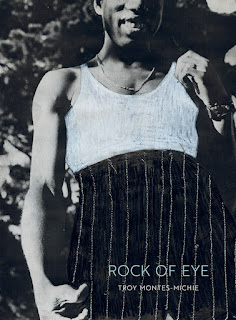
Book Review Rock of Eye Art by Troy Montes-Michie Reviewed by Laura Larson "The term “rock of eye” refers to the intuitive realm of tailoring where drape and fit are determined by the eye rather than the calculated measurements of sewing patterns. Let’s call it the eye of the beholder..."

By Troy Montes-Michie.
https://www.photoeye.com/bookstore/citation.cfm?catalog=DU286
Rock of Eye
Art by Troy Montes-Michie

Siglio, California African American Museum, & the Rivers Institute. 2021. 128 pp., 8½x11½".

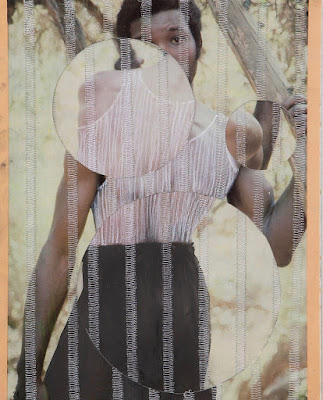
The term “rock of eye” refers to the intuitive realm of tailoring where drape and fit are determined by the eye rather than the calculated measurements of sewing patterns. Let’s call it the eye of the beholder. Troy Montes-Michie’s assemblages and collages in Rock of Eye use images drawn from an archive of 70s era gay porn featuring Black and Brown bodies. In porn’s racist vernacular, Black men are exoticized as studs, sexual objects to be consumed by the reader. In Montes-Michie’s hands, these men become fugitive subjects, radically disrupting the access porn promises.

Montes-Michie cuts, folds, layers, and misaligns these archival images. He paints then sands their surfaces, dressing the men in wife beaters and the voluminous pants of the 1940s Zoot suit. Using a sewing machine, he stitches into the paper: chain, straight, flatlock, running. Lines of stitching shapeshift, swerving between the decorative and the structural. Thin pinstripes on pants turn into a heavy zig-zag, evoking the vertical bars of a jail cell. These sutures recall notions of trauma and repair. The collages also incorporate sewing patterns, layering the light, brown translucent tissue over the photographs — another skin. Pattern lines mark welt for pockets and ease for the measure used to determine the space between the garment and the body. Cut strips of photographs are woven together, mimicking the thread structure of fabric. Fragments of bodies are revealed then concealed, elaborating a formal dialect that echoes and improvises on the techniques of sewing.


The Zoot suit, identified with working-class Latinos, emerged in the 1940s as a style from the simple act of buying clothes that were too large. This gesture was elaborated as design — theatrically concealed bodies a provocation to the notions of fit. Montes-Michie’s phantom garments cover the bodies of his subjects, and this attention makes the bodies feel held, cared for precisely because they are cloaked in this luxurious touch. Mining this connection between the eye and the hand, his work maps the energy between eroticism and affection. Montes-Michie’s tailoring disturbs the economy between visibility and availability through looping acts of repetition and return.

Two pictures. On the right, three men stand clustered together, their arms entwined. One man leans back against a smiling man in the center. His eyes are closed, and his head thrown back with the other’s hand hovering over his pelvis. Hands grasp thighs. The men are caught in a moment of abandon, but their delight remains their own. A man sits, naked, legs in a butterfly position, against a studio seamless. (Zora Neale Hurston: I feel most colored when I am thrown against a sharp white background.) There is no narrative armature or signifiers of wild nature. His body is masked by a sewing pattern with only his eyes and feet exposed in the cut. His eyes return the gaze of the camera. He won’t allow us to look or let us off the hook in this quiet reclaiming of agency.

Montes-Michie’s critical gestures of veiling are both protective and defiant. Desire isn’t banished from the frame, and this is the joyful knot of the work. He beholds his subjects with tenderness and dresses them in their rebellious threads. Midway through the book, the ring pattern of quilting is introduced, a form that resonates with its prismatic sensibility. His subjects peek out from behind the moan of these repeating Os, looking back. My eye slips, ricochets, and halts through the shifting borders of Rock of Eye’s visual somatics. Montes-Michie calibrates invitation and opacity to map the fraught and necessary space between pleasure and resistance.

Purchase Book

Read More Book Reviews


Laura Larson
is a photographer, writer, and teacher based in Columbus, OH. She's exhibited her work extensively, at such venues as Art in General, Bronx Museum of the Arts, Centre Pompidou, Columbus Museum of Art, Metropolitan Museum of Art, Museum of Fine Arts, Houston, SFCamerawork, and Wexner Center for the Arts and is held in the collections of Allen Memorial Art Museum, Deutsche Bank, Margulies Collection, Metropolitan Museum of Art, Microsoft, Museum of Fine Arts, Houston, New York Public Library, and Whitney Museum of American Art. Hidden Mother (Saint Lucy Books, 2017), her first book, was shortlisted for the Aperture-Paris Photo First Photo Book Prize. Larson is currently at work on a new book, City of Incurable Women (forthcoming from Saint Lucy Books) and a collaborative book with writer Christine Hume, All the                                                               Women I Know.
Book Review The Adventures of Guille and Belinda and The Enigmatic Meaning of Their Dreams Photographs by Alessandra Sanguinetti Reviewed by Laura Larson "Alesandra Sanguinetti’s The Adventures of Guille and Belinda and The Enigmatic Meaning of Their Dreams, originally published in 2010, has now been reissued by Mack Books. The book is the first of an anticipated three-volume set dedicated to her two-decade strong project about the Argentinian cousins, Belinda and Guille. A devotional to female friendship, Sanguinetti witnesses the girls in childhood and early adolescence, charting the imminence of adulthood in their everyday..."

By Alessandra Sanguinetti.
https://www.photoeye.com/bookstore/citation.cfm?catalog=ZJ618
The Adventures of Guille and Belinda and The Enigmatic Meaning of Their Dreams
Photographs by Alessandra Sanguinetti

MACK, London, England, 2020. 120 pp., 11x11".

Alesandra Sanguinetti’s The Adventures of Guille and Belinda and The Enigmatic Meaning of Their Dreams, originally published in 2010, has now been reissued by Mack Books. The book is the first of an anticipated three-volume set dedicated to her two-decade strong project about the Argentinian cousins, Belinda and Guille. A devotional to female friendship, Sanguinetti witnesses the girls in childhood and early adolescence, charting the imminence of adulthood in their everyday.

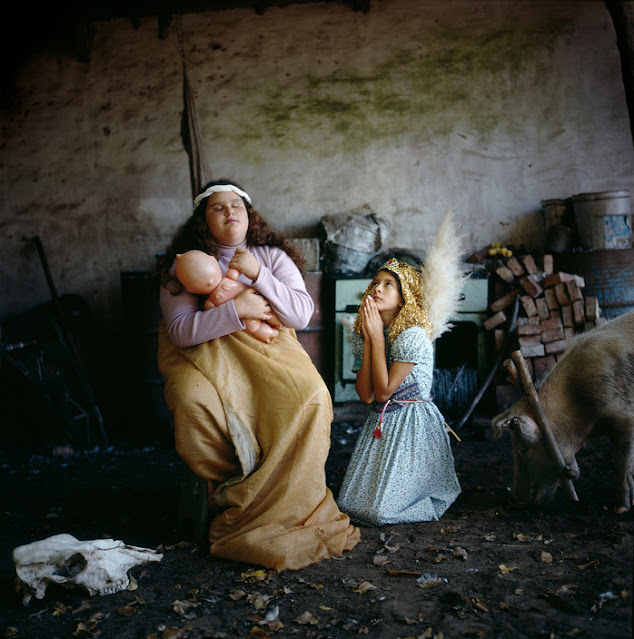
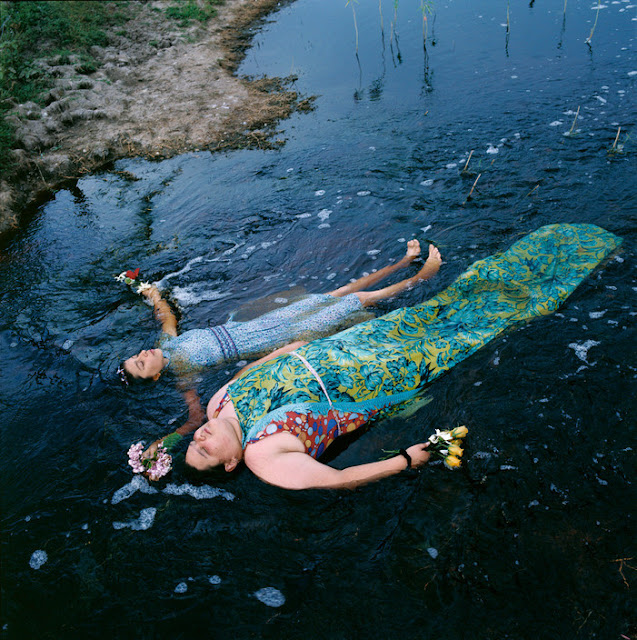
Sanguinetti elaborates on the documentary premise of the durational project with her collaborative approach to working with Beli and Guille. The girls would improvise on different narrative cues. In some, they enact the anticipated stories of (heteronormative) womanhood: romance, marriage, pregnancy. Biblical iconography informs their playacting too — a nativity scene, a dead Christ — nodding to the country’s Catholic dominant society. These dramas, refracted through the sensibilities of the girls, stage a feedback loop of play, culture, and fantasy, set within the backdrop of Argentinian farm life, a powerful third character of their dream life. Beli and Guille are charismatic performers, full of verve, humor, and vulnerability. Sanguinetti depicts their intimacy with warmth and tenderness alongside the richly observed details of their domestic landscape: family, animals (they are everywhere), and the farm.


Their roots in home and land are brilliantly depicted in a pair of images. Guille bathes in a metal bathtub in the yard, surrounded by ducks, a single chicken, and a dog. An elderly woman holds a fistful of her long hair, the strand forming a line with the grandmother’s arm. An uninterrupted stream of water, another line, flows from a pipe that juts into the upper left corner of the frame. In the next image, Beli and a man stand in a field, facing one another, holding a thin length of ribbon stretched between them. Lines of attachment unfold through touch.

Looking at these pictures, I was reminded of a game I played with my daughter when she was a baby. We held opposite ends of a Slinky. I would walk away, stretching the toy as far as it could go. Hold on, don’t let go, I said before I would walk back to her. I always come back.


A peek on Sanguinetti’s Instagram reveals a video of Belinda and Guille carrying out a funeral ceremony. Beli, playing the role of the priest, recites the prayer; Guille, the only attendant, weeps. Suddenly, they erupt into giggles, puncturing the solemnity of the play. There is no grave, just two girls riffing off one another. The photograph of this scene shows a smiling Beli watching Guille’s convincing, if scenery-chewing, enactment of grief.

Do you remember when you realized for the first time you would die?

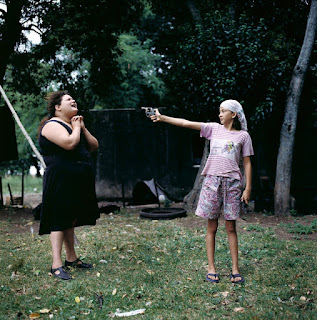
Death is a prosaic presence in the book, a familiar companion in the rhythm of their days. The girls watch the skinning of a cow. Later, Beli delicately peels the viscera off its head. Early in the book, we see Guille gently stretching the wings of a rooster in the kitchen. Later, she carries a dead chicken by its feet through a field. I wondered if it was kin to the rooster. Brutality filters into their play. The girls stage scenes of melodramatic violence, riffing on the gestures of tabloids and Hollywood movies. Beli points a toy pistol under her chin, her head lifted towards the sky while Guille, hands on her hips, watches her suicide reflected in a puddle, seemingly unmoved. In another image, Beli turns the pistol on Guille who appears to beg for mercy, hands clasped in prayer. It’s her turn to look up at the sky.

What haunts the long-term documentary project is the life expectancy of its subjects, the understanding they will die too. This is the melancholic chord of the work, knowledge held in tension with these vital portraits. I want to make a claim here that this is the gaze of a parent, a set of eyes that knows well the expanses and limits of a life and how it can, and can’t, be rendered in a photograph. She generously reserves as much as she shares, honoring the girls’ intrinsic mysteries. Sanguinetti’s photographs are prisms, multiplying and layering time: the textures of the quotidian, its roots in family and land, and the imagined joys and sorrows of the girls’ futures.

Purchase Book

Read More Book Reviews


Laura Larson
is a photographer, writer, and teacher based in Columbus, OH. She's exhibited her work extensively, at such venues as Art in General, Bronx Museum of the Arts, Centre Pompidou, Columbus Museum of Art, Metropolitan Museum of Art, Museum of Fine Arts, Houston, SFCamerawork, and Wexner Center for the Arts and is held in the collections of Allen Memorial Art Museum, Deutsche Bank, Margulies Collection, Metropolitan Museum of Art, Microsoft, Museum of Fine Arts, Houston, New York Public Library, and Whitney Museum of American Art. Hidden Mother (Saint Lucy Books, 2017), her first book, was shortlisted for the Aperture-Paris Photo First Photo Book Prize. Larson is currently at work on a new book, City of Incurable Women (forthcoming from Saint Lucy Books) and a collaborative book with writer Christine Hume, All the                                                               Women I Know.
Book Review You can call me Nana Photographs by Will Harris Reviewed by Laura Larson "Will Harris’ You Can Call Me Nana charts the life of his beloved grandmother, Nana Evelyn — and her decline from Alzheimer’s — through a critical reinvention of the photo album. The book features an array of images, including an archive of family photographs, contemporary photographs made by Harris, tipped-in recipe cards, and a mid-century advertisement for prefabricated homes..."

You can call me NanaBy Will Harris.
https://www.photoeye.com/bookstore/citation.cfm?catalog=ZJ719
You can call me Nana
Photographs by Will Harris

Overlapse, 2021. 96 pp., 120 illustrations, 6¾x8½".

Will Harris’ You Can Call Me Nana charts the life of his beloved grandmother, Nana Evelyn — and her decline from Alzheimer’s — through a critical reinvention of the photo album. The book features an array of images, including an archive of family photographs, contemporary photographs made by Harris, tipped-in recipe cards, and a mid-century advertisement for prefabricated homes. The snapshots chronicle moments from her childhood, marriage and family life, to the building of her home in Mount Laurel, NJ with her husband Bill. Evelyn’s kind and playful spirit is keenly felt in these images, her warmth radiating in a megawatt smile. Throughout the book, hand-written texts detail conversations between Harris and Evelyn, giving a voice to the shifting, intimate terrain of their relationship.
Did they ever call you Nana? 
I’m not Nana, I’m Evelyn.
Okay. Is it ok if I call you Nana? 
Banana?
No. Just Nana. 
Why?
Because. That’s what I’ve always called you. I’ve always called you Nana. 
Alright. Nana will be alright.

A photo album typically imagines the life of an individual or family as a linear, progressive story, marked by documenting rites of passage. Dispensing with chronological order, Harris wreaks havoc with the album’s narrative conventions. The photographs loop in affective rhythms that are deeply attuned to the contingencies of memory and the experience of grief. Everything feels present and departed at once. An archive, by definition, is always incomplete, subject to omission or loss, and Harris mines these blind spots with great resonance in his account of Evelyn’s life and illness.

Harris deftly interrogates the surfaces and meanings of photography’s materiality in canny juxtapositions of analog and digital imagery. The notion of witness shares space with invention and they are granted equal authority in the project of mourning.

The book’s dusty blue cover features a black and white, 1950s-era studio portrait of a Black woman affixed with photo corners. Reminiscent of a yearbook picture, her face breaks down from analog grain into crude, blocky pixelation. His attention to the vulnerability of photographs echoes Evelyn’s memory loss, as if to say a photograph is a body too: holding joy and sorrow, subject to the tolls of living, a reserve of history in the process of disappearing.

Forsaking fetishistic nostalgia, Harris places the soft, cracked surfaces of paper emulsion alongside digitally altered family photographs. Altered doesn’t convey the emotional impact of these photographs. They are wounded and they haunt: eyes are erased; heads decapitated; figures dissipate, repeat, and layer. These manipulated images correspond with a series of black-and-white portraits of Evelyn, where she appears as a ghost-like figure, doubled and disappearing. Photographed while eating a meal at a dining room table, Evelyn’s head vanishes, rendered a white orb-like aperture, during the camera’s lengthy exposure. This hole in the picture, another wound. I imagine Harris’ hands shaking while making the photographs, rattled by the nervous impulses of his own body, his subjects blurring.


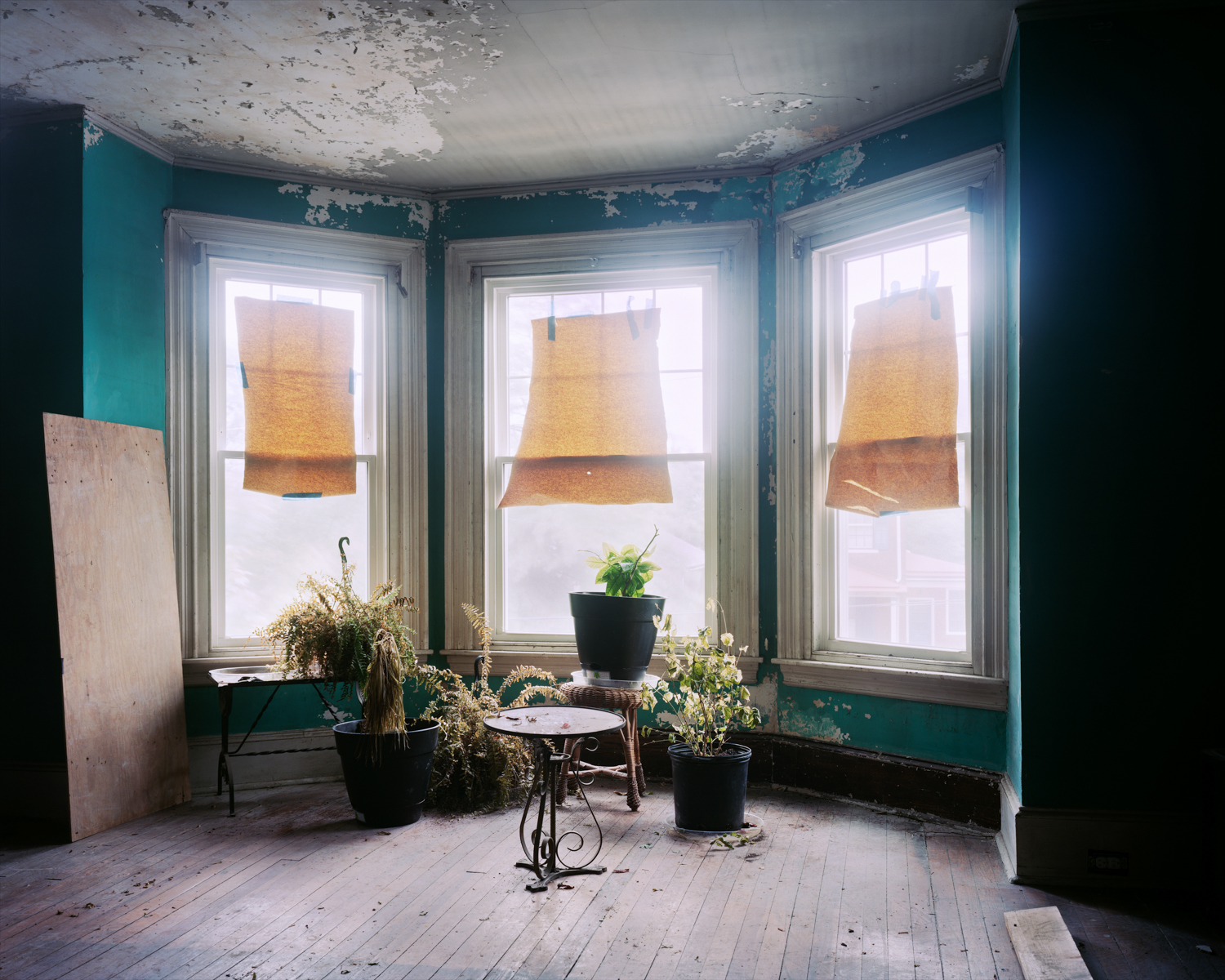
Interspersed throughout the book are color photographs of his great grandmother Irene’s Victorian house in Philadelphia, where he currently lives. The colors are muted — an apt melancholic palate — with moments of vivid color; a wall peeling strips of white and teal paint, its chips pooling on the floor. An analogue clock radio on a bedstand is caught mid-roll between 6:56 and 6:57. Family members are absent from these photographs, but traces of them are scattered throughout the ancestral home: a blue chambray dress hanging on a closet door; a framed photograph of Evelyn stationed on a dresser. It’s unclear whether we’re seeing details of Irene’s life or Evelyn’s or Harris’s. The images depict the present state of the house and hint at the vertiginous experience of remembrance within its walls. 

In his closing essay, Harris writes with devastating clarity, “I can truly say I know what it means to be forgotten.” You Can Call Me Nana ricochets between the temporal registers of loss across generations, staging memory on the fault lines of photography’s frailties.

Purchase Book

Read More Book Reviews


Laura Larson
is a photographer, writer, and teacher based in Columbus, OH. She's exhibited her work extensively, at such venues as Art in General, Bronx Museum of the Arts, Centre Pompidou, Columbus Museum of Art, Metropolitan Museum of Art, Museum of Fine Arts, Houston, SFCamerawork, and Wexner Center for the Arts and is held in the collections of Allen Memorial Art Museum, Deutsche Bank, Margulies Collection, Metropolitan Museum of Art, Microsoft, Museum of Fine Arts, Houston, New York Public Library, and Whitney Museum of American Art. Hidden Mother (Saint Lucy Books, 2017), her first book, was shortlisted for the Aperture-Paris Photo First Photo Book Prize. Larson is currently at work on a new book, City of Incurable Women (forthcoming from Saint Lucy Books) and a collaborative book with writer Christine Hume, All the                                                               Women I Know.