PHOTOBOOK REVIEWS, INTERVIEWS AND WRITE-UPS
ALONG WITH THE LATEST PHOTO-EYE NEWS

Social Media

Showing posts with label Antone Dolezal. Show all posts
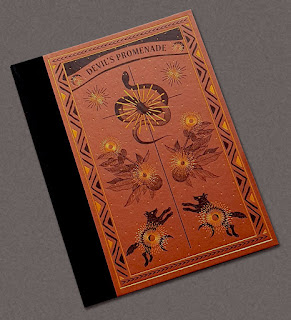
Book Review Devil’s Promenade Photographs by Antone Dolezal & Lara Shipley Reviewed by Kyler Zeleny "Within the American Breadbasket exists a physiographic region called The Ozarks. Locals will tell you that within these mountains, covering sections of Oklahoma, Kansas, Arkansas and Missouri, resides the Devil. It is within the Ozarks, on a wooded gravel road, known affectionately and sinisterly as the Devil’s Promenade, that evil lurks. For decades this evil has revealed itself as a floating orb, also known as the Ozark Light or ‘spooklight’..."

Devil’s Promenade. By Antone Dolezal & Lara Shipley.
https://www.photoeye.com/bookstore/citation.cfm?catalog=ZJ669
Devil’s Promenade
Photographs by Antone Dolezal & Lara Shipley

Overlapse, 2021. 152 pp., 104 illustrations, 6¾x9".

Within the American Breadbasket exists a physiographic region called The Ozarks. Locals will tell you that within these mountains, covering sections of Oklahoma, Kansas, Arkansas and Missouri, resides the Devil. It is within the Ozarks, on a wooded gravel road, known affectionately and sinisterly as the Devil’s Promenade, that evil lurks. For decades this evil has revealed itself as a floating orb, also known as the Ozark Light or ‘spooklight’.

Shipley and Dolezal tackle the folklore at the heart of this project in a fashion similar to Maria Lax’s Some Kind of Heavenly Fire, Amani Willett’s The Disappearance of Joseph Plummer, or Maja Daniels’ Elf Dalia, by applying mixed media to a form of elevated and layered storytelling.
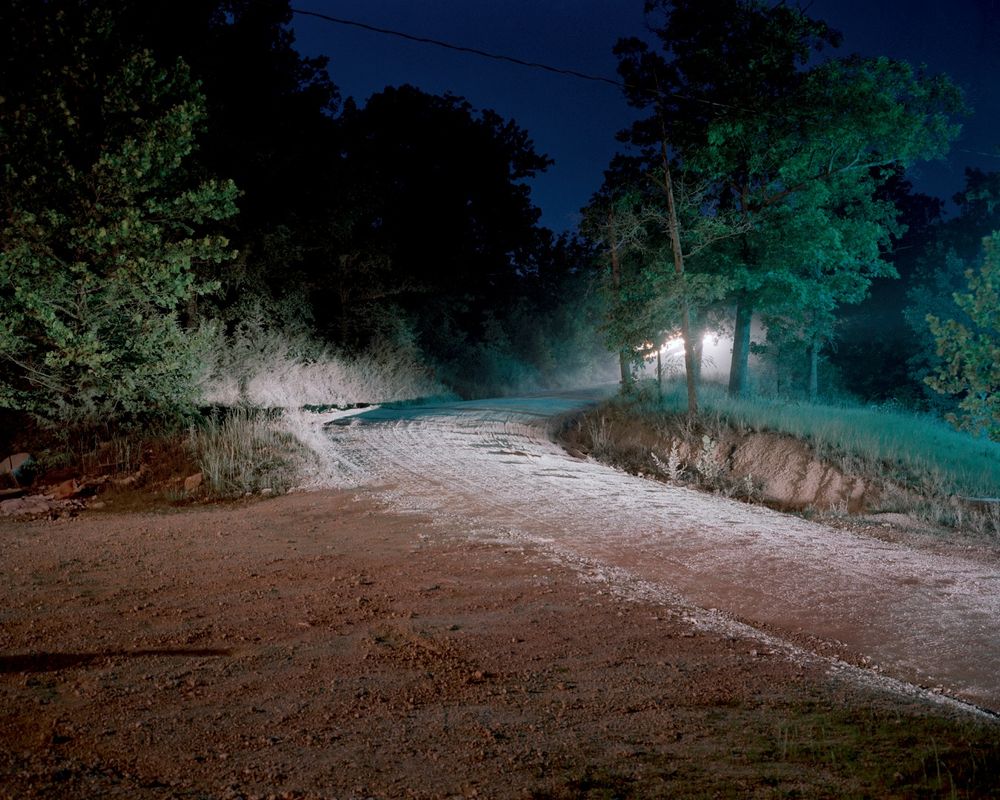

The archival images — those blurry frames of old faces — blend well with the crisp images Shipley and Dolezal produce; a delicate dance that unfolds throughout the book. The skulls and snakes, they make sense, but some portraits at first allude… who are these faces past and present, and what is their bearing on this place, its dark undertones and these balls of light? But we must remember that there is no story of place without people. Well disguised, this is a book about the region, a narrative of rural America, told through folklore acting as a welcomed break from the plight-heavy approach of nearly all contemporary narratives on the subject.

My visual vocabulary of the Ozarks is scant, as a result, I borrow tropes from the American South — the mysticism and religious overtones that a thick brush can conjure. This isn’t much of a stretch, the European folklore that fuelled the idea of myth in Southern Appalachia has found its way to this region. Both Appalachia and the Ozarks are old frontier territories, partly enclosed and remote. Both have largely retained their bubble of wooded frontierism.

Some photobooks leave you with an idea (a rumination), others an emotion (a pathos). The best books do both. Devil’s Promenade does both. I feel structure. I feel dead eyes. I feel the wilderness swimming around my legs and towering Bois D’arc trees swaying overhead. The Ozarks are in the Mid-West, but you don’t feel it. This is something different. Elements of the occult linger and something feels off about the place.


Devil’s Promenade
speaks to an innate familiarity with the region, an emotive intrigue that also feels restrained and distanced. Like an old friend who you’ve left behind as you’ve grown, memory and fondness linger, but at the core… things have changed… you have changed. We glimpse this feeling in the portraits. They speak of a familiarity only the native sons and daughters of a region know, however, they are the derivative of closeness, they lack warmth. Intrigue is also present, a reverence for a place and time no longer wholly understood — the common outcome for those who leave and return.

The Ozarks are a hilled region, old mountains that have been ground down, offering little to the farmer, a blight on the boastful soils of America’s Breadbasket in which they firmly sit. This is a poor land for farmers, a poor land where a spectre haunts.

The orb is a hook. It is a distraction placed before us so that we may gaze upon the Ozarks and learn its unique folklore, identity, history, and struggles. The orb is intrigue, and it is metaphor. The orb is a proxy for the devil and aged fables about the devil lurking in the wild. The beast we should worry about is the one inside of us. As Lara Shipley writes, “we try to put the Devil in the woods to remove him from our bodies”.

How we interpret the orb depends on how we invite the idea of good and evil in. There are many ways to save a soul, you can bathe it in baptismal waters, you can suck out evil with a palm to one’s forehead and maybe, with the right intentions, you can gaze upon an orb on the Devil’s Promenade and feel cleansed. I also wonder, if we stopped talking about the orbs, stopped searching them out, would they disappear?

Purchase Book

Read More Book Reviews


Kyler Zeleny (1988) is a Canadian photographer, educator and author of Out West (2014), Found Polaroids (2017), and Crown Ditch & The Prairie Castle (2020). He holds a masters from Goldsmiths College, in Photography and Urban Cultures and a PhD from the joint Communication & Culture program at Ryerson and York University. His work has been exhibited internationally in twelve countries and has been featured in numerous publications including The Globe & Mail, Vice, The Washington Post, The Guardian, and The Independent. He occupies his time by exploring photography on the Canadian prairies.


Book Review One Sun, One Shadow. By Shane Lavalette Reviewed by Antone Dolezal The American South is a region marked with a rich photographic history, one eclipsed by the legacies of Walker Evans and William Eggleston and contrarily plagued by an over-saturation of contemporary work. To understand the South is to understand America.
One Sun, One Shadow. By Shane Lavalette. Lavalette, 2016.
One Sun, One Shadow. 
Reviewed by Antone Dolezal

One Sun, One Shadow.
Photographs by Shane Lavalette. Text by Tim Davis.
Lavalette, Syracuse, New York, 2016. 124 pp., 61 color illustrations, 8½x10½".


Books Antone Dolezal: 2016 Best Books Antone Dolezal Selects Lost Coast, ZZYZX, and Matter as the Best Books of 2016
Antone Dolezal
Antone Dolezal is a photographer currently residing in Syracuse, NY. His photographs have been shown widely, including exhibitions at 555 Gallery (Boston), Candela Gallery (Richmond), Filter Space (Chicago), Museo Nacional de Arqueología y Etnología (Guatemala City), photo-eye Books & Prints (Santa Fe), Webber Represents Gallery (London), and are held in various private and public collections including the Museum of Modern Art Library, Museum of Contemporary Photography, New Mexico Museum of Art, and the Nelson-Atkins Museum of Art.


Book Review AP CP BL. Photographs by Christian Patterson Reviewed by Antone Dolezal It was with this in mind that I found the curious new series by Ahorn Books AP CP BL – a companion to Christian Patterson’s Bottom of the Lake – to be a refreshing resource in understanding the complexity behind Patterson’s narrative and the physical construction of the artist book itself.
AP CP BL
Photographs by Christian Patterson. Ahorn Books, 2016. 
 
AP CP BL.
Reviewed by Antone Dolezal.

AP CP BL.
Ahorn Paper 1.
Photographs by Christian Patterson. Text by Gerry Badger, Luc Sante, and Thomas Weski.
ahorn books, Berlin, Germany, 2016. 144 pp., black-and-white illustrations, 4¼x7½".


Book of the Week Book of the Week: A Pick by Antone Dolezal Photographer Antone Dolezal selects Dead Man's Hand by Jonah Samson as photo-eye Book of the Week.

Dead Man's Hand. By Jonah Samson.
Self-Published, 2013.
This week's Book of the Week pick comes from photographer Antone Dolezal who has selected Jonah Samson's Dead Man's Hand.

"Upon opening Jonah Samson’s Dead Man’s Hand I knew I had unsealed a puzzle. The box functions as an evidence file for an unsolved crime. Loose plates of crime scenes, pin-up ads and criminal arrest records are stacked on top of one another as the only proof left of a brutal act of violence. It all hints at a nostalgia for mid-20th century crime photography and the limitations the medium had for solving these violent offenses. It also begs the viewer to put together the vague pieces and come to their own conclusions of the characters portrayed in this book.

The artist doesn’t try to hide the fact that this is all one big fabrication. He blends a mixture of mediums, even constructing his own dioramas of the crime scenes and photographing them with an old Speed Graflex. It’s a refreshing approach to the genre of evidence driven photography that has come into vogue over the last few years. It’s fiction, but the artist’s puzzle hints that it could be real and the only conclusion that matters is your own."—Antone Dolezal


Purchase Book

Dead Man's Hand. By Jonah Samson. Self-Published, 2013.


Antone Dolezal is a photographer and writer whose work explores the American social landscape and its relationship with history and folklore and is often accompanied by vernacular imagery, found objects and fictional literature. His work has recently been exhibited at the Santa Fe University of Art & Design, Rayko Photo Center, among other venues and is slated for exhibition this fall at 555 Gallery in Boston. Antone’s photographs have been featured on National Public Radio, Oxford American, Photo District News and Mossless Magazine and his prints and books are held in various collections including the British Library (London), Marion Center for the Photographic Arts (Santa Fe) and the Museum of Contemporary Photography (Chicago).

Lara Shipley and Antone Dolezal's Devil's Promenade is currently on view at photo-eye Bookstore + Project Space at 376A Garcia Street. Signed copies of their new publication Spook Light Chronicles, Volume II are nearly sold out; copies of the limited edition are still available. Read the interview with Shipley and Dolezal here.
Sunder. Photographs by Bruce Haley.
Published by Charta/Daylight, 2011.
Sunder
Reviewed by Antone Dolezal

Sunder. Photographs by Bruce Haley. Introduction by Clint Eastwood, Dina Eastwood. Text by Andrei Codrescu, Bruce Haley and Taj Forer.
Charta/Daylight, 2011. Hardbound. 144 pp., 55 duotone illustrations, 12x7-1/2".

Bruce Haley can tell a dark and lonely story. The darkness often comes from the reality of the subjects he photographs, while the loneliness is inevitably his own. I imagine Haley wandering through empty fields or industrial ruins, quietly observing and listening to the land, the sounds of running water or birds overhead. I imagine the low rumble of a distant tractor and Haley silently conceptualizing how he will capture the ambient noise on a two-dimensional sheet of film. There is a personal connection Haley cultivates with his subjects that is rare to see in contemporary photography. A connection that seems to be born from both being genuinely intrigued by those he photographs and from a sense of obligation in searching for some deeper understanding of a complex human condition. Haley doesn't photograph the typical; his subjects don't look to be strangers and his landscapes certainly don't appear to be from any particular country. His photographs are distinctly his, as is the story he sets out to tell.

Sunder, by Bruce Haley. Published by Charta/Daylight, 2011.
For eight years Haley wandered the landscape of post cold war countries in Eastern Europe. Here he found a people and land in a dark period of uncertainty and transition. While many around the world embraced the fall of the Soviet Union, those left in its direct wake had the hardship of rebuilding their political and economic infrastructures. Abandoned industrial sites leaked toxic waste and metal into the ground and rampant poverty plagued the newly independent countries. Haley became immersed in this reality, subsequently soaking in the heavy weight carried on the backs of those living in this uncertain land. Sunder tells the story of those bearing this burden, while simultaneously conveying a glimpse of hope and rebirth in the communities encumbered by it.

Sunder, by Bruce Haley. Published by Charta/Daylight, 2011.
Haley's landscapes are known for their emptiness. They build upon a narrative that is at first subtle, but quickly becomes complex in its unifying vision. Grainy black-and-white panoramic images engulf the viewers' senses, forcing anyone who looks to bare witness to a wasteland created by an empire's fall. The stark realities of the land coincide with the photographer's depiction of its people; they too are contained within Haley's haunting expanse. Their hardships are easily recognized by the soot on their clothes and the lines in their face. However, in Sunder their depiction is not that of a stereotype, but fall within a lineage of Haley’s predecessors such as Koudelka and Bresson, who have allotted careful admiration towards those they photograph.

Sunder, by Bruce Haley. Published by Charta/Daylight, 2011.
While there are inevitable political overtones throughout this book, Haley himself takes no political stance. Instead, Sunder is an epic and timeless homage to human struggle and endurance. The rise and fall of societies is an assured occurrence, and this fact seems apparent throughout Haley’s photographic essay. The images here reflect the aftermath of political conflict, and Haley renders a heavy mood that brings to bear his subjects' hardships while also hinting towards the inspiring experience of the human spirit. I imagine Haley to be a kindred spirit, immersing himself with those he feels a deep connection with and telling a story that is as much theirs as it is his.—ANTONE DOLEZAL

purchase book

ANTONE DOLEZAL is a New Mexico based photographer and writer. He is a member of the media collective Finite Foto and his writing has appeared in photo-eye Magazine and Fraction Magazine. For more on Antone, please visit his site at www.antonedolezal.com.
from A Natural Order
A lot has already been written about Lucas Foglia's A Natural Order in various online publications, and the press is well deserved. Foglia's photographs are first and foremost stunning. The large-format design by Nazraeli is fitting for the mixture of portraiture and landscapes contained in the book's pages. And the work itself has to give a nod to Justine Kurland's This Train is Bound for Glory and Joel Sternfeld's Sweet Earth: Experimental Utopias in America. But personally, I like this work more than its inspiring predecessors. And what really interests me is that this book is a perfect example of an evolving dialogue that photographer's toss back and forth between each other and their comparable subject matter.

from A Natural Order
Photography has always found an interest in alternative lifestyles. From addicts to gypsies or American men seeking escape, the medium has fostered an audience of voyeurs enamored with a split from the normal. Foglia's book travels alongside this lineage of photographs exposing what is often hidden; in this case, people who choose to live off the land and away from an existence in overcrowded cities. But this book is also about personal responsibility, responsibility for the land and ourselves as a race of people. It touches on the importance of the food we eat, the way we grow or kill it and the impact this has on community and the larger culture. So interests aside, Foglia has also made a body of work that is important in its relevance.

from A Natural Order
The photographer himself grew up in a household that was reliant on itself. Within his New York City suburb, Foglia's family grew and canned their own food and heated their house with only wood. As he states, "by the time I was eighteen we owned three tractors, four cars and five computers." His experience is a good example of a lifestyle quickly catching on across the United States, one that aligns itself with a back to nature attitude, but also takes advantage of the modern world's many advances. The artist's upbringing inspired this project, although Foglia's interest was to seek out those who were fully self-sufficient. He states that he found most of those he befriended during his four-year venture weren't dissimilar in lifestyle to his parents' down home perspective. And while the subjects in this book are far removed from larger urban populations, they are certainly connected to the larger world through their own blog and laptop powered by solar panels or car battery.

from A Natural Order
It's easy to reject the world for its flaws, but doing it in a healthy way benefits us all. This book hints at that inspiring attitude. It's an attitude that acknowledges some human advances as important, but also gives thought to past achievements as maybe being more beneficial to cultural advancement. It's a book about progress, evolution and an exploration into the idea of a healthier human condition.

One last note. Along with the book is a separate zine that is reminiscent of a turn of the century self-help pamphlet. I could take or leave the text in the accompanying zine -- it's a little boring, but I really enjoy the illustrations that go along with the text. By including this additional imprint, the zine takes the project slightly further away from a traditional documentary and gives it the quirky edge included in a lot of contemporary photography projects. My only critique is I would like to see this zine slipped into the back of the book, not loosely placed to the side. The two publications are aesthetically and conceptually far enough apart that each could easily be sold separately. -- Antone Dolezal

purchase A Natural Order

from the book Darkroom published by SteidlDangin
Few members of my generation will maintain a working darkroom. Sure, to the surprise of the public, tons of us still shoot film and lug around view cameras. But for most of the photographers I run with, their analogue skill set stops there. It's a shame, too. What happens when photographers no longer learn the craftsmanship of working with their hands? Who will teach them there are 54 tones in a traditional silver print? And how will this affect photographic image making in the future? I have long said that anyone learning photography would gain more insight into image making through the patience endured in the darkroom and the slight light-headedness from the chemicals. And while digital technology seems endless in its potential to advance the medium, I do feel most new photographers would benefit by looking at the medium's past before embarking full tilt into their future.

That is why I find Adam Bartos' new monograph Darkroom to be a long overdue nod to the rapidly shifting culture of photography. The darkroom has persisted since Niépce made the first permanent photograph and Daguerre and Fox Talbot refined it. Its presence and symbolic importance will long outlast the current digital media trends. The darkroom is a relic of something real, a symbol that won't be lost in photography's short, but vibrant history.

from the book Darkroom published by SteidlDangin


There is a sense that Bartos sees his subject as such… a relic to be photographed with a certain level of indifference. There is little emotional connection. Instead, Bartos has approached his subject similar to how an archeologist would photograph the evidence of a city's ruin, displaying the aging of time through dismantled enlargers and a discontinued dry-press. Bartos takes us into the artist's darkroom to gaze not only at their relics, but also to give us a small insight into their solitude. The only information given about each space is the location and how many years the darkroom has been in operation. And while no direct information is given about whose space we are looking in on, hints such as book dummies, oddly formatted negative carriers and a few working prints tacked to the wall might give a few of us some clues.

from the book Darkroom published by SteidlDangin
Bartos' indifference also allows the viewer to imagine those photographers who find refuge in the spaces he photographs. For those of us who have worked in a darkroom, we know it is a place for filtering creative meditation and a venue for an occasional outburst of song and dance in the dark. This is a space that allows for those who see the world differently, to act a little different. The evidence of this difference is apparent through the odd objects on the walls and consistent splash of chemical stains. A meticulous application of glow in the dark tape might have one wondering who in the world would have time for such a thing. Or a sterile, thoroughly self-contained room could have another wondering what types of images come from someone so rigid! All-in-all, Bartos photographs with a style that allows us to wonder and create for ourselves the people who have assembled the work spaces and the work we are admiring. -- Antone Dolezal

Purchase a copy of Darkroom
In the Fields of Gold

Poursuite Editions publishes great photography. Whether it is moody landscapes or a haunting narrative, there is usually an underlying thread that ties together the publisher's aesthetic taste. The striking correlations implied by publishing both Benoît Grimalt's unassuming Do You Know Syd Barrett  and François Deladerrière's L’illusion Du Tranquille provides insight into the intricate patterns that tie together all of Poursuite's titles. And having only published books for a few years, these objects have slowly grown in size and design quality.

The latest addition to Poursuite's catalogue, Miquel Llonch's In the Fields of Gold, is a modest book containing a cinematic series of landscapes and portraits. Taking refuge in the outskirts of his hometown of Terrassa, Spain, Llonch seeks the open fields that lay on the edge of the city's woods. The fields, their edges and obstructing roads become surreal depictions of the real world as the photographer captures their transition from day to night. Taking photographs at dusk and capturing the distant city lights, Llonch's images offer a clear depiction of escape from the mundane. Here the viewer witnesses the transformation from light to dark, a transition that carries an emotional weight and mysterious ambience.

In the Fields of Gold
Alongside the haunting landscapes are a series of portraits of the photographer's immediate family and close friends. Taken in the same setting and under similar lighting conditions, these portraits give a sense of place and weave a poetic vision describing the photographer's relation to land and family. In the Fields of Gold provides an interesting engagement of withdrawal and a need to belong. The book's appropriate and simple design alongside its lush printing heighten the artist's intent of depicting an affecting landscape that exists both as a place for emotional connection and necessary escape. -- Antone Dolezal

Purchase a copy of In the Fields of Gold
Watershed. By Jeff Rich.
Published by photolucida, 2012.
Watershed
Reviewed by Antone Dolezal
______________________________________
Jeff Rich Watershed
Photographs by Jeff Rich
photolucida, 2012. Hardbound. 108 pp., 40 color illustrations, 10-1/2x8-3/4".

It was refreshing to see Photolucida’s coveted Critical Mass Book Award go to only one recipient in 2010. Jeff Rich certainly deserved it. His poignantly important body of work Watershed is presented in a simple format with a design both elegant and appropriate. Complete with stunning printing, Rich's work is allowed to be seen for its full significance. The wisdom of Photolucida's conclusion to publish one book for this year can be seen in the quality of Watershed as an object, and for this decision my hat goes off to them.

As Hartwell Carson states in his essay, "The geographic term 'watershed,' or 'river basin' as it is sometimes called, is often misunderstood. A watershed consists of not only the springs, creeks, brooks, rivers, ponds and lakes, but also the land surrounding these water bodies. The reason this concept is so important is that most of the pollution that impacts our waterways occurs on land." This quotation highlights an important element in understanding the staggering scope of Rich's project. Flowing through several states, the French Broad River was the life-blood of past communities inhabiting the river's banks and surrounding landscape. This geographical area has such a deep and involved history with the river that it’s hard to imagine how the photographer was able to focus on compiling a complex social, geographical and environmental narrative with only the 40 photographs presented in this book. But Rich has laid out a sequence touching on both the complicated nature of land use as a recreation space, as well as for industrial business and its unfortunate byproducts, tying a delicate thread between the people who live on the French Broad River and the unsustainable industry that has at times been seemingly exempt from environmental responsibility.

Watershed, by Jeff Rich. Published by photolucida, 2012.
Rich's photographs evoke the notion of a timeless struggle between lone individuals and a larger-than-life entity. The few people present throughout the pages of Watershed are often those who use the river as a life source. Rafting guides, fishermen and secluded landowners are pulled out of obscurity and given a face. What remain faceless are the monstrous symbols of industrialized power. Power plants, paper mills and sewer lines loom over the riverbanks, casting a gloomy shadow over the landscape and creating an unavoidable realization that these waters are not ideal for sustainable living.

Watershed, by Jeff Rich. Published by photolucida, 2012.
And while Rich's project focuses on the French Broad River, his story alludes to a larger problem that exists in a nation that places industry ahead of people. An example of this is the photographer's focus on a lone man, Steve Harris. Harris resides on 20-acres of land along the Nolichucky River, less than a mile downstream from a company called Nuclear Fuel Services in Erwin, Tennessee. Recent testing has found water and soil contaminated with uranium and plutonium as far as 50 miles away from NFS. Harris' land -- a once thriving artist community -- now sits almost vacant, existing as an unfortunate consequence of NFS's neglect, while Harris himself has been trapped in an unfortunate cycle of legal and medical bills. The photographs documenting Harris' life on the river are at once sad, thoughtful and shocking. And while you can view the full series on Rich's website, this book contains only a few glimpses of Harris' story, giving the viewer an idea of the dense scale of the photographer's project.

Watershed, by Jeff Rich. Published by photolucida, 2012.
Due to their complex content, the fine quality of Rich's photographs tends to be overlooked in lieu of putting the images in some form of historical and environmental context, as seen in the essays included in Watershed. While informative and at times personally insightful, for me the essays fall short in filling in the contextual gap that is often unavoidable with a visual documentary project. Including the thoughts of a fellow artist would have balanced the photographer's aesthetic intent with the importance of the project's historical and environmental background. That being said, Rich has weaved together a staggering series of seductive photographs teetering between evocative ambience and straight documentation. The photographer's use of atmospheric lighting often gives a sense of a land caught in an ephemeral state, damaged by past neglect, but hopeful for enlightened intervention. Here the viewer is challenged to ponder questions of the captivating landscape Rich has yielded, the photographs providing answers both disquieting and contemplative.


ANTONE DOLEZAL is a New Mexico based photographer and writer. He is a member of the media collective Finite Foto and his writing has appeared in photo-eye Magazine and Fraction Magazine. For more on Antone, please visit his site at www.antonedolezal.com.
Öglunda
A while back Robert Adams turned a switch on in my brain. I'm not sure which receptors weren't firing, but after spending a little time with Adams' photographs I became struck by their subtleties. Subtle photographs take a certain patience to absorb and a dedicated amount of time to continually revisit. Adam's work and writings have pushed my own views and tastes with regard to the medium and how I approach taking my own pictures. If it wasn't for first exploring Adams' work, I'm not sure I would have developed such a strong respect for the photographs of Gerry Johannson.

Similar to Adams, Johannson makes subtle images, often focusing on a specific geographical region or town. His photographs are always simple, rarely (if at all) contain people, and create an ambient space reflecting on an urban or rural landscape shaped by those who inhabit it. It would be easy to look at Johannson's work and point out the mundane, but spending a few extra moments with his photographs is an exercise in seeing beauty and meaning in the ordinary.

from the book Öglunda
Appropriately, Robert Adams has written the introduction to Öglunda, Johannson's new publication by GunGallery. The photographs -- taken between August 2010 to November of 2011 -- are a survey of the Skara municipality in Sweden. The photographs of farms and the quiet countryside reflect the small agricultural community, sparse forests and roaming livestock. It is a simple story, but Johansson has created a series that is thoughtful in its simplicity. The artist's depictions of the surrounding forest are some of the most elegant photographs I have seen in a long while.

from the book Öglunda
The design of Öglunda is also simple and elegant containing a debossed photograph on the front cloth cover and exquisite matte paper inside. The beautiful design only elevates the viewing experience. It is a comfortable book, handsome as an object and full of contemplative content. Here, Johansson continues to push the beauty of the subtle image, a subtlety that Adams has been pursuing over his prolific career, forwarding a photographic dialogue that started many years ago. -- Antone Dolezal

Purchase a copy here
Dirk Braeckman. Photographs by Dirk Braeckman.
Published by Roma Publications, 2011.
Dirk Braeckman
Reviewed by Antone Dolezal
__________________________________________
Dirk Braeckman Dirk Braeckman
PHOTOGRAPHS BY DIRK BRAECKMAN
Roma Publications, 2011. Hardbound. 400 pp., Color and black & white illustrations, 11-1/2x10".

There is something secret and sinister lurking in the depths of Dirk Braeckman's photographs. An omen that brings an uncanny atmosphere and uneasy tension I cannot quite put my finger on. It's this tension of unsettled mystery that keeps bringing me back, almost as if I could find myself hiding in one of the photographer's deep shadows or half empty interiors. And maybe this is it. Here I keep finding myself deep within these photographs, on some sort of journey, half lost and aimless.

It's the black that pushes such a strong ambience. A deep black, giving way to a dream-like seduction of a haunted world. It is a world that is surprisingly comfortable. The rich and persistent blacks are at the heart of the artist's secret -- a black that acts as a veil, never intending to fully let the viewer in. Images of empty dance halls, hallways and Victorian rooms are brought together alongside framed paintings that appear slightly overexposed from a hard light. The consistent dark tonalities mixed with this occasional harsh glow blend together a domain of half fiction and half reality. At times I am not sure if it is a vintage painting or one of Braeckman's bewitching mysteries I have wandered in to. Either way I find myself stepping in circles.

Dirk Braeckman, by Dirk Braeckman. Published by Roma Publications, 2011.
Braeckman's female subjects also remain veiled. Rarely do we see their faces. Only their bodies and gestures suggest a glimpse at the photographer's unseen intent. Viewing these subjects is cause for unease and strangely enough carves a path that leads deeper into this hidden place. Their sparse and strange gaze cautions us to step away, but Braeckman's complex puzzle of unease and apprehension has already formed its grasp. And then there are photographs of numerous beds, some untouched and others with crumpled sheets. There is a curious balance of enticing suggestion and an empty longing. It is never quite clear which to lean towards and only builds upon the enigmatic nature of this work.

Dirk Braeckman, by Dirk Braeckman. Published by Roma Publications, 2011.
This illusive work is contained in a hefty volume, consisting of 400 pages and almost as many photographs. Roma Publications has succeeded in the demanding task of representing the artist's subtle color palate. This book would not have worked if not for Roma's exquisite printing. And surprisingly, each one of the plates moves Braeckman's ghostly narrative further, while simultaneously leading the viewer into a series of deceptive turns. Viewing these photographs is like meandering through a labyrinth without an exit, becoming a curious observance in how one reads an ungrounded visual narrative.—ANTONE DOLEZAL

Selected as one of the Best Books of 2011 by Alec Soth and Anouk Kruithof

purchase book


ANTONE DOLEZAL is a New Mexico based photographer and writer. He is a member of the media collective Finite Foto and his writing has appeared in photo-eye Magazine and Fraction Magazine. For more on Antone, please visit his site at www.antonedolezal.com.