PHOTOBOOK REVIEWS, INTERVIEWS AND WRITE-UPS
ALONG WITH THE LATEST PHOTO-EYE NEWS

Social Media

Showing posts with label Black and white. Show all posts
Book Review Soft Eyes Photographs by Henry Wessel, Austin Leong & Adrian Martinez Reviewed by Jacques Talbot "Soft Eyes presents a selection of photographs by the late Henry Wessel, alongside those by California-based photographers Austin Leong and Adrian Martinez, in an immaculately designed and thoughtfully curated volume that synthesizes rather than juxtaposes the unique sensibilities of these remarkable photographers..."

Soft Eyes by Henry Wessel, Austin Leong & Adrian Martinez.
https://www.photoeye.com/bookstore/citation.cfm?catalog=ZK667
Soft Eyes
Henry Wessel, Austin Leong & Adrian Martinez
Deadbeat Club, Los Angeles, CA, 2024. 84 pp., 11½x11½".

Soft Eyes presents a selection of photographs by the late Henry Wessel, alongside those by California-based photographers Austin Leong and Adrian Martinez, in an immaculately designed and thoughtfully curated volume that synthesizes rather than juxtaposes the unique sensibilities of these remarkable photographers.

In 1969, at the age of twenty-seven, Wessel arrived in California from Rochester, New York. He settled in Point Richmond and taught at the San Francisco Art Institute for the next forty years. Leong (b. 1990) and Martinez (b. 1990) grew up in Anaheim and Los Angeles respectively, both relocating to San Francisco in the five-year window between 2003 and 2008. What unifies these three photographers is their affinity for capturing California’s crisp, stark light on the textured surfaces of their surroundings. This carries through the selection of photographs, which are sequenced without accompanying dates or attributions. The photographs retrace the neighborhoods Wessel once frequented, and to which Leong and Martinez now turn their lenses.

Throughout Soft Eyes, there is a noticeable contrast between the photographs that convey the expanse of California’s car-friendly terrain and those that capture interpersonal encounters. This mirrors how Wessel frequently took photographs from his car but on occasion would emerge from his vehicle to make further frames on foot. Like Wessel, Leong’s work is occasionally framed by the passenger-side door or windscreen of his car. At other times, individual subjects fill the composition. In an interesting triangulation of images, Wessel depicts a woman resting upon a blanket spread in disarray upon the sand. Later, the shadow of Leong’s bicycled figure encroaches on a man splayed on the sidewalk, apparently sunbathing. In a subsequent frame, Martinez focuses upon a child lying awkwardly, and somewhat ominously, at the foot of a staircase leading to the beach. In each instance, the ambiguity invites us to draw our own conclusions.


Interstitial space, where the built environment abuts abundant natural growth, is another theme throughout Soft Eyes. To this end, Martinez depicts foliage perforating a geodesic dome containing the remainder of a tree, suggesting a glacial transference of power. Elsewhere, in a photograph by Leong, a large plant appears to explode through the breeze-block wall of a parking lot; the shadows of its fronds radiate outward, as if from the percussive force of the impact. Several frames later, in an image of a suburban homestead by Wessel, a shrub that has had one quadrant abruptly excised is made whole again by its own shadow. These slower images perhaps best exemplify Wessel’s conviction that the meaning of a photograph is elucidated from a combination of its appearance, the experiential knowledge of the viewer, and the viewer’s imagination.


Time and again, humor serves as the inter-connective tissue between the work of Leong, Martinez, and Wessel. In the yard of a bungalow, a small cat sits discreetly against a white picket fence. Nearby, a hanging sign reads “Little Honker’. Elsewhere, the outline of a leg, whose figure vanishes into the walled entrance of a property, is mimicked by the trailing arm of a plant that projects outward from the same property, casting a wide arc from above the street as if to avoid detection. A few frames later, the larger of two dogs peers into the dark interior of a structure through missing slats at the base of one of its doors. Meanwhile, a smaller canine peers down on it, apparently undetected, from the apex of its roof. These photographs exemplify each photographer’s acute receptivity to narrative within the infinite and forever evolving permutations of their surroundings.


Soft Eyes
culminates in an insightful essay by curator Allie Haeusslein, which dives deeper into the actively receptive state of ‘soft eyes’, a phrase coined by Wessel. He spoke at length about the importance of making an image as soon as interest registers, without deliberation or further investigation. Multiple works by Leong and Martinez demonstrate their adherence to this approach, and this overarching connection serves as the progenitor of the connections that follow:
“You’re kind of like a free agent between your instinct, your anticipation, and your intelligence, and all of those things… keep continually moving back and forth in a fluid way while you’re photographing”.
Soft Eyes is Todd Hido’s choice for Favorite Photobook of 2024, appearing alongside three other titles from standout publisher Deadbeat Club. Soft Eyes, however, is unique for drawing together the work of three photographers within a volume that is undeniably greater than the sum of its parts. The images by Leong, Martinez, and Wessel are shaped in part by California’s sunlight, but more so by Wessel’s philosophy. For these reasons, Soft Eyes has also proven to be my favorite photobook of 2024.

Purchase Book

Read More Book Reviews


Jacques Talbot is a photographer and writer based in Kingston, Ontario. His writing can be found in Border Crossings, Sculpture magazine, and the American Review of Canadian Studies.
Book Review Entre-Temps Photographs by Raymond Depardon Reviewed by Christopher J Johnson "People. Gross. Not normally my thing. People elbow to elbow, like clothes hung up in a closet. People maneuvering shopping carts around and into each other at the grocery store...People sitting inches from one another, awaiting the verdict in a courtroom. Ick!"

Entre-Temps  By Raymond Depardon.
https://www.photoeye.com/bookstore/citation.cfm?catalog=ZK237
Entre-Temps
Photographs by Raymond Depardon

Atelier EXB, 2022. In French. 140 pp., 92 black-and-white Photographs, 10¾x8½".

People. Gross. Not normally my thing. People elbow to elbow, like clothes hung up in a closet. People maneuvering shopping carts around and into each other at the grocery store. People trampling people underfoot to see fireworks mark a New Year — near limitless potential for personal change. People sitting inches from one another, awaiting the verdict in a courtroom. Ick! If you’re nodding your head and thinking to yourself Yes at these peevish, post-pandemic musings, then Entre-Temps (Meanwhile) by Raymond Depardon might be for you.

Not because it lacks people, but because the people come across like octopuses in a film documentary about octopuses; solitary: eating alone or poured upon singly by a ray of sun or in pairs or (less often) trios. They seem to swim through the daylight air — perfectly reasonable amounts of people: enjoying solo meals, small in-the-know conversations, public naps on public benches, biographies of Rimbaud — another solitary figure and sometimes pair, but never mob, “I turned silences and nights into words. What was unutterable, I wrote down. I made the whirling world stand still.” Rimbaud whispers among his exclamations in A Season in Hell. An apt quote for this book, though the words here are no words, they’re Depardon’s images. Depardon searching in Paris, a vast city of people, for a kingdom of the enclosed.


There are exceptions: the packed together dead, crowded beneath gravestones. The living pouring up from the metros on escalators or flooding along the sidewalks, their bodies like blood cells in the arteries of a metropolis. But this is always background, always far off, out of focus, as are our minds in such commutes; vegetal, automatic as the various conveyors that deliver us to our solitudes of work, duos, trios, cigarettes, nights.

There are two senses in these images that insinuate themselves to me; sense A: a photographer stepped in the photographic history of Europe (a beautiful woman crosses the street, surrounded by men barely aware of her evokes Ruth Orkin’s An American Girl in Italy by stark contrast…). Sense B: the lone, sentinel figure perceiving in themselves the lone wolf and small packs of others (a public park vivisected into little packs of one, two and three — hermetic experiences of a common ground).


I could overcrowd this review. I could pack in thoughts for one to think (is there anything worse than catching some parroting thoughts, passing them off as deep personal insights?), should they pick this book up; but I’ve no glee at the sound of myself. I’m not a professor or TikTok photobook influencer, feeding one all the right words to express their excitement to others — not a joiner. I’m a wolf. An Octopus. Rimbaud transfigured upon Rimbaud. I say only, I opened this book and there I saw myself.

Purchase Book

Read More Book Reviews


Christopher J Johnson is the recipient of The Mountains West Poetry Series first book publication prize (2016). He has written on photobooks since 2012, and has been a bookseller since 2008. He is currently the manager of photo-eye Bookstore.
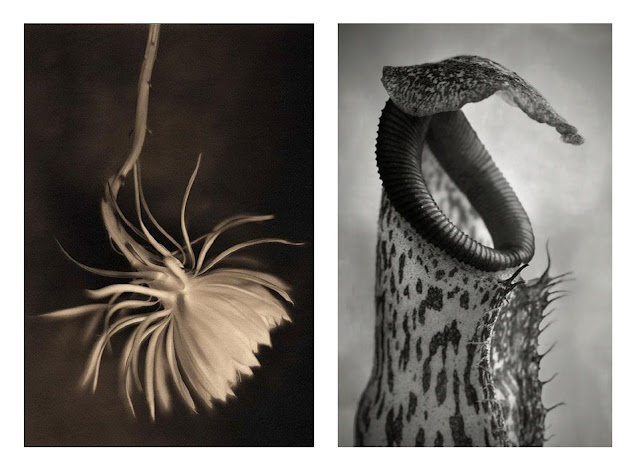
Left: James Pitts, Night Blooming Cereus, 1999, Platinum Palladium Print, 5x4", Edition of 25, $1000
Right: Beth Moon, Nepenthes Coccinea, Platinum print, 7.5x5", Edition of 9, $900 


In celebration of the spring season, we have installed a selection of Platinum prints focused on floral still lives from gallery artists Beth Moon and James Pitts.

You may be wondering, upon reading the opening sentence of this week's post, what is a platinum print anyway? To that I say: fantastic question.

Platinum printing is a method that uses light-sensitive platinum (as opposed to silver in "traditional" darkroom printing) to make a picture! This printing methodology dates back to the late 1800's and is known for being a process that has the potential to produce an incredible tonal range as well as to achieve archival permanence. When making a platinum print, the image is produced by placing a negative on top of paper coated with a photosensitive solution and then exposing that paper to light; this process is referred to as contact printing and is notoriously difficult to do well (for more in-depth descriptions of alternative processes, check out this article!).

James Pitts and Beth Moon are two who have mastered this laborious workflow through years and years of diligent practice. Their mastery is apparent, and though the overall practices of the two artists are wildly different, they converge in floral formalism.

Beth Moon's plant portraits are from her portfolio entitled The Savage Garden. This work serves as an investigation of the formal beauty of carnivorous plants. Moon's images don't treat these plants as our culture often does, with some element of novelty and exoticism, but instead highlights their supple curves and delicate structure. This attention to detail and composition is mirrored in the platinum works of James Pitts, who has been making still lives of flowers for well over twenty years as meditative studies of light and form. In Pitts' work, the flower is simply the vehicle for serene expression. 

Take a sneak peak at what's up on the wall below and explore more work from Beth Moon and James Pitts as well!

>> Beth Moon Interview <<

>> James Pitts on his Platinum printing origin story <<


James Pitts, Wild Poppy with Seed Pod in Girard's Vase, 1996, Platinum Palladium print, 5x4″, Edition of 25, $1000

Beth Moon, Nepenthes Bicalcarata, Platinum print, 12x8″, Edition of 15, $1200

James Pitts, Digbyana, Platinum Palladium print, 5x4″, Edition of 25, $1000

Beth Moon, Nepenthes Ventricosa, Platinum print, 12x8″, Edition of 15, $1200


>> Explore Beth Moon's online exhibition, BAOBAB, here! <<


>> See more portfolios from James Pitts here! <<

• • • • • 

Print costs are current up to the time of posting and are subject to change.

photo-eye Gallery is proud to represent Beth Moon and James Pitts.

For more information, and to purchase prints by Beth Moon and James Pitts, please contact Gallery Director Anne Kelly or Gallery Assistant Delaney Hoffman, or you may also call us at 505-988-5152 x202

photo-eye Gallery On View - Platinum Florals from Beth Moon and James Pitts Delaney Hoffman
In anticipation of warmer weather and lots of pollen in the air, we've installed a stunning selection of floral platinum prints from Beth Moon and James Pitts in our gallery space! Click here to see some of the work and to learn more.