PHOTOBOOK REVIEWS, INTERVIEWS AND WRITE-UPS
ALONG WITH THE LATEST PHOTO-EYE NEWS

Social Media

Showing posts with label Madeleine Morlet. Show all posts
Book Review Emerald Drifters Photographs by Cig Harvey Reviewed by Madeleine Morlet “In the last few hundred years, science has worked hard to convince us that everything is knowable. We have grown accustomed to understanding the world through the lens of this distorted truth. Cig Harvey, in her fifth monograph, Emerald Drifters, invites us to return to the wonder of being..."

Emerald Drifters by Cig Harvey
https://www.photoeye.com/bookstore/citation.cfm?catalog=PI311
Emerald Drifters
Photographs by Cig Harvey
Monacelli Press, New York, NY, 2025. 224 pp., 100 illustrations.

In the last few hundred years, science has worked hard to convince us that everything is knowable. We have grown accustomed to understanding the world through the lens of this distorted truth. Cig Harvey, in her fifth monograph, Emerald Drifters, invites us to return to the wonder of being.

Across its 224 pages, Emerald Drifters uses color as a container for life—a catalogue of pleasures and heartbreaks—where we encounter the divine in shades and tones of yellow, red, and blue. Its 101 photographs include the open-mouthed face of a porcelain cupid, the “woozy caverns and erect peaks” of a chocolate cake, and an abundant smoky tableau inspired by eighteenth century Flemish still lifes. These images stand side by side with watercolor diagrams, ‘how-to’ instructionals, and vignettes of creative non-fiction from The Sky Is Blue Only for You to How to Welcome the Unwanted.

In The Sublime and the Beautiful, Harvey writes, “In 1797, the German philosopher Immanuel Kant made two columns in his notepad, dividing aesthetics into the sublime and the beautiful. The sublime was to be revered as majestic, important, multiple, and monumental. The beautiful became the decorative, insignificant, singular, and superficial.” The Scientific Revolution, Kant, Newton, and many others have guided us towards a rejection of beauty. In the contemporary art world, few dare to defend the objective role beauty plays in the human experience and our connection to something greater than self. In Emerald Drifters, Harvey makes a case for its intrinsic value, arguing that beauty is an ontological primitive, a fundamental, irreducible entity—a foundational building block of reality.
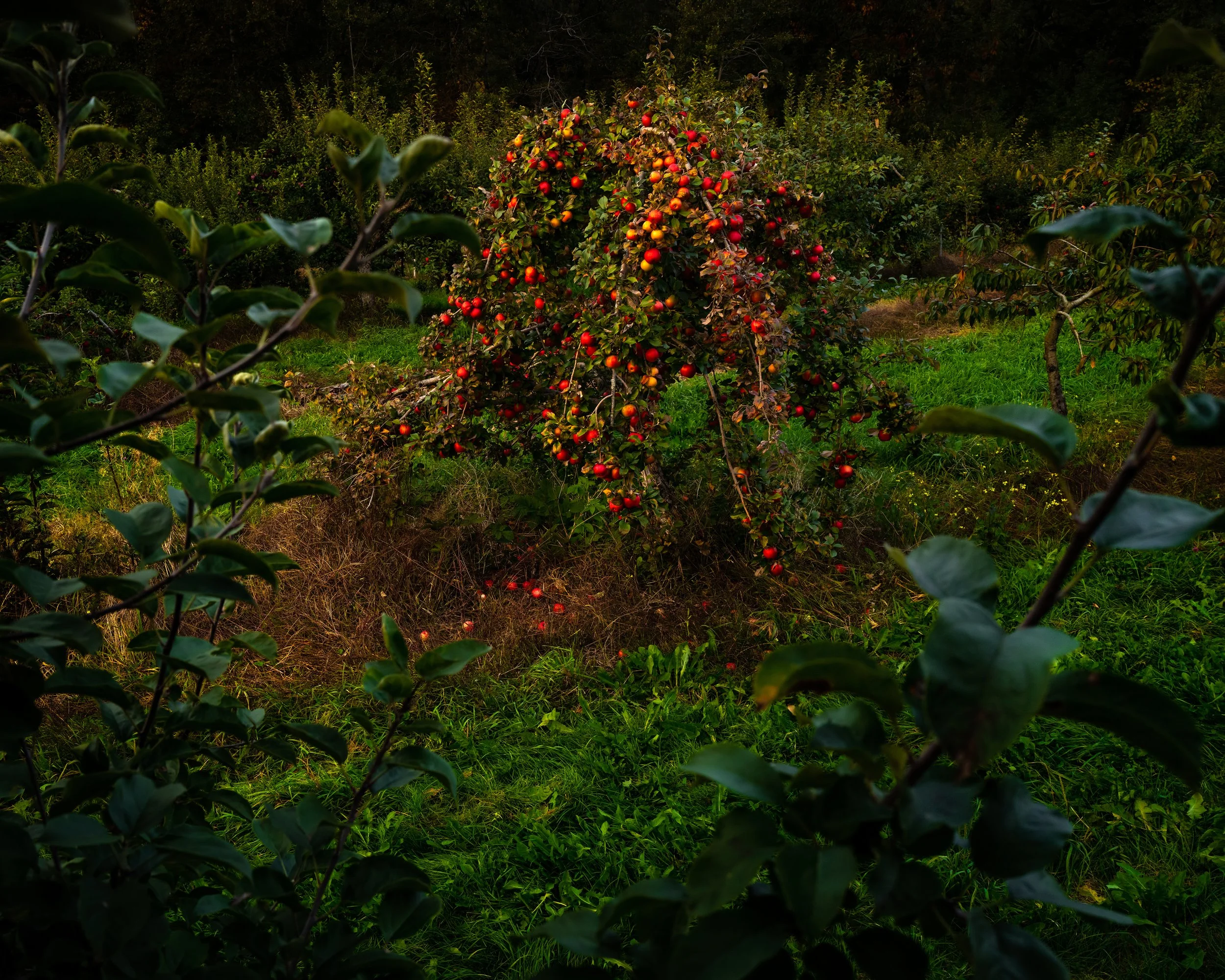

Beware. Alongside beauty exists both the awe and the agony of life. A monograph allows photographs to be contextualised beyond the single frame, and when sequenced together, the images speak to one another. In his memoir, Sculpting In Time, filmmaker Andrei Tarvoksky reflects, “The aim of art is to prepare a person for death. When a link is established between the work and its beholder, the latter experiences a sublime, purging trauma. The best sides of our souls are made known. The unfathomable depths of our own potential, and the furthest reaches of our emotions.” 

In Emerald Drifters, there are three sequences that explicitly establish this link for me, as described by Tarkovsky:


A Red That Bites, a masterclass in associative thinking: red berries, red room, white flowers, open drawer, open mouth white teeth, white napkin dabbed red, dark sky, white window square.


Emerald Drifters, the namesake vignette: a garden at night and a figure (perhaps that of Rebecca Middleton, whose story is shared) both stand amongst and are another iris. We turn the page, the iris becomes small blue flowers, and again, these flowers become a path of light.

 From the Emerald Drifters vignette Emerald Drifters

A Sea in Ease, it is here that I discover what the ancient pagans described as a thin place––the shortest distance between Heaven and Earth where we encounter the divine. Harvey writes about the passing of her dog Scarlett. “People send me pictures and videos of [her]. The messages say she will always be with me in spirit, but I don’t want her fucking spirit. I want her warm body pressed against me in my sleep, the smell between her paws. The body is not nothing. The body is everything.”

 From the Emerald Drifter vignette A Sea in Ease

Each time I revisit these pages, I am struck. Scarlett’s golden body draped in gold fabric, bright amongst the dark foliage of the garden. I think of Doug (Harvey’s husband) running to retrieve this sheet from their bed––an echo of an earlier vignette, Last Night, I Slept in the Goldenrod. Scarlett rests in a circle of nasturtiums, the colors of life—red, orange, yellow—hold her like a pagan burial. We turn the pages: a halo of yellow mustard weed rising from the darkness, stardust falling in the night sky, a field of birds taking flight. In this work, I am the beholder, bearing witness to her soul as it is carried away. “When dying, beauty is the only language worth speaking.”

 From the Emerald Drifter vignette Last Night, I Slept in the Goldenrod

It is in times of crisis where we need most to reclaim our sense of awe. Cig Harvey’s Emerald Drifters reminds us of our humanity. Its pages guide us towards the unknowable truths of goodness, beauty, and the divine. This book is an urgent call to live. Its pages burst at the seams. They “hiss, spit, and flash” rich hues of pleasure, sex, and death. The message is clear: between our first breath in and our last breath out is the everyday of living. Don’t miss out. “Be here now.”

Purchase Book

Read More Book Reviews


Madeleine Morlet
is an award-winning photographer and writer based in London. She teaches photography at Maine Media Workshops, Penumbra Foundation, and the SE Center for Photography, specializing in the photobook and the narrative potential of photography. Her work as a photo book editor includes Emerald Drifters by Cig Harvey.
Book Review The Quarry Photographs by Madeleine Morlet. Short story by Vivian Ewing. Reviewed by Odette England "The Quarry refers to both place and victim. It’s not a photobook as such, rather, a newspaper, and it contains less pictures than one might expect from either. There are a sweet sixteen of them, around which wraps the story of teenage girls who return home a week apart for their first summer break from college..."

The Quarry. By Madeleine Morlet & Vivian Ewing.
https://www.photoeye.com/bookstore/citation.cfm?catalog=TT189
The Quarry
Photographs by Madeleine Morlet
Short story by Vivian Ewing


Self-published, 2022. In English. 20 pp., 13.75x20".

Quarry. A large, deep open-air hole from which slate, limestone or granite is extracted through digging or blasting. It’s also a word used to describe prey, the aim of an attack.

The Quarry refers to both place and victim. It’s not a photobook as such, rather, a newspaper, and it contains less pictures than one might expect from either. There are a sweet sixteen of them, around which wraps the story of teenage girls who return home a week apart for their first summer break from college. But the pictures are not sweet and nor is the story. They are dark and light and beautiful and tragic. Photographer Madeleine Morlet and writer Vivian Ewing twist elements of myth-making, murder ballads, psychological horror and romance novel in broadsheet form, a shrewd choice as broadsheets tend to be more solemn and less sensationalist than tabloids.

Morlet depicts with rigor and love the community of young friends who live in the picturesque but ominous coastal Maine landscape to which she relocated from London in 2017. Even without Ewing’s words, divided into nine sections and which I only read after several weeks of looking, Morlet’s pictures feel weighted with rocks. They are implications, and what heightens their effect on me is the extreme care taken in pairing and sequencing. The pairs are like besties, any flaws or differences serving to make each other stronger. The images, all color and made during the summer of 2021, appear meticulously crafted while maintaining an innocent snapshot quality. Sometimes the best photographs are like having good fashion sense: it looks effortless but is almost insanely hard. It’s not about having the coolest equipment or a big budget, it’s about being an expert and generous observer.


When I ask Morlet about the work she describes “feeling a kinship with the adolescent experience” and writes of “domestic departure and return.” I dwell on domestic, the idea of the local and internality but also family. I learn that Morlet and Ewing, who completed her undergraduate studies in Maine, came to know each other through this project, collaborating for six months and talking almost weekly.

More than half the photographs are close range or taken from atypical angles, either low to the ground, or looking up, along or through something. Faces and especially eyes are often protected, blurred or concealed. Though our eyes are wondrous things, they have limits as do photographs, and when we can’t see our brain steps in and fills in the blanks. That’s what I found compelling about The Quarry: I was continuously anticipating what I would see or feel next. Where parts of images are obstructed through shielding or cropping, I still had a specific expectation of what the ‘story’ would look like in the end (I was wrong). Morlet’s lush photographs are like a collection of stills from a coming-of-age movie trailer. They tempt, like the quarry and its abandoned equipment and intense cold water Ewing writes about. Morlet herself describes them as “a call and response to Vivian’s writing” which “permeated my thoughts…and brought an element of fiction to the experience of capturing my subjects as themselves.”


The photographs don’t look like the ones printed in my local newspaper that I used to clip and stick to my walls — Morlet’s are finer — but as she points out, it’s less common practice now. Teenagers favor scrolling over buying newspapers or magazines, something I think about in noticing the two images with cell phones in The Quarry. But technology and contemporary life are present: false eyelashes, vaping, Reeboks, nose rings, a Subaru, a padlock-as-pendant and a letter bead necklace that spells out O-W-N quiver octaves below the trees, flowers, ropes and siding that dot the landscape around the quarry.

Every town has a place of legend and danger. Often it involves water. Think of all the books, songs or films you know where water is the backdrop for an atmospheric thriller. What makes The Quarry special is how Morlet and Ewing mine the aches and dreads of being a teenage girl and merge them with the exquisiteness of desire and freedom and the costs thereof. Their use of water as both character and characteristic. And the undercurrent of the pictures suggesting that what we can’t see can’t hurt us.

Purchase Book

Read More Book Reviews


Odette England 
is a photographer and writer based in Providence, Rhode Island and New York. Her work has been shown in more than 100 museums, galleries, and exhibition spaces worldwide. She has two photobooks out this year: Dairy Character, winner of the 2021 Light Work Book Award; and Past Paper Present Marks: Responding to Rauschenberg, her collaboration with Jennifer Garza-Cuen, which received a $5,000 Rauschenberg Publication Grant.