PHOTOBOOK REVIEWS, INTERVIEWS AND WRITE-UPS
ALONG WITH THE LATEST PHOTO-EYE NEWS

Social Media

Showing posts with label Madeline Cass. Show all posts
Book Review Blind Spot Photographs by Julie van der Vaart Reviewed by Madeline Cass "In Blind Spot, Julie van der Vaart crafts images that drift between the abstract and the tactile, the geological and the human. The silvery prints are a study in contrast — both visually and conceptually..."

Blind Spot by Julie van der Vaart.
https://www.photoeye.com/bookstore/citation.cfm?catalog=IZ161
Blind Spot
Photographs by Julie van der Vaart

Void, Athens, Greece 2023. 220 pp., 7¾x9¾".

In Blind Spot, Julie van der Vaart crafts images that drift between the abstract and the tactile, the geological and the human. The silvery prints are a study in contrast — both visually and conceptually. Over- and underexposed moments create a dreamlike experience that invites viewers into her world of chiaroscuro. The viewer questions not only the nature of our bodies but also how far are we actually removed from the slow drip of time — like stalactites we are shaped by small moments. We are reminded that time is not intuitive but merely moments strung together (much like the function of the camera itself) where seemingly abstract ideas are merged into one continuous loop. The question is this: are we truly outside the natural processes of the earth, of caves, of the slow drip of water within us all? She seems to answer: we are not. This work invites the viewer to look deeper than the skin, this crust of society we are all mired in.

Van der Vaart’s work is visceral, marked by drips, sprays, and textures that resemble acid washes or misty, stormy coastlines. Often, the imagery of bodies alongside caves evokes topographic or geological maps and visually drags us across landscapes both human and subterranean.


The imagery of people highlights humanity’s vulnerability through disassociation of not only body but place, and questions the mystery and solitude found in life. The nudes that are paired with these natural landscapes feel like echoes, their shapes abstracted into formal structures, eliciting the viewer to explore and climb in. Limbs become rivers, and bodies float like celestial objects, at times resembling the moon or stars in motion. There’s a tension here between bodies falling or arching, offering an emotional push-pull between desire and detachment.


The subtle use of color — hints of purples and blues — breaks through the monochrome, allowing for moments of stillness, like musical rests between visual notes. Van der Vaart’s repetition of forms and exposures creates a rhythm that builds, referencing both geological forces and bodily ones. In one double-page spread, the deep blue evokes Yves Klein, while elsewhere, a body and a cave meld together in a shared sense of space and form.


Van der Vaart’s work questions the boundaries of the known and the unknown — inviting us to spelunk through both physical landscapes and emotional depths. Her visual metaphors are provocative, at times playful. Through seeming imperfections, motion blurs, and long exposures, she taps into early photographic techniques, while pushing them into contemporary contexts.

Blind Spot is a journey of texture, shape, and light. Through its inky depths, we are invited to explore not only the natural world but the deeply personal and emotional spaces within ourselves. The experience of looking at these images is as much about what we see as what remains in the periphery — an invitation to uncover and understand our own blind spots.

Purchase Book

Read More Book Reviews


mad(eline) cass
is an American artist and photographer based in Lincoln, Nebraska and Kansas City, Missouri. She is the author of how lonely, to be a marsh, published in 2019.
Book Review Anne Brigman: A Visionary in Modern Photography Photographs by Anne Brigman Reviewed by Madeline Cass A much-anticipated look at one of the first feminist artists, best known for her iconic landscape photographs made in the early 1900s depicting female nudes outdoors in rugged Northern California.

https://www.photoeye.com/bookstore/citation.cfm?catalog=RZ351
Anne Brigman:
A Visionary in Modern Photography

Rizzoli Electa, 2020. 400 pp., 10x12½x1¾".

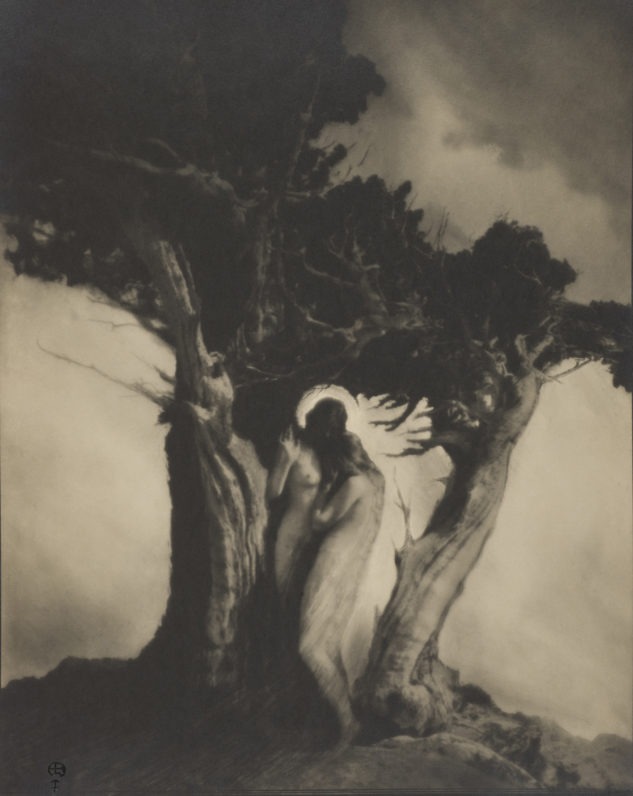
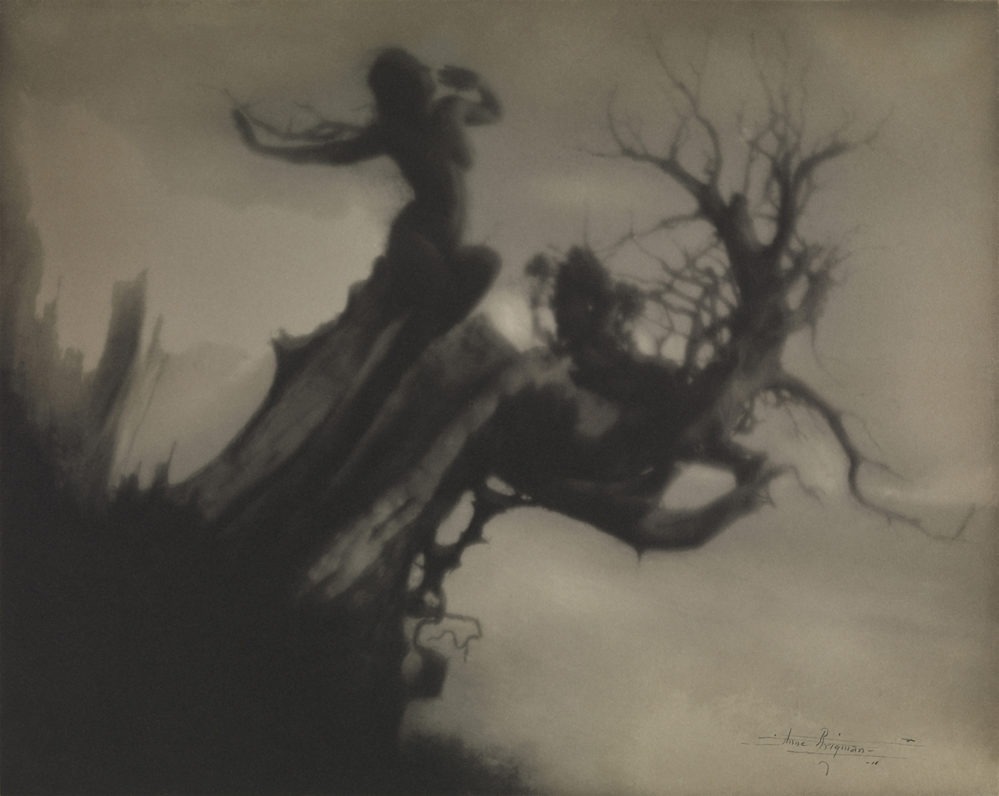
It feels both unsurprising and disappointing that I had not heard of Anne Brigman (1869-1950) until recently. She was never mentioned in my history of photography classes or textbooks. Thankfully, in 2018 The Nevada Museum of Art hosted a major retrospective of her work, providing some of the long-overdue acclaim she deserves. This book, A Visionary in Modern Photography, was published in conjunction with that exhibition. It is monolithic in stature — roughly 400 pages of beautifully reproduced images, poetry, and archival materials, such as personal letters and newspaper clippings.

Brigman’s work was primarily made within the tradition of pictorialist landscape photography. Many of her photographs are nudes, both of herself, her friends, and sisters, primarily in the Sierra Nevadas. These images feel familiar but unknown. They feel iconic, like something of a feverish and timeless dream.

Although “feminist art” didn’t exist until nearly seventy years after Brigman made her first photographs, she made nude photographs of herself — likely one of the first women to do so — at the turn of the twentieth century. This was perceived as an incredibly radical act, challenging the lingering Victorian norms of the day. Continually defying gendered social expectations, she found freedom by trekking deep into the mountains, with carriages, pack mules, and heavy photographic equipment in tow. An avid supporter of women’s rights, she married and divorced, never wanted or made children, and never required approval or permission from men. She publicly declared herself “emancipated from fear”. And she lived by these words, writing: “I slowly found my power with the camera among the junipers and the tamarack pines of the high, storm-swept altitudes.”

Rather than focus on expansive landscapes alone, her work reveals an intimacy with the landscape — an approach that male photographers of the time had not yet taken. By incorporating the body, her work rejects a false idea of “untouched uninhabited virgin wilderness”. There were people living there long before Brigman or her peers showed up.

Anne Brigman: A Visionary in Modern Photography.

Brigman’s photographs glow and ache with a kind of spirituality and environmental eroticism (perhaps she would have identified with the term “ecosexual”). She actively wrote poetry, which complemented her photographs. She had a particularly intense connection with trees; apparent through reoccurring images of arched, nude female bodies, intertwining themselves within the branches and trunks of the knotted, ancient trees of the high mountains. Perhaps she felt an attraction to the ways that bodies and branches accentuate the natural expressions of one another. She wrote of her “hunger for the clean, high, silent places, up near the sun and the stars”, and desire to “eat and sleep with the earth”.

Her attraction and need for wild places was intense and beautiful, which is eloquently transmitted through her work. Anne Brigman shows us how she touched the landscape and the landscape touched her.

Purchase Book

Read More Book Reviews

Anne Brigman: A Visionary in Modern Photography.

Madeline Cass is a native of Nebraska, and is currently based in Santa Fe, New Mexico. She earned a BFA in studio art with an emphasis in photography from the University of Nebraska–Lincoln in 2017. She primarily works within photography, poetry, and artist books. She is the author of how lonely, to be a marsh, published in 2019. Her work examines the multitude of relationships between art, science, nature, and humanity.

Book Review Entangled Photographs by Maude Arsenault Reviewed by Madeline Cass "An intimate, autobiographical body of work, Entangled is quiet and alluring visual poetry that examines and asks questions about age, family, but particularly what it means to be a femme-identifying human and the roles of gender in our society...."
Entangled. By Maude Arsenault.
https://www.photoeye.com/bookstore/citation.cfm?catalog=ZJ220
Entangled  
Photographs by Maude Arsenault

Deadbeat Club, Los Angeles, CA, 2020. 64 pp., color & black-and-white illustrations, 9½x12¼".

An intimate, autobiographical body of work, Entangled is quiet and alluring visual poetry that examines and asks questions about age, family, but particularly what it means to be a femme-identifying human and the roles of gender in our society. This project encapsulates a pivotal moment for Canadian photographer Maude Arsenault’s work, representing a shift in perspective and personal responsibility. "After years dedicated to creating glorified images of women," she says of her success in fashion photography, "I came to question my role and influence in the transmission of models of femininity."

Her perspective, as an adult and a parent, has shifted the way she views cultural demands made on the bodies and roles of women — especially younger women. Arsenault is the mother of three children, including a fourteen-year-old girl. The book opens with a handwritten Virginia Woolf quote — “Growing up is losing some illusions in order to acquire others.”

EntangledBy Maude Arsenault.

Arsenault utilizes the repetition of a number of motifs in order to reflect a personal universe and language. Water and bodies frequently intermingle. A woman floats in the ocean, staring into the sky, seamlessly comfortable between two voids; the space holds her like a womb. Waterfalls appear twice; tumultuous, beautiful and fleeting. One is paired with a backbone, similarly fluid and strong. Another is juxtaposed with the mostly bare back of a young woman, she is turned away from us, pulling on her top, something intimate — we are not sure if this is an act of modesty or revealing.

EntangledBy Maude Arsenault.
Curtains, bedsheets, blinds, clothing, a pair of cheap cotton white panties laying bleakly, they serve a similar role — veiling something intimate or empty. The cast shadows of a tree, shading; still more capitulation between masking and revealing. Bodies are often out of focus forms — perhaps it is our perception of ourselves, often too close to see clearly. The home becomes a metaphor for the body, such as in Bachelard's The Poetics of Space, wherein the attic is a metaphor for clarity of mind. The basement, on the contrary, is the darker, subterranean and irrational entity.

A lynchpin image of this work is of a young woman reading a book, one thigh resting on the back seat of a car, seemingly unaware of the surrounding world, or of the viewer. The figure in Entangled is reading a book in French, La dernière des Stanfield, by Marc Levy. One summary describes this novel as “A mystery, a love story, and a search through a shadowy past.”

In a similar fashion, Entangled elicits a sense of mystery, love and personal history. The viewer is left with a feeling of melancholy and tension in the embodiment and disembodiment of what it means to identify and be viewed as female.

Purchase Book

Read More Book Reviews

EntangledBy Maude Arsenault.

Madeline Cass is a native of Nebraska, and is currently based in Santa Fe, New Mexico. She earned a BFA in studio art with an emphasis in photography from the University of Nebraska–Lincoln in 2017. She primarily works within photography, poetry, and artist books. She is the author of how lonely, to be a marsh, published in 2019. Her work examines the multitude of relationships between art, science, nature, and humanity.


Book Review how lonely, to be a marsh Photographs by Madeline Cass Reviewed by Christian Michael Filardo The promise and pathology of America in the photographs of Epstein, more than half of which are previously unpublished.
how lonely, to be a marsh. By Madeline Cass.
https://www.photoeye.com/bookstore/citation.cfm?catalog=ZJ139
how lonely, to be a marsh  
Photographs by Madeline Cass

self published, 2019. 100 pp., 8x10".

I have been in the wetlands of Virginia when they crested their banks due to an abundance of rainwater to join the River James and caused an algae bloom to kill the fish where the heron makes its nest. Wading knee-high into blue-green, god-knows-what, down by the train tracks while looking for something I still cannot define.

Marshes have an unsettlingly quiet wilderness about them. Waters so dark that gazing into the murk will have you mimicking a witch, looking into a scrying mirror for answers stewed in myth. A similar, yet more compassionate, energy arises when leafing through how lonely, to be a marsh by Madeline Cass. The poet-photographer’s first monograph blends documentary photography with the arts to build narrative around threatened Nebraska wetlands.

how lonely, to be a marsh. By Madeline Cass.

While some may see this book as an active rebellion towards a capitalist society, pushing for the protection of nature. I believe that Cass is using the marsh as a medium to further understand her own identity. Not to imply that the goal of the artist here is inherently selfish but, rather, to say that an  eco-warrior mentality is not the main draw to this experience. That is to say, if we are going to assume that the marsh has feelings synonymous to those of a human being, then we are seeing those emotions projected, through Madeline, onto soil, water, and the wildlife therein via photography, poetry, and research.

how lonely, to be a marsh. By Madeline Cass.
What strikes me most about this book is the artist’s ability to weave themes together in a fairly chaotic way. The interior design is all over the place. Handwritten text merges with typeface, images overlay other images, archival scans go full bleed at random. If the intention behind the design was to copy the fluid natural chaos of the Earth, we find success in the presentation. Images serve as document while walking the line between fine-art and photojournalism.

how lonely, to be a marsh. By Madeline Cass.
These are images that, at times, feel like historical documents, but serve the viewer’s inherent desire for a little eye-candy. We get the sunsets, we get the eggs, we get brush blurred, we get the taxidermy eagle, we get the archival aerial photograph. All the bases are covered and serve their purpose. I wouldn’t be surprised to find this book re-issued by a larger publisher once the initial self-published batch runs out.

Ultimately, what we have in how lonely to be a marsh is the documentation of an artist’s early forays into field research and building a compelling body of work around that practice. A truly impressive result for the size of the undertaking Cass took on in Nebraska. I feel as though this book asks us to take a moment to listen to our surroundings. Beckoning us towards the idea of a more sustainable future. One where we, as human beings, are cognizant of the plague we’ve become to our only home. The hope that we can right the ship and save ourselves before the sun sets on our reality. A book abundant with riddles still waiting for answers.

how lonely, to be a marsh. By Madeline Cass.

Christian Michael Filardo is a Filipino American photographer living and working in Richmond, Virginia. Filardo uses their camera to record everyday nuances, later grouping images to create narratives from the mundane, intimate, and quiet. Filardo writes critically for photo-eye and PHROOM and is a co-founder of the Richmond based art space Cherry. They have exhibited domestically and internationally. Their latest book Gerontion was released at the LA Art Book Fair in April 2019. They also released the zine Not Until This Morning (UDLI Editions) at NYABF in September 2019 which has since sold out.