PHOTOBOOK REVIEWS, INTERVIEWS AND WRITE-UPS
ALONG WITH THE LATEST PHOTO-EYE NEWS

Social Media

Showing posts with label Perimeter Editions. Show all posts
Book Review Ghar Photographs by Anu Kumar Reviewed by Brian Arnold "The Hindi word ghar (or in its traditional Devanagari script घर), is derived from Sanskrit and means home, and can refer to both a physical dwelling and a region. This is a lovely idea, connecting the micro and macro understanding of home in one word..."

Ghar. By Anu Kumar.
https://www.photoeye.com/bookstore/citation.cfm?catalog=IZ175
Ghar
Photographs by Anu Kumar
Perimeter Editions, Melbourne, 2023. 136 pp., 5½x7".

The Hindi word ghar (or in its traditional Devanagari script घर), is derived from Sanskrit and means home, and can refer to both a physical dwelling and a region. This is a lovely idea, connecting the micro and macro understanding of home in one word. The notion of home feels so much more complicated to me today – with wars in raging in Gaza and Ukraine over the rights to a homeland – but always a notion deeply connected to our personal and cultural identities. The ancient Sanskrit word घर exists unchanged today in Hindi, perhaps because it is such an essential part of the human experience, constantly ebbing and flowing between nurture and trauma, providing us with our deepest sense of self but are also often sites of our greatest tragedies.

Without the gravity of the world’s wars, the notions of nurture and trauma provide an interesting entry point for the new book by Melbourne-based photographer Anu Kumar, Ghar. Published in September 2022 by Perimeter Editions, Ghar is a collection of photographs made in Kavi Negar, India, Kumar’s birthplace. The book is composed of archival portraits snatched from family albums juxtaposed with Kumar’s medium-format film pictures dating back to 2011 when she made her first journey as an adult.

There isn’t much text or explanation provided in Ghar, just a short letter dated June 18, 1997. It seems to be written by Kumar’s mother, Guddu, to her grandparents. The letter references a recent move from India to Melbourne, the daughter telling her parents about the remarkable challenges and burdens of being first-generation immigrants, leaving India to try and set up a new home and identity in Melbourne in hopes of providing greater educational and cultural opportunities for their children. I know Kumar lives in Melbourne today but have no idea at what age her family decided to relocate to Australia. Nevertheless, 14 years after the letter was written, she went back to Kavi Negar to try and see how much of herself she could see in the people and landscapes, a place for which she could only have minimal memories.


Ghar
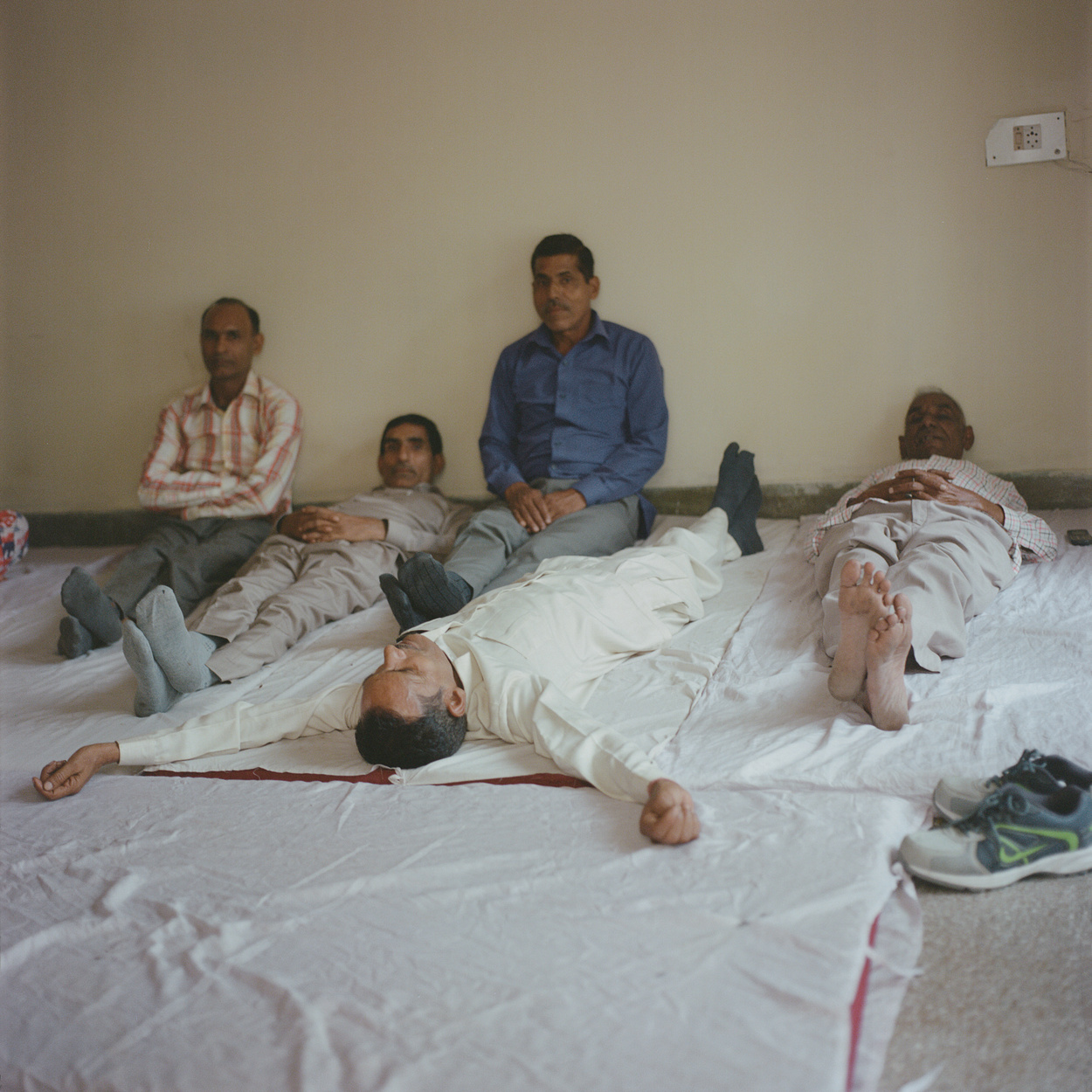
, the result of this inquiry, is really quite lovely, full of affection, beauty, longing, and humility. The pictures are quite simple, proving that once again photography is best when grounded in its most fundamental attribute of clarity. Composed concisely – the subject almost always in the middle of her square frame — but with a lyrical understanding of light and color. Each picture is grounded in just 1-2 clearly articulated colors and uses open and softly diffused light (not much shadow play to see here). The effect is moving, making the pictures feel both warm and inviting and also patient and considered. Her subjects are simple and mundane things — a recently washed bowl drying on a countertop, a woman washing her hair, streetside vendors, and people relaxing on a hot afternoon — but with a clear understanding that these are the things that define our lives; the people we share the most intimacy with are the ones we also share the most mundane parts of our days. The book is small, only 14 x 18 centimeters, printed on matte paper with a warm cloth binding, echoing the simplicity and humility found in the photographs.

After making the pictures in 2011, it took another 10 years for Kumar to make sense of them. The world grinding to a halt with the COVID pandemic forced all of us to reflect on the nature of our connections, communities, and families. Nurture and trauma were at the heart of all this, as each of us was required to retreat into our homes and find the sustenance to endure unprecedented chaos and catastrophe. This also provided Kumar the necessary backdrop to edit the pictures in Ghar, a lovely, poetic, and profound meditation on the meaning of family and place, or in a word, घर.

Purchase Book

Read More Book Reviews


Brian Arnold
is a photographer, writer, and translator based in Ithaca, NY. He has taught and exhibited his work around the world and published books, including A History of Photography in Indonesia, with Oxford University Press, Cornell University, Amsterdam University, and Afterhours Books. Brian is a two-time MacDowell Fellow and in 2014 received a grant from the Henry Luce Foundation/American Institute for Indonesian Studies.
Book Review P.North Photographs by Kathryn McCool Reviewed by Blake Andrews “Who the heck is Kathryn McCool, and why have I not heard of her before? That’s what I kept asking myself as I paged through her astonishing debut P.North..."

P.North. By Kathryn McCool.
https://www.photoeye.com/bookstore/citation.cfm?catalog=ZK328
P.North
Photographs by Kathryn McCool
Perimeter Editions, Melbourne, Australia, 2023. 96 pp., 7¼x8¾".

Who the heck is Kathryn McCool, and why have I not heard of her before? That’s what I kept asking myself as I paged through her astonishing debut P.North. After all, photographic voices this assured and distinctive do not just fall from the sky (excepting occasional savants like V. Maier). They generally take years to mature. But McCool was still a young adult when she shot much of P.North in the 1980s and 90s. Her photos flew under the radar at the time, and that’s still the case. She’s had a few photo exhibitions in Australia and her native country New Zealand, directed short films, and sung harmony as half of The Haints of Dean Hall. A renaissance woman down under.

For a while, McCool’s pictures came in fits and starts. She shot b/w film diligently — “I could spend maybe a month getting 12 shots” — but rarely had the time or funds to make prints or proof sheets. Gradually her negatives accumulated into a long-running project called “Jubilee Years”. An invitation to show at Photo Australia in 2021 helped catalyze their curation and put them on Perimeter’s radar. P. North is the resulting photobook. The title is adapted from a McCool photo of “Palm North” scrawled on an old car door. Abbreviated into a cypher, P.North becomes an amorphous catch-all, a dreamland into which McCool can slot all sorts of odd findings.


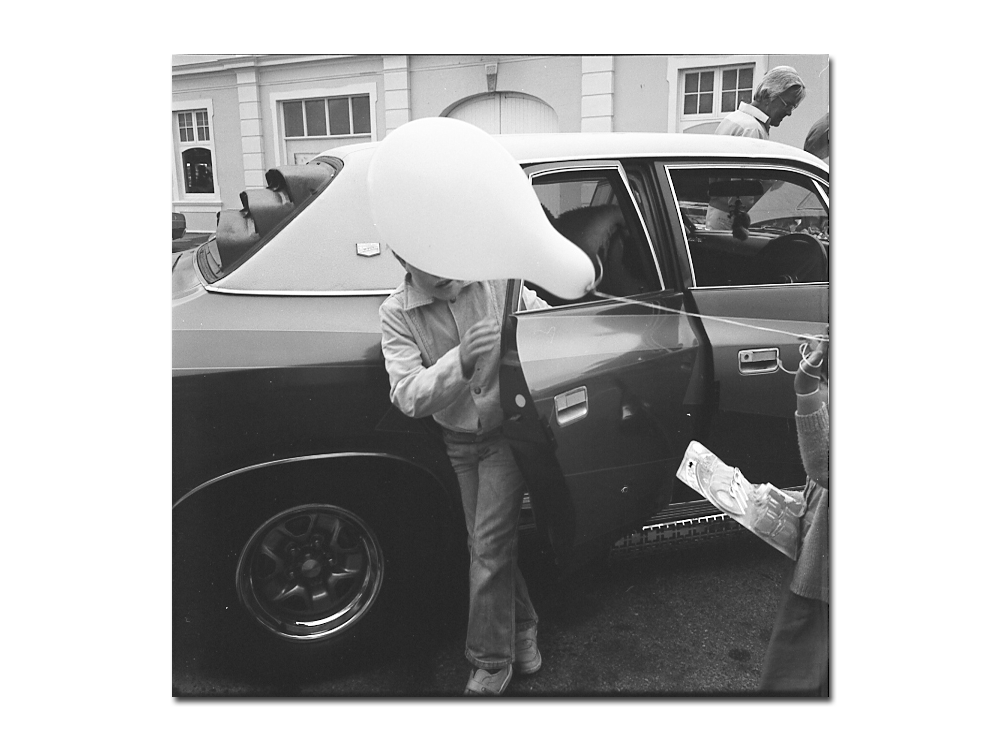
Although much of P.North was shot in New Zealand, McCool’s photos are not necessarily about that country or any specific location. “I really worked hard to have a sense of non place in the book,” she explained in a recent interview. She photographed road crossings, signs, animals and buildings, all “strangely directionless even though they’re headed somewhere.” But her primary focus was people, and portraits comprise the vast majority of P.North. She had a natural instinct for poses and expressions. That applied humans of course, but also buildings and animals. Wherever she aimed her Rollieflex, it seems she filled its square frame with easy command, the photo equivalent of Cinderella’s shoe.


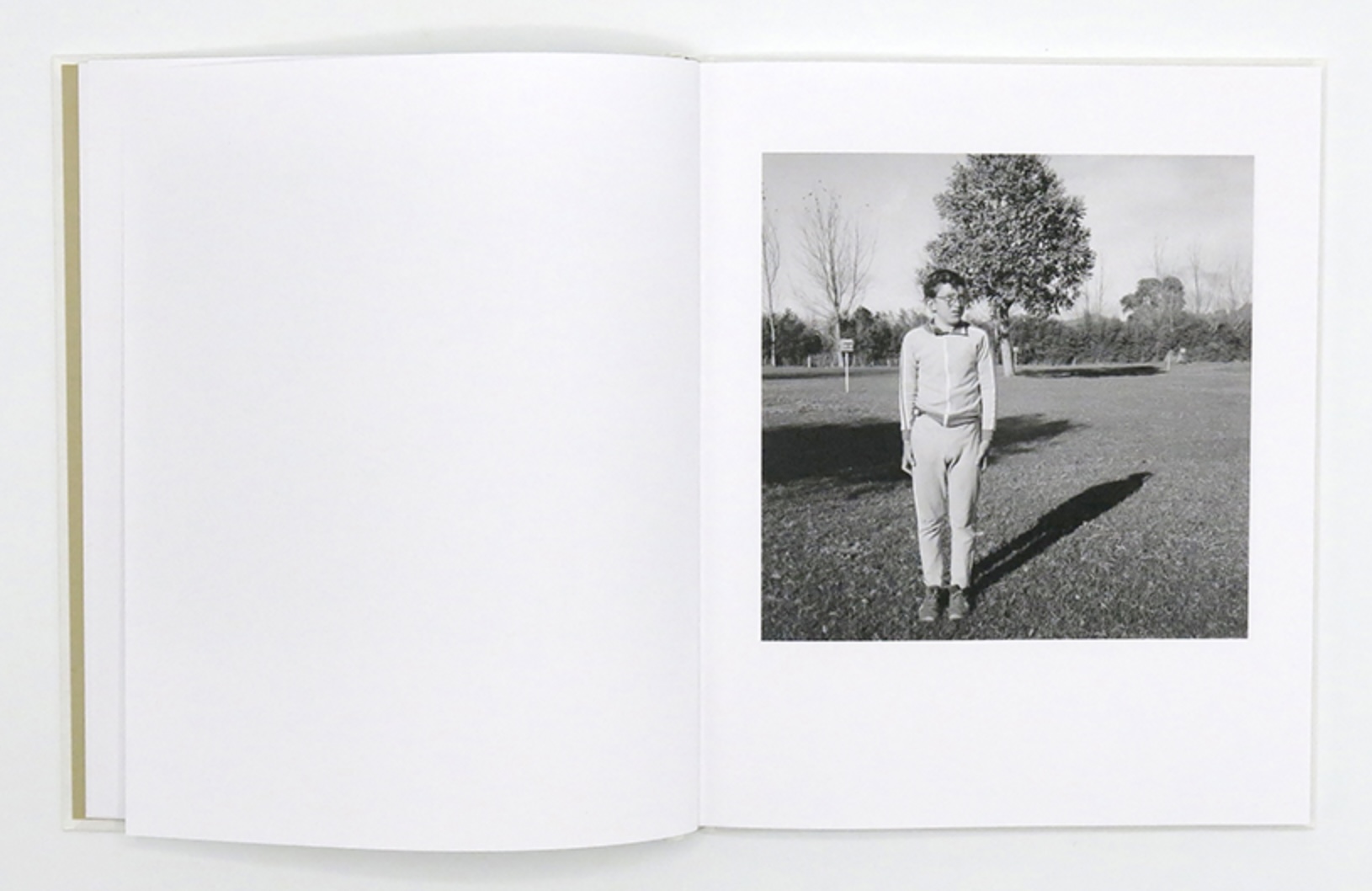
Although McCool photographed a range of ages, she was partial to children. “Childhood was a place I just recently left,” she says. “Basically I was dragged screaming out of childhood.” Photos of a freckled boy under a parasol or teen hunters by a truck bed might be an effort to turn back the clock. Both exude a timeless magic. In other frames, she documents a young girl with an armband matching a trailer, a go-carting kid with a penetrating stare, and a turtlenecked boy floating in a ghostly light leak. None are captioned. If that leaves them resistant to dates, names or memories, they are spellbinding as pure images. They prick the subconscious ineffably, in the vein of Rosalind Fox Solomon, Diane Arbus or Lisette Model.


There are adults too in the mix, along with their lyric documentary backgrounds. All are expertly composed, then placed into heterogenous sequence. Taken together P.North has a cinematic quality, as if its photos are stills from a strange feature film. They appear in the book one per spread on uncoated stock. If the tonality is slightly flattened and muddy, it doesn’t detract much, because everything else about them is perfect.

In a contemporary photobook culture that seems increasingly centered on rhetoric and conceptual theory, it’s refreshing to encounter a no-frills monograph of simple observations. This is a plain white book of photos rooted in the pleasure of seeing. What makes it work is McCool’s unique photographic voice. Her debut monograph is an unexpected treat. She may have worked in the shadows until now, but the photo world is officially put on notice.

Purchase Book

Read More Book Reviews


Blake Andrews is a photographer based in Eugene, OR. He writes about photography at blakeandrews.blogspot.com.