PHOTOBOOK REVIEWS, INTERVIEWS AND WRITE-UPS
ALONG WITH THE LATEST PHOTO-EYE NEWS

Social Media

Showing posts with label Interview. Show all posts
photo-eye Gallery Interview with Vanessa Marsh Anne Kelly We are thrilled to present "Western Landscapes" by the incredibly talented Vanessa Marsh. In this conversation, we discuss curiosity, making photographs without a camera, printing processes, and more.
 

Vanessa Marsh, Western Landscape 1, Archival Pigment Ink Print (from scanned Cyanotype), 15x20 in, Editon of 10, $1600

We are thrilled to present Western Landscapes by the incredibly talented Vanessa Marsh!

About this work, Marsh writes, "The images depict the infrastructure and amusements of modern culture set against otherwise remote locations. The darkness of the sky and the prevalence of stars allude to ancient skies before light pollution changed our everyday experience of the universe. The images act as a meditation on our connection to the story of humanity, as well as our place in the vast geologic history of the earth and the cosmos."

In this conversation, we discuss curiosity, making photographs without a camera, printing processes, and more.


Anne Kelly: What role does curiosity play in creating your artwork?

Vanessa Marsh: I think it plays a significant role; the best new pathways come from experimenting and trying new combinations of factors. Each new series is born from a curiosity to learn a new process.

AK: Please describe your process as simply as possible.

VM: I work in various photographic processes using opaque stencils and cut paper to make multiple exposures on light-sensitive paper. The result is the illusion of a layered and dimensional landscape. 


Vanessa Marsh, Western Landscape 11, Archival Pigment Ink Print (from scanned Cyanotype), 15x20 in, Editon of 10, $1600


AK: You started creating camera-less photographs in 2011. What motivated you to make this transition?

VM: In graduate school and the years afterward, I was working with scale models that I would set up in front of my camera against real skies to capture semi-realistic-looking landscapes. Around that time, I was teaching a beginning photography workshop and used some of the scale models and some torn paper to demo how to create photograms. From the moment I saw the results of that demonstration, silhouetted figures set against a hazy landscape, I was hooked on making photograms of these imagined places. I no longer use scale models, but the basic ideas of layering silhouettes and graduated exposures began that evening.

 
Vanessa Marsh, Western Landscape 4, Archival Pigment Ink Print (from scanned Cyanotype), 15x20 in, Editon of 10, $1600


AK: Over the years, you have experimented with photograms using different printing techniques. Are you drawn to the process or the resulting color plate?

VM: I think both; the technical side of learning a new process excites me, and I love the challenge of translating my core materials into different photographic forms. As I get to know a new process, the color and mood, the benefits and limitations, inform the subject matter, which shifts a bit with each new project.

AK: Do you feel that the color plates result in a different psychological experience for the viewer?

VM: Yes, I think the various print processes evoke different experiences for the viewer. For example, my series, The Sun Beneath the Sky, is very bright and airy and could be seen as quite calming. On the other hand, some of the images set in the nighttime can have a somewhat uncanny feeling.


Vanessa Marsh, Western Landscape 7, Archival Pigment Ink Print (from scanned Cyanotype), 15x20 in, Editon of 10, $1600 

AK: You recently moved from the Bay Area to Oregon. How have the changing seasons in Oregon impacted how you work?

VM: Well, on a practical level, I had to re-think making Lumen prints with sunlight year-round as I had been able to do when I lived in California. This obstacle led me to investigate other ways of making that could be done in my studio during winter months. The seasons also inform how I collect reference images, as the flora shifts way more dramatically with the seasons here in Oregon than in California. Also, my subject matter is moving away from things like palm trees and towards ferns and blackberries. The images have always been amalgamations of various Western landscapes. However, the landscape I am presently living in comes to the forefront.
 

VIEW THE COMPLETE WESTERN LANDSCAPES SERIES HERE

*      *      *

PRINT COSTS ARE CURRENT UP TO THE TIME OF POSTING AND ARE SUBJECT TO CHANGE.

*      *      *

If you are in Santa Fe, please stop by we are open Tuesday– Saturday, from 10am- 5:30pm. 

PHOTO-EYE GALLERY
300 Rufina Circle, Unit A3, Santa Fe, NM 87507

For more information, and to reserve one of these unique works, please contact 
Gallery Director Anne Kelly
You may also call us at (505) 988-5152 x202


photo-eye Gallery Chris McCaw | photo-eye Conversations LIVE + NEW book photo-eye Gallery Last month we hosted a conversation between artist Chris McCaw and photo-eye Gallery director Anne Kelly, via Zoom in honor of McCaw's new book Marking Time. In case you missed it or would like to revisit or share it, the good news, we recorded it and are pleased to share it today.
Chris McCaw, Sunburned GSP #932 (Idaho), Unique Silver Gelatin Print, 8x10 in.


Last month we hosted a conversation between artist Chris McCaw and photo-eye Gallery director Anne Kelly, via Zoom in honor of McCaw's new book Marking Time. In case you missed it or would like to revisit and share it, the good news is that we recorded it and are pleased to post it today!


photo-eye Conversations is a series of causal conversations with photographers 
 we have the honor of working with. 


View | Order  Chris McCaw's new book Marking Time HERE

Marking Time, Photographs by Chris McCaw, Datz Press, 2023. 

Sunburn was a conceptual experiment and adventure in connecting time and analog photographic tools. … I continuously study what directions and shapes of sun trajectories I can obtain in various times and spaces on the Earth. I expect a magical scene to appear, but it is not just vague waiting. I study meticulously. To obtain the traces of the rising and setting sun, you must personally travel to that time and space. It cannot be manipulated. And I just love that process. 
— Chris McCaw 

 
Marking Time, Photographs by Chris McCaw, Datz Press, 2023. 

Chris McCaw works with a manually modified large format camera, loading vintage photo paper in place of film, and letting the sun come through the lens to physically burn the paper. This analog photographic method holds the unique documentary aspects of photography, as it captures the day and night of a distinct time and place. The passage of time is also recorded on the vintage paper, marked through varying levels of sunlight throughout the day. This book is a compilation of McCaw’s diverse work from the past 20 years, featuring the significant Sunburn series along with his Heliograph, Poly-Optic, Cirkut, and Tidal series, allowing us to experience the full scope of his variations flowing as one body centered around the sun. 

 *from the publisher's description


View unique works by Chris McCaw

            *

PRINT COSTS ARE CURRENT UP TO THE TIME OF POSTING AND ARE SUBJECT TO CHANGE.

            *

If you are in Santa Fe, please stop by we are open Tuesday– Saturday, from 10am- 5:30pm. 

PHOTO-EYE GALLERY
300 Rufina Circle, Unit A3, Santa Fe, NM 87507

For more information, and to reserve one of these unique works, please contact 
Gallery Director Anne Kelly
You may also call us at (505) 988-5152 x202


Book Store Interview Strange Hours Writings by Rebecca Bengal Interview by Brian Arnold “I wasn’t far into Strange Hours before I had the idea that the right way to respond to the book would be with an interview with her. Bengal originally reached out to me after my review of Dark Waters and I used that as entry point for a new connection. What started as a simple and unrelated email exchange resulted in this interview..."

Strange Hours by Rebecca Bengal. 
https://www.photoeye.com/bookstore/citation.cfm?catalog=AP730
Strange Hours
Photography, Memory, and the Lives of Artists
Writings by Rebecca Bengal
Interview by Brian Arnold

Aperture, New York, 2023. 216 pp..

In his second collection of essays, Why People Photograph?, Robert Adams addresses the difficulty in finding good writing about photography. Too many writers, he says, get bogged down in critical jargon and unnecessarily complex rhetoric, a sort of writing he defines as “social-scientific balloon bread.” I’m inclined to agree that there isn’t much great writing about photography, but when a good writer comes around it’s easy for me to get excited about reading their work.

I’ve been familiar with Rebecca Bengal’s writing from her contributions to many great photobooks published in recent years — Dark Waters, Girl Pictures, and Juggling is Easy, to name a few — and thus found myself eager to dig into her new collection of essays published by Aperture, Strange Hours. There is a lot I could say about this book, but to keep it simple, it is clear, concise, and insightful writing about an incredibly interesting and diverse collection of photographers, lacking any of the jargon or unnecessary rhetoric Adams dismisses. Some of my favorites are the essays about Judith Joy Ross and Ming Smith, the short story written for Justine Kurland’s Girl Pictures, and an interview with Henry Horenstein about his Nashville work. It quickly became clear to me that interviews are a major part of Bengal’s practice as a writer. There are two reproduced in the book — the one with Horenstein and another with Nan Goldin — but in many of the essays Bengal references interviews she conducted with the artists either in person or by phone. With that in mind, I wasn’t far into Strange Hours before I had the idea that the right way to respond to the book would be with an interview with her. Bengal originally reached out to me after my review of Dark Waters and I used that as entry point for a new connection. What started as a simple and unrelated email exchange resulted in this interview, developed between November and December 2023.


When/how did you first get interested in photography? Do you make pictures or just write about them?

Hard to say, but well before I was aware of it, I think. Turns out quite a few of the photographers I’d eventually come to admire actually were making pictures in and around where I grew up, pre-internet rural western North Carolina, a place that as a kid I assumed was invisible to the rest of the world. Now, looking back, Mary Ellen Mark’s pictures of girls smoking in a kiddie pool, Duane Michals’ portrait of my hometown witch, Joel Sternfeld’s Nags Head photographs, are all cryptically fused with my own memories. I wrote about this unconscious, belated influence in “Self Portrait in Other People’s Pictures” (a piece which is not in Strange Hours).

I do make pictures too, but my conscious interest in photography came sideways, and later. In undergrad in Greensboro, North Carolina, I was primarily involved with the creative writing program, writing and reading fiction, and film, and art — and also music, because music was what my friends’ social lives centered around. I would find my way to different photographers through magazines — art and music and fashion magazines, skate magazines — and old books and through photographer friends. The first major photographer I remember meeting was Sally Mann, when she came to give a lecture at our school. I think she was working on what would become her book What Remains, and she was hauling around this giant bucket of decomposing liquid and photographing it in different stages of decay.

I took my first darkroom class around that time; we worked out of the same darkroom the police department still used then (this was the late 90s). I was experimenting, learning, having fun. Photography sometimes showed up in my short fiction, but I didn’t really write about it for years.

Strange Hours by Rebecca Bengal

You grew up with a deaf parent? Does that have anything to do with your interest in photography? 

My father has been profoundly Deaf from birth, as is his brother, as was their father, as was many of his siblings and his father — Deafness and different forms of sign language have been part of my father’s family for six or so generations. My mother is hearing, we all sign. My sister Joanna Welborn, who is also hearing, is a photographer — her work is incredible. Maybe for my sister and I, in our separate ways, gravitating to photography has to do with being aware of the visual in a different, heightened way. My father is definitely inclined that way — I love the films he used to make and the pictures he makes now.

But photography, for me, is about language too. Beyond growing up bilingual in English and sign, I also absorbed different accents, writing, music, and in that way photography is another language too. In “Slowly and with Much Expression,” an essay in Strange Hours about the relationship between words and images, I write about growing up with closed captioning in a time when it wasn’t common for anyone to use it unless you were Deaf.

DoubleTake magazine is mentioned several times in Strange Hours. Can you tell us a bit about your time with DoubleTake? How did you come to work at the magazine? What was the nature of your work? How has the vision of Double Take influenced your work and career?

The mainstay of my many revolving odd jobs in undergrad was at a small independent bookstore and newsstand in a shopping center in Greensboro, North Carolina. We had a giant wall of magazines and while the gambling tip sheets and car manuals were most popular with our clientele, tucked in among those I found this beautiful literary and photography quarterly magazine DoubleTake. When I found out it was published at the Center for Documentary Studies at Duke, less than an hour away, I wrote them a letter and asked if they were looking for interns. The internship paid a little more than minimum wage, but it did pay, and I primarily worked for the fiction editor, reading manuscripts and suggesting edits. I just really soaked up whatever I could, helping the nonfiction editor too, sitting in with the photo editors, proofing books, helping out with other programs at the Center.

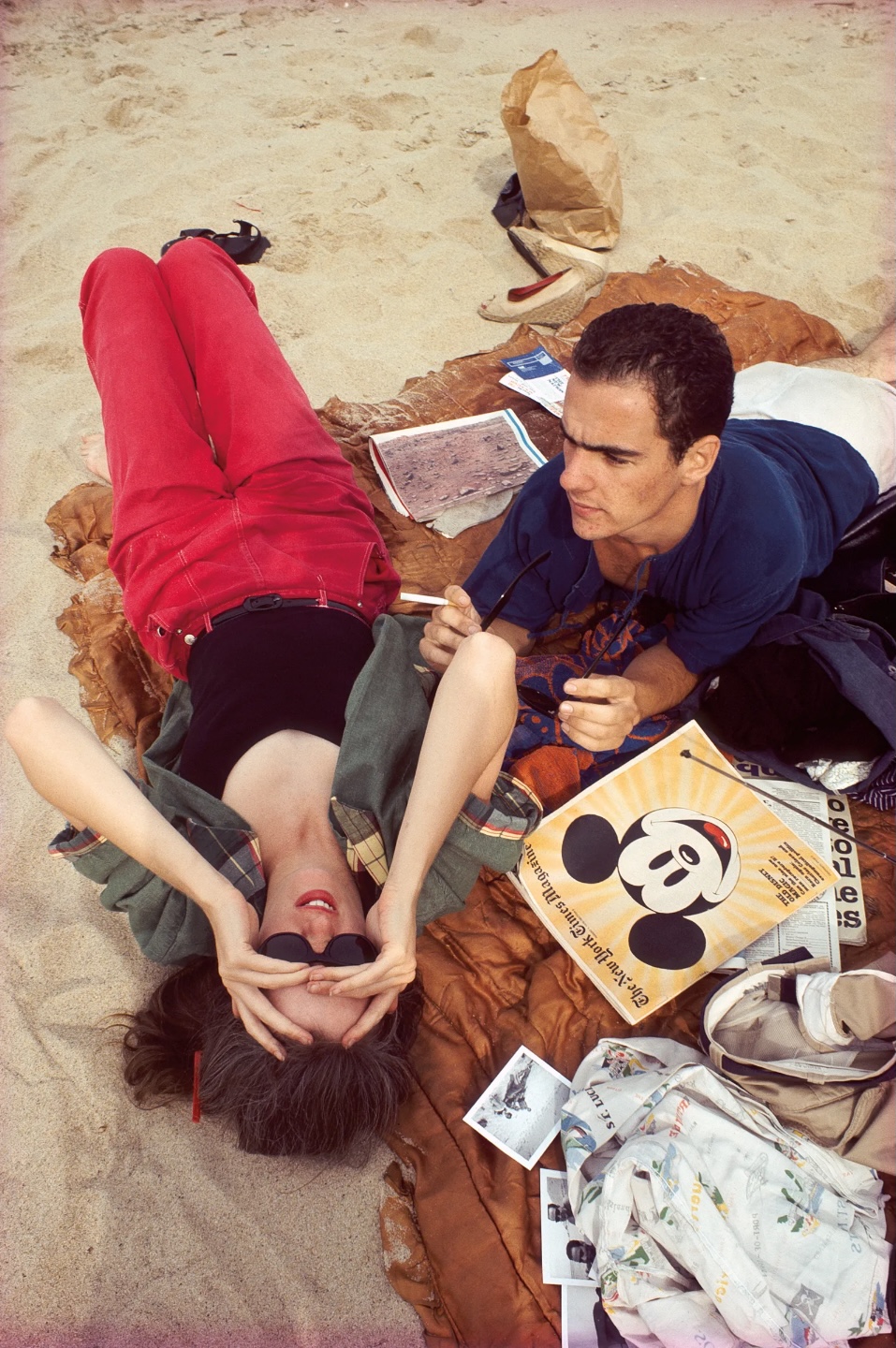
Nan Goldin, C.Z. and Max on the Beach, Truro, Massachusetts, 1976

Things were changing rapidly at DoubleTake then and I became an editorial assistant. And just a few more months and the magazine was effectively shuttered. A skeleton staff moved up to Cambridge, where one of the founders, Robert Coles, was based, but none of our jobs were guaranteed, and I had no desire then to move to Boston, where I knew no one. I think they continued for a year or two like that before it was shuttered again. Others have tried to revive it and duplicate it since then and it never works out. DoubleTake was strange and radical and earnest and exciting and also very expensive to make, and it was the work of an immensely talented group of people, several of whom I’ve worked with and/or remained connected to since  and its influence has long outlasted its several years of existence. 

For me, so young then, working at DoubleTake and CDS was an introduction to a lot of artists and writers — William Gedney, for instance — both within and outside of documentary work. It was an introduction to the community work and films and books that CDS was involved in. It was an introduction to the ethical questions around documentary. And for me, it was liberating in the sense that the magazine treated photography and writing as equals, not something that was required to literally illustrate the other.

In recent years, you’ve contributed writing to some really interesting photobooks by Danny Lyon, Kristine Potter, Justine Kurland, and Peggy Nolan, among others. How are these writings composed? Are they developed collaboratively with the photographers? Or based solely on looking at the pictures? Do you have relationships with these artists that help develop your writing?

They are all so different, everyone. Kristine Potter knew some of my connections to music and to the places of her pictures in Dark Waters, which has an undercurrent of murder ballads in the American South, especially Tennessee, where she lives, and North Carolina. We talked — but we didn’t even discover exactly how much we have in common until well after the book was published. I tried to sort of absorb the pictures the way I knew the songs, and then I went away and wrote a story, I didn’t want to pin it too specifically to any of the pictures: They are absolutely stunning on their own. The story I wrote (at the invitation of Kristine and editor Lesley A. Martin, who both were open to let me do whatever I wanted) came from two characters I already had in mind, and from my memory of the pictures or, even more accurately, the feeling I had looking at them. I’m really proud to have been a part of this book.

Strange Hours by Rebecca Bengal

That’s similar to the way I went about writing another short story, “The Jeremys,” for Justine Kurland’s Girl Pictures. I first met Justine years ago when she came to Austin, Texas, and parked her van in my best friends’ backyard while she was still making some of her narrative photographs of feral, runaway girls, pictures in which I saw my past, present, future, and fictional selves in. Justine has made so many brilliant bodies of work since, and I’ve written about many of them, but she and editor Denise Wolff gave me the freedom to write a story that is from the point of view of imagined girls in the pictures.

I love that lots of people read Carolyn Drake’s Knit Club and thought I was right there in Water Valley, Mississippi, when Carolyn Drake was making the pictures. I wasn’t — I was brought in much later, but that book was particularly collaborative in terms of many conversations with Carolyn and Paul Schiek at TBW. Because of the way the photographs work, none of us thought it should be too directly representational, but something a bit more nebulous, and so I ended up interviewing several of the women in the pictures and piecing together a semi-fictional story in their words. Carolyn sought my feedback on the sequencing and design she was working on with Paul, and it was fascinating to see it evolve. A beautiful and perfect design.

Speaking of Paul and TBW, who are one of my favorite photobook publishers around, I didn’t know Peggy Nolan at all prior to working on Juggling Is Easy, but Paul had a feeling I’d love her photographs of her teenage kids and their friends in 1980s Florida, and he was sure right. Peggy is a live wire, tremendously talented and such a force, and in her case I wanted to tell her story as much as the stories of the photographs.

I first wrote about Danny Lyon’s The Bikeriders several years ago but we didn’t meet until 2020, when I happened to be in the Southwest, and we did this interview. Last year he invited me to write an essay for a catalogue for his solo exhibition at the Albuquerque Museum of Art. I wrote about his films, which I love. Danny surprised me by including a photograph he made of me on the day of our interview in the exhibition: it was the day after Election Day 2020, and I’m all masked up.
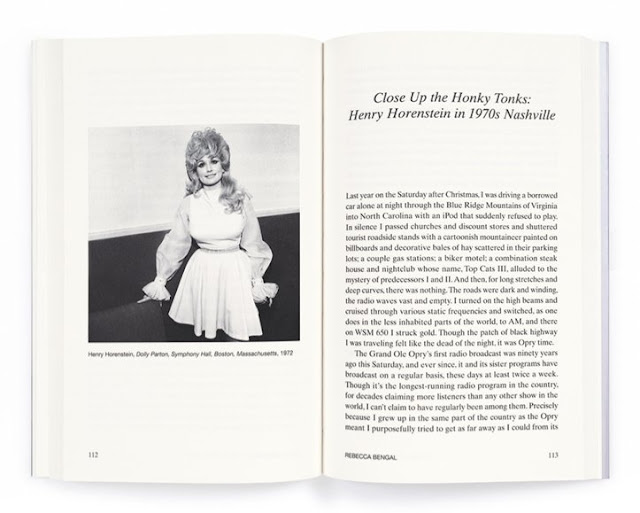
Strange Hours by Rebecca Bengal

Can you say something about how
Strange Hours was put together? Is it a “greatest hits” selection of your writings? Or was there a more directed selection process?

The initial invitation to publish Strange Hours came courtesy of one of my wonderful editors at Aperture. Brendan Embser saw the possibility of a book in the stories and essays I’d been doing for their books, the magazine, the blog, and PhotoBook Review over the past several years.

Brendan and assistant editor Varun Nayar and I looked at a ton of my writing to decide what to include. Much of the book would come from my work with Aperture, and many of those pieces have a strong narrative element (Diana Markosian, Judith Joy Ross, Chauncey Hare, for instance), and of course the short story I wrote for Justine Kurland’s Girl Pictures. So that established a core. From there we each made a list of pieces we hoped to include. The book is part of the Aperture Ideas book series, which all adhere to a set length, so that left us with a certain amount of space to work with. Also, since the Ideas series is text-focused, it’s designed for just one image per piece, plus a well of color photographs. For me, that eliminated a few pieces that I felt would be better served by multiple pictures — for instance, the semifictional story I wrote for Knit Club. But I had to eliminate many other favorites, and favorite artists.

We also didn’t want to worry too much about an overall theme. While story is the heart of the book, even if it’s just the story of an encounter with an artist and their pictures, I also wanted to include some different kinds of writing, essays, short fiction, interviews, and to create plenty of ways for anyone to enter in — whether or not they know anything about photography. “In the Place Where Prince Lived” might not seem to be about photography, for example, but it is about my and Alec Soth’s attempt to find something of Prince through the act of photographing the people who live in the places where he once did. It’s layered in with Alec also being a photographer who shares a hometown with Prince — and, for a few years, practically shared a backyard. And it’s layered in with our discovery along the way that Prince himself was retracing his own steps photographically in the months before his death.

Almost all of the pieces had been published before, but I knew I wanted to heavily revise many of them. I was able to add back in a significant and previously unpublished portion of an Eggleston interview I did years ago, in which he talks about photographing inside Graceland. This is where the book’s title (which my editor suggested) comes from: At one point, Eggleston reckons that, like Elvis, he keeps “strange hours.” And when we were choosing the cover, it wound up being a lesser-known photograph by Eggleston, too, and that gave us the purple of the cover (thanks also to the excellent designers at Pacifica). But I revised almost every piece to some extent, working with Brendan and editor Susan Ciccotti. I’ve also published pieces since our print deadline that I wish could be in Strange Hours, but we were able to include just one entirely new piece that I wrote specifically for the book: I wanted to add something that spoke more to ambiguity and perceived truth, and to a literary sense of photography, and that ended up being Yevgenia Belorusets’ stories and photographs from Ukraine. And then, I want to mention, I am deeply grateful to the flat-out brilliant Joy Williams, my teacher and friend, one of our greatest writers, who wrote the foreword essay.

William Eggleston, Untitled, ca. 1983-86

Is there a photographer you’ve never connected with or written about but would like to?


Oh, there are so many photographers whose work I love but haven’t had the chance to write with/about at the right time — far too many to mention.

Lately, mostly I’m interested in writing with or in response to, rather than about. To either collaborate in the way I’ve done on some photobooks, whether it’s for a book or some other form, in all the ways I just described to you. And/or to collaborate in the sense of working on a story together. Where you’re doing some true fieldwork collectively, as I’ve gotten to do with Joel Sternfeld on the youth climate movement, and at Standing Rock first with Alessandra Sanguinetti, with Justine Kurland after the fires near Paradise, for example. Or and especially something a little bit looser, like the stories I’ve done with Alec Soth.

Mostly, I think about all the writers and artists and filmmakers and musicians I wish I could have met or studied with. I’ll limit myself to just two photographers here who are no longer with us. First, Corita Kent, who had a wholly uncanny, playful, and experimental way of teaching and seeing the world; Ordinary Things Will Be Signs For Us, a collection of her work, was recently published by J&L Books. The other is Larry Sultan. While working on this piece about him with Alec, and especially after I wrote it, talking with Larry Sultan’s colleagues and close friends, particularly Jim Goldberg, and Larry’s wife, Kelly, I was magnetized, all over again, by Larry’s ideas and intellect and, very important, his sensibility and sense of humor. Mack is doing lovely reissues of his books; the most recent is Swimmers. As Kelly Sultan, a wonderful writer herself, once wrote: “Asking big questions by examining the mysteries of daily life was how Larry tended to approach picture making; he was always hoping to capture something just off stage, a ‘strange creature’ that would be revealed only after the picture was printed.”

One of my favorite essays in Strange Hours is the one about Prince, the project you did with Alec Soth. With that in mind, what’s your favorite Prince song or record?

Prince left the world too soon, but he left us here with so much. No way to nail down a favorite, though I love having my socks knocked off by hearing a song I haven’t heard in a while (like “Black Sweat,” one of his later ones, at a dance party recently). And when Alec and I were visiting Prince’s houses in and around Minneapolis, and leaving the story itself up to discovery, Paisley Park was just beginning to dig into the famous vaults he left behind. Some of the reissues and compilations of rare and previously unreleased work that have come out since are truly excellent — check out the albums Originals, Welcome 2 America, and Piano and a Microphone 1983.

Purchase Book

Read More Book Reviews

Strange Hours by Rebecca Bengal

Brian Arnold
is a photographer, writer, and translator based in Ithaca, NY. He has taught and exhibited his work around the world and published books, including A History of Photography in Indonesia, with Oxford University Press, Cornell University, Amsterdam University, and Afterhours Books. Brian is a two-time MacDowell Fellow and in 2014 received a grant from the Henry Luce Foundation/American Institute for Indonesian Studies.


Rebecca Bengal is the author of Strange Hours: Photography, Memory, and the Lives of Artists (Aperture, 2023). Her writing about art, literature, film, music, and the environment has been published by the Paris Review, Vogue, Vanity Fair, the New York Times, Oxford American, Southwest Review, the Believer, the Guardian, and the Criterion Collection, among many others. She has contributed short fiction and essays to books by Kristine Potter, Carolyn Drake, Justine Kurland, Paul Graham, Danny Lyon, Peggy Levison Nolan, and Charles Portis. A MacDowell fellow in literature and a former editor at American Short Fiction, DoubleTake, and Vogue, she holds an MFA from the Michener Center for Writers in Austin. Originally from western North Carolina, Bengal lives in Brooklyn.
Book Store Interview Men Untitled Photographs by Carolyn Drake Interview by Britland Tracy “If you listen closely to almost any human being who has recently acquired a dreamhouse, certain noises will emerge once the welcoming dog-and-pony show comes to a close and the cheese plates disappear..."

Men Untitled by Carolyn Drake. 
https://www.photoeye.com/bookstore/citation.cfm?catalog=ZK449
Men Untitled
Photographs by Carolyn Drake
Interview by Britland Tracy

TBW Books, Oakland, 2023. Unpaged, 9x11¾".

Recipient of the 2021 HCB Award, Carolyn Drake levels her gaze on myths of American male power in her newest photo-book and accompanying exhibition, Men Untitled, which opened at the Fondation Henri Cartier-Bresson in September. Portraits of men encountered and often befriended read like past-their-prime Renaissance statues, if Michelangelo had put David out to pasture for forty years before gently bending him over on all fours. Evocative objects whose symbolic relevance extend generations serve as punctuating double-entendres. The cultural reckoning at play is both visceral and encrypted. I had the pleasure of meeting Carolyn at her book talk in Paris and engaging in the following conversation.

Britland Tracy: These images are complicated — both in the book and on the wall. It would be easy to say that you are reversing the male gaze by photographing these men on your terms and in various states of undress. But rather than sexualizing them for visual consumption, as male artists have historically represented women, you’re placing them in positions that oscillate between tenderness and exploitation; vulnerability and playful absurdity. Some of them appear Herculean; some are Sisyphean. How did you find that balance?    

Carolyn Drake: I am a 52-year-old woman who has internalized a lot of personal and political rage over the years, most recently in response to the #MeToo movement and the U.S. Supreme Court decision on abortion rights. My hormonal impulses are also shifting. I wanted to channel all that onto the men: how can I subjugate the male body, and how will that look and feel to me?   

But on the other hand, photography for me is a way of connecting and empathizing with other people. So as I played with how it felt to look down on men and to mangle and twist and direct their bodies, I also found tenderness and began to see the ways they were fragile, and not at all fulfilling masculine stereotypes.   

I also wanted to look at the myths connected to masculine ideals, but without perpetuating them. The images are constructed, posed. I did not want to insinuate any of this as natural, so the feeling of staging and performance was important to me. 


BT: I imagine that the power dynamics you navigated for this work were quite different from the approach you took with your last book, 
Knit Club, which centered around a community of women in rural Mississippi. There seems to be a tension between collaboration and compromise with your subjects in Men Untitled. For example, you promised Wallace, one of the main ‘characters’, the centerfold, but only if you posed for him first. Can you speak to these dynamics a bit?   

CD: One of the main differences in the way I approached the men as photographic subjects is that I wanted to expose the vulnerability of their bodies and lay them bare. Whereas in Knit Club I searched for other ways to explore bonds and identities.   

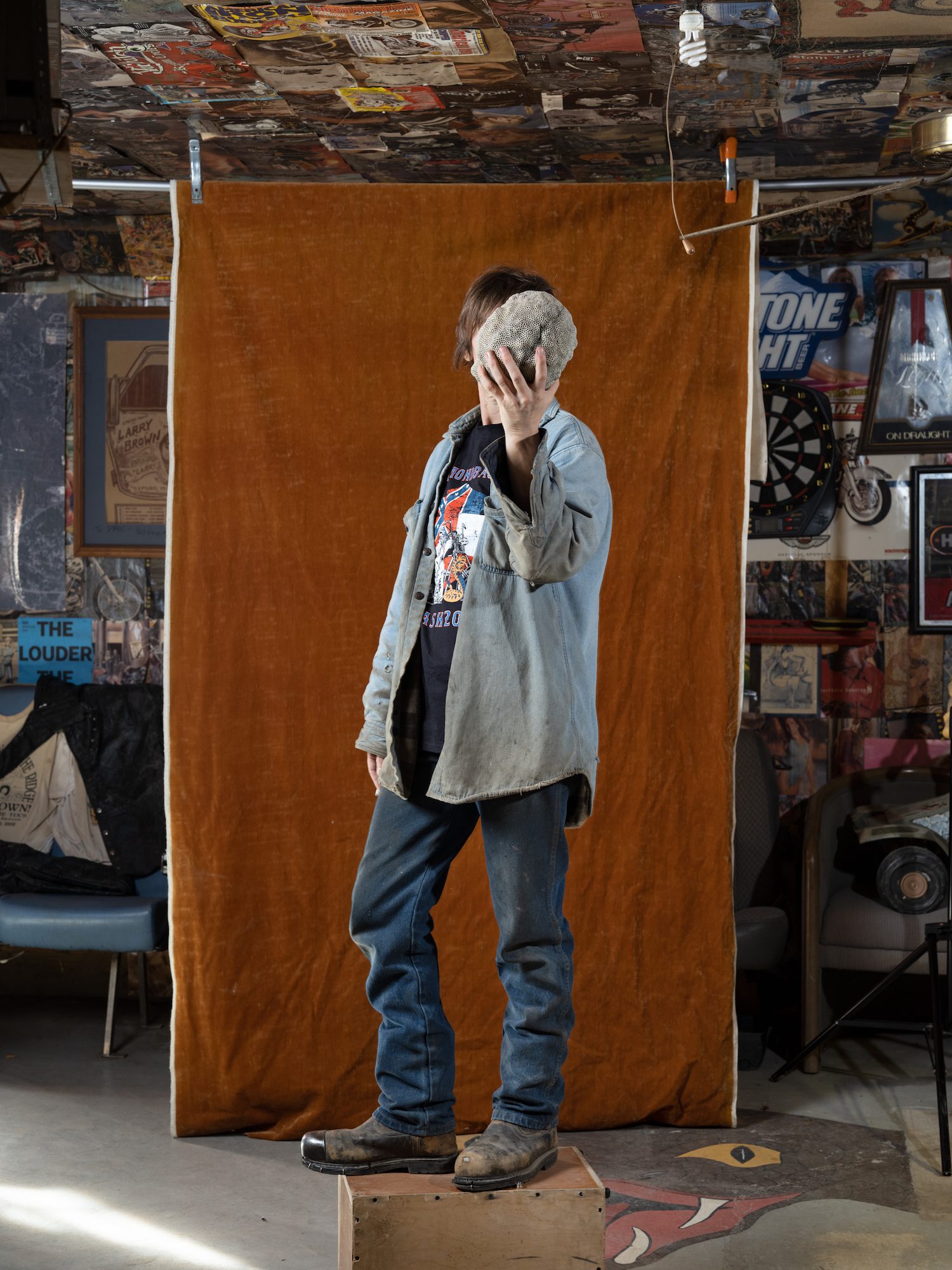
Wallace is a character I got to know pretty well over many photo shoots. Before he passed away in 2022, he ran a motorcycle club next to his house, and the inside, notably, was wallpapered floor to ceiling and all over the ceiling with centerfolds from Penthouse and Playboy magazines that he had collected over the years. This was always something on my mind when I visited his house to photograph him, so when one day he showed me an old picture he had taken of an ex-girlfriend, I knew I wanted to ask him if he would be willing to pose for me in the same position. He agreed to let me photograph him hanging upside down from a hook like a piece of meat only if I would also, and it felt natural for me to agree to it. What I chose not to do is publish the image he took of me. That final decision of what to show is where my power resides. This is about me authoring male bodies, not the reverse.

The women in Knit Club didn’t demand anything in return. They respected my authority as the photographer. The men sometimes asked for money to be photographed. Maybe there’s some irony in that.  

BT: You include a lot of still life images that serve as signifiers of heteronormative masculinity: guns, shop tools, fire, horses, centaurs, swords, etc.; but you also include a corset mannequin, a dramatically lit tapestry, a nod to the “hidden mothers” of Victorian-era portraiture, as well as an actual self-portrait. What inspired this combination of gendered iconography?
   

CD: My images contain these signifiers but I am tweaking the way they are displayed. My piano, a symbol seen a lot in depictions of 19th century gender relations, is burning to ash. I multiply guns using mirrors. I stick swords in the ground and compare their sizes. In all of this imagery, I’m overtly pushing and pulling at gender constructs. I draw on dated gender symbols because I think they still inform where we are now.   

BT: You sought out what appear to be cis-men ‘of a certain age’ as models for this project, bypassing youth and queer identities altogether. Why? 
 

CD: The men weren’t all cis, actually, but I didn’t distinguish one way or another in the image titles. It’s not a project about youth culture and the diversification of gender identities. It’s about my feelings toward old guard gender structures whose power remains entrenched, and about how I too relate to individual people on that spectrum.  Part of why I worked mostly with older men was that I wanted to see masculine strength in decline.  


BT: The role of text in this book is subtle yet powerful. I enjoy the way you circumnavigate the rote artist statement and instead leave us with an image list and a series of unsettling vignettes from your own past experiences with men, tucked away inside the epilogue. The titles listed on the back cover and the endpapers serve as both index and map legend for the ineffable portraits that precede them. Descriptions such as “Still Life, Male Anatomy on Velvet Chair”, “Bottom Half of Mythical Figure”, “Dartboard Halo (Bill)”, and “Man on All Fours (John D)” almost read like a list of trophies, subverting victim and victor. Did the written components guide your creative process, or vice-versa?   


CD: The ideas for the images came first. For example: while trying to see men as animals, I brought John D. into the woods and asked him to pose as a deer so I could ‘shoot’ him. We had to do the shoot twice because the first time around he didn’t look enough like an animal.  For “Dartboard Halo”, I had been studying a women’s beauty and charm guide from the 1940s. In one image, a cutout of a woman’s head in front of a circle is tilted back with an open mouth. I invited Bill to stand in front of a dartboard in his studio and mimic her posture.    

The image list provides ideas for how to read the images. I put it at the end, so they can be read all together, at once, and so I could stack them on top of each other to form a suggestive shape.   

I also like what you say about subverting victim and victor. I am not trying to win anything here. I want to deflate a set of power dynamics that we’re invested in, often without realizing it. It sounds heavy, but hopefully the work also rings with a bit of humor.   


BT: Speaking of the personal self-disclosures in the back of the book, I’d like to talk about anger. It is a word that you’ve used to describe the impetus for photographing men in the American South, and there is a palpable indignation that builds from one image to the next. Anger is an emotion that women are often pressured to soften, but you seem to embrace it as an activating force for this project. The violations you recount in the epilogue certainly warrant this response. What is your relationship to anger toward men, and has it changed through the process of creating this body of work?  
 

CD: In the text at the back of the book, I wrote about Christine Blasey Ford, who spoke publicly about being sexually assaulted by Brett Kavanaugh as he was on the verge of becoming a U.S. Supreme Court Justice (and subsequently repealing abortion rights for women). In the public hearing, Kavanaugh’s anger was palpable, while Ford’s was concealed. It should have been the reverse.  On top of that, the succession of public disclosures by women during the #MeToo movement triggered memories of past personal experiences that fueled more anger. Women’s bodies do carry anger, so it is absolutely something I wanted to channel into the work. 

I had to let myself feel two things at once while making this project — anger I had boxed in and the empathy needed to make human portraits. One of the things they remind you in psychotherapy is that contradictory feelings can coexist.  

Regarding geography, the American South is where I began, but I eventually decided that the project is not about a particular region. It’s about an American brand of patriarchy and its strange attachment to white penises. 


BT: There are a number of references to iconic male artists from the past, from Eadweard Muybridge to Peter Hujar to E.J. Bellocq to Caravaggio. Do you see yourself in conversation with or resistance to these men, or somewhere in between?   


CD: Most of the time I’m somewhere in between. I wanted to resist Muybridge’s “scientific” view of gender difference. In his motion studies, nude women pour vases of water over each other while nude men have sword fights. I wanted to subvert that science.    

While I am in awe of the sensuality of Peter Hujar’s nudes, I have to confess that my point of view is different. My male bodies don’t hold that amount of erotic energy.   

I’m also interested in the work of female artists like Ishiuchi Miyako, Collier Schorr, Kara Walker, Cindy Sherman, Claude Cahun, Ana Mendieta. And the ways that Laura Larson and Ahndraya Parlato have recently used writing in their photo books.   


BT:
Men Untitled opened at the Fondation Henri Cartier-Bresson in Paris in conjunction with the book publication, within a country where most civilians do not have the right to bear arms and a language in which words like ‘debonair’ and ‘suave’ were invented to describe men with sexual prowess rather than say, ‘rugged individualism’ or ‘lone wolf’. Has the process of exhibiting and speaking about this project abroad affected the way you think about this particular brand of American masculinity?    

CD: The work stems from the inclinations of an American, but a lot of people in France are exposed to American ideals of masculinity through Hollywood films, so I think ‘rugged individualism’ is not totally unfamiliar in the French context. And Americans can also feel the appeal of a suave French man.  I think maybe showing the work in France helped me take a step back and see it more from the outside. And also step back from the emotions, which I’m still pretty wound up in.


BT: The final image depicts a man curled toward the ground in a duck-and-cover stance, wearing nothing but a pair of sneakers. Is this an act of contrition? Repentance? Protection? Cowardice? It feels like a definitive last word. 


CD: I see the curled man both as an infant and as someone bracing for punishment. It reminded my publisher of Wolfgang Tillmans’ picture Like Praying. When the meaning is not directly spelled out, the viewer can draw their own conclusion. 

On the very last page of the book, we almost included a mold of a human figure that is either waving farewell or calling for help. We cut it out at the last minute. Either image could have become the definitive last word.

Carolyn Drake’s exhibition Men Untitled is on view at the Fondation HCB in Paris through January 14th, 2024.

Purchase Book


Britland Tracy is an artist and educator from the Pacific Northwest whose work engages photography, text, and ephemera to observe the intricacies of human connection and discord. She has published two books, Show Me Yours and Pardon My Creep, and exhibited her work internationally. She holds a BA in French from the University of Washington and an MFA from the University of Colorado, where she continues to teach remotely for the Department of Critical Media Practices while living in Marfa, Texas.
photo-eye Gallery Exploring Surrealism & the Creative Process: A Conversation with Artist Tom Chambers Anne Kelly Tom Chambers discusses his new series, the influence of Covid, and the evolving role of AI in the art realm, provoking thought and inspiring creativity.

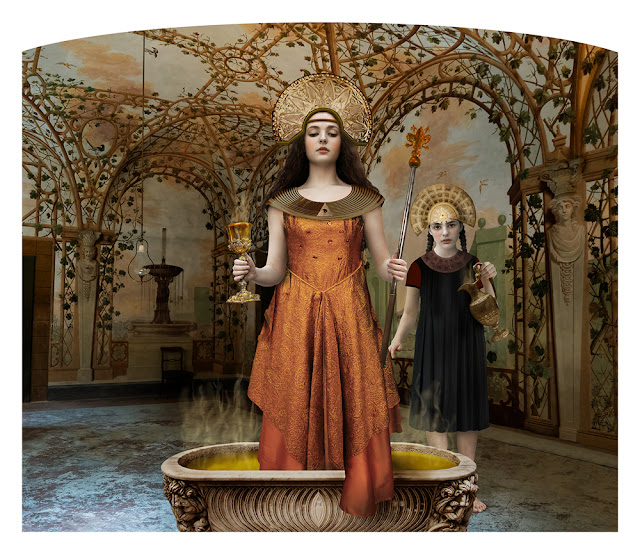
Tom Chambers, Ascension, 2023, Archival Pigment Print, 20x20", Edition of 20, $1,200 

In the realm of art, the boundaries between reality and imagination often blur, giving rise to captivating and thought-provoking creations. photo-eye Gallery director Anne Kelly sits down with acclaimed artist Tom Chambers to delve into his latest photographic series, Declaration, which ventures into the realm of surrealism. Known for his mastery of the magical realism genre, Chambers shares his insights on this artistic shift, the inspiration behind his work, and his thoughts on the use of AI-generated images in the visual arts.

Amidst the discussion, Chambers opens up about his artistic process and emphasizes his deliberate choice to eschew AI in the creation of his new series. Drawing upon his expertise in Photoshop, Chambers meticulously composes his images by combining hand-drawn elements and photographs sourced from his inventory. By consciously avoiding the use of AI, he seeks to preserve the distinct personality and creative touch of the artist in his work, raising thought-provoking questions about the rise of AI-generated images in the art world. As the conversation unfolds, Chambers shares valuable insights and advice for fellow creatives, encouraging them to follow their passions, infuse their work with enthusiasm, and constantly challenge themselves to push the boundaries of their chosen mediums.


Tom Chambers, Genesis, 2023, Archival Pigment Print, 13x15", Edition of 20, $750 

Anne Kelly: You typically work within the Magical Realism genre, but in this new series which was made in 2022, two years into Covid, you drift into surrealism. Do you think this is a new direction for you? Please elaborate on this shift.
Tom Chambers:  Magic Realism is an art genre which contains a magical element within a generally realistic scene. Surrealism can be sometimes full-blown unrealistic. I always felt that when using Photoshop for Surrealism you are walking a fine line between serious art and somewhat corny art. I have read many of the magic realism writers and have felt that that direction works better for what I’m trying to say. Because of Covid I was not shooting models or traveling, I had to rely on images I had in my inventory. I decided to step into the Surrealism genre, mainly to shake things up with how I work and push my work in a different direction. The times felt irrational, so Surrealism felt like the right fit. I don’t plan to continue to move in the Surrealism direction permanently, but it will be fun to fall back on occasionally.

AK:  Your images come from your mind–Instead of “moments captured” in one frame with a camera. In the past you had credited "daydreams" as your muse–do you think this new surreal work took you into a different part of your mind, or would you credit an alternative muse?
TC:  The sources of inspiration for this new series “Declaration” have not changed. Daydreams are still an inspiration for new ideas. Before Covid I had spent some time in Italy where I thought, why not try to combine Renaissance religious images with contemporary ideas? During Covid was the perfect time to pursue this direction. I felt the world was out of kilter, so why not push my photo work a bit further than I had been. My ideas for the magic realism images and the surrealism images all come from the same places, very often daydreams.

Tom Chambers, Rejuvenation, 2023, Archival Pigment Print, 19x22", Edition of 20, $1,200

AK: In your statement, you note that you didn't use AI in the creation of the new work and that all elements were drawn or photographed by you, and montaged together. In your past work, images started from sketches and then were composed by combining multiple images to create your final composition. I believe this is the first time you have incorporated actual drawings included in the composition. Is this accurate? Please tell us a little more about both the technical part of that process and the creative process that inspired you to incorporate the drawings.
TC: In my art statement for the “Declaration” series I state: “Artificial Intelligence, (AI) was not employed in creating any of these images. All elements of each image were photographed or hand-drawn by me.” When I say elements were hand-drawn, I’m referring to digitally drawing some of the smaller elements. Each image is planned ahead. I make a small thumbnail sketch and then follow it loosely. I photograph the elements or background I need to create that image. Sometimes I pull images I have previously photographed from my archives. I hate to have to make the “No AI” statement, but I feel that it’s almost necessary at this point with the rapid development of AI software. I didn’t want this particular series of work to be swept up into the AI category by mistake.

Tom Chambers, Visitation, 2023, Archival Pigment Print, 30x30", Edition of 10, $2,300

AK: What are your current thoughts on the use of AI-generated images in visual art?
TC: I feel torn between a number of thoughts. I’m all for new directions in art and new tools for creating art. But, I like to see the hand (and brain) of the artist in their work. Is there a personality who is making the work? Hopefully, there is and it would be important to see that personality reflected in the work. In some cases the artist chooses to use AI only for an element or two in a larger image, maybe combining it with Photoshop. This begs the question: How much of the image is AI created? An element? Five elements? The background? Should the artist make a statement that the work or a percentage of it is AI created? In the past my art statements mention that the work is photomontage to eliminate any confusion. I felt that this was necessary. Does the artist owe it to the viewer or purchaser to give that information? I think so. 

I understand that when prompting AI software like Midjourney or DALL•E 2, the software “scrapes” the internet and pulls images or parts of images from different locations, combining them. These locations can include other artists’ work and always pulling it without the artists’ permission. I feel that in a sense this is a form of plagiarism. The same could be said for ChatGBT, as I understand that it will be easy for a student to use AI to create and write a paper. There are a lot of questions that need to be answered in the coming months as I can see that the art field might radically change. Lawsuits already have been filed by artists against AI users saying their art has been stolen. The technology will soon be available for AI painting. As a CAD machine can draw a large format drawing, a similar piece of machinery will be able to paint large format paintings from a computer file. Is the art world ready for this conversation? How will we answer the question, “What is art?” 

Tom Chambers, Presentation, 2023, Archival Pigment Print, 11x17", Edition of 20, $750

AK: As an early innovator of Photoshop–do you see any parallels between the early days of AI and the early days of Photoshop? 
TC: There is a similarity in the sense that it’s a new tool. I feel the parallel ends there since the artist’s creative hand is no longer in use when employing AI. AI supporters say that it’s a creative process when prompting the software. How much creativity goes into coming up with a descriptive prompt? A photomontage image is parts of photographed images that have been combined. The debate should be, “Can an AI-generated image be called Photography?” I don’t think so. The word Photography literally means “drawing with light”, derived from the Greek word for photo.

AK: Do you have any advice for others that are trying to tap into creativity?
Yes, decide what excites you. If bugs excite you, then it’s taking photos of bugs - do it. Your excitement for your subject matter will keep you interested and your work will exude that energy. My direction turned out to be photomontage because I enjoy the planning and the building of an image, along with adding that extra twist that throws things off kilter.

Tom Chambers, Repose, 2023, Archival Pigment Print, 30x30", Edition of 10, $2,300

Artist Statement: 

“Declaration” was inspired by my return to international travel in 2022. Just as life had changed with the impact of Covid, my photography work shifted from elements of magic realism to surrealism. The Covid years often felt irrational, as though we were living in a different dimension. Through the resumption of travel, I was drawn to the idea of blending the influences of Italian Renaissance art with surrealism resulting in a timeless look and feel. 

Narration is a key element of my work. All of the women represented in this series “Declaration” belong to a society of women living not in the past or in the future but in a different planetary space and time. They tell stories and reveal ideas of importance, perhaps of an existential nature.
 
Artificial Intelligence, (AI) was not employed in creating any of these images.  All elements of each image were photographed or hand-drawn by me, Tom Chambers.


photo-eye Gallery is proud to represent artist Tom Chambers.


*    *    *

The prints from this series are Archival Pigment Prints 

Small, Edition of 20, Starting at $750
Medium, Edition of 20, Starting at $1,200
Large, Edition of 10, Starting at $2,300


PRINT COSTS ARE CURRENT UP TO THE TIME OF POSTING AND ARE SUBJECT TO CHANGE.


*    *    *

If you are in Santa Fe, please stop by during gallery hours or schedule a visit HERE.

For more information, and to reserve one of these unique works, please contact
Gallery Director Anne Kelly or Gallery Assistant Jovi Esquivel.

You may also call us at (505) 988- 5152 x202


photo-eye Gallery

1300 Rufina Circle, Unit A3, Santa Fe, NM 87507
Tuesday– Saturday, from 10am– 5:30pm