PHOTOBOOK REVIEWS, INTERVIEWS AND WRITE-UPS
ALONG WITH THE LATEST PHOTO-EYE NEWS

Social Media

Showing posts with label SPBH. Show all posts
Book Review Anonymous Objects Photographs by Kim Beil Reviewed by Brian Arnold "Photography is an extremely deceptive medium, but given its ubiquity, I think we are blind to most of what it offers. I am not sure how to calculate the number of photographs I see every day, but I reckon it’s in the thousands. For most people, I am afraid, the constant barrage of pictures we all experience allows us to think we understand what we see in photographs..."

Anonymous Objects. By Kim Beil.
https://www.photoeye.com/bookstore/citation.cfm?catalog=ZK576
Anonymous Objects
Inscrutable Photographs and the Unknown
By Kim Beil
SPBH Editions, 2023. 175 pp., 4x6".

"It’s easier to ignore things we do
not understand than it is to try to
capture and comprehend them.
This perceptual strategy may even
be an evolutionary necessity."

— Kim Beil, Anonymous Objects

inscrutable /in-skru-tə -bəl/: not readily investigated, interpreted or understood: mysterious

Photography is an extremely deceptive medium, but given its ubiquity, I think we are blind to most of what it offers. I am not sure how to calculate the number of photographs I see every day, but I reckon it’s in the thousands. For most people, I am afraid, the constant barrage of pictures we all experience allows us to think we understand what we see in photographs. Because of its accessibility, we’ve become complacent (or perhaps numb?), and too infrequently question our relationship to photography, readily assuming what we see is what we get. Unfortunately, it’s a bit more complicated. Every picture is full of ideas, intentions, circumstances, and objects we know nothing about. Part of the draw of photography is its ability to offer clear depictions of time and space, but I'm of the belief that the unknowable parts of a photograph are its most interesting and essential attributes. I think those of us weaned on darkroom photography can speak to that first, magical experience when we watched an image emerge in a tray of developer. Every day, despite how inundated I am with photographic information, I try to remember the fundamental mysteriousness that first drew me to the medium.


The new book by Kim Beil, Anonymous Objects, asks the reader to embrace and relish the mysteries of photography by taking note of the little, often unknowable, items that appear within its frames. The book is the fifth installment in the SPBH Essays series and is seemingly about the small objects that appear in photographs that we know nothing about, often just little things that fall outside the scope of our own experience. What do these objects represent if we don’t know what they are? Does that change how we understand a photograph? If we can’t identify an object depicted in a picture, what does it represent? Can we really know a picture if we can’t understand all that is held within it? When I got into photography, the first artist I really studied was Frederick Sommer, and as a result, I remain committed to the belief that the best photographs represent ideas beyond what is described in their frames (Sommer’s doll head is more Enochian than documentary). This is important, I think, when reading Anonymous Objects, because on the surface Beil is writing about specific attributes — those tiny things stacked out of the way on the top left shelf in Walker Evan’s photograph of a general store in the American South — but digging deeper between the lines, Beil is really creating an incredible labyrinth of ideas about what photographs can and cannot represent, like Sommer giving something well beyond a literal reading.


As many before her, Beil’s argument pays homage to Roland Barthes, his name and ideas appearing throughout her text:
“Photographs of unrecognizable
things produce a curious analog
to this ‘temporal hallucination’
that Barthes finds in portraits.
Studying inscrutable photographs,
we come face to face with our
own limits, just as Barthes faces
his own mortality when studying
a picture of a person.”
It had been a while since I read Camera Lucida, Barthes’s groundbreaking book on photography that questioned the very nature of the medium, and I found that revisiting it can shed some light on Anonymous Objects. First published in 1980, Camera Lucida is a personal narrative in which Barthes developed a free-form, stream-of-conscious text divided into small, discrete parts, each section its own meditation on photography. Throughout Camera Lucida, Barthes negotiates sophisticated ideas about pictures, language, symbolism, and representation, ultimately offering new conclusions about photographic images, and their infinite capacity to evoke personal experiences and cultural representations.


Beil’s Anonymous Objects offers something similar, a free-flowing text that breaks down the personal and cultural significance of photographs. Using the small, unknowable attributes of different pictures, Beil negotiates much more complex ideas about representation, time, and both personal and cultural symbolism. Part of what I love about Anonymous Objects is quite simple: how the text appears on the page; the design of the book dictates its meaning. Throughout the book, Beil dissects several different photographs, some iconic — like Alexander Gardner’s portraits of Lewis Payne before his execution and early souvenir photographs of George Washington’s home — as well as pictures collected from flea markets. As she deciphers these pictures, Beil knits together a larger narrative about the objects that appear in the photographs and how they impact our understandings. The design of the book, however, facilitates more poetic possibilities. Printed in a big, bold font that allows single sentences to fill an entire page, her phrases and ideas breakdown in an evocative manner, each encapsulating a distinct and succinctly described idea of its own (in sharing quotes from the book, I’ve transcribed them like they appear on the page, as though poetry not prose). You can read the book cover to cover to follow that larger train, but you can also open the book at random and find brief but mysterious ideas about photography. This approach replicates something I love about the medium itself — full of short, sharp, and clear ideas that somehow remain elusive and mysterious, presenting clear and wonderful ideas but also an unending array of ambiguity and questions.

Purchase Book

Read More Book Reviews


Brian Arnold
is a photographer, writer, and translator based in Ithaca, NY. He has taught and exhibited his work around the world and published books, including A History of Photography in Indonesia, with Oxford University Press, Cornell University, Amsterdam University, and Afterhours Books. Brian is a two-time MacDowell Fellow and in 2014 received a grant from the Henry Luce Foundation/American Institute for Indonesian Studies.
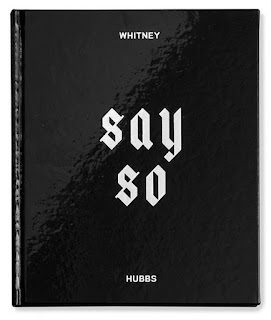
Book Review Say So Photographs by Whitney Hubbs Reviewed by Laura Larson "Whitney Hubbs’ Say So catalogs a ruminative and goofy series of self-portraits made in 2019 and 2020. Produced with a 4x5 view camera, the photographs abandon the master class mentality of large-format practice for a messy and private performance of desire and identity..."

Say So. 
By Whitney Hubbs.
https://www.photoeye.com/bookstore/citation.cfm?catalog=DU207
Say So
Photographs by Whitney Hubbs

SPBH Editions, 2021. 64 pp., 24 illustrations, 9½x11½x½".

Whitney Hubbs’ Say So catalogs a ruminative and goofy series of self-portraits made in 2019 and 2020. Produced with a 4x5 view camera, the photographs abandon the master class mentality of large-format practice for a messy and private performance of desire and identity. The photographs are staged in the artist’s studio with its trappings all squarely in the frame — nothing is concealed. I’m very much aware I’m in a site of construction and contingency: plywood sawhorse, cinder blocks, buckets, vinyl drop cloths repurposed as backdrops, duct tape everywhere. In this atmosphere, Hubbs auditions the accessories and gestures of amateur pornography with an eye on how they rely on the constituent fiction of female availability. She pretends to deep throat a 2 x 4 and straddles a tall, thin houseplant. She pours water down the front of her body — a studio experiment in girls gone wild. Both a medium and a comedian, she channels and disarms porn’s conventions.

Subject and object, Hubbs is a guileless contortionist who looks back at her camera. In the first image of the book, she’s adorned in a black, lace bodysuit, her sleepy eyes peering through a gas mask. The heels of her black boots are perched on top of cinder blocks and her thighs are spread. (I want to note that Hubbs owns many pairs of black boots — workwear, not the sexy variety.) The heel of her right boot presses into the black rubber bulb of the shutter release. I like how the studio equipment becomes a sex toy in this scene, holding tension. Hubbs holds a Chipotle tin bowl lid in front of her crotch, folded slightly to impersonate a vulva — female genitalia as fast food. In Plate 15, Hubbs faces the camera, seated in a metal folding chair, and holds two fake breasts over her own. At first glance, I thought her arms were doubles too until I recognized her tattoos. It’s like she’s proliferating, growing multiple appendages. Milk pours from her tensed mouth, running down the center of her chest. It leaks from beneath the fake boobs and cascades down the length of her torso, soaking her black lace underwear and the crotch of her acid-wash jeans. Mother’s milk, wet pussy: Hubbs collapses the false divide between the maternal and sexual body and it’s LOL funny. Witness Plate 8 for emoji humor. Wearing a python print jumpsuit, Hubbs stands facing the camera, stretching the band of taupe pantyhose over her belly with two tennis balls and an eggplant held taut at her crotch. There’s a run in her stocking creeping down her leg.


Hubbs’s comic delivery is sharp, but she’s got different stakes in the game. She’s not interested in punchlines or pratfalls or the gag of substituting her real body within porn’s airbrushed tableaux. Case in point: there are no money shots in the book, no humiliations of surrender. Her performance trades the animation that fuels slapstick, which relies on making yourself the butt of the joke, for something else. Her photographs tap the energy of longing and fury meeting the relentless forces that rigidly police and punish the agency of female sexuality. I can feel this gravity in these photographs, the undertow of fatigue, a commonplace experience for women. Hubbs looks to porn for her visual language but it’s her homages to Francesca Woodman and Jo Ann Callis, artists who also tangle with female pleasure, who are her true interlocutors in Say So. In each photograph, I imagine her thinking: how does this make me feel? With a somatic sigh, Hubbs taps a vein of feeling about what it’s like to live in a female body with all its drives, vulnerabilities, and contradictions in a culture with little capacity to imagine these subjectivities. Her photographs limn the too-much-ness of this experience, holding the leaky tension between being and seeing with ambivalence and generosity.

Purchase Book

Read More Book Reviews


Laura Larson
is a photographer, writer, and teacher based in Columbus, OH. She's exhibited her work extensively, at such venues as Art in General, Bronx Museum of the Arts, Centre Pompidou, Columbus Museum of Art, Metropolitan Museum of Art, Museum of Fine Arts, Houston, SFCamerawork, and Wexner Center for the Arts and is held in the collections of Allen Memorial Art Museum, Deutsche Bank, Margulies Collection, Metropolitan Museum of Art, Microsoft, Museum of Fine Arts, Houston, New York Public Library, and Whitney Museum of American Art. Hidden Mother (Saint Lucy Books, 2017), her first book, was shortlisted for the Aperture-Paris Photo First Photo Book Prize. Larson is currently at work on a new book, City of Incurable Women (forthcoming from Saint Lucy Books) and a collaborative book with writer Christine Hume, All the                                                               Women I Know.
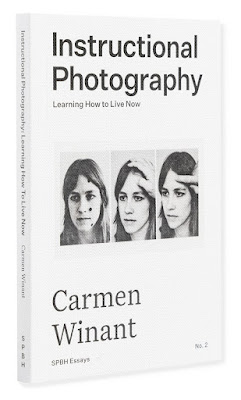
Book Review Instructional Photography Artist's book by Carmen Winant Reviewed by Kim Beil "Carmen Winant coins a novel term, 'Instructional Photography,' with the title of her new book. Her neologism is so apt that it doesn’t even strike me as new. The term is as forthright and instrumental as the photographs themselves..."

By Carmen Winant
https://www.photoeye.com/bookstore/citation.cfm?catalog=DU176
Instructional Photography
Learning How to Live Now
Artist's book by Carmen Winant


SPBH Editions, 2021. 96 pp., 48 illustrations, 4¼x5¾x½".

Carmen Winant coins a novel term, “Instructional Photography,” with the title of her new book. Her neologism is so apt that it doesn’t even strike me as new. The term is as forthright and instrumental as the photographs themselves.

Winant collects, collages, and re-presents photographs from how-to manuals in this book, as in her larger practice. There are instructions in aerobics, ceramics and rock climbing, as well as pictures from the literature of medicine and sexuality. The key feature of an instructional photograph is its promised relation to a viewer’s body. In long view and in close-up, models demonstrate their tasks. Their bodies stand-in for the viewer’s body. We are meant to mirror their poses, whether learning how to shape pottery or practice self-defense.

It’s a small book that makes a big claim: that instructional photographs don’t just teach viewers how to accomplish a given task, but that, as a whole, the genre is a guide to living. As Winant puts it in the subtitle, they are a guide for “Learning How To Live Now.”


Immediately her tone is convincing: “In a moment — we might agree? — of heightened anxiety and re-imagination, I want, on these pages and together, to investigate the potential of photography to teach us how to live.” I cannot resist her first-person plural aside, nor the insistence of her italics. I do agree; I want to learn. Like John Berger’s Ways of Seeing, Winant makes her point through the combined rhetorical logic of words and pictures. She uses the form of the how-to book — a small, hand-held object — to emphasize its familiarity. We are, in effect, reading an instructional book about instructional photography.

Winant’s argument is bigger, though, than just defining the genre. She suggests that all photographs are instructional. She asks, “Don’t artists too believe we have something to ‘teach’ with and through our work?”

With all the visual intelligence of a photobook editor, Winant’s page breaks underscore her argument in words and pictures. Like a poet, Winant gets in your head. Like instructional photographs themselves, the interaction demanded by her book — read the words, turn the page, read the images as words — makes this promise real. In neuroscience, this relationship between bodies is described as kinesthetic empathy. Watching a body perform a task, we can feel the motion in our own bodies. In Winant’s book, this is most effective in the full-bleed sequences that unfold over several pages. Like the still photographs that take on a sense of movement in Chris Marker’s La Jetée, photographs of a woman seated and back-lit on a patio become uncannily live as I turn the pages.


Winant amplifies this experience of connection by giving the viewer control over the pacing. You turn the page, you create the movement, you decide to go forward or backwards in time. You also choose to inhabit the image, to imagine yourself into it. There’s a powerful movement from self-recognition to self-actualization in these images. Winant admits that such grand hopes for photographs are often dismissed as “didactic” in art school. They are too obvious.

But, what they also do — and what Winant’s book does — is make a gift of themselves. They are literally self-sacrificing, in that they make an image of the self available to others. They promise the image of the body as a container, a shelter for others to inhabit. But they are also endlessly renewable. I might inhabit this body for a moment in my mind, I might feel its sensations in my own body, but it’s also available to others who study it. We can try on new ways of doing and new ways of being with others in the world through instructional photography. I agree; ‘in a moment… of heightened anxiety and re-imagination,’ I hungrily turn to art like Winant’s for instruction in life.

Purchase Book

Read More Book Reviews


Kim Beil is an art historian who teaches at Stanford University. She is the author of Good Pictures: A History of Popular Photography.