PHOTOBOOK REVIEWS, INTERVIEWS AND WRITE-UPS
ALONG WITH THE LATEST PHOTO-EYE NEWS

Social Media

Showing posts with label STANLEY/BARKER. Show all posts
Book Review Something Else, Something Other Florida Strawberries
Photographs by Anthony Blasko
Reviewed by Odette England "Start with fun facts about strawberries. The fear of strawberries is fragariaphobia. Strawberries are members of the rose family. They come in many colors other than red. They have eight copies of seven chromosomes. They don’t continue to ripen after picking. And Belgium has a museum dedicated to them..."

Florida Strawberries. By Anthony Blasko.
https://www.photoeye.com/bookstore/citation.cfm?catalog=ZK158
Florida Strawberries
Photographs by Anthony Blasko

STANLEY/BARKER, London, UK 2022. 120 pp., 11¾x9".

Start with fun facts about strawberries. The fear of strawberries is fragariaphobia. Strawberries are members of the rose family. They come in many colors other than red. They have eight copies of seven chromosomes. They don’t continue to ripen after picking. And Belgium has a museum dedicated to them.

Fun’s over. Let’s talk understated elegance in photobooks.
Those fun facts are harder to find.

Maybe it’s because I’ve seen too many photobooks masquerading as something else, something other. Trying to be clever with unnecessary design. Unnecessariness, period. This book — Florida Strawberries by Anthony Blasko, published by Stanley Barker — is not that book. This book takes its cue from the humble strawberry. It is fresh and ripe and deliciously simple. The only hints of design whimsy appear outside the book, like the ‘seeds’ of the strawberry itself (called achenes, inside which is the actual strawberry seed). The front and back covers feature hand-painted fruits by Shaun Morris. And the book comes wrapped in disposable, takeout-style wax paper packaging that I can’t bear to recycle, it’s too darn cute.

Unobtrusive white borders frame most of the full-color images. When I say color, I don’t mean regular everyday color. Nor Eggleston, Ho, Greenberg, Cousins, Aldridge or even Kodachrome color. Blasko favors the color of a warm squishy hug. Freckled face-plant into a melty cream cake color, soaked in one-too-many strawberry slushies color, sugar-rush sunset fairy floss color. The color Sherwin Williams might call “All The Fun of The Fair.” Even the endpapers look like Pantone 1788C Strawberry.
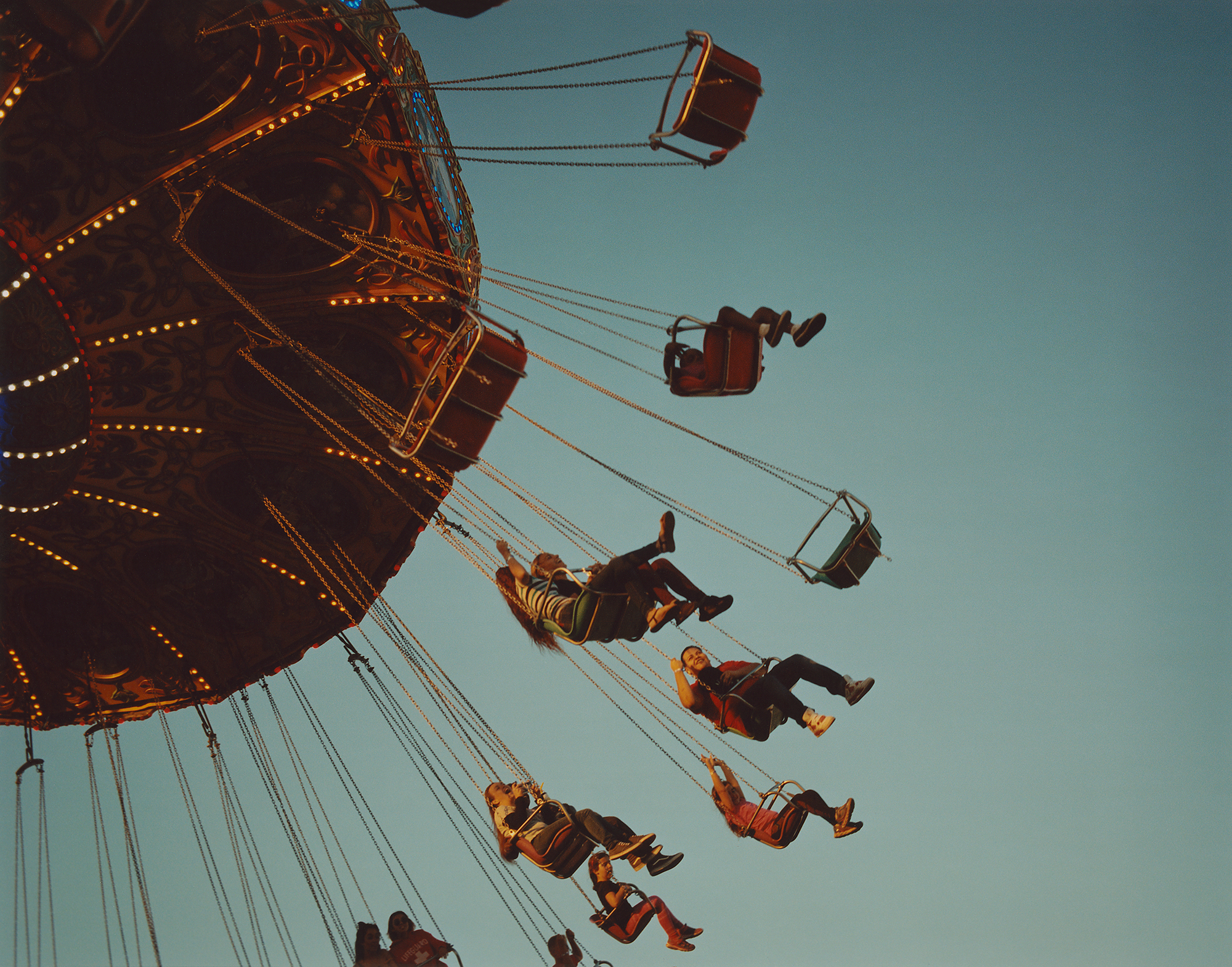

The complexity of this book is strewn in the pictures, which Blasko has made at the annual Strawberry Festival in Plant City, Florida since 2013. Except for a six-year hiatus during and after World War II, the event has run since 1930. For eleven days, people from all over gather for attractions, parades, entertainment and of course enjoying strawberries in ways you never thought appealing or possible. It is this intoxicating combination of people, place and time Blasko focuses on.

All the photographs are made in strawberry-stained late afternoon light. They are heavy on the ROY. Red shirts, orange drinks, wedding bands, goldfish. There are lots of lotsas. Lotsa red and strawberry-colored hair. Lotsa kids. Lotsa exposed skin. Lotsa indirect portraits, of people not knowing they were being looked at. People photographed from the side or from behind. People watching people. I imagine Blasko bumper-car-bumping his way through the crowd looking for the ding-ding-ding pictures. Lusting the light.

I grew up attending two local county fairs, the sounds and smells of which persist. I mention this because despite the visceral joy and excitement, what I remember most are the unsmiling faces. Yes, there was screaming and sirens, clapping and balloons popping, the relentless heckling of carnival workers. But there was also a sense of sadness, distraction and longing. Fairs have a way of transforming reality into something else, something other. Something mysterious but also menacing and risky, all the while giving off vibes of simpler, happier, safer times. It is this paradox that photography too is good at, and that Blasko elicits with his camera. The squinting, watching, waiting, chomping, wriggling, head-tilting and draping. Fairgoers devouring corn dogs with ketchup and show rides on repeat but without the overt rapture. Going to see and going to be seen.


For all the action and bewilderment these photographs imply, they unfold in slow motion. The light hypnotizes. The shadows lull. There is an undertow of disconnection. It is as if Blasko wants to lure us to the gates, fill us up until we’re tired or sick or our ears and feet hurt, and then, only as we’re walking to our cars, look over our shoulders and get a bout of the warm fuzzies from seeing the Ferris wheel still turning. Knowing that the fair is still fair. We go without questions, we leave without answers. We socialize and learn and enjoy. And, if we’re lucky, get reminded that less is more, and to stop and smell the roses. Or in this case strawberries.

Purchase Book

Read More Book Reviews


Odette England 
is a photographer and writer based in Providence, Rhode Island and New York. Her work has been shown in more than 100 museums, galleries, and exhibition spaces worldwide. She has two photobooks out this year: Dairy Character, winner of the 2021 Light Work Book Award; and Past Paper Present Marks: Responding to Rauschenberg, her collaboration with Jennifer Garza-Cuen, which received a $5,000 Rauschenberg Publication Grant.
Book Review The Golden City Photographs by Mimi Plumb Reviewed by Arturo Soto "Despite the surplus of ‘Golden Cities’ around the world...Mimi Plumb’s new book opens with numerous spreads of demolition sites and piles of dirt spreading in all directions, taking its time to situate us in the outskirts of the Golden State’s crown jewel, San Francisco..."

The Golden City by Mimi Plumb.
https://www.photoeye.com/bookstore/citation.cfm?catalog=ZJ903
The Golden City
Photographs by Mimi Plumb

STANLEY/BARKER, London, UK, 2021.

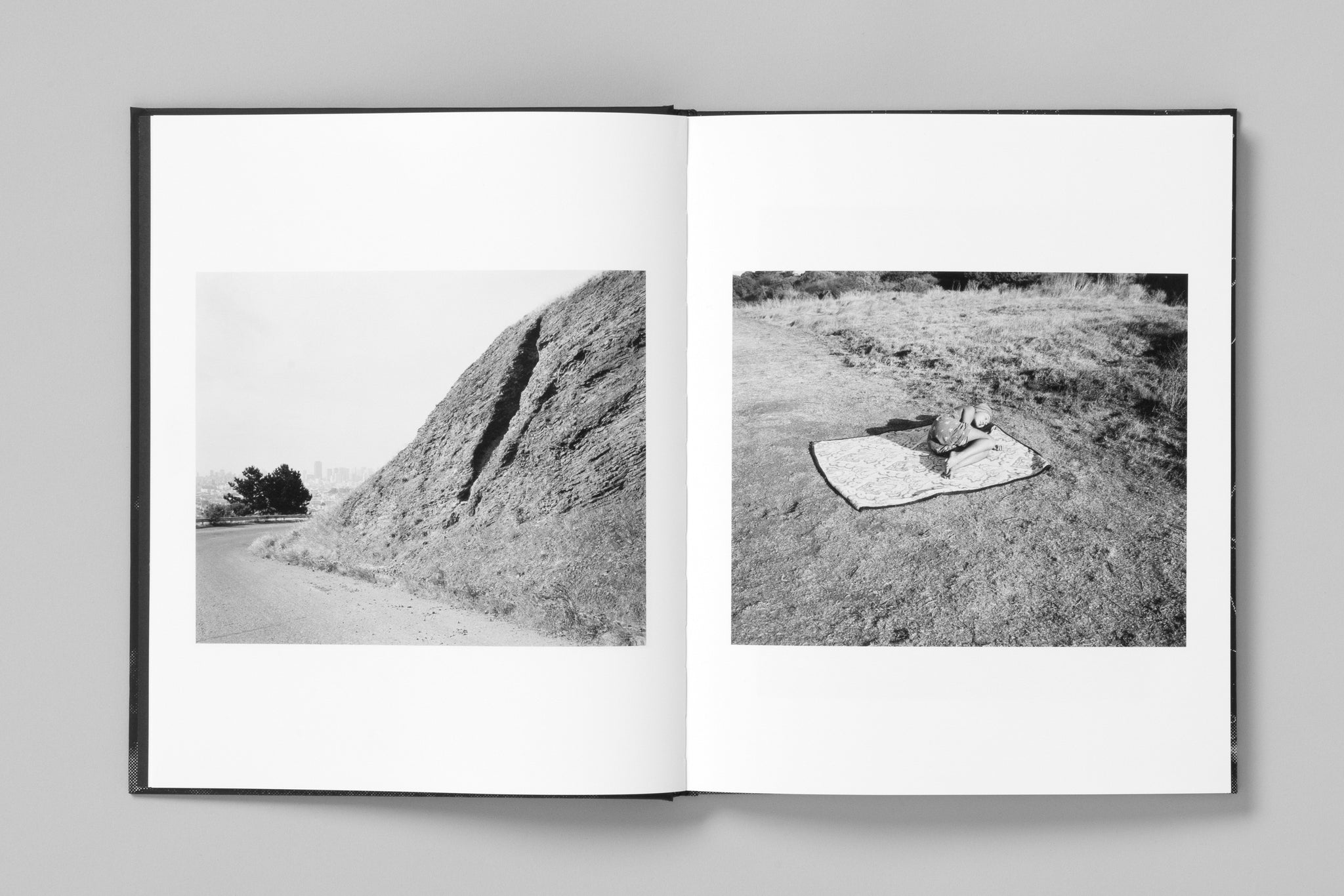
Despite the surplus of ‘Golden Cities’ around the world — India, Australia, and Czechia all claim one — Mimi Plumb’s new book opens with numerous spreads of demolition sites and piles of dirt spreading in all directions, taking its time to situate us in the outskirts of the Golden State’s crown jewel, San Francisco. My favorite of these initial images, presumably from the early ’80s, is of an old console television abandoned in open land with an ominous processing plant in the background. The two main elements signal the end of an era, with heavy industry giving way to urbanizations that will become the home of media and technology industries, the last nail in the coffin of a West Coast utopia. We move into the city as the image sequence progresses. An aerial view showing the complex transportation infrastructure and the rejection of horizontal planning implies an immeasurable sprawl that commodifies every aspect of life, with people spending their lives from one store to the next, buying things rather than seeking meaningful social interactions.  

The Golden City combines cityscapes with portraits, including a few featuring a dark-haired man. We first encounter him giving his back to us atop a gabled roof close to a billboard with a giant protruding hand. We return to the rooftop a few pages later, this time from a higher vantage point that reveals the giant hand holding a stack of bills, punching through a bank advertisement. Across the avenue, a Nissan ad induces us to “Think Fast,” leaving the dark-haired man wedged between commercial promises of a better life. The recurring character next appears alongside a blonde couple in a scene with the air of a lazy Sunday. The three of them sit on a couch in a back garden, looking like the predecessors of contemporary hipsters, but without the belabored effort of today’s legion. The young trio might not be as carefree as their attitude suggests, given the baby walker near the edge of the frame. Their attention is occupied by something in the sky, although I would like to think they’re contemplating their future, sensing that the market forces will soon snatch their places of creativity and self-organization. In his last appearance, again on a roof, we finally see the face of the dark-haired man tenderly embracing a young woman from behind. Both wear altered T-shirts and punk hairstyles, the sun harsh on their faces, commanding our attention as if they were celebrities letting their guard down for a candid picture.   


The other images of people in the book, shown mostly partying or otherwise having fun, are similarly deployed with a sense of nostalgia for a time when a bohemian lifestyle was more easily attainable. The colophon informs us the photographs were made between 1984 and 2020, but The Golden City seems to concentrate on the years when the Bay Area transitioned from a haven for intellectuals and free spirits to a corporate one where money and technology command the agenda. From this perspective, the book seems to correlate the destruction, development, or renewal of places with the diminishment of seminal communities that consequently altered the city’s social composition.  


As with her previous publications, Plumb uses images from her vast archives to shape a poetic sequence with an ambiguous narrative. The open relationship between pictures in The Golden City makes it hard to define unequivocally what the book is about. Plumb does not facilitate the interpretive process by giving us essays, titles, or statements, so we must rely on close attention and repeated viewings. While it would be tempting to say it is about how socioeconomic changes have transformed San Francisco, such an explanation would leave out the charged biographical dimension of the work. I can’t offer a satisfactory reason for this — I know neither Plumb nor San Francisco — but I believe the author’s presence is closely felt in many of these pictures, regardless of whether they are of people or places.   

With The Golden City, Plumb has once again crafted an abstract narrative that comes across as sincere, serving to interrogate whom the city is for. Since the primary purpose of cities is function, with the daily grind allowing little room for the kind of romantic notions that attract tourists, it is curious to find an idealized skyline of San Francisco in the most unexpected of places, such as a painting on a window ledge above dirty sheets, pillows, and food containers. The scene has been captured with a flash, making it look like police evidence, although it’s even more evident that someone’s taken comfort in that view, perhaps because it glosses over the difficult living conditions that overwhelm so many, giving him or her a sense of hope instead. The book, overall, achieves something similar.

Purchase Book

Read More Book Reviews


Arturo Soto
is a Mexican photographer and writer. He has published the photobooks In the Heat (2018) and A Certain Logic of Expectations (2021). Soto holds a PhD in Fine Art from the University of Oxford, and postgraduate degrees in photography and art history from the School of Visual Arts in New York and University College London.
Book Review Son Photographs by Christopher Anderson Reviewed by Odette England "I wanted a boy. My husband wanted a girl. We have a girl. I can’t believe I ever wanted a boy..."

Son by Christopher Anderson.
https://www.photoeye.com/bookstore/citation.cfm?catalog=ZJ820
Son
Photographs by Christopher Anderson

STANLEY/BARKER, London, UK, 2021. 160 pp., 80 color illustrations, 8¾x9¾".

I wanted a boy. My husband wanted a girl. We have a girl. I can’t believe I ever wanted a boy.

My reasons for wanting a boy are not as interesting as why we tend to say ‘boy’ or ‘girl’ rather than I want a son or I want a daughter. It could be because there’s a stronger personal attachment to the word ‘son’ than ‘boy’. ‘Son’ feels more human, more real.

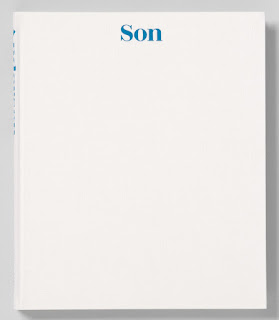
I have many new thoughts about photographing children and photobooks generally thanks to Christopher Anderson’s Son. Starting with the cloth cover, the position of the word ‘son’ at the top in petrol blue where the sun would be at high noon. I learn that Anderson, the only word on the book’s spine, which also ends in ‘son’ means ‘Son of Andrew’, derived from the Greek name Andreas meaning man or manly. I also notice that Anderson uses ‘son’ rather than his son’s name, Atlas. What a title to grow into! He’s got the whole world in his name.

Those of you who are parents might recall the first moment you saw and held your child. I hadn’t considered that when we meet them, they are a stranger to us and us to them. Nor had I considered that when we gift a child a name, what they are called is very different to their certified relationship to us. Which makes ‘son’ as a fact, idea, inference and photobook title a shrewd choice. How well do we know, can we ever claim to know, our children? The camera, in this case held by Anderson, adds both comfort and complication to the question. I say this as someone who has photographed her daughter since birth, watching her change and grow through a glass rectangle.


Son
, published by Stanley/Barker, comprises 80 color-rich images made between 2013 and 2021. This edition expands the original version published in 2013, a “second chapter” of the story. Many aspects stand out to me within the first twenty-five images. That any discussion about a son also involves a mother and grandfather, among other family members. That the sun, the only star and central body of our solar system, is a prevalent sub-character (and, an analogy for son). That as we age we become hyperaware of our death and that of our children. That we take many more photographs of our first child than their siblings, and far fewer of aging family, especially if they have a serious illness. And that we’re all a son or daughter to someone, somewhere, at some point.

The images offer a variety of distances between photographer and subject. They reveal time through seasons, light, vacations, reflections and clothing. There are interior and exterior views. We see where Atlas lives, sits, plays, eats, sleeps, swims and showers. We see his toys, pets, friends and hobbies. We see him accept, reject and ignore the camera. We see him being in the world, looking at the world, sometimes eyeing his father. We see him but we don’t know him like his father does. I wonder to what extent Atlas recognizes himself in these photographs of love and admiration. I also wonder which image is the last one we ‘see’ of Anderson’s father.

This book is about more than childhood, parenthood or life or death alone. It is about responsibility, sincerity, legacy and a dash or two of regret. I say this because about halfway through the book Anderson shares with us a letter he writes to Atlas after “a fuss about your homework”. I’m going to resist the temptation to copy the letter here in full though I do have questions about it. Did Anderson handwrite it to Atlas? How was it given to him (if indeed it was)? Is it shared in the book with us as-is, without editing or rewriting? The penmanship is magical and Anderson offers a remarkably concise explanation for the how and why of his photographs. And then ties it up with the neat bow of “I love you to the moon and back”.


Anderson makes photographing family look easy, unhurried and naïve, which is a positive quality. It’s very hard to do, even harder to do well. There is no objectivity here, no neutral gaze, and thank goodness. There are also few images (or few obvious images) of all those messy truths like arguments, tantrums, piles of dishes, diapers or dirty clothes. There are fewer still that depict major milestones at which we’d take out our cameras or phones, like birthday parties. It’s Anderson’s unforced eye capturing the roles of father, son, photographer, husband and friend that make this book so potent. Son is a star around which many a photobook could do with orbiting.

Purchase Book

Read More Book Reviews


Odette England 
is a photographer and writer based in Providence, Rhode Island and New York. Her work has been shown in more than 100 museums, galleries, and exhibition spaces worldwide. She has two photobooks out this year: Dairy Character, winner of the 2021 Light Work Book Award; and Past Paper Present Marks: Responding to Rauschenberg, her collaboration with Jennifer Garza-Cuen, which received a $5,000 Rauschenberg Publication Grant.