PHOTOBOOK REVIEWS, INTERVIEWS AND WRITE-UPS
ALONG WITH THE LATEST PHOTO-EYE NEWS

Social Media

Showing posts with label Book. Show all posts
photo-eye Gallery Chris McCaw | photo-eye Conversations LIVE + NEW book photo-eye Gallery Last month we hosted a conversation between artist Chris McCaw and photo-eye Gallery director Anne Kelly, via Zoom in honor of McCaw's new book Marking Time. In case you missed it or would like to revisit or share it, the good news, we recorded it and are pleased to share it today.
Chris McCaw, Sunburned GSP #932 (Idaho), Unique Silver Gelatin Print, 8x10 in.


Last month we hosted a conversation between artist Chris McCaw and photo-eye Gallery director Anne Kelly, via Zoom in honor of McCaw's new book Marking Time. In case you missed it or would like to revisit and share it, the good news is that we recorded it and are pleased to post it today!


photo-eye Conversations is a series of causal conversations with photographers 
 we have the honor of working with. 


View | Order  Chris McCaw's new book Marking Time HERE

Marking Time, Photographs by Chris McCaw, Datz Press, 2023. 

Sunburn was a conceptual experiment and adventure in connecting time and analog photographic tools. … I continuously study what directions and shapes of sun trajectories I can obtain in various times and spaces on the Earth. I expect a magical scene to appear, but it is not just vague waiting. I study meticulously. To obtain the traces of the rising and setting sun, you must personally travel to that time and space. It cannot be manipulated. And I just love that process. 
— Chris McCaw 

 
Marking Time, Photographs by Chris McCaw, Datz Press, 2023. 

Chris McCaw works with a manually modified large format camera, loading vintage photo paper in place of film, and letting the sun come through the lens to physically burn the paper. This analog photographic method holds the unique documentary aspects of photography, as it captures the day and night of a distinct time and place. The passage of time is also recorded on the vintage paper, marked through varying levels of sunlight throughout the day. This book is a compilation of McCaw’s diverse work from the past 20 years, featuring the significant Sunburn series along with his Heliograph, Poly-Optic, Cirkut, and Tidal series, allowing us to experience the full scope of his variations flowing as one body centered around the sun. 

 *from the publisher's description


View unique works by Chris McCaw

            *

PRINT COSTS ARE CURRENT UP TO THE TIME OF POSTING AND ARE SUBJECT TO CHANGE.

            *

If you are in Santa Fe, please stop by we are open Tuesday– Saturday, from 10am- 5:30pm. 

PHOTO-EYE GALLERY
300 Rufina Circle, Unit A3, Santa Fe, NM 87507

For more information, and to reserve one of these unique works, please contact 
Gallery Director Anne Kelly
You may also call us at (505) 988-5152 x202


Book Review The Settlements Photographs by Ken Taranto Reviewed by Arturo Soto "Photobooks often double as didactic devices that introduce us to unfamiliar places. Such is the case with Ken Taranto’s The Settlements, which documents the houses, roads and general infrastructure in the Israeli-occupied territories..."

The Settlements by Ken Taranto.
https://www.photoeye.com/bookstore/citation.cfm?catalog=ZJ881
The Settlements
Photographs by Ken Taranto

GOST BOOKS, London, England, 2021. 112 pp., 53 photographs, 9x12¼".

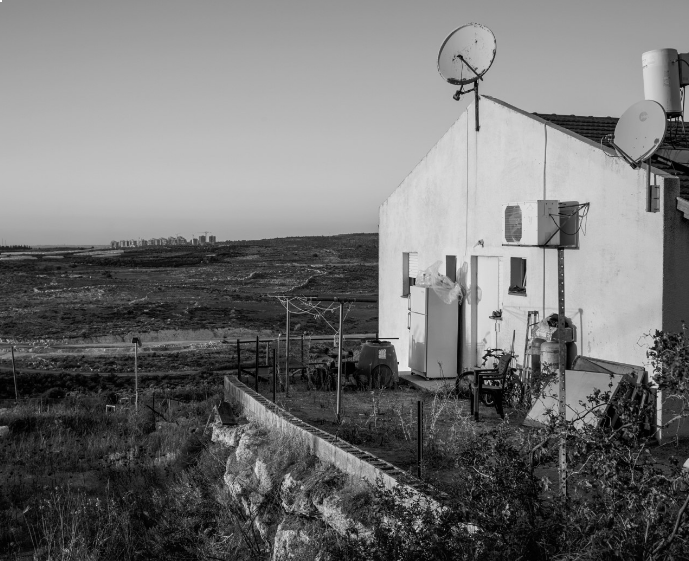
Photobooks often double as didactic devices that introduce us to unfamiliar places. Such is the case with Ken Taranto’s The Settlements, which documents the houses, roads and general infrastructure in the Israeli-occupied territories. Taranto’s series constructs an “architectural portrait of the settlements from a broad sampling of all types, sizes, densities, ages and regions” to know what these communities “actually looked like and how it felt to be there.” His intention is laudable since the topographies in question have a troubled history that’s difficult to capture. The pictures suggest the arduous human labor responsible for these structures in communities surrounded by a vast emptiness. But while the hasty transformation of some of these territories may be recent, the political, historical and theological grounds on which they are disputed constitute one of our age’s most controversial subjects. 

The sociological characteristics of the land are conveyed in spectacular foldout panoramas that, on the one hand, give us a sense of the scale of these urbanistic operations and, on the other, break the rhythm of an image sequence composed almost exclusively of deadpan pictures. The tonal range achieved during exposure is masterfully replicated in the printing, offering incredible detail in the shadows, where Taranto often places essential information. Take, for instance, the panorama showing a barbed-wire fence in the foreground and the settlement a few hundred meters in the background, with the elevated perspective rendering the in-between space as a source of political debate. The place of this panorama in the sequence is significant, between frontal images of unadorned houses, suggesting that we shouldn’t judge these structures on their architectural merits alone. 


The book eschews a comparative approach, which keeps us from seeing how Israeli communities differ regarding materials, design and planning from their Palestinian counterparts, as if Taranto wanted the occupied territories to tell the whole story. The dissatisfaction that ensues can be taken as a metaphor for our unending desire for photography to explain the world, presenting us with an opportunity to reflect on the nature of documentary work. Is it even possible to make impartial photographs of this (or any) topic, or should we demand that they explain — with words or sounds — one of the most multifaceted conflicts in history? What do we make of all those things that Taranto’s proposition leaves out? It’s unclear if, by not including certain kinds of pictures, viewers will look at The Settlements with admiration, indignation or indifference.

While it’s true that each photograph carries with it an aesthetic, moral and political position, artists can hide their views using specific combinations of tools and techniques. The problem of reading moral values in images of the landscape reminds me of the negative response some visitors had to the landmark exhibition The New Topographics (1975), perceiving the works on view as dull and concluding they were meaningless. For these visitors, the combination of a particular subject matter (urban landscapes devoid of people) and a ‘way of seeing’ (detailed prints of deadpan views made from large negatives) passed as banal and styleless. Only the ulterior success of the exhibition legitimized this way of working and accustomed us to its advantages.   


In the case of politically divisive places where controversy seems unavoidable, how much signposting should a project include? Is Taranto’s attempt to avoid offending politically negligent, or is he a victim of self-censorship? Critics like Ariella Azoulay would likely condemn Taranto’s approach as morally suspect. Since the conclusions one arrives at will depend entirely on one’s political beliefs and moral compass, The Settlements is a good starting point to discuss ideas about the role of political art and whether it needs to be accompanied by activism. Taranto’s detached stance, which reads like an aspiration of neutrality, sharply contrasts with that of fiction writers like Adania Shibli, for whom writing about Israel seems intrinsically linked to addressing the conflict with Palestine (as she does in her novel Minor Detail, linking the foundation of the Israeli state with the ongoing oppression of minorities in two devastating stories). 


The difficulty of representing these landscapes is that they mean different things to different people, with their current context always enmeshed with considerations of justice and human rights as much as fanatic patriotism. The Settlements is far from neutral, but its ambivalence will probably not please either committed faction. The images don’t emphasize Judaism in the way some might desire, nor do they show the repercussions of these constructions on Palestinian life. However, Taranto’s willingness to focus solely on the landscape to extract its secrets is undoubtedly welcomed, even if it comes in a visual manner that’s exceptionally challenging to interpret. 

Purchase Book

Read More Book Reviews


Arturo Soto is a Mexican photographer and writer. He has published the photobooks In the Heat (2018) and A Certain Logic of Expectations (2021). Soto holds a PhD in Fine Art from the University of Oxford, and postgraduate degrees in photography and art history from the School of Visual Arts in New York and University College London.
Book Review The Golden City Photographs by Mimi Plumb Reviewed by Arturo Soto "Despite the surplus of ‘Golden Cities’ around the world...Mimi Plumb’s new book opens with numerous spreads of demolition sites and piles of dirt spreading in all directions, taking its time to situate us in the outskirts of the Golden State’s crown jewel, San Francisco..."

The Golden City by Mimi Plumb.
https://www.photoeye.com/bookstore/citation.cfm?catalog=ZJ903
The Golden City
Photographs by Mimi Plumb

STANLEY/BARKER, London, UK, 2021.

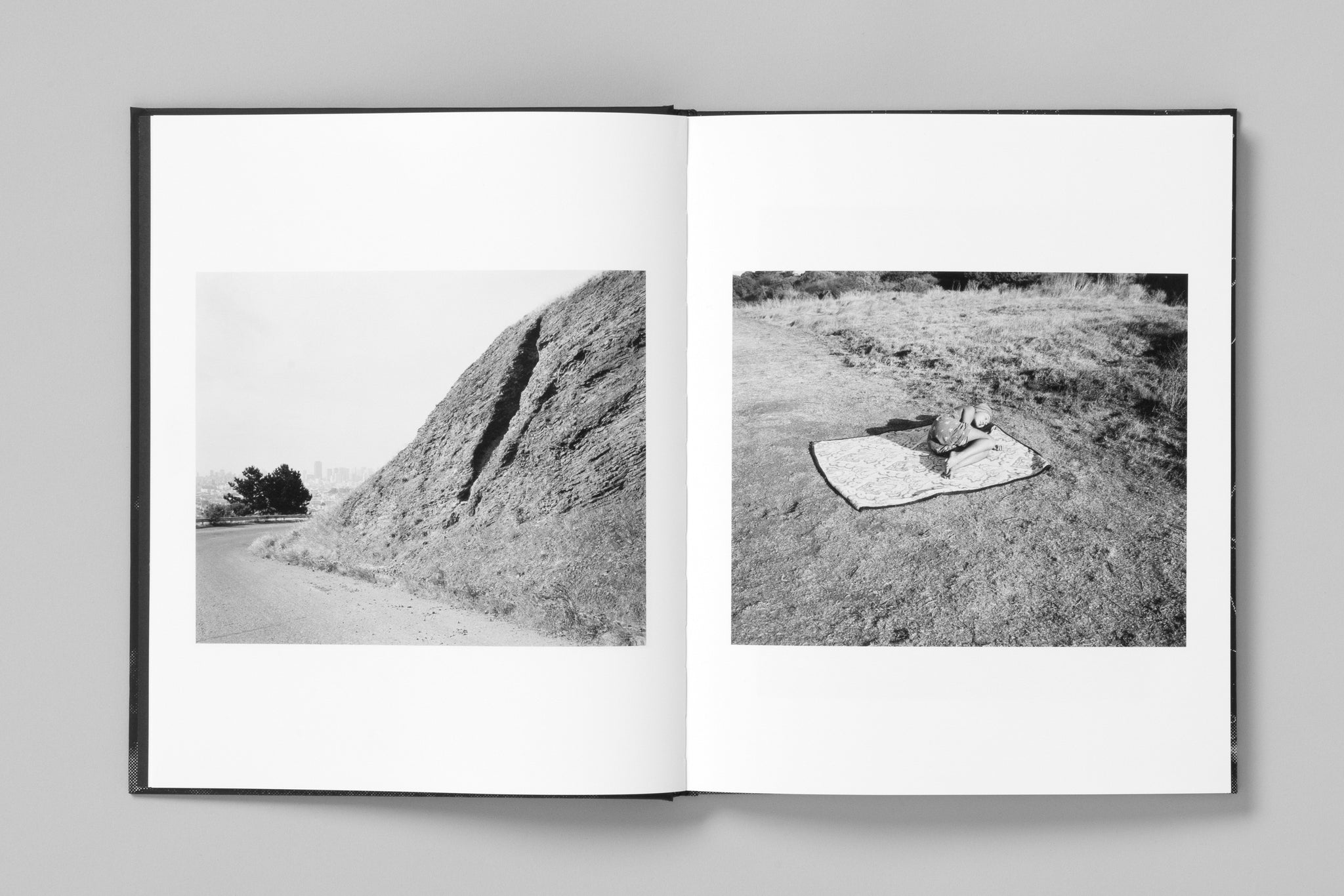
Despite the surplus of ‘Golden Cities’ around the world — India, Australia, and Czechia all claim one — Mimi Plumb’s new book opens with numerous spreads of demolition sites and piles of dirt spreading in all directions, taking its time to situate us in the outskirts of the Golden State’s crown jewel, San Francisco. My favorite of these initial images, presumably from the early ’80s, is of an old console television abandoned in open land with an ominous processing plant in the background. The two main elements signal the end of an era, with heavy industry giving way to urbanizations that will become the home of media and technology industries, the last nail in the coffin of a West Coast utopia. We move into the city as the image sequence progresses. An aerial view showing the complex transportation infrastructure and the rejection of horizontal planning implies an immeasurable sprawl that commodifies every aspect of life, with people spending their lives from one store to the next, buying things rather than seeking meaningful social interactions.  

The Golden City combines cityscapes with portraits, including a few featuring a dark-haired man. We first encounter him giving his back to us atop a gabled roof close to a billboard with a giant protruding hand. We return to the rooftop a few pages later, this time from a higher vantage point that reveals the giant hand holding a stack of bills, punching through a bank advertisement. Across the avenue, a Nissan ad induces us to “Think Fast,” leaving the dark-haired man wedged between commercial promises of a better life. The recurring character next appears alongside a blonde couple in a scene with the air of a lazy Sunday. The three of them sit on a couch in a back garden, looking like the predecessors of contemporary hipsters, but without the belabored effort of today’s legion. The young trio might not be as carefree as their attitude suggests, given the baby walker near the edge of the frame. Their attention is occupied by something in the sky, although I would like to think they’re contemplating their future, sensing that the market forces will soon snatch their places of creativity and self-organization. In his last appearance, again on a roof, we finally see the face of the dark-haired man tenderly embracing a young woman from behind. Both wear altered T-shirts and punk hairstyles, the sun harsh on their faces, commanding our attention as if they were celebrities letting their guard down for a candid picture.   


The other images of people in the book, shown mostly partying or otherwise having fun, are similarly deployed with a sense of nostalgia for a time when a bohemian lifestyle was more easily attainable. The colophon informs us the photographs were made between 1984 and 2020, but The Golden City seems to concentrate on the years when the Bay Area transitioned from a haven for intellectuals and free spirits to a corporate one where money and technology command the agenda. From this perspective, the book seems to correlate the destruction, development, or renewal of places with the diminishment of seminal communities that consequently altered the city’s social composition.  


As with her previous publications, Plumb uses images from her vast archives to shape a poetic sequence with an ambiguous narrative. The open relationship between pictures in The Golden City makes it hard to define unequivocally what the book is about. Plumb does not facilitate the interpretive process by giving us essays, titles, or statements, so we must rely on close attention and repeated viewings. While it would be tempting to say it is about how socioeconomic changes have transformed San Francisco, such an explanation would leave out the charged biographical dimension of the work. I can’t offer a satisfactory reason for this — I know neither Plumb nor San Francisco — but I believe the author’s presence is closely felt in many of these pictures, regardless of whether they are of people or places.   

With The Golden City, Plumb has once again crafted an abstract narrative that comes across as sincere, serving to interrogate whom the city is for. Since the primary purpose of cities is function, with the daily grind allowing little room for the kind of romantic notions that attract tourists, it is curious to find an idealized skyline of San Francisco in the most unexpected of places, such as a painting on a window ledge above dirty sheets, pillows, and food containers. The scene has been captured with a flash, making it look like police evidence, although it’s even more evident that someone’s taken comfort in that view, perhaps because it glosses over the difficult living conditions that overwhelm so many, giving him or her a sense of hope instead. The book, overall, achieves something similar.

Purchase Book

Read More Book Reviews


Arturo Soto
is a Mexican photographer and writer. He has published the photobooks In the Heat (2018) and A Certain Logic of Expectations (2021). Soto holds a PhD in Fine Art from the University of Oxford, and postgraduate degrees in photography and art history from the School of Visual Arts in New York and University College London.
Book Review SCUMB Manifesto Artworks by Justine Kurland Reviewed by Brian Arnold "Looking back at Hannah Höch’s work provides an interesting platform for understanding the new book of collages by American photographer Justine Kurland, SCUMB Manifesto. If you believe that history comes in cycles, there are incredible overlaps between the time Höch was developing her work and the cultural environment Kurland experiences today..."

SCUMB Manifesto. By Justine Kurland.
https://www.photoeye.com/bookstore/citation.cfm?catalog=ZJ957
SCUMB Manifesto
Artworks by Justine Kurland

MACK, London, UK, 2021. 288 pp., 9¾"x12¾.

sabotage /sabə täZH/
    verb     deliberately destroy, damage, or 
                  obstruct (something), especially for
                  political or military advantage.

I visited the Museum of Modern Art in New York City for the first time in 1997, where I saw a retrospective by the German Dada artist Hannah Höch. This was not only my first time at the museum, but this was also the first time I saw a major retrospective exhibit, and I was enthralled. Höch’s imagination captivated me, using simple tools she was able to create such an expressive reality, both a personal narrative and a scathing critique of cultural norms. Dada came to light between the World Wars, and collage was an essential tool for their vision. Disillusioned by the industrial revolution and a war-torn Europe, collage provided new vocabularies for identifying and deconstructing the societies of their time. Höch was an innovator of her day, not just by being a woman in the extremely patriarchal ranks of the Dada artists, and a self-identified lesbian, but as a truly visionary and original artist. Collage was the perfect medium for her to create her own vocabulary for constructing her identity and challenging a culture that attempted to control and define her sense of self.

Looking back at Hannah Höch’s work provides an interesting platform for understanding the new book of collages by American photographer Justine Kurland, SCUMB Manifesto. If you believe that history comes in cycles, there are incredible overlaps between the time Höch was developing her work and the cultural environment Kurland experiences today. When the work of the Dada artists took root, Europe was grabbling with the Spanish Flu, Fascism was on the rise (we have Trump and Putin), and Europe was divided by a war emanating along their Eastern borders. Dada, by its very name, was nonsense, and an attempt to subvert the norms that allowed for so much cultural cacophony. Collage was a perfect tool for their vision, providing an atavistic approach to dismantling the media and the cultural environment.


SCUMB Manifesto
is similar in so many ways, using a primitive cut-and-paste approach to collage (refreshing to see in our highly polished digital age) to dismantle the works of a culture defined by a pandemic, war, and abuses of power too abundant to fully acknowledge. In the wake of her superb publications with Aperture — Highway Kind and Girl Pictures, as well as the more autobiographical book The Stick published by TIS — this new book takes aim at the institutions that have allowed for and facilitated suppression of gender and queer personalities, specifically the white, European men that have defined and controlled the field of photography for its first 150 years. SCUMB Manifesto is a book of collages — deliberately identified by Kurland as a violent methodology — with all the source imagery culled from the heteronormative, patriarchal, white male culture that has controlled photographic discourse and created the canon. Artists like Edward Weston and Lee Friedlander — icons of the medium — are sliced apart and glued back together in pieces, creating monstrosities that reveal the oppressive gender hierarchies at play in their visions. She also calls out the “rapey gaze” of the tenured professors and curators that have provided the architecture to create this canon. To call Kurland’s book aggressive is an understatement; at times the book is overwhelming in the violence it visualizes, full of a rage only tempered by the compositional sophistication and insight of an extremely accomplished photographer.


Kurland makes no attempt to hide the source of her collages, and any discerning and well-informed photographer will recognize the pictures and books she cuts apart to make SCUMB Manifesto. Indeed, many of the collages are made from one book, the final creation pasted into the spines laid bare by her knife (an interesting material metaphor). For those interested in photobook history, you will see so many legends ripped apart — probably blasphemy to some, but I think this is precisely the kind of reaction Kurland wants — What We Bought by Robert Adams, American Monument and Nudes by Lee Friedlander (there are several collages built from this book), Sleeping by the Mississippi by Alec Soth, The Americans and Lines of My Hand by Robert Frank, The Bikeriders by Danny Lyon, and American Prospects by Joel Sternfeld are all amongst these books. You can also recognize pictures by Larry Clark, Hans Bellmar, Gordon Parks, Richard Avedon, Edward Weston, William Eggelston, David Douglas Duncan, Nicholas Nixon, Philip-Lorca diCorcia, Irving Penn, etc. (there is a list of titles in the back that usually identifies the source, but I found it more fun to see how much I could identify on my own). The commonality of all these men is their irrefutable position in the photographic canon, and all (or at least most) actively embracing their masculinity as part of their vision.

In assembling her pieces, Kurland uses several different types of collage strategies. Many are about representations of women, but not all. She also creates color abstractions; multilayered, 3-dimensional pieces as she burrows down into the pages of a book rather than ripping them apart, and collages that strip the source photographs down to the barest bones of representation. Seeing all these together is very interesting as it often feels like you can witness Kurland learning her process as you page through the book, noting different methodologies and techniques she discovered along the way.


As I often feel when looking at MACK publications, this book warrants an acknowledgement of Morgan Crowcroft-Brown, the chief designer for their publications. This is a large-format book with plenty of gatefolds, both lending the book a labyrinthian experience but also allowing for a clear engagement of the original work. I reckon these are printed 1:1 with the original pieces (at least some of them) and as such facilitating what feels like a direct engagement with the ideas rather than just being reproductions. The binding of the book is unfinished, making the book appear like the remnants of Kurland’s compositional strategies — the original act of destruction by freeing the spine is an essential step for any book-based collage (have you ever ripped a book out of a spine? It’s much more visceral and gratifying than you can possibly imagine).

Often the vitriol of Kurland’s work is more interesting than the visuals, the physical and violent act of cutting and defiling is more interesting than her compositions. Recognizing how tightly edited and disciplined Highway Kind and Girl Pictures are as books, SCUMB Manifesto does feel under-edited. There are over 110 compositions in the book, and all were made over just two years — between 2019-2021, not much time to produce so much work. And several times in the book, Kurland cuts the photographs into slivers that she uses to spell out her name, Justine. I’m sure this is self-referential, but it also works as a reference to the famous book by the Marquis de Sade. Either way, it feels a bit too much like a tagline and not an important visual expression. Most of the collages are powerful and layered statements, and something so simple and blunt diminishes the complexity of these images.


The book does include writing by Marina Chao, Renee Gladman, Catherine Lord, Ariana Reines, and Kurland herself. The writing has a unique character for this kind of lavish art publication. There are some art historical perspectives, but other pieces are personal memoirs or prose poems built around Kurland’s work. I like Ariana Reines’, a poet, playwright, performance artist, and translator, piece entitled “The First Cut is the Deepest,” a reflection back to her punk rock feminist roots. Catherine Lord’s contribution also has an especially nice swagger:

The master’s tools will never dismantle the master’s house. Yes. YES. NO, thing on it sister Audre, madame, ma belle, ma Cherie, ma jumelle, sa zami. Sometimes the master’s tools are the only things that will cut apart the big house. Think Grace Poole and the candle. Think Antoinette Cosby. Think Valeri, the patron saint of razor-sharp satire, thus razors, thus collage.

To fully address SCUMB Manifesto, it is necessary to say something about Valerie Solanas, a feminist writer and radical from the late 1960s, and whose fingerprints appear on every page of this book. Author of SCUM Manifesto, Solanas is typically better known for shooting artist Andy Warhol. Both books are titled with acronyms, SCUM for Society for Cutting Up Men, and SCUMB as a simple adaptation of the original, Society for Cutting Up Men’s Books.

The story of Solana shooting Warhol is interesting and tells us a bit about her vision and ire. In 1968, she marched to the Chelsea Hotel with a gun in search of Maurice Giordias, a publisher and pornographer newly arrived in New York City from France. Giordias ran the Olympia press, a publisher eventually absorbed by the Grove Press. He made his money publishing pulp erotica for soldiers fighting in Europe during World War II, but developed both his controversy and reputation by being the first to publish such innovative and challenging novels as Lolita by Vladimir Nabokov, The Ginger Man by J.P. Donleavy, and The Story of O. He also published Henry Miller, William Burroughs, James Joyce, and D.H. Lawrence — all these writers and books providing decisively masculine, if not misogynistic, visions. Solanas went to the Chelsea Hotel to demand that Giordias publish her book, if not she would kill him with her gun. Giordias was away for the weekend, so was never confronted. Not to be deterred, Solanas next went to the office of Barney Rosset, founder of Grove Press, to demand the same. Again, he was gone. In a last-ditch effort, Solanas next went to Andy Warhol’s studio, the Factory. She shot Warhol because she felt he had stolen the rights to one of her plays, another agent of her artistic oppression. All these men were leading figures in a cultural and artistic avant-garde (a cross-section of culture in which Solanas identified), chauvinistic gate-keepers intent on oppressing her vision of radical feminism. Ironically enough, Giordias had paid Solanas $500 and felt that entitled him to publish SCUM Manifesto after she was arrested, to cash in on her newly found notoriety.


I think of Solanas as a Ted John Kaczynski-like voice of late 1960s feminist thought, and the SCUM Manifesto professed the belief that men had ruined the world and it was up to women to take it back to a more righteous form (like Kaczynski, Solanas was onto something). I think she shot Warhol simply for being a powerful man with so much influence over the art world. A hypocrite, indeed, Warhol was someone who benefited from a gay or bisexual lifestyle but still did nothing to champion women and feminists of his day. Justine Kurland’s book is an appropriation of sorts, clearly and deliberately referring to Solana’s book. I think Kurland, however, is also trying to rewrite history and asks us not to think of Solanas simply as the woman who shot Warhol, but instead to see her as a revolutionary thinker who understood the caustic effects of patriarchy on art and intellectualism.

I submitted this essay to photo-eye on May 4, 2022, a day after a document leaked from the office of Samuel Alito that declared an end to the Civil Rights for women created by Roe v. Wade, and I am stunned by this remarkably backwards step in our culture. But I must confess it also makes Justine Kurland’s SCUMB Manifesto that much more timely and urgent. I think there are a lot of women and men who would like to take a hammer to the corrupt government and electoral systems that allowed for such a brutal and minority opinion to define the law of the land. Cut with a kitchen knife, indeed.

Purchase Book

Read More Book Reviews


Brian Arnold
is a photographer, writer, and translator based in Ithaca, NY. He has taught and exhibited his work around the world and published books with Oxford University Press, Cornell University, and Afterhours Books. Brian is a two-time MacDowell Fellow and in 2014 received a grant from the Henry Luce Foundation/American Institute for Indonesian Studies.
Book Review Puglia: Tra albe e tramonti Photographs by Luigi Ghirri Reviewed by Brian Arnold "When I teach beginning photography, I try to emphasize the importance of curiosity. I tell my students that an insatiable sense of curiosity is just as important as equipment or tools. This doesn’t exclude any conceptual or critical rigor, but in my mind, it is still the most essential characteristic of any good photographer..."

Puglia. By Luigi Ghirri.
https://www.photoeye.com/bookstore/citation.cfm?catalog=ZJ954
Puglia
Tra albe e tramonti
Photographs by Luigi Ghirri


MACK, London, UK, 2021. In English/Italian. 288 pp., 8¾x10".

“Luigi would often stop in silence...It was not just a place where he could rest a little, but one where he perhaps felt and acknowledged himself finally empty and ready to experience the wonder of being there in the world, in the world where ‘there is nothing old under the sun.’”
— Gianni Leone


When I teach beginning photography, I try to emphasize the importance of curiosity. I tell my students that an insatiable sense of curiosity is just as important as equipment or tools. This doesn’t exclude any conceptual or critical rigor, but in my mind, it is still the most essential characteristic of any good photographer. Wonder and curiosity are enough to drive a lifelong investigation of the medium, especially when combined with a strong literary, historical, psychological, or philosophical sensitivity. A deep love of photographic craft can still make the world feel surprising; a camera in the right hands can also lead to a deeper understanding of how much love and humanity still exist in this discordant and confusing world.

Italian photographer Luigi Ghirri provides a perfect example of how much can be discovered if you approach the world with enough curiosity, and Puglia, his new book with MACK, provides remarkable evidence of such. My first time through this book reminded me of my first experiences with John Szarkowski’s books about Eugene Atget, providing a feeling of profound photographic discovery and affirmation. Like these Atget books, each page of Puglia feels like a masterpiece of modernist photography – characterized by a remarkable attention to formal and technical details, and a patient, humble, and caring approach to the landscapes and people around him.


Located along the Adriatic coast, Puglia is not as well documented or touristed as Rome, Venice, Cinque Terra or Tuscany, but is nevertheless full of a rich cultural history. For close to 10 years, Ghirri explored the totality of Puglia with his cameras, but many of the pictures were made in Bitonto, a small city or commune within the larger city of Bari. Like many Italian cities, Bitonto is filled with brick streets and buildings that appear hundreds of years old. Walking these streets, Ghirri focused on the residential and daily life, looking at the people and the landscapes that seamlessly integrate the past and present (in the accompanying texts, the phrase there is nothing old under the sun comes up time and again), reminding us that the they are one and the same. Ghirri successfully embraces sentimentality without falling for anything saccharine or nostalgic, instead representing a place full of love and humanity, simplicity and humility, and somehow effortlessly existing outside of time, being contemporary and full of presence while evoking a rich history that imbibes the simplicity of the pictures with an historic grandeur.


Throughout Puglia, we often see multiple views of the same scene. In one photograph Ghirri shows us a sleepy store front with one man sitting alone out front, in the next frame he’s joined by his friends for conversation and coffee. We see children acting out a wedding procession on a street corner, with the next frame showing the same corner emptied. Other times he shows us multiple views of the same architecture, changed by the shadows or his walking of the landscape. Collectively, this approach lends the book a delightful cinematic quality, breaking free of the decisive moment and instead showing a more animated interpretation of an ongoing presence. The book does provide some quotes from Ghirri in which he shares some of his working strategies and philosophies, substantiating this cinematic quality as an essential part of the photographer’s vision:

“My way of interpreting through telling a story is simply that of managing to work with stronger images, so that some points are more evident and others less so; a method that is very close to literature, but also to cinema. Cinema has moments of greater overall intensity with more narrative moments or with pauses, which are nevertheless necessary for the comprehension of the film. Translated into photography, it can be a sequence, or shots of different distance, or different moments of approach…Images conceived to strengthen another, or offset another, or contrast with another, so that the narrative is not dull and lifeless.”

Coupled with this narrative approach, Ghirri brings an incredible understanding of photographic form, using light and shadow to create photographs that are deceptively simple, truly complex, and dynamic arrangements that reveal an incredible understanding of shape, balance, depth, and form. Indeed, Ghirri uses an original approach for understanding the play of shadow on architecture which ultimately make many of the spaces he photographs appear so much more elusive, all grounded with an incredible sensitivity to light. Page after page of Puglia, Ghirri demonstrates a remarkable ability to organize pictures, playing with light, shadow, color and shape in ways that appear simple but are clearly the result of patience, mastery, and an infectious love of photography.


The most exciting and innovative aspect of Ghirri’s photographs is his use of color; I cannot think of another color photographer who sees and understands white like Ghirri. The best comparison I think of is Rauschenberg’s White Paintings, which provide a remarkable meditation on degrees. While working with a broader palette than Rauschenberg’s paintings, Ghirri’s pictures nevertheless have a similar richness in their subtleties and embrace white like no other color photographer.

Puglia is divided into three basic sections. The bulk of the book is composed of Ghirri’s pictures, with around 200 photographs made between 1982-1990, printed just one per page. After the photographs are the accompanying texts, three different pieces that help contextualize Ghirri’s pictures and accomplishments. The final section is a series of 100 thumbnails which show the photographer’s original edit of his pictures from the region for an early exhibition of the work. Seeing Ghirri’s original sequencing of the photographs is interesting and presents a more narrative approach to the pictures than offered in this publication, and a very sharp acumen for developing visual relationships and ideas.
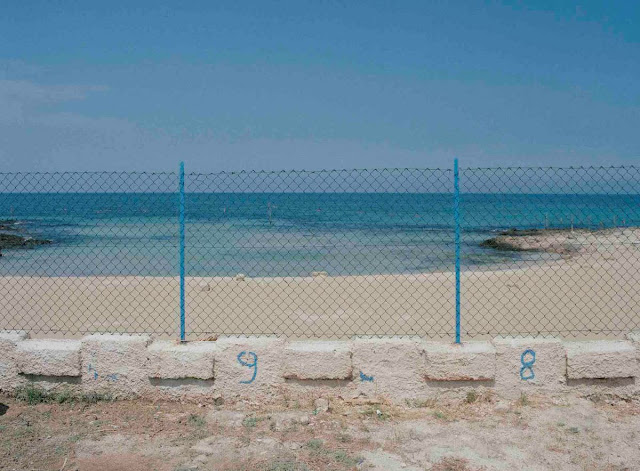

In the book’s final essay, “Ghirri: Fotografia, Sturttura, Romanzo (Ghirri: Photographs, Structure, Novel),” is by renowned Italian art historian Arturo Carlo Quintavalle, who provides a rich and insightful look at Ghirri’s work, career, and photographic philosophies. Quintavalle breaks down Ghirri’s work by first looking at his theories about images and narrative, citing the photographer’s own writings (from the beginning of his career, Ghirri wrote prolifically about photography): “I tried to construct and design whole works, and constructing whole works or projects meant thinking about a form of narrative through images, rather than a construction of single images.” He then looks at the evolution of Ghirri’s visual vocabulary over time, looking at the evolution of works as different and innovative as Kodachrome and Cardboard Landscapes, all leading to Quintavalle’s remarks on Puglia. He closes this essay with a close reading of the pictures, presented with important background information to help contextualize and understand Ghirri’s photographs from Puglia. Quintavelle walks us through the book, almost page-by-page, looking at the individual pictures, sequencing, and some of the ideas behind the book’s design. He points out the technical challenges and discoveries Ghirri confronted making these photographs (the white walls and the harsh sun of southern Italy, specifically), explains the sophisticated compositional and conceptual strategies the photographer developed while picturing the people and architecture of the region, and addresses the narrative strategies at play in book.

For those already familiar with Luigi Ghirri, Puglia provides incredible insight into his work and career, highlighting a body of work that further solidifies him as an essential contributor to the development of photography in Italy. For those not yet familiar with his work, this book is a wonderful introduction into the pictures, strategies, and theories of an innovative, imaginative, disciplined, and insightful photographer. With a substantial collection of photographs created across Puglia, and the insight of the accompanying texts, Puglia provides an incredibly thorough look at Ghirri and how he engaged a landscape and community.

Purchase Book

Read More Book Reviews


Brian Arnold
is a photographer, writer, and translator based in Ithaca, NY. He has taught and exhibited his work around the world and published books with Oxford University Press, Cornell University, and Afterhours Books. Brian is a two-time MacDowell Fellow and in 2014 received a grant from the Henry Luce Foundation/American Institute for Indonesian Studies.
Book Review Encampment, Wyoming Selections From The Lora Webb Nichols Archive 1899-1948 Reviewed by Blake Andrews “Lora Webb Nichols was born in 1883 and died in 1962. For most of the years between (apart from a mid-life spree to Stockton, CA) she lived in Encampment, Wyoming, a small town on the eastern frontier of the Rockies. Webb was a devoted journal writer from pubescence until death. Beginning around 1899 (her camera a gift from the man she would marry) she was a prolific photographer too, first in an amateur capacity and later as a working pro..."
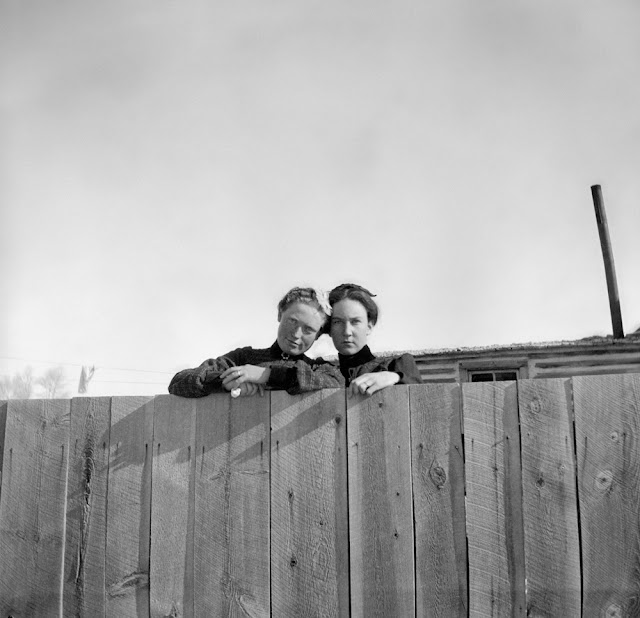
Encampment, Wyoming. By Lora Webb Nichols.
https://www.photoeye.com/bookstore/citation.cfm?catalog=IB964
Encampment, Wyoming
Selections From The Lora Webb Nichols Archive 1899-1948

Fw:Books, 2020. 108 pp., black-and-white illustrations, 8¾x11".

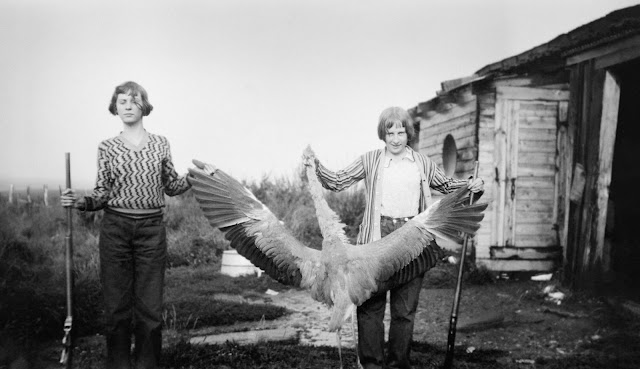
Lora Webb Nichols was born in 1883 and died in 1962. For most of the years between (apart from a mid-life spree to Stockton, CA) she lived in Encampment, Wyoming, a small town on the eastern frontier of the Rockies. Webb was a devoted journal writer from pubescence until death. Beginning around 1899 (her camera a gift from the man she would marry) she was a prolific photographer too, first in an amateur capacity and later as a working pro. She founded her own studio, making commercial pictures as well as photo finishing, while always just barely keeping the creditors at bay. And, oh yes, she also supported two husbands and mothered six kids along the way. All in a day’s work.

Her photographic output totaled some 24,000 negatives, a massive quantity for the time. Nichols’ photographs and journals might be considered dual legacies of the same impulse, to affirm her presence by the power of careful observation. “I know I don’t amount to much,” she wrote disarmingly in her diary, “I don’t cut much figure. I can’t seem to do any good in the world… Nevertheless I’m here and will have to keep pegging away trying to make myself useful…”


Perseverance furthers. Today her archive is a treasure, providing both a detailed record of one person’s daily activities and a glimpse into early 20th-century frontier life. But Nichols’ photographs have another surprising dimension. Many transcend a mere functionary role, elevated into art by her uncommon camera talents. They would have been lost to history were it not for Nancy Anderson, a neighbor who befriended Nichols toward the end of her life and arranged to house her archive in what would become the Encampment Museum. They were a civic novelty but attracted little outside attention. Fast forward a half-century, when the Nichols photo archive was discovered in 2012 by Nicole Jean Hill. The archive was too unwieldy for the museum. It was poorly stored and disorganized. But Hill recognized seeds of promise. With Anderson’s help, she undertook a multi-year effort to digitize, organize, and curate Nichols’ photos.

The result is the recent monograph Encampment, Wyoming: Selections from the Lora Webb Nichols Archive, 1899-1948. Although Nichols shot a range of subject matter, this book focuses on her portrait work (future curations may feature other material). Designed by Hans Gremmen and published by his Fw:books imprint late in 2020, it became a sleeper hit last winter, making several year-end lists. The first and second printings have sold out, with a third now on the way.


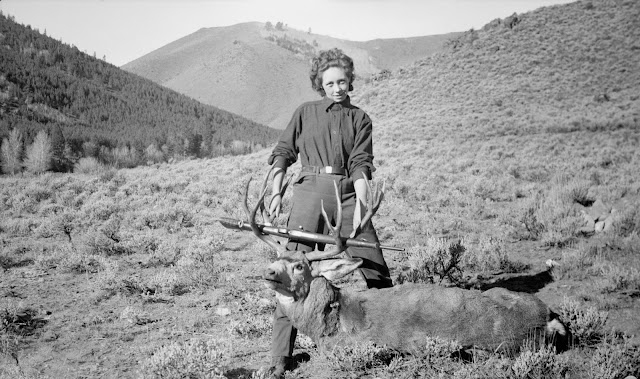
All three contributors — Nichols, Hill, and Gremmen — have joined forces to create a minor classic. That said, it is mostly Nichols’ show, as Hill and Gremmen wisely steer clear and let her photos take the lead. Frontier Wyoming comes alive before her camera, with a life force and casual aesthetic that feels quite contemporary. Gun-toting fur-lined grannies, fuzzy banjo players, hungry cats, balloons on Christmas trees. It all looks like a grand old time, and a weird one too. This is not the staid old west of C.S. Fly and Carleton Watkins, but one much closer to contemporary mores.

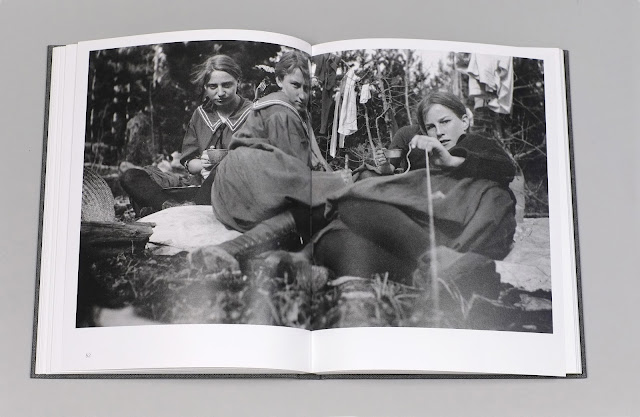
The book jumps into the photographs without a prelude. There are 115 in total, appearing in a range of sizes and layouts, one or two per spread. They bounce around in time and place. The reproductions are generally excellent. Scratches, hairs, and chemical artifacts of age have been cleaned up. Presented without theme or caption, the pictures have a time machine purity. The reader can sit on Nichols’ shoulder and encounter the world roughly as she saw. In addition to her photos there are some images by others included. These were gathered by Nichols as part of her collection, and they fit seamlessly into the mix although the authorship is separate. For those who want to sort photographers, dates, and locations, a helpful rear index lists that information, or at least what is known.


It’s worth lingering on the rear index a moment. It is one component of a sprawling text section that comes at the end as a design marvel. Nancy Anderson contributes an essay, followed by Hill’s story of discovery. Both women are openly enamored with Nichols, referring to her as “Lora” by first name. “I didn't want to initially include pictures that I wasn't confident were perfect in terms of both form and content,” explains Hill, “or could be labelled as a collection of snapshots, because I really wanted to the photo world especially to take Lora seriously as a photographer.” A plate listing and brief bios close out the writing. Several photographs are inserted in the essays, including a few of Nichols herself. The entire section is printed on silver ink against black matte paper, an abrupt departure from the white polish of the main body. The photographs shimmer with a ghostly glow, and even the words seem photographic in their vibrancy. One almost wishes the entire book could be this way. Almost. On second thought it’s fine as-is.

The photo world has experienced a tidal wave of similar projects in recent years, as contemporary photographers and curators mine and reappropriate old film archives in new ways. Compared to most, this one offers a relatively unfiltered channel to a bygone era. The design is dowdy, with a grey clothbound cover and plain san-serif typeface. The main body’s division into white paged photographs and black matte text section shows a flared reserve. The structure is conservative, functional without taking centerstage. The reader’s attention is directed to Nichols and her extraordinary legacy.

Purchase Book

Read More Book Reviews


Blake Andrews is a photographer based in Eugene, OR. He writes about photography at blakeandrews.blogspot.com.