PHOTOBOOK REVIEWS, INTERVIEWS AND WRITE-UPS
ALONG WITH THE LATEST PHOTO-EYE NEWS

Social Media

Showing posts with label Siglio Press. Show all posts
Book Review The Sleepers Photographs by Sophie Calle Reviewed by Britland Tracy “It’s 5:00pm on Monday, April 1st, 1979, and Sophie Calle has one rule: her bed must be occupied at all times, between now and 10:00am next Monday. She has a plan, or so she thinks, because she has meticulously scheduled twenty-seven friends, friends-of-friends, and curious or bored strangers to come over to her apartment and sleep in her bed with the chronological synchronicity of a relay race..."

by Sophie Calle. 
https://www.photoeye.com/bookstore/citation.cfm?catalog=ZK655
The Sleepers
Photographs by Sophie Calle
Siglio Press, 2024. 304 pp., 6x8".

It’s 5:00pm on Sunday, April 1st, 1979, and Sophie Calle has one rule: her bed must be occupied at all times, between now and 10:00am next Monday. She has a plan, or so she thinks, because she has meticulously scheduled twenty-seven friends, friends-of-friends, and curious or bored strangers to come over to her apartment and sleep in her bed with the chronological synchronicity of a relay race. Logistically, she has prepared a menu to offer upon arrival or departure, fresh sheets if desired, a voice recorder, a camera, and a questionnaire through which these volunteers will divulge everything from their dreams to their occupations to their histories of bed-wetting. Symbolically, she has purchased a goldfish which will stand watch in her bedroom to demarcate this week of…art? labor? slumber exchange? espionage? That is for the “sleepers” to define.

But, but, but: Bob the Trumpeter needs to take a bath. Graziella and Françoise insist on airing out the room first. Maxine will only settle into a nap if his coworker joins him. X the Babysitter’s jealous fiancĂ© would prefer she take the sofa. Jean-Yves Le Gavre is day-drunk and running three hours behind, Marino is four hours late, and Maggie has altogether disregarded the appointment. Henri-Alexis doesn’t like the magnetic aura of the sheets. Once in bed, their needs lengthen, and nothing short of Valium, sex, silk pajamas, a book, a beer, a gust of fresh air, the radio, a phone call, a cigarette, silence, closed doors, open windows, a wall-and-pillow fortress, and/or their dog will suffice as a tranquilizer. Sophie’s Sleepers are in fact human beings, still very much awake, with eccentricities and predilections and some apprehensions about why exactly they have agreed to crawl into her bed in the first place. And so her game begins.


A Sophie Calle Project is at its best when its initial scheme grows legs and runs circles around itself, persuading happenstance and human error to disrupt the rulebook, and that is precisely what unfolds throughout this week. Her subjects push back. They answer her questions with meandering diatribes or not at all. They’re annoyed or hungry or lusty or not yet tired. They’re laid bare in their idiosyncrasies yet remain impenetrable; they know they’re being watched. Voyeurism is a reciprocal mirror, and the specimens placed under glass have some observations about their examiner: “She’s mad.” / “This needs to stop, this acting like a social lunatic who asks questions and says nothing about herself.” / “Sophie, really, I find this a bit excessive. You’re spying on the most intimate moments. It’s unacceptable. If this is how it’s going to be, we’ll go to sleep.”

To follow the rules and fall asleep in her bed is, ironically, the eject button out of her game. Sleep is the least interesting thing that can happen here.


Les Dormeurs
was Calle’s first major project and a harbinger of what was to become of her now half-century career as an artist-writer-investigator of the human condition, and it has at long last arrived stateside as The Sleepers by way of Siglio Press and translator Emma Ramadan. The book itself is an intimate object whose tactility falls somewhere between a pillow and a sacred text, with its cushioned navy cover and three hundred silver gilded pages. It is meant to be read and regarded in equal measure, as images follow the lead of their textual counterparts, cataloging one sleeper after the next and confirming in black-and-white evidence what Calle has recorded in words. Look, there really were people in her bed. This man was a mouth-breather; this woman was nude. A tangle of limbs here; a snuggling cat there. Here they laid awake, smoking cigarettes before breakfast, sipping champagne, reading a newspaper, buttoning a shirt, staring back at the camera, greeting the next in line. The photographs of these gestures are grainy and monotone and satisfying in the way that crime scene photographs are satisfying – not for their technical craftsmanship but rather for the matter-of-fact secrets they reveal for our visual consumption.


It could go without saying that The Sleepers is not about sleeping, but rather those vulnerable, banal threshold moments usually shrouded by the curtain of night and solitude. If there is a narrative to be found in this game, it resides in the very peculiarities that render these participants insubordinate to its “stay in bed” rule – much in the same way a lover’s scrupulous nail clipping routine delivers more intrigue than whether or not they happen to snore. If one dies as one lives, then perhaps sleeping is the next best parallel lens we have onto the precarious business of living.

In the wake of this experiment, Calle would go on to, among other things, excavate occupied hotel rooms under the auspices of a chamber maid; hire a private detective to shadow her; follow a man to Venice for a whisper of a reason; publicly dissect a breakup letter, an abandoned address book, and her own mother’s death with the surgical aloofness that has become her signature affect and greatest tool. But first, she asked people to sleep in her bed, that unruly horizontal stage on which we spend a third of our lives, and documented their prostrate improvisations.


Now it is 10:00am on Monday, April 9th, 1979, and Sophie Calle has made a heap of concessions, inserted herself and her family members as bed doubles for some absentees, and gradually neglected her questionnaire. She has absorbed the trepidations of her sleepers and acquiesced to their chaos. They have run circles around her, and taking their cue, the goldfish has leapt from its bowl to its demise. Her gaze slackens; there is no one left to watch. She strips the sheets. The unraveling becomes this book.

Purchase Book

Read More Book Reviews


Britland Tracy is an artist and educator from the Pacific Northwest whose work engages photography, text, and ephemera to observe the intricacies of human connection and discord. She has published two books, Show Me Yours and Pardon My Creep, and exhibited her work internationally. She holds a BA in French from the University of Washington and an MFA from the University of Colorado, where she continues to teach remotely for the Department of Critical Media Practices while living in Marfa, Texas.
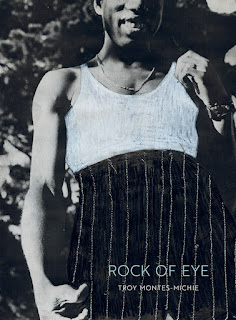
Book Review Rock of Eye Art by Troy Montes-Michie Reviewed by Laura Larson "The term “rock of eye” refers to the intuitive realm of tailoring where drape and fit are determined by the eye rather than the calculated measurements of sewing patterns. Let’s call it the eye of the beholder..."

By Troy Montes-Michie.
https://www.photoeye.com/bookstore/citation.cfm?catalog=DU286
Rock of Eye
Art by Troy Montes-Michie

Siglio, California African American Museum, & the Rivers Institute. 2021. 128 pp., 8½x11½".

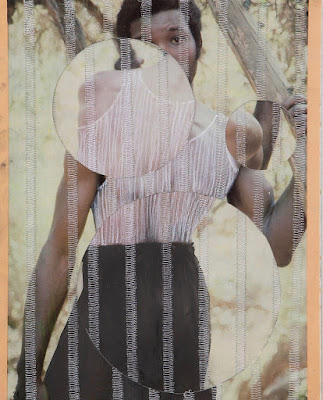
The term “rock of eye” refers to the intuitive realm of tailoring where drape and fit are determined by the eye rather than the calculated measurements of sewing patterns. Let’s call it the eye of the beholder. Troy Montes-Michie’s assemblages and collages in Rock of Eye use images drawn from an archive of 70s era gay porn featuring Black and Brown bodies. In porn’s racist vernacular, Black men are exoticized as studs, sexual objects to be consumed by the reader. In Montes-Michie’s hands, these men become fugitive subjects, radically disrupting the access porn promises.

Montes-Michie cuts, folds, layers, and misaligns these archival images. He paints then sands their surfaces, dressing the men in wife beaters and the voluminous pants of the 1940s Zoot suit. Using a sewing machine, he stitches into the paper: chain, straight, flatlock, running. Lines of stitching shapeshift, swerving between the decorative and the structural. Thin pinstripes on pants turn into a heavy zig-zag, evoking the vertical bars of a jail cell. These sutures recall notions of trauma and repair. The collages also incorporate sewing patterns, layering the light, brown translucent tissue over the photographs — another skin. Pattern lines mark welt for pockets and ease for the measure used to determine the space between the garment and the body. Cut strips of photographs are woven together, mimicking the thread structure of fabric. Fragments of bodies are revealed then concealed, elaborating a formal dialect that echoes and improvises on the techniques of sewing.


The Zoot suit, identified with working-class Latinos, emerged in the 1940s as a style from the simple act of buying clothes that were too large. This gesture was elaborated as design — theatrically concealed bodies a provocation to the notions of fit. Montes-Michie’s phantom garments cover the bodies of his subjects, and this attention makes the bodies feel held, cared for precisely because they are cloaked in this luxurious touch. Mining this connection between the eye and the hand, his work maps the energy between eroticism and affection. Montes-Michie’s tailoring disturbs the economy between visibility and availability through looping acts of repetition and return.

Two pictures. On the right, three men stand clustered together, their arms entwined. One man leans back against a smiling man in the center. His eyes are closed, and his head thrown back with the other’s hand hovering over his pelvis. Hands grasp thighs. The men are caught in a moment of abandon, but their delight remains their own. A man sits, naked, legs in a butterfly position, against a studio seamless. (Zora Neale Hurston: I feel most colored when I am thrown against a sharp white background.) There is no narrative armature or signifiers of wild nature. His body is masked by a sewing pattern with only his eyes and feet exposed in the cut. His eyes return the gaze of the camera. He won’t allow us to look or let us off the hook in this quiet reclaiming of agency.

Montes-Michie’s critical gestures of veiling are both protective and defiant. Desire isn’t banished from the frame, and this is the joyful knot of the work. He beholds his subjects with tenderness and dresses them in their rebellious threads. Midway through the book, the ring pattern of quilting is introduced, a form that resonates with its prismatic sensibility. His subjects peek out from behind the moan of these repeating Os, looking back. My eye slips, ricochets, and halts through the shifting borders of Rock of Eye’s visual somatics. Montes-Michie calibrates invitation and opacity to map the fraught and necessary space between pleasure and resistance.

Purchase Book

Read More Book Reviews


Laura Larson
is a photographer, writer, and teacher based in Columbus, OH. She's exhibited her work extensively, at such venues as Art in General, Bronx Museum of the Arts, Centre Pompidou, Columbus Museum of Art, Metropolitan Museum of Art, Museum of Fine Arts, Houston, SFCamerawork, and Wexner Center for the Arts and is held in the collections of Allen Memorial Art Museum, Deutsche Bank, Margulies Collection, Metropolitan Museum of Art, Microsoft, Museum of Fine Arts, Houston, New York Public Library, and Whitney Museum of American Art. Hidden Mother (Saint Lucy Books, 2017), her first book, was shortlisted for the Aperture-Paris Photo First Photo Book Prize. Larson is currently at work on a new book, City of Incurable Women (forthcoming from Saint Lucy Books) and a collaborative book with writer Christine Hume, All the                                                               Women I Know.
Book Review The Hotel Photographs & text by Sophie Calle Reviewed by Odette England "I dismember the book page by page. Isn’t taking a photograph a sort of dismembering of the world? Consider subbing dismemberment for another word. Word is in world. There is no L in Moyra or Davey or Peter or Hujar or The Shabbiness of Beauty or Vanishing. Rather, lots of love, lonesomeness, lust, looking, and light..."

The Hotel by Sophie Calle.
https://www.photoeye.com/bookstore/citation.cfm?catalog=DU166
The Hotel
Photographs & text by Sophie Calle

Siglio Press, New York, 2021. 248 pages, 212 illustrations, 6x8."

You shouldn’t invite me to a dinner party. I mean, I’m a reasonable guest. I arrive on time, bearing something nice (flowers, wine, dessert, pet treats). I offer to help serve or dry the dishes. I have a non-offensive laugh. You can seat me on the upside-down trash can that doubles as a spare chair, I won’t complain. I also know a few two-drink-minimum party tricks, like applying lipstick using only my breasts. But when I go to the restroom, my inner spy manifests: I will inspect the contents of your medicine cabinet.

Why? Because that’s where your uncensored life is. It’s one of the few concealed spaces of a home I can access without detection. Peek at a private version of you, presented in rows with reasonable lighting, revealing much more than your refrigerator. Your birth control preferences, meds you’re taking; wow, you use that brand, yeesh… I check out your stuff and draw conclusions. I know you know: it’s estimated almost 40 percent of folks admit that they put things away before guests arrive. Good thing, too; otherwise I’ll treat myself to a spritz of that classy perfume, thank you so much. It’s also a project I thought about as a student: thrusting my Speedlite into the shallows of friends’ little cupboards, then using their surnames or addresses as captions.


Few would do more justice to such a project than Sophie Calle. The only photographer I’d invite to stay with me long-term to see her take, in words and pictures, on the unflattering reality of my life. Remember in 1999 when the world gave birth to the Big Brother franchise? John de Mol Jr. missed an opportunity by not inviting Calle to direct what would become the biggest reality competitions on the planet. Though, it’s more fun to think of Calle turning down the offer. She has already syndicated her creative genius in more persuasive, compelling ways. One being her latest photobook The Hotel, first included in the 1999 book Double Game (long out of print). Now, a single standalone book and available in English for the first time.

The first spread is a black-and-white image of a bed. The book’s gutter separates left side from right. There are two pillows top of frame, then a sheet, wrinkled and turned down; then a patterned stained bedspread. Along the bottom of the page the text reads: On Monday February 16, 1981, I was hired as a temporary chambermaid for three weeks in a Venetian hotel. I was assigned twelve bedrooms on the fourth floor. In the course of my cleaning duties, I examined the personal belongings of the hotel guests and observed, through details, lives which remained unknown to me. On Friday March 6, the job came to an end.

It may seem Calle is giving the game away. Far from it: The Hotel becomes spicier and weirder with every page turn.


Let’s pause to consider Monday February 16, 1981, two days after Valentine’s Day (when almost a third of cheaters have affairs in hotels). Calle is 28 years old. A hand grenade explodes and kills the man carrying it at a stadium in Karachi, before Pope John Paul II arrives to celebrate mass with 70,000 people. It’s the year Ronald Regan is shot, Kiev’s Motherland Monument opens, and The Smurfs make their television debut. People are listening to Dolly Parton’s 9 to 5 on the radio. It’s also International Pancake Day. Why does any of this matter? This is a sliver of the backdrop to which Calle pokes her lens and pen into the lives and suitcases of strangers whom she is entrusted to clean up after. It provides some context, and context is everything.

Now for some theories about hotel land. The TV remote control is the dirtiest object in your room. Big suitcases mean high-maintenance guests. Never use the decorative cushions; they spend most of their lives on the floor. If you leave out your expensive shoes, they will be Cinderelled (yes, borrowing guests’ clothes happens outside of films like Maid in Manhattan). Oh, and having a fourth floor in a hotel is bad luck, a bit like a gate thirteen at an airport.

There are twelve color images positioned at intervals in The Hotel, full-bleed portraits of the beds in each of the rooms assigned to Calle. They are frontal, formal, clinical photographs. Beds made, the perspective direct. Everything is in its place. Each followed by a black and white photograph of an opposing view. Beds are now messy, angles off-kilter. Neatness replaced with the creases of cuddles, courtship, and conversation. On the next page, we’re given the room number and dates of occupancy, followed by seesaw arrangements of Calle’s adroit storytelling. It’s here the content hovers between police report, diary, press photo caption, missing cat poster, home shopping network catalog, photocopy log, and medical invoice. In short, a genre all its own.


Combining image and text well in a photobook is tricky. Calle is a master. Neither triumphs over the other. Calle takes to words like a surgeon wielding a favorite ten-blade. Each sentence is a balance between rudimentary and essential. So too with her camera. I feel Calle’s gaze touch every object. I hear her inhale the musty smell of the hotel iron that has infected your poly-cotton shirt. Her lips so close to its collar she can almost taste its texture. All the while she unravels, labels, authenticates her version of your life in the starkest, most enchanting minimalism.

I’m not distracted by assessing the technical quality of the pictures. I could care less about the focus, film grain, or camera used. This is not a book about darkroom techniques or rules of thirds. It’s about interactions of evidence that excite, amuse, even titillate.


The Hotel
, as a book-object, is meticulous. It presents, in size and weight, like a good quality bible kept in the bedside top drawer. Its cloth cover bearing three different patterns, replicating the hotel’s soft furnishings. The endpapers a shade of heritage green used in carpet made for high traffic areas. Also, for paint that hides sinful stains on hotel walls. It even comes with a bookmark in the shape of a miniature hotel doorknob hanger that says JOYFULLY RESTING… ah, Calle, I adore your sense of humor.

What stands out to me about The Hotel is how we assume we could possibly know anything true about a stranger through their ordinary stuff. What Calle reveals is much more than getting close to it, using flash to photograph it, writing about it, et voila! So many inferences, so many conclusions. There is no greater context-cutter than the camera and its offspring, the photograph. No one exorcises reality like these partners in crime. Yet we give them so much latitude, so much faith, hope, and charity.


The Hotel
documents Calle’s experiences while also probing complex relationships between photography, discretion, instinct, and appetite. Indeed, why as photographers we often lean into snooping and sneaking. Curiosity doesn’t so much kill the cat as feed the camera. It removes some of the barriers to who we are and what we assume the world cannot see. It makes known the detritus of intimate acts that leave us vulnerable without us knowing. Calle proves that few if any spaces are ours and ours alone. Even spaces we assume are private (or neutral). Calle’s heightened senses gather information about us, our traits and personal concerns. She’s not looking for social cohesion or conformity. She’s not looking for damning evidence to support what she thinks she knows. Maybe she’s making snap judgements. Really, she’s just looking. Stripping away tiers of privacy we’re so accustomed to building up.

Why do we like insider photo projects like The Hotel? Because we’re curious about people. We enjoy secrets. We like to think about what people do behind closed doors. Yes, people take out their earrings and use them to clean their fingernails. They remove their wristwatches and sniff the sweaty skin behind. We pick our noses, rearrange our underwear, use utensils for purposes unintended. And then we lie about it or, worse, tell people we never lie. As I write this I wonder to myself how long an affair between a photograph and lie detector would last. Calle’s book shows us from all angles: none of us lie straight in bed.

Purchase Book

Read More Book Reviews


Odette England is an artist and writer; an Assistant Professor and Artist-in-Residence at Amherst College in Massachusetts; and a resident artist of the Elizabeth Foundation for the Arts Studio Program in New York. Her work has shown in more than 90 solo, two-person, and group exhibitions worldwide. England’s first edited volume Keeper of the Hearth was published by Schilt Publishing (2020), with a foreword by Charlotte Cotton. Radius Books will publish her second book Past Paper // Present Marks in collaboration with the artist Jennifer Garza-Cuen in spring 2021 including essays by Susan Bright, David Campany, and Nicholas Muellner.