PHOTOBOOK REVIEWS, INTERVIEWS AND WRITE-UPS
ALONG WITH THE LATEST PHOTO-EYE NEWS

Social Media

Showing posts with label Yoffy. Show all posts
Book Review This is Bliss Photographs by Jon Horvath Reviewed by Blake Andrews “The closest town to me growing up had perhaps a thousand residents. Redway in the 1970s was a sleepy turnoff where not much ever happened. It was originally settled as a timber town..."

This is Bliss By Jon Horvath.
https://www.photoeye.com/bookstore/citation.cfm?catalog=IG126
This is Bliss
Photographs by Jon Horvath

Yoffy Press / Fw: Books, 2022. 280 pp., 9½x11½".

The closest town to me growing up had perhaps a thousand residents. Redway in the 1970s was a sleepy turnoff where not much ever happened. Originally settled as a timber town, it later transitioned half-heartedly to tourism and counterculture. After being bypassed by 101 the town became even sleepier, but it still boasted the basic components of Americana. There was a post office, a school, a community center, a few diners and a local swimming hole. Everyone knew everyone’s business.

If Redway fell into Hollywood stereotype, that’s no accident. American pop culture has long been infatuated with small-town life. The tendency to romanticize such places as a community ideal spans all art forms, from Andy Griffith to John Cougar to Fargo to Norman Rockwell. Photographers are no exception. Think of Richard Rothman poking around Crescent City’s back lots, Nick Waplington in tiny Truth or Consequences, Timothy Briner joining various Boonvilles or Alessandra Sanguinetti recently in Black River Falls. Their motivations vary, but as a general rule, all are outsiders combing small towns as potential fonts of wisdom and salvation. Perhaps, the thinking goes, these quaint backwaters might turn up photogenic characters. In the process they might provide insight into the national character.

This may be what drew Jon Horvath to Bliss, Idaho, a minor hamlet tucked between the Snake River and I-84, a full day’s drive west of his Milwaukee home. The Bliss census tally when he arrived was 318 and falling. Its elevation: 3271’ and rising. If the town’s threadbare charms weren’t quite attractive enough on their own, its name clinched the deal. Bliss: a double entendre almost too good to be true, at least when viewed by poetic souls. For the record, Bliss was named for a person (founder David Bliss), not a state of being.
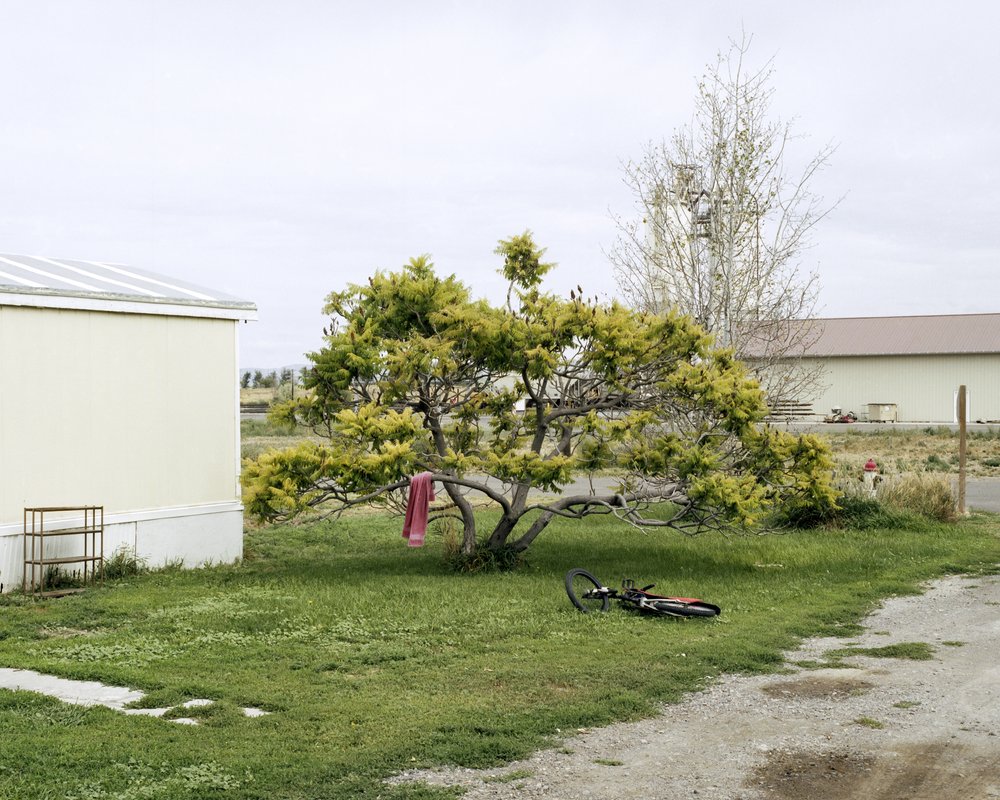

Horvath made several return trips to Bliss throughout the mid-2010s, poking his camera sometimes where he shouldn’t have, establishing relationships, and gradually compiling a photographic record of its people and geography. If he were a typical photographer, those images might have surfaced by now in a standard picture monograph. But Horvath’s creative interests extend well past photography. By his own reckoning, he is “an interdisciplinary artist routinely employing systems-based strategies within transmedia narrative projects.”

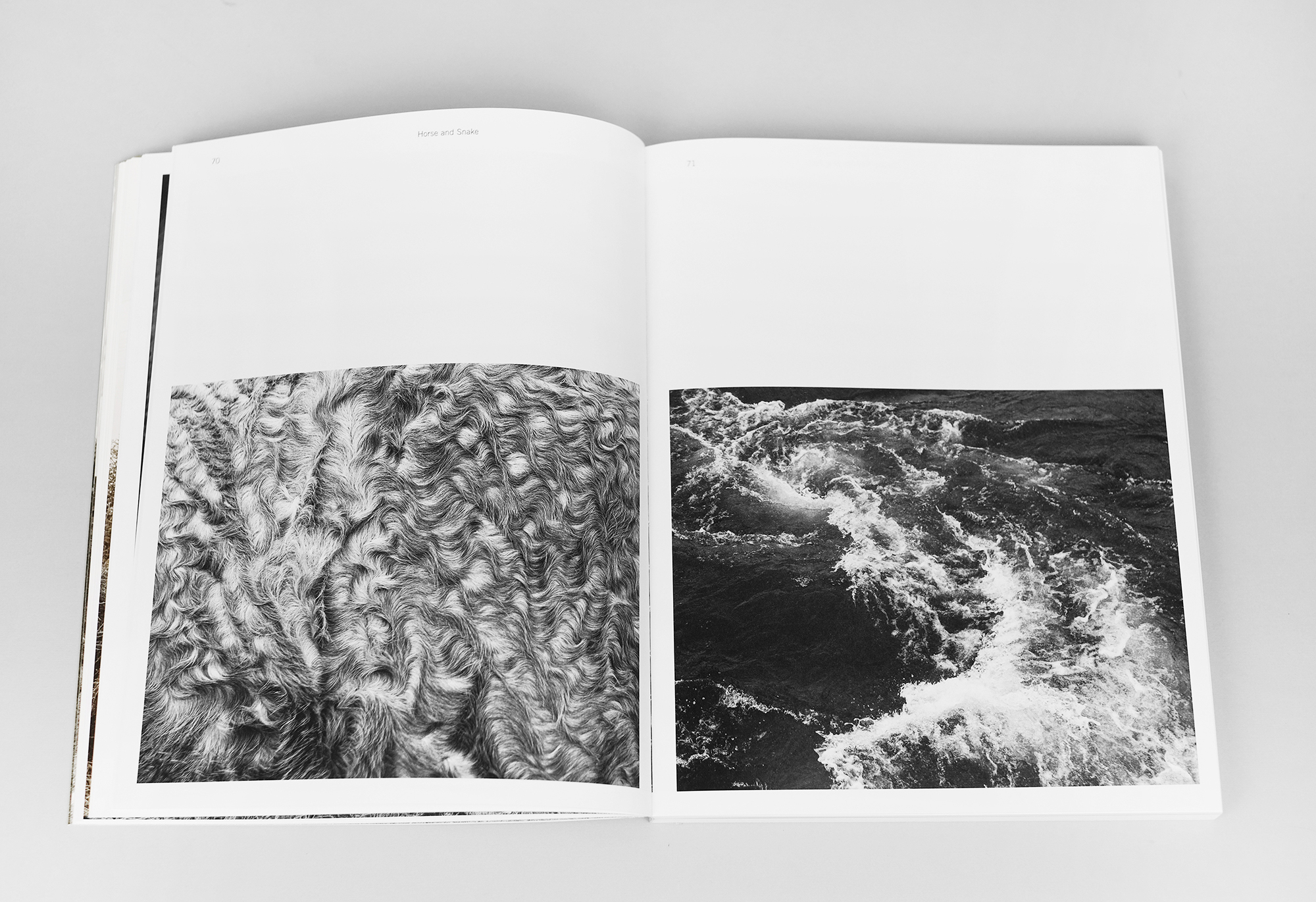
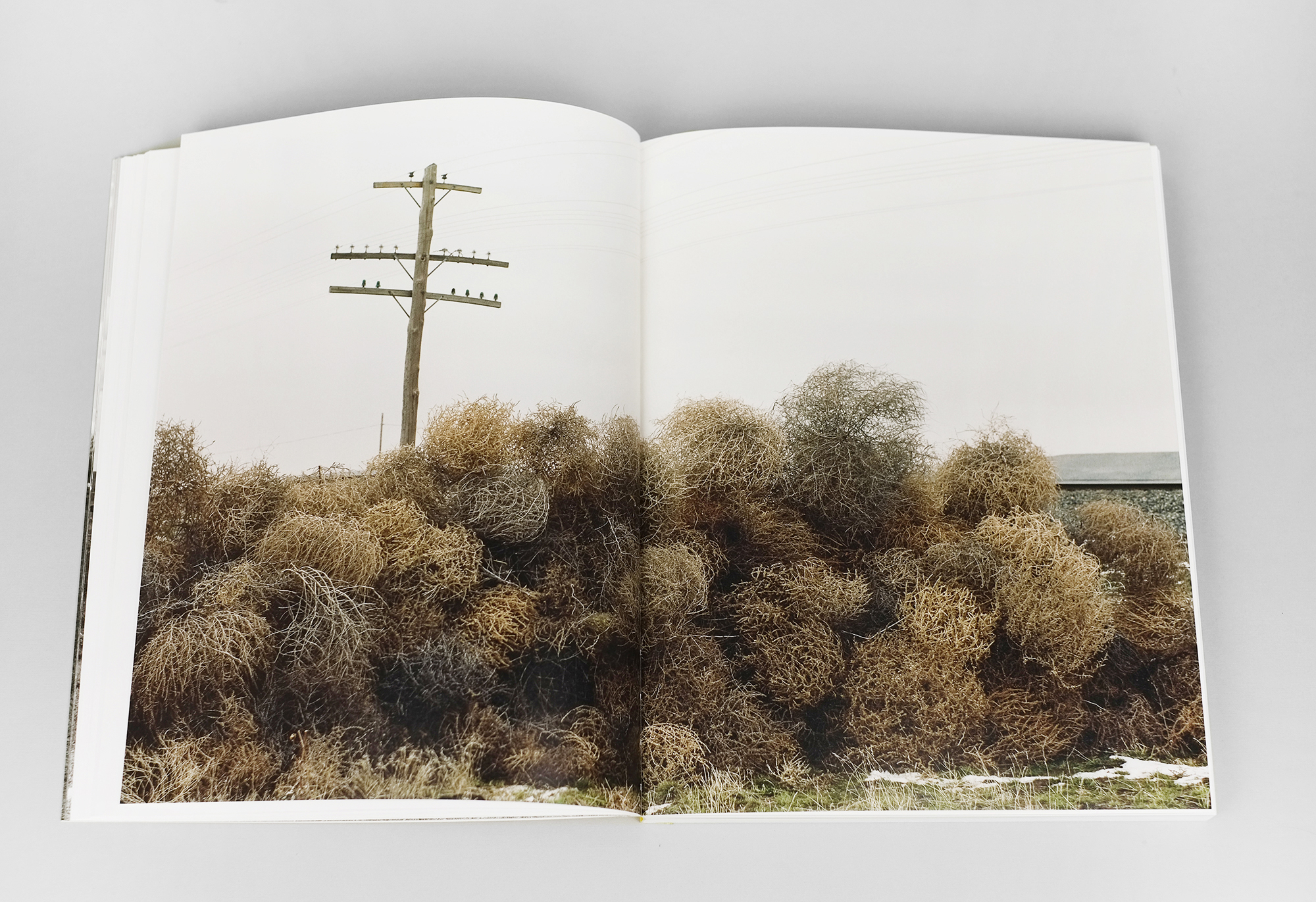
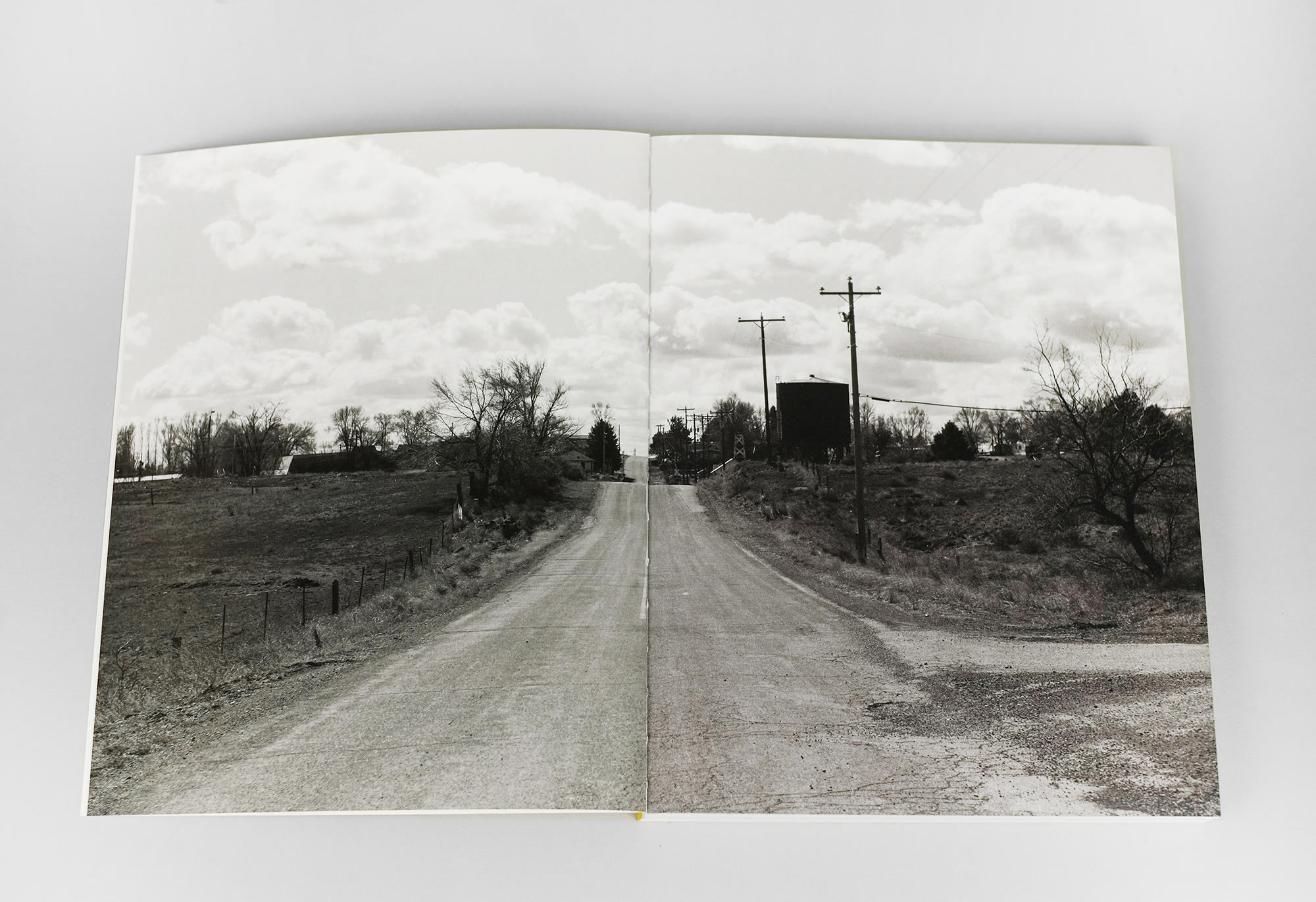
If that phrase has the whiff of artsy hokum, his recent photobook is more grounded. This Is Bliss is a sprawling tome of images, layouts, stocks and treatments. It is large, dense and thought-provoking, in a way that belies its whistle-stop subject. To give a rough sense of the book’s heterogeneity and scope, here is a sampling: There’s an opening spread of monochrome byways, a quick shift to smaller color work, three green restaurant checks, scattered portraits of silverware, people and a dog named Cash. There are wet collodions of discarded beer bottles, branding tools, weaponry and a graphic pun. There are iterations of a floral bouquet photographed against a peeling faux-wood-grained backdrop, a small diversion to explore Holden Caulfield (his namesake lived in Bliss), shots of signage, airplane wreckage, model figures and barely legible dark impressions of Chinese burial sites. There are arrowheads, Senior Class Quotes on paisley color fields and Horvath himself shown in multiple frames skipping stones across the Snake River. Also: birds, puddles, an Ansel Adams photo converted to jigsaw, an evangelist’s note, a melted beer bottle adorning an anecdote about Horvath’s first ever (!?) alcoholic drink in a Bliss bar.


That may seem like an overload already. But it’s just a taste. You’ll have to grab a copy to see it all, and it might take some time to digest. This Is Bliss reflects Horvath’s attempt to size up the place, but the town’s character remains elusive. The book offers a patchwork quilt of images and ideas, a “transmedia narrative project” if you will. As to what they all amount to, that’s harder to say. The project started as a multi-media installation and feels still bounded by that form as a book. We see this facet of Bliss, then that one, then another view. But they are blind men feeling parts of the elephant, disjointed and unintegrated. What is it actually like to be there, to walk down the main street? Perhaps that burden is beyond the scope of any monograph. Horvath wants to crack the small-town code and root out its American essence. But perhaps Bliss has flipped the script and cracked the author in the process.


But all is not lost. The Bliss jigsaw eventually fills in, with the help of a sharply rendered text by Horvath. This comes at the very end, after all the images have been digested and the reader’s brain pulled this way and that, a conscious nod by Horvath toward the literary strategy of short story cycle. The story “Coyote” is seemingly based on actual events and relationships, and its primary characters Jared, Karl, and Cash appear to correspond with photos earlier in the book. But it comes with the subheader: “short fiction”. Is the label a ruse to throw us off the scent? More transmedia jujitsu? It’s hard to know which parts are real and which are imaginary. In the end, it may not matter, since “Coyote” is well-written and entertaining enough to stand on its own. Spilling over thirty pages the tale describes a series of minor hunting expeditions near Bliss. Horvath’s language penetrates the existential angst of the place in a way that his photos sometimes can’t, sketching a multidimensional portrait of boom/bust and perseverance. Ah, the reader might nod knowingly afterwards, so this finally…This is Bliss.

This is Bliss is co-published by the American imprint Yoffy, and Fw:Books out of Amsterdam. It’s not clear exactly how duties were divided, but the design boasts the urbane fingerprints of Hans Gremmen, Fw’s founding editor and one of photoland’s expert bookmakers. His choice of softbound cover — on oddly doubled cardstock? — and yellow cloth spine is eye-catching offset with a crimson cover silhouette. I’ve already mentioned the interior images but not the layout, which Gremmen has punched up to match. The sequence feels its way along like the Snake river through basalt highlands, trying this layout for a bit, then that one. Eventually, it arrives at “Coyote”, stacked eight pages per spread. By this point, we’ve witnessed Bliss from every possible vantage. Its ingredients have been spread out on the table like model parts. How they fit together is anyone’s guess. Nevertheless they’re a joy to observe.

Purchase Book

Read More Book Reviews

Blake Andrews is a photographer based in Eugene, OR. He writes about photography at blakeandrews.blogspot.com.
Book Review West of Here Edited by Leonardo Magrelli Reviewed by Blake Andrews “We live in a world in which we are bombarded by images. Thousands of them hit our eyeballs every day through various channels: TV, Internet, video games, print, vernacular reality, and good old-fashioned photographic prints. The deluge is so constant that it might be hard to remember a time when reality’s mediation was less pervasive..."

West of Here. By Leonardo Magrelli.
https://www.photoeye.com/bookstore/citation.cfm?catalog=IG072
West of Here
Edited by Leonardo Magrelli

Yoffy Press, 2021. 80 pp., 7x9½x½".

I’ve never played Grand Theft Auto (GTA) but my kids have spent many hours on it. Maybe there is some end-goal in the game? If so I could never tell while watching them. The main objective seemed to be mayhem. My sons could hijack cars, run over pedestrians, deploy weapons, and destroy property with impunity. For teens just on the verge of driving, the lure was irresistible. Of course outlandish activities become twice as fun when relived vicariously. GTA’s in-game camera app Snapmatic offered a way to photograph scenes, and share hijinks with others. Millions — maybe billions? — of photographs have been generated and filed away in GTA’s archives. There are far too many to categorize easily, but my hunch is that most involve scenes of violence, carnage, crime, pyromania, and general misbehavior.

For his recent book of Snapmatic photographs, West of Here — curated from raw source material created by actual GTA players — Leonardo Magrelli has wisely decided to bypass salacious material. The emphasis is on vernacular mood and visual timbre, with scant action and few people. West Of Here’s pictures are monochrome and the vibe subdued, starting with the book’s design: modest-sized and grey. The title in Hollywood Sign font is the first clue to the subject matter. This is Los Santos, GTA’s version of Los Angeles. Pictures of the imaginary city begin on its west side with a shot of the faux Santa Monica pier and a beach fire under a lifeguard shack. The sequence then moves east to virtual versions of familiar So-Cal landmarks. We see the Hollywood sign, the downtown skyline, palm trees and ranch houses. Golfers lounge around a fairway. Tennis players enjoy an afternoon on a private court. Not a cloud in the sky, just another day in sunny paradise. Everything seems more or less ordinary. The only nagging peculiarity is that every vehicle is strangely jacked up and polished. But hey, it’s auto-friendly Los Santos. Car pampering can be expected.


Before long the scenes take on a forlorn tone, and we begin to sense that West of Here may not be so postcard-friendly after all. A picture of utility poles hovering over a trash-strewn sidewalk is decidedly non-paradisiacal. Neither is a cramped stucco rental, a scene which would fit better into Ed Ruscha’s Some Los Angeles Apartments than any civic-boosting brochure. A following spread shows a decrepit Apartment For Rent sign, then some dingy interiors with a fridge and a centerfold taped to a grimy wall. Then more graffiti, some scrappy storefronts, and a bottoms-up view from the concrete Los Santos Riverbank.

Closer examination reveals the jigsawed pixelation of poorly resolved screens. Faces — notoriously hard to mimic with coding — don’t look quite right. The lighting is plastic and garish. If the book’s promise begins to flag down the virtual rabbit hole, it’s merely a faithful recording of the source material, for Los Santos is a painstakingly constructed fantasy. “It is not an exact replica,” writes Mirjam Kooiman in the afterword. “Los Santos is rather a way of perceiving LA — seen through the windshield.”

That said, perhaps there is a layer of truth in the madness. Considering that La La Land is a city built on stage sets, acting, and reinvention, its portrayal as a fiction feels somehow fitting. Photographers normally attempt to translate reality into 2D constructions. But Magrelli has done the opposite, converting 2D fantasy into something approximating the real. Captions that reference Los Angeles rather than Los Santos further blur the lines.

The discontinuity between Los Angeles and Los Santos may be jarring at first. But disorientation shifts to admiration as one realizes the time and skill required to create the GTA world. It might have been tempting, and perhaps simpler, to build an over-the-top theme park a la Disney or Mann’s Chinese Theatre, with soaring skyways and slick towers. But GTA’s designer Aaron Garbutt has instead focused on the small stuff. Looking at a barren alley takes on a new dimension when one realizes that every tiny piece of litter, detritus, and graffiti was created from scratch and placed there by a human.


If pictures of chain-linked lots and potholed plazas remind you of New Topographics, you’re not alone. Britt Salvesen’s essay Eternal Present (written in computer gaming font) makes the direct link from NT to GTA, beginning at their roots. “Despite the appearance of mechanization, New Topographics and GTA 5 convey authenticity because they are hand-crafted.” Using drop quotes she contrasts Garbutt’s thinking directly with 1975 participants. Ed Ruscha’s musings on everyday banalities jibe seamlessly with Garbutt’s, as do Henry Wessel’s thoughts on LA light and Frank Gohlke’s ideas on craft. Salveson knows her stuff. She wrote the essay for NT’s second printing. After absorbing her essay, the bridge between NT and GTA seems less of a stretch. Indeed Magrelli has not only conjoined the two worlds, but expanded their former boundaries. If Doug Rickard’s A New American Picture swelled street photography’s territory into the cyber realm ten years ago, West of Here does the same now for New Topographics.


In the book’s latter third, night settles on Los Santos. The lighting fades into dusk, then darkness. When dawn breaks again in the book’s last few pages, the reader has been transported east of the city into rural desert-scapes. Scenes of squalid Inyo, Kern, and San Bernardino Counties (collectively known as San Andreas Country inside of GTA) might be prime territory for Joe Deal or Lewis Baltz to operate. But captured inside a computer game these places feel rather depressing.

Mirjam Kooiman’s afterword points out that “for many people their first experience of Southern California landmarks will be through the gaming encounters in San Andreas.” This latter section might be a nod to the countless GTA players who’ve strayed from the urban core to poke around in the sticks outside, before returning to Los Santos. Their ventures into offbeat cyberworlds are encapsulated in the coda, a photo of a running figure tipped into the back cover. Whatever nondescript contents were in the photo originally are rendered less distinct by camera shake and small size. But it retains an essential spirit of exploration.

Purchase Book

Read More Book Reviews


Blake Andrews is a photographer based in Eugene, OR. He writes about photography at blakeandrews.blogspot.com.