photo-eye Gallery
Beth Moon - The BAOBAB Interview
Anne Kelly
This week, Gallery Director Anne Kelly sits down with Beth Moon to learn more about her stunning book project and online exhibition, BAOBAB! Hear about Beth's photographic journey through the African continent here!
Beth Moon is inspired by the natural world, like many photographers. However, Moon treats all of her explorations as a portraiture project. She isn’t simply documenting -- the goal is to connect with her subject and to share that experience with the viewer. Knowing this, I wasn’t surprised to learn that Moon was returning to Africa in 2018 to re-visit a former subject, this time, a specific Baobab tree, that was in the process of toppling over. It was Moon mission's to share the story of the Tsitakakoike Tree and other Baobabs that she encountered on the journey.
In 2021, Moon’s “Baobab” project was released, including a collection of platinum prints and a
book by the same title as well as an
online exhibition at photo-eye. The book includes text from Moon’s personal journal which assists in telling her story and calls attention to the impact of drought on Baobab trees that have historically had a life span of 2500 years.
In honor of this new project, I caught up with Beth to discuss her affinity for trees, her 2018 pilgrimage, and more...
Enjoy!
— Anne Kelly, photo-eye Gallery Director
*************
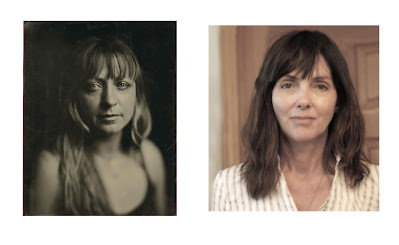 |
Anne Kelly, Gallery Director at photo-eye (Credit: Dave Hyams) & Beth Moon
|
Anne Kelly, Gallery Director (AK): Your mission to photograph the oldest trees in the world began about 20 years ago. What is the origin story of this exploration, and did you anticipate that it would end up spanning over decades?
Beth Moon (BM): The first ancient tree that I visited was in 1999. I drove about an hour outside of London to a churchyard in Surrey to see this extraordinary yew tree whose presence could be felt throughout the cemetery. But I didn’t return with a photograph. I was so overwhelmed; all I could do was sit in front of the tree and stare in complete amazement.
In time I was able to harness my excitement into taking photographs, but I had no idea that I would continue to do this work 23 years later. Of course, I have been interested in exploring other work though out that time, but I always seem to be pulled back into the realm of trees. Either someone tells me about an amazing tree, or I will read an article. It appears there is no escape!
AK: And why would you want to escape!? Your tree exploration has taken you to many places, including Africa, a few times. The most recent trip was a “pilgrimage to visit a tree” that you had photographed in the past, that was in the process of tumbling. On receiving the information, I get the impression that you made the decision to return as soon as possible and that you made the decision very quickly. It wasn't a matter of if, but when. Is that pretty accurate, and can you expand on that?
BM:I had taken various trips to Botswana, South Africa, and Namibia as the oldest trees are mostly found in the southern hemisphere, and traveled to Madagascar three times.
Yes, when I was told the tree was dying, I knew it would be a matter of a few weeks at most before the entire tree would come down, so I had to act fast. This meant traveling during the rain and cyclone season and that came with its own set of obstacles!
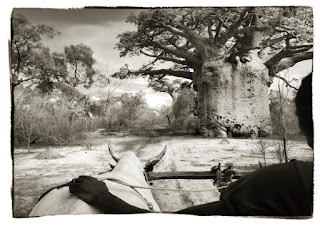 |
| Beth Moon, Zebu cart, NFS |
AK: Like most things that are worth doing, nothing about your voyage was easy – from five days of travel to the storm that you arrived in. The original plan to travel to the Tsitakakoike Tree by car had to be rethought – and you ended up traveling by cart, pulled by large African cattle -- yet, another testament to your dedication. Do you think the modified method of travel change the project?
BM: What at first was seen as a deterrent, actually turned into a positive. Large pools of water were too deep to drive through, but amazing African zebu can traverse the water without difficulty. By taking alternative routes into the forest, we discovered trees of important stature that local villagers had not seen before.
AK: This makes a lot of sense – much like opting to travel on a two-lane highway, as opposed to a superhighway or airplane! What was the most exciting or surprising encounter that you had based on this method of travel?
BM: I’d like to use an excerpt from the book for this.
I have asked the chief for permission to stay overnight in the forest…An unfamiliar sound jolts me from sleep. I sit up in complete darkness and remember my headlamp is still on my forehead. Fear is the length of time it takes my eyes to adjust. A flash of light illuminates a couple of dozen pairs of eyes before me. A surprised herd of zebu, looking for a place to settle down for the night, stares back at me.
The rhythmic sound of snoring zebu nearby lulls me back to sleep.
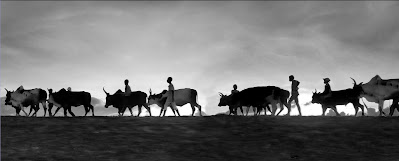 |
| Beth Moon, Zebu panorama study, NFS |
AK: Would you opt for this method of travel again, in the future, even if not necessary?
BM: By surrendering I was able to come to grips with so many things out of my control, and ultimately able to trust spontaneous outcomes. Being forced to slow down and appreciate the view along the way is not only a good metaphor, but a good lesson!
AK: You described seeing the Tsitakakoike Tree in partial collapse as a mix of “astonishment and horror”. I can only imagine what that must have felt like. Was photographing the tree a cathartic experience?
BM: Standing in front of the destruction of this tree, was a life-changing experience in a way that I cannot describe in words. Largely, the project was just about bearing witness.
Upon returning home, I had a mixture of anxiety and grief that consumed me. Directing my energy into the book felt cathartic. Writing the text, organizing information, and sharing images of the trees allowed me to reveal the plight of the trees to others.
AK: I love how the text in the book reads like a journal – and how the text is interspersed between the images. Can you talk about that, and the design of the book as a whole?
BM: On trips like this, I usually write in a journal as a way of keeping track of day-today details. Professor Patrut and his team have been radiocarbon dating the oldest trees for the last decade and through this study, they learned just how fast the ancient baobabs were declining. I thought there was great value in this scientific research, but the information felt dry and clinical. Weaving a story of my personal experience around the data was the reason to make the book, so the journal entries became the backbone.
 |
| Beth Moon with Baobab tree, NFS |
I usually prefer to see images without the clutter of text, but it felt more compelling to intermingle the images around the story, similar to a travel book. I hoped to bring the reader on the journey in this way. Enlarging certain phrases took the place of captions.
To differentiate between the platinum portraits, I hand-colored the travel photos and did not mask the edges, which were also platinum prints. Many of the tree portraits were panoramic and single frames were at a 2:3 ratio. There is always a fine balance between using the highest quality materials while staying within a reasonable retail price. Price also dictates book size, so I was pleased when my editor accepted my 10” x 15” book suggestion that would make the most of this format.
AK: I hear you, pairing text with images can be a challenge, but I think it was the right call in this case – it adds to the experience of viewing the book. The text that you wrote is anything but dry.
Regarding your printing process, it would be great if you could touch on that. I have an affinity for the printing process, however, it is labor-intensive and costly. For you, what keeps your black and white work rooted in this process?
BM: I guess I remain true to my original thought when I first started this series, “a platinum print can last for centuries, drawing on the common theme of time and continuance, pairing photographic subject and process.”
However, I am also making prints with pigment inks of the panoramic images on a large scale to emulate the sheer size of the trees and landscape.
AK: What is next for you?
BM: I never like to talk about new projects because sometimes they don’t gain enough momentum to be fully actualized, but more often the reason is that I usually sit on projects for years before they are finished. Often, I like to look at work months later, hopefully with new insight and inspiration
For example, I was going to the coast for a couple of years photographing ravens, not really thinking this would amount to a series of work, but one day I happen to remember the Norse god Odin, that had two ravens. Odin’s Cove! That element spoke, not only of the birds but the beautiful coast where they lived and it formed a structure to bind all the elements together. I continued to photograph the birds with a larger focus.
AK: And lastly, sweet or salty? What is your favorite dish from all the places you’ve traveled?
BM: I should probably point out that most of the places I go are not known for their culinary expertise. However, having fresh fish from the Arabian Sea cooked on an open fire in the Frankincense Forest does stand out in my memory. My guide was also able to make flat bread baked on a hot stone, drizzled with honey and strong Mokha coffee. All of this with two pots!
• • • • •
Print costs are current up to the time of posting and are subject to change.
photo-eye Gallery is proud to represent Beth Moon.
For more information, and to purchase prints by Beth Moon, please contact Gallery Director Anne Kelly or Gallery Assistant Delaney Hoffman, or you may also call us at 505-988-5152 x202


