PHOTOBOOK REVIEWS, INTERVIEWS AND WRITE-UPS
ALONG WITH THE LATEST PHOTO-EYE NEWS

Social Media

Showing posts with label Datz Press. Show all posts
Book Review This Earthen Door By Amanda Marchand & Leah Sobsey Reviewed by Cheryl Van Hooven “Amanda Marchand’s and Leah Sobsey’s This Earthen Door is a creation of stunning beauty and reverence — reverence for Emily Dickinson and her love of flowers and poetry, and, more generally, reverence for the natural world..."

This Earthen Door. By Amanda Marchand 
& Leah Sobsey. 
https://www.photoeye.com/bookstore/citation.cfm?catalog=ZK606
This Earthen Door
By Amanda Marchand & Leah Sobsey
Datz Press, Seoul, Korea, 2024. 128 pp., 8¼x10½".

Amanda Marchand’s and Leah Sobsey’s This Earthen Door is a creation of stunning beauty and reverence — reverence for Emily Dickinson and her love of flowers and poetry, and, more generally, reverence for the natural world.

Using digital scans from a facsimile edition of Dickinson’s mid-19th century herbarium, the original too fragile to be taken from dark storage at Harvard’s Houghton Library, their imaginative reinterpretation of this work is a collaborative synergy of photography, poetry, art, botany and bookmaking.

There are many ways to approach This Earthen Door: as an inventive engagement with Dickinson’s own 66-page herbarium; as an immensely original artists book; as an introduction to the Victorian pastime of botanical pressings; as a reevaluation and further resurrection of the feminine in early photography; and, most assuredly, as pure visual pleasure — but all the while noting the underpinnings of conceptual depth and breadth that carry Marchand’s and Sobsey’s effort into another realm.

Considering This Earthen Door through the lens of ecofeminism (“a view of the world that respects organic processes, holistic connections and the merits of intuition and collaboration”*), one sees the deep connections between Amanda Marchand’s and Leah Sobsey’s three year immersion into the world of Emily Dickinson’s herbarium with the alchemy of plant emulsions, collaborative research and practice.


Asked about the spark that led to This Earthen Door, Marchand and Sobsey said they had long wanted to collaborate on a feminist project, and in their discussions during the Covid pandemic, together arrived on Emily Dickinson’s herbarium. With a background in literature, Marchand said she was interested in bringing the literary world, specifically poetry, into her artwork. Sobsey, on the other hand, has had a long and rich history working with archives, and this Dickinson archive seemed a natural choice for her.

Referencing mid-19th century photography, Marchand and Sobsey used the historic anthotype process of applying plant-based extracts to paper and then exposing that paper to sunlight with a photographic negative on top. The resulting images, while beautiful, are fugitive, and after being scanned for prints and reproduction, are now also kept in the dark.


With self-imposed rules and structure, detailed notes and charts, and partnering with experts in both botany and Dickinson herbarium studies, Marchand’s and Sobsey’s methodology and documentation mirrored Dickinson’s own rigor of method, which had elevated her herbarium to scientific research, botany, affording one of the few avenues of scientific study open to American Victorian women.

Determined to stay as close to the flowers in Dickinson’s botanical work as possible, they chose 66 specimens of the over 400 in the original herbarium, one for each of Dickinson’s 66 pages.

Marchand and Sobsey grew most of their own flowers and plants or collected them on walks just as the poet did, choosing plants in Dickinson’s herbarium that were crossovers to their own gardens in Quebec and North Carolina. It was those flowers that provided the plant-based emulsions used in the anthotypes and chromotaxia, their color taxonomy.


This Earthen Door
is a gorgeous book whose every element is considered for beauty and knowledge. Upon opening the book’s cover, the reader encounters 13 separate and brilliantly colored pages washed with plant pigment emulsions, ready-for-exposure. Younghea Kim, Datz designer, and Sangyon Joo, Director, suggested putting each color sheet on its own unique paper stock whose somewhat raspy and unforgettable tactility is carried in finger memory as one reaches the smooth interior pages. Even as I type this, I remember the surprise of the papers’ textures on my fingertips.

Following the full color pages are the 66 stunning color plates of the anthotype interpretations of Dickinson’s herbarium, some of which bear notations in Dickinson’s own hand. To say they are vibrant and alive and seductive is to understate their impact. The plates not only carry the reproductions of flowers but are themselves composed of organic matter.

Literally bookending the plates, eleven additional full color pages appear at the back, adding to one’s retinal memory long after the cover is closed.


Inserted within This Earthen Door is another pleasure, Bloom – is Result, a second smaller booklet generously sharing process information, the anthotype timing chart, a color wheel and the description of additional work done during the Datz Museum of Art residency. As one more gift to the reader, there is a small piece of handmade paper embedded with wildflower seeds to plant with Dickinson’s poem, ‘To make a prairie’.

The Korean translations interspersed throughout speak both to Emily Dickinson’s international following and respect for Hangul, the beautifully graphic writing system of the publisher’s home country.

Ghost Flowers, an essay by Dickinson scholar, Marta Werner, underscores the poetry of time travel in this conversation between Amanda Marchand, Leah Sobsey. “Are they images of the herbarium’s lost memories of the vernal earth of more than a century ago? Or are they after-images from the herbarium’s dream of a world to come. . .”


Throughout much of human history, women have carried the herbal knowledge of a culture or community, and despite being denied access into most of academe and scientific societies, brilliant and intrepid Victorian women found ways to research and practice in scientific fields, eventually gaining the acknowledgment and respect of their colleagues.

Marchand and Sobsey, in their research and investigations, came upon Mary Somerville, a Scottish polymath for whom the designation ‘scientist’ was created. There is some dispute as to whether she or her colleague John Herschel was the first to discover the use of vegetable matter in creating photographs through the anthotype process, but there is no doubt that she was part of the flourishing and exciting early discoveries within photography during themid-19th century. At the same time, Anna Atkins, having learned the cyanotype process from Herschel made her celebrated seaweed photograms and is the first person to publish a book with photographic images. Although Atkins, Somerville, and Herschel were contemporaries of Dickinson, it’s unknown whether she knew of their work, but she, too, through the study of botany made her way into scientific exploration.


As creative descendants of Atkins and Somerville, Amanda Marchand and Leah Sobsey are of the lineage of women artists working with nature and photography in an alchemical vein, and it’s more than fitting that their ravishing book is inspired by and pays homage to the proto-ecofeminist Emily Dickinson.

Purchase Book

*Britannica


Cheryl Van Hooven is a photographer and writer based in New York and often working in the California Mojave Desert. Her work has been exhibited internationally and is in the collections of the Brooklyn Museum, the New York Public Library, Miriam and Ira D. Wallach Division of Art, Prints & Photographs, Imagery Estate Winery Permanent Collection at Sonoma State University, among others. She is currently working on a photo/text book.

Book Review Yesterday Photographs by Sal Taylor Kydd Reviewed by Christopher J Johnson "I get a lot of kitsch. I also have a horror of nepotism. Nothing should be gotten through the who-you-know; that’s how culture declines, in my opinion. Why is this relevant? I get sent a lot of kitsch, but my mania doesn’t let me keep any of it — well, almost any of it..."
https://www.photoeye.com/bookstore/citation.cfm?catalog=ZJ865
Yesterday
Photographs by Sal Taylor Kydd

Datz Press, South Korea, 2021. 56 pp.

I get a lot of kitsch. I also have a horror of nepotism. Nothing should be gotten through the who-you-know; that’s how culture declines, in my opinion. Why is this relevant? I get sent a lot of kitsch, but my mania doesn’t let me keep any of it — well, almost any of it.

When I first ordered a Sal Taylor Kydd book for the store about two years ago now, I had no idea who she was or what the work was like or how she had progressed as an artist. The first box of books I received from her had a postcard, not a print, a simple postcard of a work by her entitled, Lola in the Ferns. This was probably my 25th, 50th, or 100th postcard of the year baring an inscription to me on the back that says something like “thanks for stocking my book,” or “What a thrill to have my book in your store.” Such are the comments of these cards… Sal’s says something like that, but it’s not the words that have stuck with me — rather, it’s that singular image, Lola in the Ferns…

“Lola” is a girl of about 7-12 years of age. I can no longer tell how old people are outside of a ballpark. They are simply older than me, younger than me, around my age and beyond that it’s half-decade blocks when I try to approximate an age… Her face is downcast, she parts her hair which is inextricably tangled with some fern leaves… I am not drawn to images of children, though many of my favorite photographers have been compelled to capture them, usually their own: Raymond Meeks, Ralph Eugene Meatyard, Romualdas Rakauskas — to name a few solely within the vast regions of R… But, what I am drawn to in those images is that they seem to be situated somewhere between the daily and the realm of dream, resting in the subconscious as indistinguishable one from the another. Lola in the Ferns is just this, a work as applicable to the realm of dream as it is to the realm of memory, the one resting its hand in the other so that there are no boarders between what has been experienced in waking and what has been experienced in dream, either possibility is equally likely.


And this is what has stuck with me about Kydd’s work. It’s what I see evolving in her work. The line where what is and what has been imagined (dreamed, daydreamed, fevered-out) blend together, disintegrating even the idea of the primacy of one over the other.

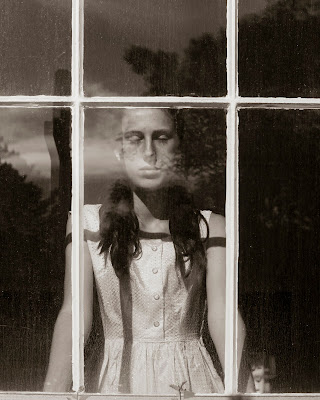
So, typical of me, I have now gotten to the fifth paragraph and have yet to mention a book and this is, after all, a book review. Yesterday, Kydd’s most recent book, is a document of the lockdown. A book of isolation in a time-period dominated by isolation. There’s been so many of these and, in retrospect, the sense of isolation is — I think — what spoke to many of us from the pages of Meeks’ ciprian honey cathedral in 2020. Isolation is, in its very nature, dream-like; it is asphyxiate, homogeneous, spacious, but tightly enclosed… Isolation has a poverty of actors. All of this is contained in Yesterday, which chronicles Kydd’s time with — of all the possible cast members — Lola, of course. Lola sitting by herself. Lola looking through the window. Lola standing in the yard, viewing something far off and out of frame… perhaps staring through the tree-line at another isolated pair of eyes, staring back at her… And the images are spacious, inky, over-exposed, tightly framed and, at times, mysteriously Modern… as in the image entitled, Watching Pins or the one called Spaces.

What Kydd has successfully created here, to my mind, is a fixed point. A unchanging and timeless time. A time capsule, even, of the pandemic. But, not in its anxiousness and jarringness, this is not the pandemic of radio buttons and phone scroll throughs and fear… This is the pandemic of slow hours and uncertain waiting. The Pandemic of empty roads. The Pandemic of being startled to hear voices in the dark. The Pandemic of permissive travel notes, that we have printed and resting on the passenger seat, but never think we’ll be called on to use because to interact would be stranger than not to interact. It is the Pandemic of birds in surplus and Nature’s reclamation.


Yesterday
is an achievement. It shows us Kydd evolving in her book form. There is a master narrative here, though its something more like Walden than Death on the Installment Plan. The narrative ambles, rather than lurches; it whispers... It is a work of tranquility. A work of silences and deep, unhurried breaths. Yesterday is a set of dream-view goggles to transpose upon your waking eyes. It is, as the narrative itself suggests (you’ll just have to get your hands on one) a window.

Some collector specs: Yesterday is a Datz book, which means it was printed in Korea. It contains a signed and numbered print and an acetate dust jacket with a beautifully printed image as the front matter, as well as an embossed back cover. My own copy is # “review” of 200. That’s a joke. But a true, and beloved joke. But, this edition is in a print run of 200 total — minus those, like mine, review copies. Meaning if you can snag a copy, you should do so — right now, because tomorrow Yesterday will be gone.

Purchase Book

Read More Book Reviews


Christopher J Johnson is the recipient of The Mountains West Poetry Series first book publication prize (2016). He has written on photobooks since 2012, and has been a bookseller since 2008. He is currently manager of photo-eye Bookstore.
Book Review Good Pictures Text by Kim Beil Reviewed by Brian Arnold "Most histories of photography focus on the work of individual photographers and the fine art of the medium. When they address technology, it is mostly to discuss the major changes that caused seismic shifts, like the development of wet plate or the Kodak Brownie. The bulk of the field, however, is much more commercial and pedestrian than these histories reflect..."

Good Pictures. By Kim Beil.
https://www.photoeye.com/bookstore/citation.cfm?catalog=IG030
Good Pictures
A History of Popular Photography
Text by Kim Beil


Stanford University Press, Stanford, 2020. 336 pp., 7½x9x1".

“All pictures do cultural work and can allow insight into the concerns of their makers and viewers. Through their makers’ aesthetic choices, photographs indicate not only that they are ‘good pictures’ but that they are good pictures according to the rules of a specific time and place. Photographs reveal their allegiance to particular social groups through the formal decisions they exhibit...” — Kim Beil

In his influential history and guidebook from the 1970s, The Keepers of Light, author William Crawford begins his text by defining photographic syntax. If syntax is the rules of language that help give it shape and create meaning — the rules of sentence and paragraph structure — then photographic syntax, Crawford argues, is developed by the technologies and processes that we use to create pictures, the essential parameters of visual meaning.

Most histories of photography focus on the work of individual photographers and the fine art of the medium. When they address technology, it is mostly to discuss the major changes that caused seismic shifts, like the development of wet plate or the Kodak Brownie. The bulk of the field, however, is much more commercial and pedestrian than these histories reflect. The new book by Kim Beil, an art historian at Stanford University, Good Pictures: A History of Popular Photography, addresses the popular development of photography, and traces the technological advancement of the medium through its commercialized discourse. She emphasizes the much more common uses of the medium, and thus the development of more vernacular uses of photography. In doing so, she shows the subtle and remarkable evolution of the medium since its inception, and provides an insight attuned to Crawford’s discussion on photographic syntax, looking at how photographic technologies, codes, and styles have developed with the advancement of the medium.


Beil’s book is divided into six sections, each representing decades of photographic history, and these sections are further divided into short chapters. The topics detailed include technical innovations and trends that took hold during the times outlined in the sections. Such topics include the tools required for a daguerreotype portrait studio, the development of magnesium flash, soft-focus, the Rembrandt effect, ruin porn, drone photography, and the prevalence of digital filters today. Each of the chapters can be read independently, as an essay describing the particular innovation or trend discussed — the book even includes prompts encouraging the reader to jump between related chapters, rather than reading it from beginning to end — but, collectively, they offer a greater understanding of the popular development of amateur and commercial photography from the beginning of the medium to the present day.

There are parts of Beil’s history that are well researched and documented elsewhere (the popularity of gum printing and pictorialist photography, for instance) but nevertheless, she discusses photographic innovations and trends I knew little about (the story of Jacob Riis burning down a building with flash powder, for example. I knew little about the development of magnesium flash). There are other topics, too, that she discusses from a new perspective; the chapters on modernist composition show how photographers like Weston and Maholy-Nagy influenced popular and amateur photography texts and trends.


Beil’s research comes from unlikely sources. Histories of photography typically document important collections, but Beil instead quotes popular magazines and how-to books. Looking at her sources for reproductions also reveals a great deal about her intentions and perspective; she includes pictures from books marketed toward “weekend” photographers produced by Kodak, Instagram accounts, Gourmet magazine, Magnum Photo, Hollywood headshots, the Metropolitan Museum of Art, and Popular Photography. Together, these point to a broader and more pedestrian history — and thus perhaps more accessible and democratic — than those that have created and defined the photographic canon.

I’ve been teaching photography since 1999, and have seen many trends come and go (cross-processing and HDR were especially popular) and some that never seem to go out of fashion (ruin porn, specifically dilapidated barns). The collective study of these techniques and trends, however, reveal how photography took root and became the all-pervasive medium we know today. Perhaps more importantly, thinking back to Crawford’s idea about photographic syntax, in reading Beil’s book we can see how technologies and fashion evolved into new vocabularies and help create and influence how we make meaning for visual and photographic experiences.

Purchase Book

Read More Book Reviews


Brian Arnold
is a photographer and writer based in Ithaca, NY, where he works as an Indonesian language translator for the Southeast Asia Program at Cornell University. He has published two books on photography, Alternate Processes in Photography: Technique, History, and Creative Potential (Oxford University Press, 2017) and Identity Crisis: Reflections on Public and Private and Life in Contemporary Javanese Photography (Afterhours Books/Johnson Museum of Art, 2017). Brian has two more books due for release in 2021, A History of Photography in Indonesia: Essays on Photography from the Colonial Era to the Digital Age (Afterhours Books) and From Out of Darkness (Catfish Books).
Book Review Nothing Will Ever be the Same Again Photographs by Amanda Marchand Reviewed by Brian Arnold "Amanda Marchand’s photobook, Nothing Will Ever Be the Same Again, unapologetically embraces photography’s proclivity for sentimentality. The work is tempered by a deep longing, subtle visual poetics, and a feeling of detachment as we watch time pass through the camera..."

By Amanda Marchand.
https://www.photoeye.com/bookstore/citation.cfm?catalog=ZJ081
Nothing Will Ever be the Same Again
Photographs by Amanda Marchand

Datz Press, Seoul, 2019. 84 pp., 11½x9¾".

“Three windows in an old schoolhouse. 
Four, if you count the camera as a window too.” 

— Amanda Marchand 

Sentimentality is an inherent attribute of photography. By depending of impressions based on prior experiences, photography allows (maybe even encourages) a nostalgic and romanticized view of our personal and shared histories. This sentimental nature can be either an asset or a trap. When looking back at the work of Clarence White or Heinrich Kühn, it is easy to dismiss them as excessively romantic and saccharine. And yet even relentless, aggressive photographers like Lee Friedlander and Garry Winogrand have sentimental streaks.

Amanda Marchand’s photobook, Nothing Will Ever Be the Same Again, unapologetically embraces photography’s proclivity for sentimentality. The work is tempered by a deep longing, subtle visual poetics, and a feeling of detachment as we watch time pass through the camera. Marchand, a Canadian photographer, made the pictures in Nothing Will Ever Be the Same Again over just a few months. The photographs are all of just three windows in an old schoolhouse in Finland, made deep in winter when the days are short and the light rich, but elusive.


Designed and printed by Datz Press in Seoul, South Korea, the book is beautifully conceived. Printed in a small edition, Nothing Will Ever Be the Same Again is produced with great care and sensitivity, helping to substantiate the poetic and romantic narrative in Marchand’s pictures. The book begins with the dust jacket; removing the jacket and seeing its underside reveals what at first glance appears as free-verse poetry, each line offering short impressions on the passage of time. A closer look, however, reveals that interspersed within the lines of verse are small, light grey squares. As you enter the book, it becomes clear that these grey squares map out the pictures spread across the pages of the book, and the poem is really a list of titles or descriptions of the photographs.

This design strategy, keeping some of the content and intent of the book hidden from view, perfectly describes and anticipates the pictures found inside. All of Marchand’s pictures feel like something is hidden, like what she really photographed is an internal landscape, rather than the one described by the camera. She invites the viewer into a romantic, nostalgic reverie in which we watch time evaporate, leaving us longing for something much more concrete. Marchand asks the viewer to look beyond the pictures, to recognize that the gestures and feelings driving the photographs offer the real substance of the book.

By focusing on windows, Marchand has chosen an obvious metaphor, but again, the design and photographic strategies help elevate the book beyond simple cliches. The page spreads are staggered, some with a single photograph of a window printed full-page, others with 6 or more pictures interspersed across the spread. Some are gatefolds that open to show much larger spreads of pictures, and still others where photographs hinged and floating on the surface of the paper with little bits of words and secrets printed beneath. At times the pictures look at the world beyond the windows, at other times the way the windows refract light on the interior walls. The combined effect is two-fold; each spread feels like a contained passage of verse or a poem itself, and yet, collectively, they render a broader passage of time, sustaining a more complex narrative about photography and personal experience.

True to its title, each copy of Nothing Will Ever Be the Same is unique. One page towards the back of the book has a print tipped in, and no two of these are the same. Limited to just 300 copies, reading Nothing Will Ever Be the Same feels like an intimate experience.

Purchase Book

Read More Book Reviews


Brian Arnold
is a photographer and writer based in Ithaca, NY, where he works as an Indonesian language translator for the Southeast Asia Program at Cornell University. He has published two books on photography, Alternate Processes in Photography: Technique, History, and Creative Potential (Oxford University Press, 2017) and Identity Crisis: Reflections on Public and Private and Life in Contemporary Javanese Photography (Afterhours Books/Johnson Museum of Art, 2017). Brian has two more books due for release in 2021, A History of Photography in Indonesia: Essays on Photography from the Colonial Era to the Digital Age (Afterhours Books) and From Out of Darkness (Catfish Books).