PHOTOBOOK REVIEWS, INTERVIEWS AND WRITE-UPS
ALONG WITH THE LATEST PHOTO-EYE NEWS

Social Media

Showing posts with label Amanda Marchand. Show all posts
Book Review This Earthen Door By Amanda Marchand & Leah Sobsey Reviewed by Cheryl Van Hooven “Amanda Marchand’s and Leah Sobsey’s This Earthen Door is a creation of stunning beauty and reverence — reverence for Emily Dickinson and her love of flowers and poetry, and, more generally, reverence for the natural world..."

This Earthen DoorBy Amanda Marchand 
& Leah Sobsey. 
https://www.photoeye.com/bookstore/citation.cfm?catalog=ZK606
This Earthen Door
By Amanda Marchand & Leah Sobsey
Datz Press, Seoul, Korea, 2024. 128 pp., 8¼x10½".

Amanda Marchand’s and Leah Sobsey’s This Earthen Door is a creation of stunning beauty and reverence — reverence for Emily Dickinson and her love of flowers and poetry, and, more generally, reverence for the natural world.

Using digital scans from a facsimile edition of Dickinson’s mid-19th century herbarium, the original too fragile to be taken from dark storage at Harvard’s Houghton Library, their imaginative reinterpretation of this work is a collaborative synergy of photography, poetry, art, botany and bookmaking.

There are many ways to approach This Earthen Door: as an inventive engagement with Dickinson’s own 66-page herbarium; as an immensely original artists book; as an introduction to the Victorian pastime of botanical pressings; as a reevaluation and further resurrection of the feminine in early photography; and, most assuredly, as pure visual pleasure — but all the while noting the underpinnings of conceptual depth and breadth that carry Marchand’s and Sobsey’s effort into another realm.

Considering This Earthen Door through the lens of ecofeminism (“a view of the world that respects organic processes, holistic connections and the merits of intuition and collaboration”*), one sees the deep connections between Amanda Marchand’s and Leah Sobsey’s three year immersion into the world of Emily Dickinson’s herbarium with the alchemy of plant emulsions, collaborative research and practice.


Asked about the spark that led to This Earthen Door, Marchand and Sobsey said they had long wanted to collaborate on a feminist project, and in their discussions during the Covid pandemic, together arrived on Emily Dickinson’s herbarium. With a background in literature, Marchand said she was interested in bringing the literary world, specifically poetry, into her artwork. Sobsey, on the other hand, has had a long and rich history working with archives, and this Dickinson archive seemed a natural choice for her.

Referencing mid-19th century photography, Marchand and Sobsey used the historic anthotype process of applying plant-based extracts to paper and then exposing that paper to sunlight with a photographic negative on top. The resulting images, while beautiful, are fugitive, and after being scanned for prints and reproduction, are now also kept in the dark.


With self-imposed rules and structure, detailed notes and charts, and partnering with experts in both botany and Dickinson herbarium studies, Marchand’s and Sobsey’s methodology and documentation mirrored Dickinson’s own rigor of method, which had elevated her herbarium to scientific research, botany, affording one of the few avenues of scientific study open to American Victorian women.

Determined to stay as close to the flowers in Dickinson’s botanical work as possible, they chose 66 specimens of the over 400 in the original herbarium, one for each of Dickinson’s 66 pages.

Marchand and Sobsey grew most of their own flowers and plants or collected them on walks just as the poet did, choosing plants in Dickinson’s herbarium that were crossovers to their own gardens in Quebec and North Carolina. It was those flowers that provided the plant-based emulsions used in the anthotypes and chromotaxia, their color taxonomy.


This Earthen Door
is a gorgeous book whose every element is considered for beauty and knowledge. Upon opening the book’s cover, the reader encounters 13 separate and brilliantly colored pages washed with plant pigment emulsions, ready-for-exposure. Younghea Kim, Datz designer, and Sangyon Joo, Director, suggested putting each color sheet on its own unique paper stock whose somewhat raspy and unforgettable tactility is carried in finger memory as one reaches the smooth interior pages. Even as I type this, I remember the surprise of the papers’ textures on my fingertips.

Following the full color pages are the 66 stunning color plates of the anthotype interpretations of Dickinson’s herbarium, some of which bear notations in Dickinson’s own hand. To say they are vibrant and alive and seductive is to understate their impact. The plates not only carry the reproductions of flowers but are themselves composed of organic matter.

Literally bookending the plates, eleven additional full color pages appear at the back, adding to one’s retinal memory long after the cover is closed.


Inserted within This Earthen Door is another pleasure, Bloom – is Result, a second smaller booklet generously sharing process information, the anthotype timing chart, a color wheel and the description of additional work done during the Datz Museum of Art residency. As one more gift to the reader, there is a small piece of handmade paper embedded with wildflower seeds to plant with Dickinson’s poem, ‘To make a prairie’.

The Korean translations interspersed throughout speak both to Emily Dickinson’s international following and respect for Hangul, the beautifully graphic writing system of the publisher’s home country.

Ghost Flowers, an essay by Dickinson scholar, Marta Werner, underscores the poetry of time travel in this conversation between Amanda Marchand, Leah Sobsey. “Are they images of the herbarium’s lost memories of the vernal earth of more than a century ago? Or are they after-images from the herbarium’s dream of a world to come. . .”


Throughout much of human history, women have carried the herbal knowledge of a culture or community, and despite being denied access into most of academe and scientific societies, brilliant and intrepid Victorian women found ways to research and practice in scientific fields, eventually gaining the acknowledgment and respect of their colleagues.

Marchand and Sobsey, in their research and investigations, came upon Mary Somerville, a Scottish polymath for whom the designation ‘scientist’ was created. There is some dispute as to whether she or her colleague John Herschel was the first to discover the use of vegetable matter in creating photographs through the anthotype process, but there is no doubt that she was part of the flourishing and exciting early discoveries within photography during themid-19th century. At the same time, Anna Atkins, having learned the cyanotype process from Herschel made her celebrated seaweed photograms and is the first person to publish a book with photographic images. Although Atkins, Somerville, and Herschel were contemporaries of Dickinson, it’s unknown whether she knew of their work, but she, too, through the study of botany made her way into scientific exploration.


As creative descendants of Atkins and Somerville, Amanda Marchand and Leah Sobsey are of the lineage of women artists working with nature and photography in an alchemical vein, and it’s more than fitting that their ravishing book is inspired by and pays homage to the proto-ecofeminist Emily Dickinson.

Purchase Book

*Britannica


Cheryl Van Hooven is a photographer and writer based in New York and often working in the California Mojave Desert. Her work has been exhibited internationally and is in the collections of the Brooklyn Museum, the New York Public Library, Miriam and Ira D. Wallach Division of Art, Prints & Photographs, Imagery Estate Winery Permanent Collection at Sonoma State University, among others. She is currently working on a photo/text book.
photo-eye Gallery From the Flat Files: Jovi Esquivel photo-eye presents a collection of spring-themed photographs that capture the essence of the season in their own unique way, highlighting the beauty and fragility of nature, the promise of new beginnings, and the wonder and magic of the world around us.

Cig Harvey, Bougainvillea, Bequia, 2019, Archival Pigment Print, 16x20", Edition of 10, $3,000 

Spring is a season that fills us with hope and promise. As the earth awakens from its winter slumber, nature bursts forth with new life, reminding us that even in the darkest of times, there is always the possibility of renewal. It's a time when we are reminded of the power of change and the resilience of the natural world. This week, we'll explore stunning photographs from artists Cig Harvey, Chaco Terada, Tom Chambers, Kate Breakey, and Thomas Jackson, to name a few, that capture the essence of spring and its message of hope and renewal. From delicate blossoms to vibrant landscapes, these images are a celebration of the beauty and wonder of the world around us. So let's dive in and immerse ourselves in the colors, textures, and emotions of this incredible season. 


Chaco Terada, Sakura Front 4, Sumi & Pigment Ink on Silk, 9.5x11", Unique Print, $4,200 


Tom Chambers, Tea for Two, 2018, Archival Pigment Print, 32x18, Edition of 20, $1,850


Maggie Taylor, Golden Hour, 2019, Archival Pigment Print, 8x8", Edition of 15, $1,700


Ben Depp, Mayflies, 2021, Archival Pigment Print, 22.5x30", Edition of 10, $2,000


Walter Plotnick, Love Birds, Silver Halide Print, 16x20", Edition of 15, $1,950


Zoë Zimmerman, Quarantine #60 (Day #76), Archival Pigment Print, 20x16", Edition of 24, $1,200


Kate Breakey, Tulip Bud, Archival Pigment Ink on Glass & 24kt Gold Leaf, 8x6", Edition of 20, $1,200


Hiroshi Watanabe, TDTDC 39 (Purple Tree), 2011, Archival Pigment Ink, 9x9", Edition of 5, $1,800


Amanda Marchand, Hart's Tongue (Kodak Polyfiber FD), 2020, Unique Archival Pigment Prints, 18x15", Edition of 3, POR


Thomas Jackson, Tulle no.34_v1, Ocracoke Island, North Carolina, 2021, Archival Pigment Print, 20x25", Edition of 4, $2,500


Print costs are current up to the time of posting and are subject to change.


*      *      *


If you are in Santa Fe, please stop by during gallery hours or schedule a visit HERE.

For more information, and to reserve one of these unique works, please contact
Gallery Director Anne Kelly or Gallery Assistant Jovi Esquivel

You may also call us at (505) 988-5152 X202

photo-eye Gallery

1300 Rufina Circle, Unit A3, Santa Fe, NM 87507
Tuesday– Saturday, from 10am– 5:30pm
photo-eye Gallery Celebrating 2022: photo-eye Gallery Highlights! photo-eye Gallery As the year comes to a close, our gallery staff is reflecting on some of our favorite artworks and highlights from 2022— work that has brought us beauty, inspiration and solace.

Chaco Terada, Little Fox, Sumi Ink on Silk, 10x7.5", Unique print, $1800 

Greetings! 

It's hard to believe that this year is ending, I think about the time in my life when "time" felt eternal. Now, as each year passes, I find myself working harder to hang onto the threads of each passing day. 

I started at photo-eye Gallery six months ago, and while I've been fortunate to have worked with photographs most of my career, it has been a joy to have the opportunity to collaborate with our artists — I admire each of them for their exceptional ability to capture a sense of reality shaped by their perspective eye and mind. So much beautiful work has come to us this past year and I'm excited to share new work by artists Beth Moon, Vanessa Marsh, and Maggie Taylor in the new year — I will also be introducing a few new artists. 

As the year comes to a close, our gallery staff is reflecting on some of our favorite artworks and highlights from 2022. The year began with an exhibition of Linda Connor and Pentti Sammallahti's work, a photo-eye Conversation between Anne Kelly and Brad Wilson, and an online exhibition of Beth Moon's portfolio of Baobabs. Spring and Summer brought us the beautiful exhibition of Platinum Florals by Beth Moon and James Pitts, new portfolios from Zoë Zimmerman, Siri Kaur, Tony Chirinos, and Keith Carter, Reuben Wu was featured on the cover of the August issue of National Geographic, and the exhibition Internal Logic by Maggie Taylor. In the Fall, Chaco Terada and David H. Gibson made their annual visit, giving gallery staff a day full of new work to admire. In this blog, you'll find work that has brought us beauty, inspiration and solace that range from interviews with artists to photographs, and exhibitions. 


We hope you enjoy viewing our selections and are looking forward to what the next year brings.

Wishing you all a happy and healthy end to the year! 


Beth Moon, Ankoabe Forest, Platinum Print, 22x36", Edition of 5, $7,000


Tom Chambers, Marsh Flight, Archival Pigment Print, 20x20", Edition of 20, $1200 


Zoë Zimmerman, Quarantine #14 (Day #18), Archival Pigment Print, 20x16", Edition of 24, $1200


David Trautrimas, Night Sweats, Archival Pigment Print, 9x13", Edition of 5, $900


Keith Carter, Starry Night, Archival Pigment Print, 16x16" Edition of 25, $1600


Left to right: Mitch Dobrowner, Shiprock Storm; Mark Klett, Moonset with Venus; Edward Bateman, Antelope Island No. 766

Over the summer, Gallery Director Anne Kelly asked photo-eye Gallery artists for their thoughts on the belief that "Turmoil is necessary for an artistic Practice." Mark Klett, Mitch Dobrowner, and Edward Bateman share in Part One, and in Part Two Amanda Marchand and David Trautrimas chime in.   


photo-eye Gallery is proud to represent all of the artists in this article.


Print costs are current up to the time of posting and are subject to change.


For more information, and to reserve one of these unique, extraordinary works, 
please contact photo-eye Gallery Director Anne Kelly or Gallery Associate Jovi Esquivel.


photo-eye Gallery

1300 Rufina Circle, Unit A3, Santa Fe, NM 87507
Tuesday– Saturday, from 10am– 5:30pm

You may also call us at (505) 988– 5152 x202


  photo-eye Gallery   Creativity and Turmoil, Part 2    Anne Kelly, Amanda Marchand, David Trautrimas       Is turmoil fuel for an artistic process?


Throughout history, people have suffered physically, emotionally, and spiritually during pandemic and quarantine, and through these shifts, many great works of art have been made. Recently, Gallery Director Anne Kelly asked a few photo-eye Gallery artists their thoughts on the belief that having a little turmoil can be used as fuel in the artistic process. 


In part two of this series, we hear from artists Amanda Marchand and David Trautrimas.  


Amanda Marchand

“Death cannot harm me more than you have harmed me, my beloved life.”  
                                                                                            — Louise Gluck
We’ve grown to accept the myth of the “suffering artist,” Van Gogh who cuts off an ear, the young Francesca Woodman who jumps from a window at 22, and Kurt Kobain, as a trade-off for “great” works of art. This question of having “a little turmoil” as fuel is universally accepted. While there are many examples of artists past and present who suffer for art’s sake, I think this idea does a disservice to creatives today. The artists I know are all wearers of many hats — and emotions. They are generally incredibly hard workers who have their act together and create from a place of pain as well as contemplation, curiosity, passion, joy, humor, intelligence, compassion, and intuition. If creatives feel life’s intensity to a greater degree and work from that place, I think it’s likely that they’ve simply given themselves the space and time to feel.

Right now, 2.5 years into a global Pandemic, with massive inflation, various democracies on the brink, women’s universal rights denied now even in the U.S., and glaring racial inequity, we are at a pretty intense point in history. For me, making art is utterly personal, intuitive, experimental, and from the heart, but taps into societal undercurrents. My work has always come out of an emotional register first, before anything, compelling me to create (photograph, edit, write, tape, cut, sew…). Sometimes I am working from a place of deep calm and contentment. I have been exploring breath and meditation as a creative path for the past few years. But the path of creation contains galaxies. So yes, drawing on a range of sources and emotions, “a little turmoil’ also fuels my practice, though I would never seek it out.

An upheaval or shock, a difficult truth, can be a galvanizing force: My mother’s terminal cancer, for instance, propelled me to make a body of work in her garden at night. The harrowing fact that we are losing 150 species a day on the earth, set in motion a project I am working on, a contemporary Field Guide to endangered birds, ferns, and flowers. Similarly, Trump’s inauguration, causing such radical divisiveness and upheaval, revealing a new world, gave way to a new way of working photographically for me — abandoning the camera to work camera-less. And again, the sudden pandemic generated 2 pandemic projects (still in progress), and then a third isolation-born long-distance collaboration, all a response to the heightened urgency and alarm we’ve been collectively experiencing.

As I spend more time making art, I see the importance of balance, nurture, self-care, and slowing down, as being simple but radical acts. I use art/photography and its many processes as a tool to —counter turmoil— in its various forms. What is so important and incredible about art, and throughout history, the way humans are drawn to it, is that it can be a register through which we synthesize, understand, or emote, pain, longing, beauty, loss, fear, and love. It’s a channel. Turmoil may go into the funnel or it may not, but something entirely different and often extraordinary will come out on the other side.

Amanda Marchand, Henslow's Sparrow, Unique archival pigment print, 2020, 18x15", Edition of 3.

As part of our video series photo-eye Conversations, Gallery Director Anne Kelly interviewed Marchand. They discussed her photographic practice, the process of creating The World is Astonishing With You In It, and other bodies of work, like The Lumen Circle Project. Watch this enlightening conversation in the link below. 


Portrait of artist Amanda Marchand
Amanda Marchand is an award-winning, Canadian, New York-based photographer. Her work explores the natural world with an experimental approach to photography. 
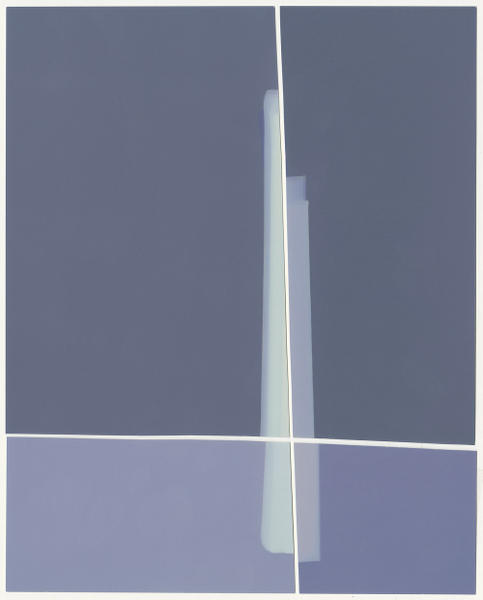
Recently, Marchand has been working with an unpredictable, camera-less process also known as sun-prints or photograms. Each particular paper brand, photo finish, and paper type, combined with different exposures, produces a spectrum of colors. Because the lumen colors are fugitive, the exposed papers act as negatives which are fixed by scanning, although they also continue to change color/darken due to the light of the scanner. 

Marchand began this work by using objects and ephemera from her studio as the tools to block light— starting with utilitarian photo boxes and envelopes; then moving to reference books and artist monographs -- as visual cues. She approached each exposure as a measure of time, a meditation; in turn, the exposed papers are then cut and re-assembled into collages of multiple panels. The fundamentals of this fugitive process are an important point of departure from the documentary qualities of camera-based photography and mark an embrace of a materials-based approach that combines early photographic methods with new technologies. 


David Trautrimas


If I was asked this question a few years ago I’d find myself on the side of disbelief, convinced that turmoil was a wet blanket tossed onto the fires of creativity. But as they say, the only constant is— change, and like solving for ’X’ in a math equation, context is everything for calculating meaning.

That’s not to say I haven’t endured turmoil prior to the last few years, but to get through those challenges I did everything I could to put a wall between those experiences and my creative pursuits, leaving the latter as a place of escape. That trajectory continued relatively unabated until late 2019…

At the time I was working on a series of new works titled The Fun Never Spoils. The plan was to exhibit these works at the ‘No Name Biennale’, a group exhibition in Hamilton, Canada that playfully undermines high-value art culture by taking its name from a popular Canadian discount food brand. The idea for my contribution to the show was fairly direct: create a still-life of plastic, laser-cut discount foods.

But not long after I began work on this series, Covid-19 started its troubling sweep around the world and everything shifted. In relation to the sourcing and collection of food, grocery store panic shopping took hold. Regular food items became scarce, people started buying in massive quantities and any sense of food security was shaken. Within this context, social isolation became the norm with many aspects of our lives grinding to a halt, and my thinking around my playful 'foodstuff, still-life' completely changed.

Striving to keep a sense of normalcy I found myself still working in the studio on a daily basis, fabricating more and more laser-cut foods. The continued creation of these objects was no longer just about making a playful still-life. They become an anchor point amidst this capricious Covid landscape; an emotional self-portrait that represented my desire for certainty in that time of intense precarity.

That body of work opened the floodgates to embracing turmoil as an engine of creativity. My most recent and ongoing series, Rest Onwards, is a meditation on the traumas I’ve experienced: life-threatening injuries, loss of loved ones, and mental health challenges. In these works I use distorted objects and spaces as stand-ins that carry these injuries, providing a place for these wounds outside of my consuming thoughts. Demonstrating their burden, these stand-ins have been extended, bonded, confined, made redundant, or dangerous. And although the subjects carry a personal meaning they are nearly universally recognizable, providing room for the viewer to relate to the work without requiring the exact narrative of my own experiences.

Going forward I don’t think everything I do creatively will be connected to turmoil, personal or otherwise. But what I’ve learned in the past few years is how to open myself up to its creative potential, allowing space for all manner of plants in the walled garden of my creative space: the weeds with the roses.

David Trautrimas, Night Sweats, 2022, Archival Pigment Print, 9x13", Edition of 5, $900 

A few months ago, Gallery Director Anne Kelly sat down with Trautrimas for a conversation! In this episode of photo-eye conversations, they talk about modernist architecture, materiality, and conceptual flexibility. View the video and learn more about David Trautrimas below!


>> David Trautrimas | photo-eye Conversation <<


Portrait of artist David Trautrimas
David Trautrimas is an artist/photographer/all-around maker hailing from Toronto, Canada. Here at photo-eye, we know David for his series Habitat Machines, wherein the artist dissembled and photographed household items before using these components to digitally create architectural spaces. The importance of space continues to be important in Trautrimas' newest series, which turns the focus inward. Using Cinema 4D and the digital toolbox that comes with it, Trautrimas has spent the pandemic crafting uncanny, entrancing images of his own interior life that resonate across Western culture. 


Print costs are current up to the time of posting and are subject to change.


To learn more about these and other works by Amanda Marchand or David Trautrimas
or to acquire specific prints, 
please contact photo-eye Gallery Director Anne Kelly or Gallery Associate Jovi Esquivel.

1300 Rufina Circle, Unit A3, Santa Fe, NM 87507
Tuesday– Saturday, from 10am– 5:30pm
You may also call us at (505) 988- 5152 x202
photo-eye Gallery Amanda Marchand: Photographer's Showcase + Conversation photo-eye Gallery
photo-eye is excited to welcome Amanda Marchand to the Photographer's Showcase and feature her brilliant series The World is Astonishing with You in it: A 21st Century Field Guide to the Birds, Ferns and Wildflowers.

Northern Goshhawk (Child) (1st generation) (Illford MG V RC deluxe), 2020, unique archival pigment print collage, 22" x 16.5", edition of 3, price upon request

photo-eye is excited to welcome Amanda Marchand to the Photographer's Showcase and feature her brilliant series The World is Astonishing with You in it: A 21st Century Field Guide to the Birds, Ferns and Wildflowers.
 
In this body of work, Marchand examines the shifting environment through the impermanence of the cameraless lumen process. The suggestive photograms are made using vintage field guides from her library, and each references an endangered species described in the guides. 
 
Recently, as part of our video series photo-eye Conversations, Gallery Director Anne Kelly interviewed Amanda Marchand. They discussed her photographic practice, the process of creating The World is Astonishing with You in it, and other bodies of work, like The Lumen Circle Project. Watch this enlightening conversation below or on Vimeo.


"These are lumen prints from a larger, ongoing series Lumen Notebook. In these sun-prints, I explore ideas about our changing environment through the temporality of photography’s lumen process. These images are all made with expired and current black & white photo papers. This work employs three field guides — North American birds, ferns and wildflowers. I mark/expose the photographic paper, making one mark per quadrant or half, with an edge of the respective Field Guide book. Each photograph references an endangered or disappearing species (bird, fern, wildflower).

I have been making the work in nature, at different residencies, and my family's Canadian cabin, where the birds and ferns and wildflowers abound. This is a personal meditation — as each paper shifts color, slowly or quickly, in the variegated light of the sun."
— Amanda Marchand

The Lumen Circle Project - Work Statement

2017-2020: The Lumen Circle Project comprises an ongoing series of collaborative sun prints, made as a response to turbulent times. I invite collaborators to mark our time together on the planet, as we sit in silent meditation. We sit on photo-sensitive paper and for the duration of the sitting, the sunlight marks the paper leaving a lighter imprint where there is a human form. 
 
The First Lumen Circle at SFAI © Amanda Marchand, 2017

These large-scale images are titled "Lumen" prints, taken from lumen printing, the art of making simple images with the sun and photo paper. Everyone who participates signs the work and is gifted a small print.

Print collage from the Lumen Circle Project © Amanda Marchand

The first Lumen Circle took place on February 4, 2017, in San Francisco. The second Lumen Circle took place March 16, 2017, on Manasota Key, Florida. The third Lumen Circle took place July 2019, in Seoul, Korea.  


Amanda's Marchand Studio: Test Strips


• • • • •


For more information, and to purchase prints, please contact Gallery Director Anne Kelly or Gallery Assistant Patricia Martin, or you may also call us at 505-988-5152 x202