PHOTOBOOK REVIEWS, INTERVIEWS AND WRITE-UPS
ALONG WITH THE LATEST PHOTO-EYE NEWS

Social Media

Showing posts with label Exhibitions. Show all posts
photo-eye Gallery photo-eye Gallery at Virtual Collect + Connect Last Weekend photo-eye Gallery
We had a great time last weekend exhibiting at photo l.a.'s first edition of Virtual Collect + Connect, their first-ever virtual photo fair. We featured a wonderful selection of new and recent work by represented and invited artists, including Maggie Taylor, Reuben Wu, and Jennifer Greenburg.


photo-eye Gallery's 3D booth at Virtual Collect + Connect

We had a great time last weekend exhibiting at photo l.a.'s first edition of Virtual Collect + Connect, their first-ever virtual photo fair. We featured a wonderful selection of new and recent work by represented and invited artists, including Maggie TaylorReuben Wu, and Jennifer Greenburg.  

There were numerous 3D interactive gallery exhibitions and installations, as well as virtual meet-and-greet events and talks. We were excited to host a live conversation between artist Reuben Wu and publisher Kris Graves. They had a chance to discuss the process behind both Reuben Wu's artwork and the books they have collaborated on. photo-eye's gallery director, Anne Kelly, also had a chance to sit down with Steve Fitch and discuss both his creative process and the history behind his extraordinary body of work. Stay tuned to our blog in the next two weeks to watch the conversations!

Did you miss us last weekend? No worries, our 3D booth is still accessible! See the link below:


» Visit our 3D booth at Virtual Collect + Connect 


Exhibiting Artists:


Featured Artwork


Mitch Dobrowner, Lighting Storm and Homestead, 2017, archival pigment print, 15 x 20 inches, edition of 40, $1500


Maggie Taylor, The philosopher's study, 2020, archival pigment print, 8 x 8 inches, edition of 15, $1500

 • • • • •

All prices listed were current at the time this post was published.
Prices will increase as the print editions sell.

For more information, and to purchase prints, please contact Gallery Staff at
505-988-5152 x202 or gallery@photoeye.com

photo-eye Gallery Closing Soon! FRACTURED Ends June 20, 2020 FRACTURED
We are entering the last days of FRACTURED! See the exhibition before it ends on June 20th.


Fractured featured in Pasatiempo, Santa Fe's weekly magazine for the arts
We are entering the last days of FRACTURED! See the exhibition before it ends on June 20th. 


To celebrate its 40th year anniversary, photo-eye organized its first-ever juried exhibition with an international open call for artwork relating to the concept fractured. Artists were asked to be broadly creative in interpreting the theme, as it might relate to our seemingly broken world, politics, society, identity, or emotional states of being. Applicants were also charged with exploring art’s role as a way to bridge personal and social divides in our fractured times. The gallery received an immense amount of work, which covered a wide range of topics.

The exhibition was juried by the photo-eye Gallery staff, and out of thousands of submissions, 25 artists were selected for the exhibition.


The artists exhibited in Fractured are: Charles Anselmo, Tom Atwood, Edward Bateman, David Paul Bayles, Jo Ann Chaus, Heidi Cost, Kelly Cowan, Lauren Davies, Monica Denevan, K.K. DePaul, Marcus DeSieno, Virgil DiBiase, Peter Essick, Jon Feinstein, Meg Griffiths, Jennifer Steensma Hoag, Ruth Lauer Manenti, William Lesch, Christine Lorenz, Marie Maher, Jennifer McClure, Daniel McCullough, Leigh Merrill, JP Terlizzi, and Ira Wagner.


Opening night for Fractured


Within Fractured, lay a very diverse exhibition of work that considered “fractures” both literal and from perspectives a bit more nebulous. Jo Ann Chaus mysteriously examined the concept of fractured identities in her bold, psychologically captivating self-portraiture, while the photographs of grafted tree species by David Paul Bayles are a direct representation of man-made fractures in our agricultural environment. There are fresh, unexpected takes on materials, as seen in Lauren Davies’ deconstructed blanket works, which push the boundaries of how a photograph can exist — in this case, as a fractured, deconstructed object. The show also featured exciting explorations into alternative analog photography techniques, like the physical alterations Daniel McCullough makes to his film before exposing it, which creates chance interactions between his mark-making and imagery.

For a more in-depth discussion about the work featured in Fractured, check out at our mini-interview series with the participating artists here. 


Installation view of Fractured at photo-eye Gallery


                                                      >> View the work from Fractured 


>> Read more about Fractured


For more information, and to purchase artworks, please contact photo-eye Gallery Staff at:
(505) 988-5152 x 202 or gallery@photoeye.com 

photo-eye Gallery Fractured: Mini Interviews William Lesch and Charles Anselmo Welcome back to our mini-interview series! In the last 8 weeks, the artists we've spoken with have enlightened us on the role photographers play in observing, documenting, and healing the fractured landscapes around and within us all. This week we conclude our series with the amazing artists William Lesch and Charles Anselmo.

Exhibition view of Fractured

Welcome back to our mini-interview series! In the last 8 weeks, the artists we've spoken with have enlightened us on the role photographers play in observing, documenting, and healing the fractured landscapes around and within us all. This week we conclude our series with the amazing artists William Lesch and Charles Anselmo.

It takes a moment to orient oneself to the bright, earthy colors and gritty textures of William Lesch’s Earth Remains #45. Lesch's brilliant aerial photomontage of mines and prickly pear cactus pads examines the impact of rampant human development on natural landscapes, and, further, how this unrestrained process has affected our relationship to the environment. Ironically mounted on a byproduct of these mines, a copper plate, his unique perspective makes one pay attention to these important issues.

Working exclusively with a large format camera, Charles Anselmo’s compelling photographs of urban landscapes address the role of memory in man-made environments. In his captivating image, Teatro Campoamor #13, a tropical landscape occupies the center stage of an abandoned theatre. This image offers a powerful metaphor for how memory frames our landscapes and question our ecological notions of wilderness.

Enjoy!

WILLIAM LESCH | Earth Remains


William Lesch, Earth Remains #45, 2020, mixed media mono print, copper sheet, 23 x 23 inches, ready to hang, $1780

What is your process like?
The process for this particular work and others in the same series starts with what to me are an interrelated series of aerial views. By that, I mean views with little to no perspective — views of surfaces, not necessarily views from the air. It could be a view looking down at a one-foot section of desert or a one-inch square of cactus pad, the planet’s surface to the surface of a bug’s wing. What I look for are pieces of a puzzle that has no solution yet. I used to build stonewalls for a living, and the most interesting walls are built by having a lot of stones of various sizes and shapes, all laid out on the ground. You start with one and if you have enough material to choose from, it builds itself by intuition and some sweat. As you transition from a novice to an actual stonemason, the more you are able to look at a jumble of stones and know which one goes where — your mind disconnects as your eyes and body take over.

I try to do the same sort of thing in the computer with photographs, thinking of various pieces like stones in a wall, waiting for that moment when they click into place. There is usually a structure, like a background made up of aerial photographs of mines, but even those are often pieced together from many different photos. For instance, in Earth Remains #45, I fit together photographs of the surfaces of prickly pear cactus pads and skeletal remains of desert plants. They have not only a visual affinity but a physical and an environmental connection.

Print Process
Earth Remains #45 is printed on a thin sheet of 28 gauge copper. I first prepare the copper by grinding, sanding, and polishing. Then I treat it with various poured, painted, and dipped chemical patinas. The result is a random, organic pattern of metallic markings, similar in spirit to what chemicals achieve on aged film or photographic paper. I then pre-treat and coat the metal panel with Ink-Aid White Matte Precoat paint, an acrylic white paint made specifically for printing with pigment printers. I often use several thin coats interspersed with drying the piece in the hot desert sun which causes the paint to contract and create surface cracks and fissures that expose veins of copper below the paint. Next, I run this painted copper sheet through my Epson 9800 with it set to the widest platen setting. After the print has dried, I attach the thin copper panel to a sheet of dibond, form and bend the edges and corners around the dibond. I fasten hanging hardware to the back and half a dozen coats of water-based varnish to the front for a finished piece that hangs on the wall with no need for a plexiglass or any other kind of glass barrier. This is very important to me as I want the immediacy of the physical object, the texture of the paint and the feel of the copper, as opposed to a hermetically sealed print under glass as photography has traditionally been presented. I want a living, breathing object you can see and touch, not a museum piece like a butterfly preserved under glass.

What inspired this image?
One of the earliest inspirations for this series were the Medical Collage pieces Frederick Sommer made late in his career from pieces cut out of medical textbooks. I spent a month, early in my career, working and living with him in Prescott, and since then his work and life have had a great influence on my approach to art and to developing a spirit of continual curiosity. I also came in contact with Emmet Gowin at this time, and, of course, his aerial work of Mt. St Helen’s and later some of the same mines I now photograph in Arizona have both been very important to me. My inspiration, if you could call it that, for this series is the destruction humanity and our appetites have unleashed on the planet. I feel as if our dominant culture has lost what it means to actually live in a place. We no longer have a relationship to the earth and to its non-human beings, the trees, cactus, stones, and clouds that is of the same depth and love as the relationships we have to our spouses or to our children. All of my work is an attempt to re-imagine and re-establish those severed relationships, the fracture between humanity and our wider self, the world of which we are but a small, relatively insignificant part.


Behind-the-scene video of William Lesch shooting from a plane

Bio:
William Lesch lives and works in an adobe home and studio he built by hand, himself, in downtown Tucson. He has lived in the desert southwest for over forty years; putting down roots, raising a family, living in place much as his barrio neighbors have done for generations. He has learned the names of the plants, the animals, the stones and the watersheds of his homeland; has studied the light and the changing seasons. His art is not his “career path”, it is an inextricable part of his life and work, an affirmation of what it means to actually live in one place on earth. In his case, that is the Sonoran Desert Bioregion. Our dominant culture has forgotten how to talk to the trees, how to sing to stones and saguaros. Lesch has spent a good part of his life walking the desert, listening to those forgotten songs, learning to sing the non-human songs of his region. The songs he hears as he walks are increasingly ones of anguish —of drought, fire, and extinction intertwined with the sounds and images of new life and celebration. Lesch believes there are stories to tell that are not about humanity at all, that there are far older, greater stories all around us. His life has been devoted to making art that tells those stories.

CHARLES ANSELMO | Havana Portfolio


Charles Anselmo, Teatro Campoamor #13, 2017, archival pigment print, 16 x 22 inches, edition of 9, $875 framed

Can you tell us about your artistic process?
Sometimes social-documentary projects emerge from purely visual ideas that aren’t yet obvious but actually stem from my fascination with color, line and the internal geometry of forms. This is particularly true when working with the unique historical/architectural richness of Havana, Cuba. Ultimately the photographic narrative will emerge, leading the way to the developed portfolio; working with large and medium format film, this cumulative process is very slow, such that it requires years to coalesce images into ongoing groups of large format prints. Overall, my process involves a kind of visual seduction, in that the vibrancy and color of deconstructed surfaces will hopefully draw the viewer closer to enticingly abstracted forms, which a moment later yield the realities of the narrative, the story. Strange dissonances ultimately tend to coalesce within the complexity of these urban landscapes, which basically are chosen for their ability to find and interpret the place where memory intersects with social context.

What inspired this image?
Within the fabric of populous urban environments there persist abandoned places that exist tenuously as inconvenient symbols of an earlier time, and which prompt complex questions concerning design, intention and waste. These architectural ghosts seem to lead to the uniquely dualistic status of urban visual culture, so an insistently human presence tends to prevail at derelict sites to yield scenes saturated with disquieting contradictions. Images of peaceful disconnection are instilled with a pervasive sense of human activity and grand design, but also reveal a textured, deconstructed landscape of historical fragments and skeletal details that reference the way in which memory changes perception as we reconsider the past. This image, of the abandoned Teatro Campoamor, was inspired not only by the textural splendor of nature overtaking a grand performance space, but also by its central place in a series of images that prompt a dialog about buildings that have been repurposed by the natural world, a dialog about inner, constructed spaces that are transformed into roofless “outer” spaces.

Can you share an interesting story about your subject matter or the making of your image?
Nestled behind the extraordinary baroque beauty of Havana’s restored Gran Teatro is the smaller, derelict Teatro Campoamor. For fifteen years I had walked by this remarkable fragment, unable to enter due to its barricades and boarded doors. One oppressively humid day in July, 2017 a friend suggested he might know of someone with a key. I was inside minutes later, and met the caretaker who had lived in this relic for twenty-four years in what had been a coat-check room. I was captured by the beauty of this place so beautifully overtaken by vines and lichen, its wooden stage turned into soil by roof debris and seasons of rain. Fifteen-foot tropical palms had been gifted to this interior by seeds driven by the hurricane winds of previous years, the gold gilt peeling from ornate plasterwork. A gracious host always, Reynaldo allowed me to spend entire afternoons there while he swept the then-seatless orchestra seating area and proudly kept his “house.” I visited many times over the next two years, studying the light, photographing endlessly, and ultimately returning to film a documentary about the theater, which is now closed again until the indeterminate date of its restoration into a regional art center for the people of Cuba. The site will always be an expression of the way in which visually inherent architectural narratives remain in some way connected to their original identities, even as they are changed by the warm palette of decay.

Bio:
Working exclusively with photographic film, Anselmo has developed extensive portfolios on abandoned military bases, post-Katrina New Orleans and the peripheral urban spaces of California. Beginning in 2000, he has worked photographically in Cuba more than seventy times, developing collaborative relationships with numerous Cuban arts organizations such as the Museo de Bellas Artes and the Escuela Nacional de Bellas Artes San Alejandro, Cuba’s oldest art school. Starting in 2012, he has presented solo exhibits at the Fototeca Nacional de Cuba, the Universidad de la Habana, the Instituto Internacional de Periodismo, as well as other state art gallery venues. Anselmo also curates US shows of work by established Cuban analog photographers and conducts photography field workshops to Havana several times each year. He is owner of Avenue 25 Gallery in San Mateo, California, and also operates Anselmo Image Works, a photographic art digital printing studio. Exploring a variety of ongoing projects, Anselmo continues to photographically explore urban sites that compellingly demonstrate the nascent beauty of forgotten places.


All prices listed were current at the time this post was published.

For more information, and to purchase artworks, please contact photo-eye Gallery Staff at:
(505) 988-5152 x 202 or gallery@photoeye.com


photo-eye Gallery Fractured: Mini Interviews Meg Griffiths and Virgil DiBiase In week 8 of our mini-interview series, we talk to Meg Griffiths and Virgil DiBiase. In their unique practice, these artists examine perception itself — our sensing and making sense of the world — and question our fractured experience of reality.


Exhibition view of Fractured

In week 8 of our mini-interview series, we talk to Meg Griffiths and Virgil DiBiase. In their unique practice, these artists examine perception itself — our sensing and making sense of the world — and question our fractured experience of reality.

Meg Griffiths conceptual still lives direct our gaze to those liminal spaces where light and matter fall apart to create something new. In each carefully constructed photograph, she captures the sublime in the ephemerality of life — her work invites us to embrace the uncertainty of a moment and let it transform us.

Virgil DiBiase’s series Dementia Portraits and Perception examines how our perception of time and space is fractured under extenuating circumstances, such as a debilitating illness like dementia. His exquisite platinum prints are “perfect metaphors” for a fragmented state of mind and questions what constitutes memory, and if it can even be fixed in time or kept intact.

Enjoy!

MEG GRIFFITHS | SOMEWHERE WITHIN AND WITHOUT


Meg Griffiths, A Soft Unconscious Mourning, 2018, archival pigment print, 20 x 20 inches, edition of 10, framed, $1380

What is your process like?
The two pieces selected for the show from my ongoing series Somewhere within and without are all about process, both external and internal. Just as Baruch Spinoza, the 17th Century Dutch philosopher, states, "an individual is a process" so too is the making of these still lives in my small studio here in Denton, Texas. The images I construct work to subtly shift and deconstruct the ways in which we engage with space, time and perception. They are means of working through uncertainty into understanding. The inspiration for these images is particular to each one and based upon personal experiences, or ways of seeing and sensing the world. I also do a fair amount of research and writing, on subjects such as philosophy, physics, beauty, and the ephemeral meaning of what it means to be alive. I feel all of it is synthesized through me and comes to converge into a small square box 
the image really being a mark of that distillation.

Meg Griffiths, Sieve of the Universe, 2017, archival pigment print, 20 x 20 inches, edition of 10, framed, $1380

What inspired this image? 
"Sieve of the Universe" was one of the first images I made in the series. It is what really set me on the path to making the way that I have been for the past few years and will continue to make.  I think the title sums up, in a way, what the entire series alludes to.

Can you share an interesting story about your subject matter or the making of your images?
When people ask me about "Sieve of the Universe" they ask one of two things, the first being, "is this image upside down?" and the second, "what is that white powder?" I Iove questions and often find that the most interesting thoughts and responses can arise from such prompts. 

When asked, I do not so much answer the first question, for I feel the question is actually rhetorical in a way. But sometimes I like to just share a quote, such as this lovely one by Magritte, who said, "the deepest mysteries lie in the things that are conventionally familiar, including our own thinking." And then, possibly, respond with a few questions of my own. Why be so coy? Well, for one, it is more fun, and, further, I find a conversation starter much more interesting than a conversation ender. In a way, all conversations surrounding this question can be been traced back to how the question speaks to our desire for order, certainty, and knowing. There is a thirst to know the "real" way or the "right" way. There is an up, there is a down. Knowing this makes us comfortable. Not knowing creates discomfort. Why? Well, mainly because uncertainty is not something we like as humans. So I love questions like this, for the image is most definitely meant to make you question, to make you feel something, to make you look at who you are and reflect upon that as much as what I have tried to express. That is my hope anyway. 

The answer to the second question is definitively flour.  I like common household objects and conventional or domestic substances that ground you in the familiar, but I enjoy using them in ways that are unfamiliar. Allowing them to function differently, as metaphors, symbols, surrogates for something other than what their creators intended them for. A ball of red yarn is factually a ball of red yarn, but it also alludes to space and time and how those two things curve. In some of my images, things are more fixed, in others, however, they are not what they seem. I like this dialectic when moving through the meaning of one image to the next. There is a metaphor for life in there somewhere I know it, just need to spend a bit more time working through that.

Bio: 
Meg Griffiths was born in Bloomington, Indiana and raised in Houston, Texas. She received two B.A.’s at the University of Texas in Cultural Anthropology and English Literature and earned her Master of Fine Arts from Savannah College of Art and Design in Photography. She currently lives in Denton, Texas and is an Assistant Professor of Photography at Texas Woman's University. She was awarded 2nd place prize at PhotoNola in 2019 for her series Somewhere within and without. She was awarded the Julia Margaret Cameron Award for Best Fine Art Series in 2017, honored as One's to Watch in 2015 at Atlanta Celebrates Photography, and PDN 30 Photographers to Watch in 2012. Her books and works have been shown and collected nationally and internationally.


VIRGIL DIBIASE | DEMENTIA PORTRAITS


Virgil DiBiase, 1000 Pieces, 2019, platinum/palladium print, 8 x 10 inches, edition of 5, unframed, $500

What is your process like?
I shoot with a full format digital camera. I then make digital negatives for contact printing with the platinum palladium process. I coat a PtPd solution on to 100% rag paper, let it dry, place the digital negative onto the paper and expose it to ultraviolet light. Then develop and wash it.

What inspired these images? 
The photo with the puzzle, that’s my mother-in-law, who lived with my wife and I for five years, until she recently passed in September 2019. She was quick at putting together puzzles, so my wife dared her to try a 1000 piece puzzle. I had just bought a Lomo pancake lens and this was the first time I got to use it.  I shot 7 photos of her with the puzzle before she waved me off. We got along fine, but she was feisty. She was on her cellphone talking to her son for the first 5 images, the 7th was the one. She didn’t finish the puzzle because she couldn’t find the 4th corner piece… she would start with the corner pieces. When I showed her the photo she said: “what do you see in that?”

Virgil DiBiase, behind the scene of 1000 pieces, 2019
I’ve been working and continue to work on a project concerning dementia, portraits and perceptions. My mother-in-law did not have dementia though the photograph is a document and a metaphor. I didn’t realize it at the time I shot it, but instinctually I did.

Virgil DiBiase, Blind, 2019, platinum/palladium print, 8 x 10 inches, edition of 5, unframed, $500

The picture with the snow: In January 2019, my wife and I were walking in the woods during heavy snow. I had my small camera with a built-in-flash and thought it could be a good picture. I took four shots. Several weeks later, I looked through my files and was thinking about what my patient had said to me that day. She had Alzheimer’s disease and said “when you look at me and question me, I go blind.” I looked at the file with the snowflake blocking my wife’s face and there it was. A perfect metaphor.

Virgil DiBiase, behind the scene of Blind, 2019

Bio: 
Virgil DiBiase lives in rural Indiana with his wife and two donkeys. He is a full-time clinical neurologist, photographer, and part-time farmhand. He has exhibited his work in many juried group shows including Griffin Museum of Photography, Fort Wayne Museum of Art, Colorado Photographic Arts Center, Edition One Gallery, Soho Photo Gallery and Providence Center for Photographic Arts. He’s been published in B&W magazine, LFI Magazine, Burn Magazine, The Cresset, and recently PBS News hour, Brief but Spectacular. He’s had solo shows at the Rangefinder Gallery in Chicago, Strimbu Gallery at Valparaiso University and the Workspace Gallery in Lincoln Nebraska. He’s been short-listed three times for the Royal Photographic Society International Print Exhibition and has been a Critical Mass Finalist for the last 3 years. His work is in the permanent collection of the Fort Wayne Museum of Art.


Stay tuned for next's week post, where we'll talk to Charles Anselmo and William Lesch


All prices listed were current at the time this post was published.

For more information, and to purchase artworks, please contact photo-eye Gallery Staff at:
(505) 988-5152 x 202 or gallery@photoeye.com 

photo-eye Gallery Fractured: Mini Interviews Jennifer Steensma Hoag, David Paul Bayles, Peter Essick Welcome back! This week we talk to artists Jennifer Steensma Hoag, David Paul Bayles, and Peter Essick. In their distinct approach to photography, their work comments on our connection to the natural world and how our perceived separateness from the natural environment is socially constructed.

Exhibition view of Fractured

Welcome back! This week we talk to artists Jennifer Steensma Hoag, David Paul Bayles, and Peter Essick. In their distinct approach to photography, their work comments on our connection to the natural world and how our perceived separateness from the natural environment is socially constructed.

Jennifer Steensma Hoag’s exceptional photographs illustrate a perspective of nature that is oppositional—humans as manipulating and ruling nature, not as part of it. The white figure in the Hazmat suit is isolated from his environment, removed from that which constitutes humanity as a species, limited by the plasticity of human behavior and culture.

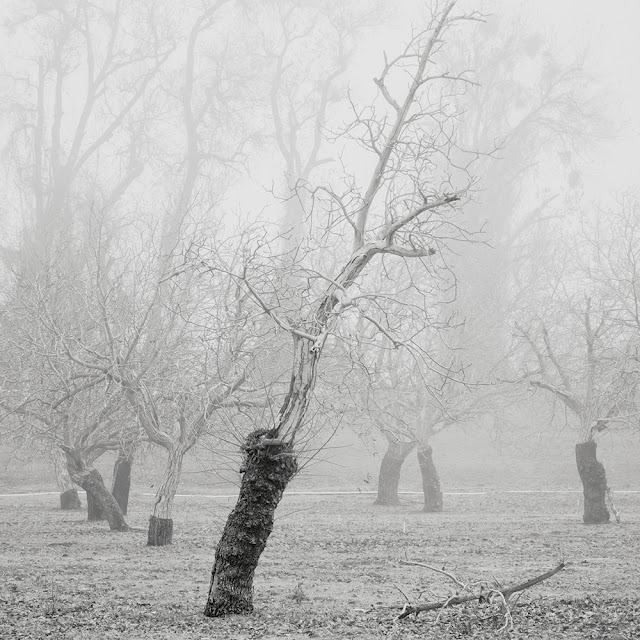
David Paul Bayles stunning black-and-white photographs of grafted walnut trees stand as metaphors for a landscape historically fractured by social inequality. His work documents how the natural landscape is able to tell a human story of difference and pain. Yet, the trees in David’s photographs give us hope by presenting a vision of growth and rebirth after the winter of a sad history.

Peter Essick’s “Construction Site, Tucker, Georgia” is a remarkable drone-captured image. The removed composition creates a rhythmic surface that reminds us of an Abstract Expressionist painting—the elevated one-point perspective reduces the waste material below to flat vibrant fields of color, and transforms the construction elements on site, into beautiful abstract lines. His work reminds us of the bigger picture, how we are inseparable from our environment and live in a symbiotic relationship with all of life.

Enjoy!


JENNIFER STEENSMA HOAG | BROKEN MODELS


Jennifer Steensma Hoag, Untitled, 2016, archival pigment print, 17 x 22 inches, edition of 10, framed, $1100

What is your process like?
The initial process of my work is conceptual and research based. After I feel the idea for the work has solidified, I’ll begin gathering equipment and working on logistics. I’m a planner by nature and I enjoy research, so I think I naturally gravitate to this way of working. Once I’m on site, I am very focused. Other than the technical aspects of shooting, I work extremely intuitively and like to explore my subject by trying different possibilities that come to mind. I think this probably came from my background shooting film; not knowing exactly how the photo would turn out made me want to give myself a lot of choices. Often the images I ultimately select will not be my first photographs and it is through the process of exploring the subject within the constraints of my idea that I find my best work. Even shooting digitally, as in this body of work, as I’m photographing, I’m not entirely sure which photograph I will ultimately select. After shooting, editing down the photographs and optimizing the files is an important part of the process because I think photography is a beautiful medium and the crafting of a gorgeous finished print is important to me.

What inspired these images?
I saw an exhibit titled "Late Harvest" at The Nevada Museum of Art while I was attending their Art + Environment Conference. The show featured historical wildlife paintings juxtaposed with contemporary artists who made their work with taxidermy. I was entirely captivated by the exhibit and cannot tell you how often I visited the show during the conference. It was the inspiration I was looking for as I moved from my last body of work, Compromised Beauty, to a new series of photographs. At that point I began researching taxidermy and found Rachel Poliquin’s book, The Breathless Zoo. A fascinating historical and poetic account of the process and meaning of taxidermy, Poliquin’s eloquent writing helped to solidified my concepts and increase my excitement about this idea. Utilizing a Hazmat suit was a continuation of my previous photographic series in which I photographed a figure in a bright yellow Hazmat suit in beautiful landscapes. Our connection to the natural world has been a consistent thread in my work for over twenty years. From large color photographs of ambiguous land use to digitally manipulated photographic fictions of deer in urban and suburban environments, my work has addressed the relationship of humans with the land and its inhabitants.

Jennifer Steensma Hoag, Untitled, 2016, archival pigment print, 17 x 22 inches, edition of 10, framed, $1100

Can you share an interesting story about your subject matter?
What is not apparent is that the model in the photographs is my husband. An art collector and gallerist, he is my artistic accomplice and trusted critic. We have a similar aesthetic and appreciation for art. I love it that he is excited about my work and offers suggestions while on site. While shooting, he claims I get really intense and tend to bark out orders. I think it’s ironic that he has always been willing to model for me, but as a landscape photographer I never took him up on it. Now that I’ve been working in a directorial way, he is modeling for me but is nearly anonymous in his suit.

Bio:
Hoag earned her MFA from Rochester Institute of Technology, Rochester, New York (1992), and is currently an assistant professor at Calvin College, Grand Rapids, Michigan. Her solo exhibitions include Interpreting Mary at Campos Photography Center, Rochester and Terra Incognita at both the Urban Institute for Contemporary Arts, Grand Rapids, Michigan, and the Adams Hall Gallery at Wheaton College, Wheaton, Illinois. Her work has also been exhibited at such places as Flatfile Photography Gallery, Chicago; Paint Creek Center for the Arts, Rochester, Michigan; Gallery Arcadia, Grand Rapids, Michigan; and the Center for Land Use Interpretation, Wendover, Utah.

What inspired these images?
My wife and I were in northern California awaiting the birth of our grandson. He was having kidney troubles in utero so there were issues and concerns for all of us. We were staying on a piece of property along the Sacramento river that my son-in-law is working on.  It will become an artist retreat space. It has two barns, one for art making and gallery space and the other has been converted to a residence. Lea and I were staying in what they call the orchard house. It was originally used to house migrant farm workers. It was built by combining four huge wooden crates 8’x 8’x 12’ that were obtained at auction right after WWII. The huge crates were used by the military to airdrop supplies during the war. Gabe is converting the orchard house into a somewhat traditional Japanese Tea House that the owners of the land will stay in when they visit.

The property is surrounded by orchards. I had been looking at these grafted walnut trees and thinking of the migrant farm workers and how for so long white people have disproportionately benefited from the labors of people with darker skin. It hurt to be in this place of beauty and tranquility which also bore the evidence of many years of pain and inequality.

Early in the morning on the day my grandson Arlo was born, I was in the orchard house reading a review of Peggy Wallace Kennedy’s memoir, Broken Road. Kennedy is the daughter of George Wallace.
Her life has been a long effort toward reckoning with her family’s racist past. When her sons were born she was determined to help them live with love and respect for all people.  On the 50th anniversary of the 1965 “Bloody Sunday” march across the Edmund Pettus Bridge in Selma, Alabama, Kennedy walked across the bridge with Bernice King, the youngest daughter of Dr. Martin Luther King Jr. They held hands as a symbol of strength, unity, and commitment toward a better future for all people.

An image of their black and white clasped hands was in my mind when I walked to the window and looked out into the orchard. Until then I had seen the grafted trees, dark at the trunk and light where the trees begin to branch out, solely as a metaphor for how light-skinned people had so often reaped the fruit of the labor of dark-skinned people.

Thirty years ago the Black Walnut rootstock was grafted with the white-barked English Walnut scion. The outer layer of bark still bears the historical record of that forced union, while the inner tissues of the trees took a mere eight weeks to fuse together, sending moisture from the roots to the leaves and photosynthesized sugars from the leaves to the roots. Seven years later, and every year since, the trees have borne fruit.

With the image of Kennedy’s and King’s black and white clasped hands, I walked into the orchard choosing to also see hope.

Can you share an interesting story about your subject matter?
Projects usually evolve slowly for me, so this was very different. The inspired moment hit. The light was perfect and I walked out and made 10 successful images. In the days following I researched grafting walnut trees and species types.

Bio:
Photographer David Paul Bayles focuses on landscapes where the needs of forests and human pursuits often collide, sometimes coexist and on occasion find harmony. Some of his projects utilize a documentary approach while others use a more contemporary art practice. His photographs have been published in numerous magazines including Orion, Nature, Audubon, Outside, The L.A. Times Sunday Magazine and others. Public collections include The Portland Art Museum, Santa Barbara Art Museum, The Harry Ransom Center, Wildling Museum and others. His book Urban Forest, Images of Trees in the Human Landscape was chosen by The Christian Science Monitor as one of their seven favorite books of 2003. The David Paul Bayles Photographic Archive was created in 2016 at The Bancroft Library at UC Berkeley to archive his entire life’s work. He currently lives and photographs in the Coast range of western Oregon.


PETER ESSICK | CONSTRUCTION SITES


Peter Essick, Construction Site, Tucker, Georgia, 2019, archival pigment print, 20 x 29 inches, framed, $1275

What is your process like?
I have been working on a project photographing construction sites in Atlanta. I have been using a drone to get a unique perspective. I try to fly the drone early or late in the day when there are no workers at the site. My focus is on the patterns in the landscape that result from the construction of a residential or commercial building.

What inspired this image?
My main inspiration has been Abstract Expressionist paintings, especially those of the Color Field style. I am also inspired by the great aerial photographer, William Garnett, and the photographer Robert Adams who photographed new suburban constructions in Denver in the 1970s.

Can you share an interesting story about your subject matter or the making of your image?
Construction sites are a subject matter that by definition are constantly changing. After a while, I have found there are certain stages that are similar to all construction sites but I continue to find different designs in the land and buildings. What fascinates me the most are compositions that look abstract when seen from a distance, but reveal realistic details up close.

Peter Essick flying a drone

Bio:
Named one of the 40 most influential nature photographers in the world by Outdoor Photography Magazine UK, Peter Essick has been influenced by many noted American landscape photographers from Carleton Watkins to Robert Adams. His goal is to make photographs that move beyond mere documentation to reveal in careful compositions the human impact of development as well as the enduring power of the land. Essick is the author of two books of his photographs, The Ansel Adams Wilderness and Our Beautiful, Fragile World. He has photographed stories for National Geographic on many environmental issues including climate change, high-tech trash, nuclear waste and freshwater. Essick's photographs are in public and private collections. He is represented by Lumière Gallery in Atlanta and Cavan Images in New York. Currently, Essick is working on a book of his photographs about Fernbank Forest, an urban old-growth forest in Atlanta, and will be published by Fall Line Press in the October 2019.


Stay tuned for next's week post, where we'll talk to Meg Griffiths and Virgil DiBiase

>> View more work from Fractured

>> Read more about Fractured

All prices listed were current at the time this post was published.

For more information, and to purchase artworks, please contact photo-eye Gallery Staff at:
(505) 988-5152 x 202 or gallery@photoeye.com 

photo-eye Gallery Fractured: Mini Interviews Marie Maher, Heidi Cost, Ruth Lauer Manenti Welcome to week 6 of our mini-interview series! This time we talk to Marie Maher, Heidi Cost, and Ruth Lauer Manenti. In a world that is constantly becoming through rapid transformation, their photographs reflect this process by portraying moments of heightened subjectivity. They bring up the question, can we be objective observers and storytellers in a fractured world?


Opening night for Fractured

Welcome to week 6 of our mini-interview series! This time we talk to Marie Maher, Heidi Cost, and Ruth Lauer Manenti. In a world that is constantly becoming through rapid transformation, their photographs reflect this process by portraying moments of heightened subjectivity. They bring up the question, can we be objective observers and storytellers in a fractured world?

In Marie Maher’s alluring composite Highway 41, a female figure emerges abstractly from a silhouetted rural street. The character is frozen in a confused movement leaving the subject matter open to many interpretations. Marie’s photograph can be seen as a voyeuristic mystery, a strange and captivating rhythm on a solitary night.

Heidi Cost combines digital photography with alternative darkroom processes. In Escape Through the Window, she uses self-portraiture and double exposures as a way to portray and manage her feelings while looking after her ailing mother. Paradoxically, the window in this multi-faceted cyanotype offers no magical escape, but is directly confrontational. 

Ruth Lauer Manenti’s delicate print powerfully conveys a story in one single image.  The cut braids offer a beginning, a middle, and an end in the story of a close friend. The work pushes the boundaries of storytelling and examines the relationship between the photographer and her subject matter.

Enjoy the interviews!


 MARIE MAHER | NIGHT MOVES


Marie Maher, Highway 41, 2017, archival pigment print with mixed media on board, edition of 10, 12 x 18 inches image, unframed, $400

What inspired this image?
I am a nocturnal person by nature and enjoy photo shoots at night. Everything seems more dramatic in the dark. During one of my nighttime outings, I decided to take some shots of desolate streets from inside my car. These images became the basis for my latest series, which I call “Night Moves.” It is a collection of stories around various encounters that occur at night. I wanted the scenes to be mysterious, perhaps a bit creepy, and open to interpretation as to what exactly is happening. The subjects are shadowy, indistinct characters, and there is a sense of motion that captures an instant in time, which adds to the drama. There may be a certain voyeuristic element to these images as well, but that is up to the viewer’s imagination.

The Highway 41 piece shows a blurry image of a female figure on the side of a deserted rural street. The subject is turned away from the vehicle and illuminated in the headlights. What exactly is happening is not clear. Is this about a fractured relationship? Is the woman in danger? If so, will the driver stop for assistance, or is the driver the danger? I like this piece a lot because of the suspense it creates.

Can you share an interesting story about your subject matter or the making of your image?
The image was created in two parts. I first photographed the road, which is less than a mile from my house. I later photographed the model and then composited her into the background. I generally use compositing on my surrealistic work, but I find that it can also be a powerful tool for achieving the effect I want on more “realistic” images as well, like this one.

My own interpretation of the story behind the image shifted as I created it. We may conclude something about a person only seen as a blur in low light, but how accurate can that be? I was reminded that initial impressions and assumptions about others may not be accurate when we aren’t directly involved.

Bio:
I can’t remember a time when I didn’t love art. I started painting in oils at the age of 12 and studied art and photography at SUNY, Buffalo and the University of New Mexico during my college years. Though I ended up with degrees in Architecture and Pharmacy to make a living, I never lost my passion for artistic expression, and decided to completely immerse myself in photography after a serious illness rearranged my priorities in 2007. 

Since 2009, I have entered over 60 juried contests and received over 30 awards from judges, peers, and the public alike. My work has been included in solo and group exhibitions, notably the Jadite Gallery in New York City. I have received numerous awards, including finalist in both the fine art & the alternative processes categories in the Julia Margaret Cameron Award. Five images from The Misled series have been exhibited at the 4th Biennial of Fine Art and Documentary Photography in Berlin, Germany.


HEIDI COST | ESCAPE THROUGH THE WINDOW


Heidi Cost, Escape Through the Window, 2019, toned cyanotype, 6 x 6 inches, edition of 5, framed, $560

What is your process like?
My artistic background is in analog photography. When digital photography became popular, I felt as though I had lost the connection with the physicality of creating images. This loss of direction resulted in an interest in alternative processes that combine digital negatives and actual darkroom printing. Cyanotypes do not require toxic chemicals and are easily manipulated by bleaching and toning the print to achieve tonalities other than the classic Prussian Blue of a traditional cyanotype. This image reminds me of a mummy with layers of covering in a kind of bandage. It made sense to print it as a cyanotype with its clinical blue tonalities and harsh lighting.

What inspired this image?
I was homebound for a period of time, taking care of my elderly mother who was suffering from dementia. Trying to carve out the few moments I could in each day, I made a series of self-portraits expressing the emotions I was experiencing while being a dutiful daughter.

Much is left to chance when working with double exposures and this image, a combination of Venetian blinds and self-portrait, evokes a sense of the mechanical self, going through the motions and repressing the layers of grief. I really had no idea how the two exposures would work with each other, so the majority of the creative process was about surrendering any control of the final image.

Bio/Artist Statement:
I find distinct beauty in organic shapes and forms and am intrigued with the way my simple surroundings fall into place without any effort or forced arrangement. This noticing is part of the process: a pile of leaves blown into a corner of the back porch, a dead bird among winter vegetables, window blinds casting shadows on the bedroom wall.

The imagery can be as simple as a discarded knitting project or a shadow falling across an adobe wall in the late afternoon –all invite individual interpretation and hold a story. I invite you to look at my photographs and dwell in the quiet potential of the images.
I work with traditional alternative processes such as Cyanotype, Kallitype, Van Dyke, and Platinum Palladium. The complex alchemy of these photographic processes leave much to chance, rendering each image unique.

I often present my final images in a hand-created book or portfolio form, in order to add to the handmade quality of the photographs.

Exhibitions:
Photo-eye Gallery Juried Show | Fractured | Santa Fe, NM | 2020
Nude Nite – An Annual Art Happening and Juried Show | Tampa, FL | 2020
New Mexico Women in the Arts Juried Show | Center for Contemporary Arts | Santa Fe, NM | 2012


RUTH LAUER MANENTI | TWO BRAIDS


Ruth Lauer Manenti, Two Braids, 2018, archival pigment print, 6 x 8 image, edition of 10, framed, $1000

What inspired this image?
The inspiration for this picture came from my love for Céline (Initially she was my student but we then became friends). She decided to cut and give her hair to Locks of Love and I asked her if I could photograph her hair first. Being that I’m looked upon as the “artist” in our community, she accepted my request and did not find it strange. Months later, after Una was born, I gave her this and one other photo of her hair. They were in a box and I don’t think, as of yet she has opened that box. I don’t think she feels ready for this reminder.

Céline's mother died of cancer in the spring of 2018, three months after Céline found out she was pregnant with her first child. It had been a long road leading up to that as Céline was anorexic and had to heal from that before she could have any children. Her body was too fragile to carry excess weight. We all kept an eye on her at that time, looking for any signs of a relapse, especially in her face, but it seemed that her marriage to David, the move to house with a backyard and potential for gardening, and the prospects of family, improved her condition, little by little, over the course of several years. So, there she was, happy, healthy and pregnant, while receiving the news of a terminal diagnose from her mother’s doctor.

Her mother Audrey was only 52 and not at all ready or prepared to die. In fact, up until the very end she was angry and unaccepting. The ambiguity and impermanence of life, she had not reflected upon. Whatever she wanted, more or less, she had had and now she wanted to live longer and to be a grandmother. Céline tried to help her mother find peace or acceptance, but her efforts were not enough to matter. The more effort Céline made, the more the circles under her eyes darkened. That’s when she started to feel ambivalent about the baby she was carrying, or not so much about the child, but about the happiness she felt, none the less, of this new chapter of her life. . .husband, baby, house etc.

Bio:
I live in a cabin in the woods in the Catskill Mountains of New York. My background is in painting and drawing, but fifteen years ago I inherited a K.B. Canham large format camera from someone I greatly admire. I taught myself how to use the camera and gradually accomplished what I was striving for in drawing and painting, through photography. I gather much of my inspiration from looking at drawings and paintings continuously over decades. My mother was also an artist. She had a wealth of talent and worked steadily throughout her life, yet her number one role was to take care of her family. Sadly, she left behind a legacy of unwanted, unpublished, unknown work. I realize, now that she has passed away, that part of my determination as an artist is to honor my mother and to create a continuum. Since breaking my neck in a car crash at the age of twenty, I have developed a strong spiritual life and practice for which I have made annual trips to India for the last thirty-five years to study yoga, meditation and Sanskrit and to adapt a way of life simpler and more ritualistic than I had known before.

I received a BFA from SVA in NYC and an MFA in drawing, printmaking and painting from the Yale School of Art in 1994, where I later taught. I also taught at Dartmouth College. I have exhibited at the Bill Maynes Art Gallery, the Lower East Side Printshop, John Michael Kohler Arts Center, Paula Cooper Gallery, The Griffin Museum of Photography, John Davis Gallery, and Le Salon Vert in Switzerland. I received a 2016 New York Foundation for the Arts grant in photography. I was an International Portfolio Winner in the Soho Photo Gallery competition in 2019.


Stay tuned for next's week post, where we'll talk to Peter Essick, Jennifer Steensma Hoag, David Paul Bayles.

>> View more work from Fractured

>> Read more about Fractured

All prices listed were current at the time this post was published.

For more information, and to purchase artworks, please contact photo-eye Gallery Staff at:
(505) 988-5152 x 202 or gallery@photoeye.com