PHOTOBOOK REVIEWS, INTERVIEWS AND WRITE-UPS
ALONG WITH THE LATEST PHOTO-EYE NEWS

Social Media

Showing posts with label LOCAL EIGHT. Show all posts

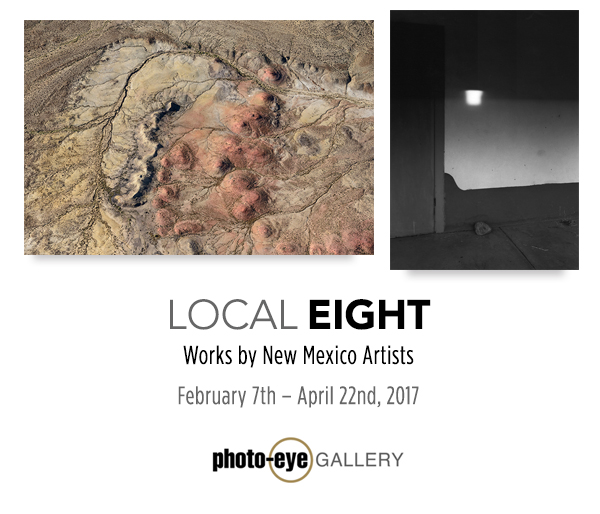
photo-eye Gallery LOCAL EIGHT: Jamey Stillings & Edward Ranney Jamey Stillings and Edward Ranney's images in LOCAL EIGHT both prominently feature New Mexico as a subject, but with exceedingly different intent, experience, and aesthetics. We reached out to Stillings and Ranney for some insight and information about their photographs and we're pleased to share their thoughts with you here. LOCAL EIGHT is on view through this Saturday, April 22nd.


photo-eye Gallery's LOCAL EIGHT is a diverse exhibition featuring work from represented artists who live in northern New Mexico. Jamey Stillings and Edward Ranney's images in LOCAL EIGHT both prominently feature New Mexico as a subject, but with exceedingly different intent, experience, and aesthetics. We reached out to Stillings and Ranney for some insight and information about their photographs and we're pleased to share their thoughts with you here.  LOCAL EIGHT is on view through this Saturday, April 22nd.

Jamey Stillings
© Jamey Stillings – #10183, 9 September 2015, Bisti Badlands, New Mexico 

"Since 2010, when I first photographed over Ivanpah Solar in the Mojave Desert of California, I have been working on a long-term project, CHANGING PERSPECTIVES, about renewable energy development. As this project gradually builds into a global project, I also want to document energy development closer to home in New Mexico.

The San Juan Basin of New Mexico is a region of incredible beauty and geologic diversity. The ancestral Pueblo peoples, who lived in and around Chaco Canyon and throughout the Basin from around 850 to 1250 A.D., represent an important example of a highly developed native culture in North America prior to European contact. The San Juan Basin is also a region with significant fossil fuel resources in the form of coal, petroleum and natural gas that have been tapped from the 1920's to the present.

© Jamey Stillings – #10292, 9 September 2015, Bisti Badlands, New Mexico 
© Jamey Stillings – #11071, 9 September 2015, Chaco Canyon, New Mexico 
As might be expected, the area's natural beauty, the livelihood of native and non-native peoples, and invaluable anthropological sites compete with our contemporary culture's thirst for energy. Energy exploration, mining, and drilling continue to encroach on limited water resources, scar the land, disrupt its natural beauty, and impact the region's people in complex ways, both positive and negative.

The work I shot over the San Juan Basin looked at the area's diversity from coal-fired power plants west of Farmington, to oil and natural gas exploration around Navajo Lake, to the protected lands of Chaco Culture National Historical Park and the Bisti/De-Na-Zin Wilderness.

This group of four images selected for this exhibition shares the natural beauty of mystique of Chaco Canyon and the Bisti Badlands. While you may not have the opportunity to experience these incredible sites from the air, I hope you will make the point of visiting them and savoring their natural beauty on the ground."

–– Jamey Stillings


Edward Ranney
© Edward Ranney – Chaquaco, NM 1973–2017
"I was intrigued to learn recently, when asked to make some comments regarding the four photographs I had chosen to exhibit in photo-eye gallery’s recent show called “Local Eight”, that the pictures resonated, surprisingly, with a preoccupation of Dorothea Lange. Invited in 1957, toward the end of her working career, to teach a course at the California School of Fine Arts (now the San Francisco Art Institute), she often asked her students to make photographs in response to the question, “Where do I live?”.  Her interest was not to have her students make portraits, or depict human interaction, but to photograph the “most meaningful and personal place” of their environment, and in doing so to look inward, not away from themselves.

© Edward Ranney – Chaquaco, NM 1973–2017

        Beginning in 1973, my wife and I settled at a rural homestead south of Santa Fe known as Chaquaco, previously occupied by cattle ranchers and earlier settlers who had raised sheep. While we raised our three daughters there, I photographed our life in this isolated setting, recording changes in the surrounding landscape and subtle nuances of light around the house, in the process becoming adept at using the large format camera in a way that has informed my work at ancient sites of the Andes. The pictures run the gamut from some surprising successes to many of inconsequence. But at their best, they correspond to a comment recollected by one of Lange’s students, as published by Milton Meltzer in his biography of Dorothea Lange." – Edward Ranney

        “We ought to know beyond a doubt that the things we look at in these pictures are the most important things in the world, that to the photographer this desk, this garden, is home. And by the time we have looked at all these pictures, we ought to feel that our own homes, our own hearts - by the view we have been given of the hearts of others - are not what they were when we began to look.” 
– Nancy Walker Katz As quoted in Dorothea Lange, A Photographer’s Life, by Milton Meltzer, pg 305, Farrar, Straus, Giroux, NY, 1978


For more information, and to purchase prints please contact photo-eye Gallery Staff at 505-988-5152 x 202 or gallery@photoeye.com.

LOCAL EIGHT is on view through this Saturday, April 22nd at photo-eye Gallery.

photo-eye Gallery Interview: James Pitts photo-eye Gallery is delighted to have five of James Pitts stunning platinum palladium prints included in our current exhibition LOCAL EIGHT, and Gallery Associate Savannah Sakry asked James to elaborate on his personal seeds as an artist and his thoughts in the studio.

Dried Clematis Blossom, 1995 © James Pitts | Platinum/Palladium Print, 10x8", Ed. of 25, $750

photo-eye Gallery is delighted to have five of James Pitts stunning platinum palladium prints included in our current exhibition LOCAL EIGHT. The work is not to be missed if you are in Santa Fe and have yet to see these remarkably elegant still lifes in person. "Flowers" is an ongoing series of which Pitts collects various flora and backdrops to set the stage for his large formant view camera.  His results are classic, timeless photographic works of art, beautifully frozen in platinum. Gallery Associate Savannah Sakry asked James to elaborate on his personal seeds as an artist and his thoughts in the studio.

Savannah Sakry: Where did your appreciation of art begin, how did you come to photography?

James Pitts: I grew up in a small town in Alabama, it was actually a very cosmopolitan place because all the German scientists from the missile program came there. My best friend's father was a friend of Von Braun's and worked for Von Braun. There were a lot of those guys in Huntsville and they brought an element of sophistication which probably wasn't in any other city, especially that size. My grandmother didn't go to college, or high school. Well, she graduated high school, but she got married when she was 16. She had some kind of innate knowledge about direction and culture that she wanted to give to me, and I guess I was more receptive than my sister and my brother to it, so that's where the camera came from, probably a Christmas present. I took art classes from the museum because of her and she gave me music lessons, piano lessons. My grandmother was extremely loving and so my whole aesthetic I think was formed really early by living at my grandmother's house which is antebellum, a beautiful, large home. She liked nice things so there were antiques everywhere and wool oriental-type rugs and it was just, you know, very nice. So my love of art started with her.

SS: When did you discover Platinum printing? 

JP: The summer of '80. One of the last classes that I had at art school, a guy named Kevin Wrigley came and he did a workshop on platinum printing. And I fell in love with it. I only saw half the workshop so I missed out on a bunch of stuff, technical stuff but I was just in love with that process. I had saved up and decided I was either going to buy an enlarger or a large format camera. I decided to get the large format camera, which was fortuitous. We moved to New Mexico and then I started trying to find out how to make platinum prints and it wasn't easy. There was really no information out there and I didn't know anybody, other than seeing this workshop. But after a period of time, I found web sources that had the materials and started to be able to do that. I worked in a camera store for a year and bought an 8 x 10 camera.

Bottle With Sharon's Seeds, 1998 © James Pitts | Platinum/Palladium Print, 9.5x7.5", Ed. of 25, $750

SS: How did you arrive at photographing flowers? 

JP: I met John Stevenson, I showed him my work, he liked it. He was real interested in platinum stuff and he was having a show on flowers. That's why I started photographing flowers because of that show and then I just kind of enjoyed it. It was kind of an excuse to make pictures and a theme without having to search for it. Everything is there. It's not really about the flowers so much for me, it's about the composition, all the formal elements of art.

SS: Interesting, I had in my head you must have this remarkable relationship with flowers. But it's not so much the flowers themselves as it is composing the piece?

JP: I love taking pictures. I never get tired of doing that. I don't have enough time to do it. So it's a structured way of doing it. It's not that I'm not in love with the flower or the object of nature, it's just a structured way of working.

SS: They're a perfect model for you, right? I mean, especially if you studied painting and drawing, you can really craft the composition, set the stage in a very attainable way.

JP: Well, it is a stage. I mean that's kind of what I think about it is being, this stage. It's problematic, it has its challenges. Flowers don't stay still. Light doesn't stay still. Finding different backgrounds to not keep repeating myself, that's hard.

SS: Tell me a little about your backgrounds. Are you always searching for them? 

JP: Yeah, I'm always looking for something that might be interesting and might be not obvious. There's one background I've used a lot, which is this old cigar box covered with tin on the inside that used to sit in my grandmother's kitchen. It has a kind of rusted metal interior and as you move it, it has all kinds of different ways of looking. I wish I could find something else that is equally good but I haven't. That has a chameleon kind of quality so it doesn't always look exactly the same unless you know what you're looking for I guess. Objects that I think have nice shapes. I mean, a bottom line to me, it has to be to my aesthetic, appealing. It has to be something that's interesting to look at for me.

Clover Flower, 1994 © James Pitts | Platinum Palladium Print, 10x8", Ed. of 50, $750 
SS: I think you're driving home this previous quote "The photographs are largely about order and control. For example, the utilization of formal, classical, compositional tools to structure an ideal representation of reality. This is how I want the world to be, rather than the way it is." 

JP: Yeah, I'll still hold to that.

SS: That doesn't surprise me. In your work there's certainly a minimalistic quality but also this quiet and sense of control. I mean, everything is very directed. Nothing is by accident. Doesn't sound like you leave any room for that. I love your use of light. Who have been your influences, either painters or photographers? 

JP: Well, Matisse, Diebenkorn, Cy Twombly, those are three painters I really like a lot. Paul Klee earlier ...  I mean, I've been through a lot of phases of people's work I like but those three, Diebenkorn, Paul Klee, and...

SS: Matisse. 

JP: Yeah, Matisse, I never get tired of looking at.

SS: Yeah, me neither. 

JP: And Cy Twombly, I just, I love his work. As far as photographers, August Sander, Diane Arbus, I think, early on I was really influenced by Harry Callahan to some degree and Aaron Siskind.

SS: I can see the impact those artists have had for you, would you say there is also an Asian influence in your work?

JP: I think I have this affinity with simplicity, which is kind of Zen.

-------------------------------------

Two Garlic Flowers in Japanese Vase, 1999 ©James Pitts | Platinum/Palladium Print, 10x8", Ed. of 50, $750 


James Pitts' platinum/palladium works are on view at photo-eye Gallery through April 22nd, 2017. Please inquire with Gallery Staff regarding Pitts' extraordinary handmade artist books. For more information or to purchase prints, please call 505.988.5152 x202.


About LOCAL EIGHT:

Northern New Mexico and Santa Fe is home to a vast, varied and thriving artist community. Local Eight is a group show focused on the diversity of style represented by eight area photographers exhibiting wide-ranging conceptual and material practices.

photo-eye Gallery From Local Eight: Works by Steve Fitch and Edward Ranney Represented artists Steve Fitch and Edward Ranney share insights about their process as well as some behind-the-photo stories for two works included in photo-eye Gallery's group exhibition LOCAL EIGHT – on view at photo-eye Gallery through Saturday, April 22nd.


photo-eye Gallery's current exhibition LOCAL EIGHT features a diverse selection of works from a passionate community of represented artists living in Nothern New Mexico. Even though Steve Fitch and Edward Ranney, two of the eight photographers featured in LOCAL EIGHT, both create anthropologically-based landscape images using large-format cameras their fundamentals, intentions, and experience are wildly different. 

Ranney's images are distanced and lyrical observations primarily focused around humanity's impact on the natural world, while Fitch trains his keen and detailed eye on the eccentricities within an environment people make for themselves. Both sets of prints are beautiful and fascinating. photo-eye Gallery is excited to share insights from both Ranney and Fitch about their process as well as some behind-the-photo information for a couple of the works included in LOCAL EIGHT – on view at photo-eye Gallery through Saturday, April 22nd.

STEVE FITCH

Royal Motel, Highway 66, Elk City, Oklahoma, 1973 – © Steve Fitch
"In 1972 after I had been making pictures along the highway for about a year I reflected upon all the pictures that I had made so far and realized that something was missing. I had photographed tourists, truck stops, motels, billboards, truck drivers and waitresses, snake-pits and dinosaurs but some crucial aspect of the American highway was missing. It dawned on me that I needed to make some photographs at night. So much of the experience of traveling our highways had to do with driving at night, listening to funky AM radio stations and pulling into towns that you could see coming twenty miles away because of all the neon. So, on the next highway trip, I decided to try making some photographs at night—something that I was not even sure was possible. In Deadwood, South Dakota I spotted a homely little motel at dusk, with a row of bare light bulbs and a neon sign. Through the window, I could see a neon-rimmed clock. Over the next hour, as it got dark, I shot a roll and a half of 120 film, bracketing my exposures. Two weeks later, back in Berkeley, I developed the film and was excited. The photographs of that motel looked great! I picked one to print and it is in Diesels and Dinosaurs. I love the quality of light at dusk and in this photograph, the clock visible through the window tells me what time the photograph was made (8:20), and the second hand is blurred for about a second so it also tells me how long the exposure was. Ever since I have been very fond of photographs with clocks in them!"
– Steve Fitch


EDWARD RANNEY

Wastwater from Whinn Rigg, Cumbria, England, 1981 – © Edward Ranney

"Northern England, of course, is an entirely different world from Peru’s desert, and I made the picture of Wastwater over 20 years earlier than the desert picture. Nevertheless, the same outlook regarding vantage point is relevant, especially in an area where quickly changing weather can give one an unexpected insight at a particular spot, or render a successful picture impossible. I considered rather carefully the conditions that would keep me from getting drenched by rain as I hiked up the area near Scafell Pikes and Great Gable in the western sector of the Lake District and found that by prowling around the cliff above Wastwater, there were hints of light conditions and vantage points that might give me something special. It took some time, but the structure for the image gradually developed and finally became clear from a certain spot, much as a drawing might develop as one sketches in the landscape. In addition, I saw the shapes of the fields below to be of some importance, along with the role the elegant little house plays in the picture. Different elements can play integral parts in a successful landscape, but overall what we’re after, I suppose, is a view that can help us discover what Robert Adams suggests is the 'significance of a place.' Hopefully, that is open to as many interpretations as there are viewers of the picture."
—Edward Ranney

Read Lucas Shaffer's 2014 interview with Edward Ranney
Purchase Books by Edward Ranney
View LOCAL EIGHT


LOCAL EIGHT: Works by New Mexico Artists
On view through Saturday, April 22nd

For more information, and to purchase prints, please contact Gallery staff at 505-988-5152 x 202

About LOCAL EIGHT:
Northern New Mexico and Santa Fe is home to a vast, varied and thriving artist community. Local Eight is a group show focused on the diversity of style represented by eight area photographers exhibiting wide-ranging conceptual and material practices.

The artist excerpts from this post were originally authored by photo-eye Gallery as promotional content during solo exhibitions for Fitch and Ranney.

photo-eye Gallery Zoë Zimmerman on Her Dream In an interview, represented artist Zoë Zimmerman speaks about collaborating with her daughter on the seies Her Dream.

Represented artist Zoë Zimmerman in her Taos, NM studio – image: Paul O'Connor

Currently on display at photo-eye Gallery as part of the LOCAL EIGHT exhibition is a selection of new images from Zoe Zimmerman's ongoing series Her Dream.  LOCAL EIGHT is a group exhibition of photographs featuring eight represented artists from Santa Fe and Northern New Mexico and will be on view through April 22nd. Zimmerman’s images from Her Dream are photographed using a large format camera in her studio in Taos, NM in collaboration with her daughter. In honor of the new images and the exhibition, I caught up with Zoe to discuss this fantastic ongoing series.  – Anne Kelly