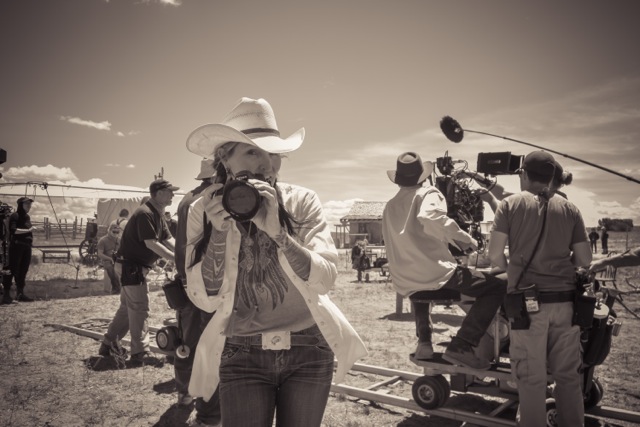
The story of Karen Kuehn's early career is fascinating. Raised in the Californian suburb of Los Alamitos Kuehn volleyed between Art School and Ranging in Glacier National Park during her early 20's before landing a coveted internship with National Geographic in Washington DC in the mid-1980's. By 1985 Karen hits New York City and an incendiary scene lit by the energy of punk rock,
, and Andy Warhol's The Factory, among a myriad of other factors, and grabbed gigs at The New York Times Magazine, Saturday Night Live, and Spy Magazine during her 16 years in the city.
When I transferred to junior college to take classes they had a photo class. I took a class at Cypress College in California and John Sexton, who was Ansel Adams first assistant, was one of the teachers there. The faculty liked that I was applying ideas to the technical aspect of the zone system photography.
LS: Where were you living at this time? Were you still living at home, or already on your own?
KK: I was living at home in Los Alamitos, California. It was like a Doris Day bedroom community. It still is the quintessential suburban neighborhood.
At one point, I turned my bedroom into a darkroom, and I don't know why my parents let me do that, but I put plastic over the beds, and I had my darkroom enlarger on my desk. I would develop everything on my bed because there was no table in there. Then, I would rinse it in the bathtub, which was right around the corner from the bedroom.
About age 20 through 25, I worked for the park service. I was part-time, Seasonal Ranger, and decided that "I don't just want to be a seasonal ranger. I wanted to be a back-country ranger because I really felt akin to horses, I wanted to be in the back-country, I wanted to hike and fish and camp. That's the way we grew up, camping.
LS: What park were you rangering for? Was it different parks? Was it all in California?
KK: I went to Yosemite because that's where I kind of spent a lot of my childhood, so I started there and eventually transferred to Glacier NPS. It was awesome. I loved my life. I had no intention of going to New York City, ever. That was not part of my personal plan, having lived in a cabin and hiked a lot of my life and camped, so the last place in mind as a young woman is to live in New York City if you're an outdoors girl, you know?
LS: How did that take place then? How did that transition happen?
KK: It was sort of a basic and logical process of getting one’s education. I begged my parents to pay for me to go to art school. I wanted to go to Cal Arts and would have gone the fine art route if it was a little less expensive, but the cost was enormous. I ended up going to Art Center.
 |
| Thank You's, 1st Dollar, and Photographic Credentials from Karen Kuehn's National Geographic Internship. Feature in the background is from Kuehn's first assignment covering the Mountain Men of Kluane National Park. |
LS: It sounds like, even at junior college, you stumbled into an amazing pedigree with John Sexton.
KK: I did just stumble into Cypress College to do the general education program and the photography classes hooked me. John didn't really put me under his wing. He had a lot of people. He's an absolute, perfect instructor. I think what he does best is teach.
I went through that whole process of learning the zone system and then getting a BA in photography. I was graduating, and I thought, "I'll just go back to the park's service." Then, my classmates were all like, "You've been there, done that. You need to go on and get on with your career."
So I applied for an internship at Rolling Stone and National Geographic. I saw myself at both places. National Geographic called me and awarded one of their coveted internships. Rich Clarkson was stepping into that position, so he's really the person who gave me that opportunity with Tom Kennedy, who was The Assistant Director of Photography.
I went out there for three months, two days after I graduated from school.
LS: How did your parents feel about the internship?
KK: That was the moment that validated paying for art school – they're like, "Oh, my God. She is going to be a photographer." We went out and celebrated at my mom's favorite restaurant. Two days later, I'm in D.C. as an intern.
 |
| Images of Karen Kuehn, and an excerpt of her personal journal from her early days in New York City. |
LS: Wow, that is a big change; what was it like?
KK: I had three months at National Geographic, and when winter came I was like, “Where am I going?" people at Nat Geo said, "You have to go to New York." I said, "Can you keep me here a little longer?" And they did. They let me there another three months. Then I made all these connects and used that internship to walk me into offices.
I arrived in New York with a backpack, a sleeping bag, very little gear, cowboy boots and high heels, a leather mini skirt, and jeans. I really didn't have a lot, but I had 1,000 bucks in my pocket. It wasn't easy. It wasn't really where I saw myself, but I had an amazing journey.
I originally saw myself doing fine art projects and installations, but I needed to have money and sustain myself. Nobody was giving me a trust fund, you know?
LS: Did you just start freelancing while you were in New York or did you work for an agency?
KK: For the first year, I just went knocking on doors. New York Magazine was my first job and Nan Goldin was my assignment. That's in that book. It's the first picture in the book. I was fresh off the turnip truck looking like a real farm girl and Nan was lower-east side heroin chic. I had no idea. I was a foreign object to her, and she was a foreign object to me.
 |
| Nan Goldin • 1985 • NYC • New York Magazine – © Karen Kuehn |
LS: That’s an incredible first assignment – you show up in New York City, and here's quintessential New York City photographer Nan Goldin, and you're photographing her.
KK: Yeah. That's kind of how everything happened. Every week I would go out, I would get a call. "Hey, can you go photograph this band, or this person, or project?" I stumbled through it; I figured it out.
I like people, so it was fun relating to another person; I wasn't really a nature photographer. I would welcome that now, but it wasn't really what I went after. I kind of had this connection with people. I can figure out people quickly.
LS: Looking through the portraits in Maverick Camera, it seems like you connect with your subjects. What is it like to build rapport and that kind of connection with your subjects so quickly, especially when they're celebrities?
KK: I think it's like ... It's like cooking to me. You have to have all the ingredients in front of you to create something. For me, I always research everybody I photograph.
It's also important to allow them to be part of that process, whereas, I know a lot of photographers just document somebody. I think about the details. I like telling a story. I like it to be accurate. I like to co-create it with a person so I'm always trying to run ideas by them.
 |
| Bill Murray • 1989 • NYC • New York Times Sunday Magazine © Karen Kuehn |
LS: How did Maverick Camera the book come about, and as you were working on it, what was it like putting it together – to go through, 25 years of pictures?
KK: It came about because of a friend of mine Larry Mitchell, a guitar player. He's always like, "Why don't you have a book out? You should have had a book out years ago." I just didn't play that game. Larry finally prodded me enough and in 2009, I started pulling images. As I pulled it together, and it became like nine books – I have 25 oak wooden file cabinets full of negatives from my career in New York City.
I just started pulling and separating everything. "Here's the Saturday Night Live book. Here's the musician book. Here's the writer book."... "Here's the pregnant book." There were 50 pregnant women shots. After a while, I started to zero in like, “I think I just want to talk about my New York years because I don't think everybody gets to go to New York." I think what happened to me and how I made it kind of work was really a pretty amazing experience.
LS: The way your career began sounds almost storybook.
KK: ... It was storybook. I look at
Maverick Camera, and I'm like, "I don't even know that person now." That's a whole other person. I'm glad I am who I am now. That book and all those experiences got me to this point.
 |
| Sean Penn • 1987 • NYC • Saturday Night Live – © Karen Kuehn |
LS: Can you talk a little bit about that? What was it like for you when you were putting that book together – was it complicated to look at your past?
KK: Yeah. I mean … I'm a task master, and this comes from my mother.
My son and I both agree that we're a lot like Grandma. We just go get it done. I'm a big fan of making a list, manifest, go down that list, achieve what you need to do, grow and move forward. My whole life has gone that way. I just started pulling images. I made this journal, and I wrote about each image.
LS: How long did it take you from start to finish. The project started in 2009 and the book was published in 2016, so that's what? Seven years?
KK: Yes, 2009, and in between, I published five other books about Burning Man.
LS: When you started putting the final edit together, how did the reflections start? Had you decided early on to write about each photograph or did that decision come out of the editing process?
KK: I just had my list of pictures and I was saying, "Wow, I hope I can remember all this accurately enough." I thought, "Well, I better do this now because I probably won't in another ten years. So, I wrote.
 |
| Excerpt from Maverick Camera with an image of Spike Lee and recollection about the experience. |
LS: To be consistently creative and execute those ideas under tight time constraints is pretty special.
KK: Well, it's a ... Why else are we here? To me, it's all just in the pot. Everything inspires me. I probably work outside so much just to relax my brain, otherwise, my brain is just on all the time, I need nature. I prim roses like Edward Scissorhands. I'm in there.
LS: Why did you end up leaving New York?
KK: I need the smell of grass. I need green all around me. I need roses. I wanted my kid to grow up somewhere besides a library or a pool hall.
I just wanted to be outside, and we achieved that. Was it a career move? I don't know. Maybe in ten years, it will be when I get to another level, but for me, it was a healthy move on a lot of levels.
Maverick Camera is a big chapter in my life, definitely... it’s 16 years of my life, and flying by the seat of my pants. I wasn't really living in the past or in the future. I was so in the moment. The phone rings, "Hey, do you want to go to Maine and do a story on Camden." And you go.
 |
| Steve Martin • 1987 • NYC • SNL – © Karen Kuehn |
LS: What’s next for you?
KK: I probably could have marketed my career bigger with my name over the years, but I didn't. I think my ego has stayed intact and humble, but I want the work out there. I have other projects to do. I have projects that I want to do that are about animals. I need people to be more aware of animals and their energy and that their sentient beings.
I'm in the local 600 Union. I'm doing promotional and still shooting on films because that's what's happening in New Mexico. At the same time, I also have artistic ideas that I want to make happen in the next ten years. Every day is anew and the phone rings and I go. Always something to do and create.