PHOTOBOOK REVIEWS, INTERVIEWS AND WRITE-UPS
ALONG WITH THE LATEST PHOTO-EYE NEWS

Social Media

Showing posts with label photo-eye photographer's showcase. Show all posts

photo-eye Gallery Fluid Documents– An Interview with Diana Bloomfield
photo-eye Gallery welcomes Diana Bloomfield to the Photographer's Showcase with The Old Garden, a portfolio of labor-intense tricolor gum bichromate prints featuring delicate images of floral specimens.

Diana Bloomfield, Autumn Clematis, 2018, Tri-Color Gum Bichromate Print,
 12 x 9 inches, Edition of 5, $1,200

Diana Bloomfield's photography looks and feels different than the majority of camera-based work today. Her labor-intensive tricolor gum bichromate technique, which requires precise registration and multiple layers of exposure to create each individual image, imbues her prints with a feeling of tactile object-hood. Her color palates range from muted earth tones, to bright flashes of yellows, greens, and blues, to delicate pastels and sepia tints. Documentary in spirit, and fluid in expression, the work feels like a gentle nod to the past in both process and subject matter.

Diana Bloomfield in her studio, developing an image
in her signature tri-color gum bichromate technique

Bloomfield’s series The Old Garden, featuring delicate images of various floral specimens from her own yard, is the newest addition to photo-eye Gallery’s online Artist Showcase. photo-eye Gallery Director Anne Kelly met Bloomfield at the PhotoNOLA portfolio review earlier this year, and felt drawn to her work and mastery of uncommon analogue practices. photo-eye recently had the opportunity to speak with Bloomfield about her work and process:

photo-eye:     In your artist statement you talk about the photograph’s relationship to time, and how each image that you document, regardless of subject, is preserved in the past. Can you speak more about what draws you to these acts of documenting, remembering, and looking to the past?

Diana Bloomfield:     While I do try to live in the present, I’m consistently aware that whatever I’m doing, wherever I am at any given moment, whatever conversation I’m having— all of that is also passing me by, almost simultaneously. As soon as the moment is here, it’s gone. For me, the past and present are always colliding. So I make these visual documents in an attempt to preserve those moments that, for me, jog some memory or visually make a connection to my past. It’s never preserved exactly as I saw it, of course, because the memory of the scene itself is fluid and may never jibe with the actual experience, or even in the way the image is ultimately printed. I try to preserve what I saw in my mind’s eye, though, much like keeping a visual diary. Whatever I photograph is of value to me in some way, so I document and preserve that moment in time. The entire process seems elusive, but a visual document works to honor and acknowledge both my past and my present. And if the images ultimately resonate with others in some meaningful way, then that’s a bonus.

Diana Bloomfield, Quince, Tricolor bichromate over cyanotype, 12 x 19 inches, edition of 5, $1,300

p-e:     Even your process evokes the past in method. There is meticulous, physical labor that goes into creating each image. Can you explain your method in a bit more detail?

DB:     Although I do work in several printing processes, my process of choice is tricolor gum bichromate. It’s the only process I’ve ever used that hasn’t bored me after a while, and that’s because the creative possibilities appear truly endless. This is a 19th-century process that involves an emulsion of watercolor pigment, gum arabic, and potassium (or ammonium) dichromate. I use watercolor paper as my substrate. Gum dichromate is a short tonal range process, so the first goal— before ever printing— is to manipulate the image on-screen so that a long tonal range can be achieved in the final print. I do that by uploading my onscreen color image to the computer, and applying a curve that offers a flat, low contrast image. After applying the curve, I separate the image, onscreen, into CMYK (cyan, magenta, yellow, black) negatives. I then print those CMYK separation negatives, using digital transparencies.

My first layer is often the C (cyan) layer, since that’s the darkest of the pigments and creates a good strong base on which to re-register the subsequent layers. I often cross-process and substitute cyanotype as a base— a totally different 19th c stand-alone process— that meshes well with gum bichromate, because the two processes use the same curve. If using gum bichromate for that first layer, I mix a specific emulsion of watercolor pigment, gum arabic and potassium dichromate, pour it on the paper, and brush-coat it to the size of my image. That dries in the dark, and once dry, I lay down the C (cyan) negative on top, and expose to UV light. Although the sun is a free source of UV light, it’s inconsistent, so I use a UV vacuum print frame. That layer I’ve just exposed, typically for about 5 minutes, requires washing in a water bath for about an hour. That allows the dichromate to leach out of the paper, the whites to clear, and everything that is blue in the image remains, while the rest washes out. Once that layer is removed and dried, I then coat that very same print with a black pigment and perform the same routine, this time registering the black negative over top of that black pigment and the cyan layer I’ve already printed. Again, that requires washing, and everything that isn’t black (mostly deep shadow detail) washes out. Some people use registration pins or some other method to ensure perfect registration, but I simply register by eye. I find it easier. I go through yellow and magenta in the same way.

Generally, my prints are anywhere from 5 to 11 layers. Applying so many layers, I do alter the ratio of gum to dichromate to pigment, every few layers, to avoid any muddiness. In the end, what remains is basically an archival print that is watercolor pigment encased in hardened gum arabic. Each print can certainly take several days to a week to make.

That’s the short version of this process, but it does require a sense of knowing how colors work, and how they work together, and an awareness of what ratios and pigment mixes can do to achieve what you want, and also just knowing when to stop.
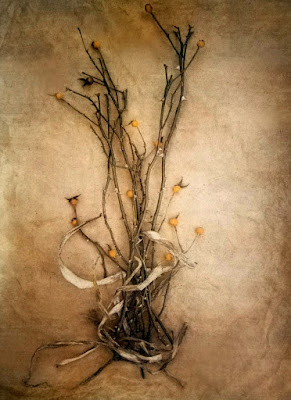
Diana Bloomfield, Rose Hips, 2018,
Tricolor gum bichromate over cyanotype,
12 x 9 inches, Edition of 5, $1,300
p-e:    Can you talk more about why you use this method, or how you feel that it conveys your concepts and interests better than other processes?

DB:     The gum bichromate process is often unpredictable and certainly rife with variables and surprises, frustration and heartache. But when it works, there’s nothing quite like it. And, for me, those surprises and unpredictability make it all the more fascinating.

The repeated layerings are meant to add a tonality and a saturated richness, yet each layer added also serves to remove all the hard, clearly defined edges and sharp clarity. I like that in my images. Softness and ambiguity results-- even in the colors—much the way we see and remember. In that way, this process meshes with my images, which are almost always first seen in my mind’s eye— and that’s never a clear sharp vision. The process itself, where total control is elusive, yet filled with possibilities, also seems a lot like life.

p-e:     Your statement also mentions the act of opening and closing the shutter to create an image as making a statement... and indeed, to choose to capture something in camera is to confer importance on that thing.

DB:     I do consider the act of photographing as a way to preserve both the present moment, and certainly when looking at the photographs later, the past. For me, those images are akin to a visual diary, but one that is less about what happened during my day, and more about what I might have had in my mind at any given time.

p-e:     How do you choose your subject matter for the images you make?

DB:     I tend to work in series, rather than singular photographs. So I have various bodies of ongoing work, some that began decades ago, that still hold my interest and that I continue to grow. Others, like The Old Garden series, began more recently. Something about the subject matter that I see or that I’ve been thinking about, evokes a memory and connection for me. And I try to put that to paper. I also have a continuing figurative series that I began of my daughter, Annalee, twenty years ago. That’s very much a collaborative effort, where she seems to intuit what I’m looking for in an image— and this work is an ongoing narrative.

p-e:     How does narrative or storytelling play a role in your work?

DB:     I do have a running story in my head about each of these different bodies of work. I like to think that each image can exist as a stand-alone narrative. That is, viewers could see an image, and it might evoke certain memories of their own and easily enable them to weave their own unique story around that one image. However, the images are generally meant to work together as a larger and, for the viewer, a wholly interpretive narrative.

Diana Bloomfield, Lambs Ears, 2019, Tricolor gum bichromate over cyanotype, 12 x 9 inches, Edition of 5, $1,300

p-e:     Do events from your own past ever make their way into your subject matter?

DB:     The Old Garden series certainly overlaps the past with the present in a visual intertwining of my grandmother’s urban Southern garden with my own. Mostly, though, that overlapping of past and present is less overt. But certainly, I don’t think any of us can create without the past intruding into our work. My past totally shaped me and informs how I see and experience the world, so to have my past somehow not make its way into my subject matter seems unavoidable.

p-e:     It seems like playing with pinhole cameras, long exposures, and other more experimental formats and processes are also important to your photography practice.

DB:     Yes; the one problem I’ve always found with still photography is that it is, in fact, so still. I love the fluidity of moving films, and short of going into film-making, I find pinhole cameras, with their long exposures and skewed perspectives, offer a similar type of fluidity and movement. In a slightly different way, toy cameras also offer that softness and fluidity. This is true for the tricolor gum process, too. So I use those tools to exploit that softness, ambiguity, and sense of movement and nuance. And I prefer the unpredictability inherent in each.

p-e:      Can you talk more about how unpredictable outcomes or relinquishing control over the final look of an image-making play a part in the work?

Diana Bloomfield, Hydrangea, 2018,
Tricolor gum bichromate over cyanotype,
12 x 9 inches, Edition of 5, $1,200
DB:     I always feel I’m at my creative best when total control is just out of reach, and a certain unpredictability is a constant. I love the surprises, the promise of discovery, and, most especially, the challenge. I work and print in an intuitive way, and all the tools I use easily play into that. I have an idea about how I want a print to look, but I also want to remain open to the possibilities. Those possibilities can often lead to something new and exciting that I had never even contemplated.

p-e:     Color is used in a wide variety of ways in your work. How do you approach handling color when you make a photograph?

DB:     I’ve always loved the fugitive and dynamic nature of color, which never remains constant, but shifts and transforms with the light, and the quality of that light. Consequently, I’ve never really cared that a scene or figure was perfectly aligned with what I saw, because what I actually saw shifted in front of me, and, once in my mind, also remains fluid. So I try to exploit color in the way I saw and remembered it— often two different experiences— while also maintaining the luminous nature of it on paper, which is not easy and not always successful. To do that, I use thin layers so that all the colors might interact with and shine through the previous layers.The goal, for me, is to create depth, while maintaining a translucence. My combination of watercolor pigments and their repeated layerings work to offer a suggestion of color and hues, rather than something specific and identifiable. I’m also aware that color is extremely seductive, so while color may be the thing that initially draws in the viewer, the image itself is what I want people to experience. So I try to create images that could just as easily stand on their own in black and white. I think about that a lot, even when I look at other photographs. I try to ensure the color works in tandem with the image, rather than being the center, or what holds it all together. Also, in my experience, watercolors often seem a bit too happy, so I also tend to print relatively dark— while still maintaining detail — so that a particular mood is created.

p-e:     photo-eye's Gallery Director, Anne Kelly, met you at PhotoNOLA, and recalls that you were well prepared and did an excellent job presenting your work. Tell us about your experience at PhotoNOLA, and what advice you might have for other photographers who are thinking about attending a portfolio review?

DB:     Thank you, and I so enjoyed meeting Anne and talking with her there. PhotoNOLA was the first big portfolio review I had ever participated in, and it was a great experience. I actually got to see all of my top choice reviewers, including two additional reviewers that were assigned. And all of them were interesting and interested, and just fun to talk to. The best piece of advice might be preparation. I do think reviews can be stressful, but if your portfolio is prepared and presented in such a way that you have no regrets about it, then that eliminates one area of stress from the get-go. You can walk in confident. And, really, just be yourself. That sounds simplistic, but being entirely comfortable with who you are, and where you are (in your artistic life) puts everyone at ease. Do not walk in with a slew of expectations. As with anything, just enjoy the experience and the process itself. You have 20 minutes each with some pretty amazing, knowledgeable people who are willing to take the time to look at and talk with you about your artwork. Ask questions, and relish the conversations— with both reviewers and fellow reviewees. Finally, I thought the Portfolio Walk was a real highlight, so always participate in one. There was such great and positive energy at the one in PhotoNOLA. You never know who you’ll meet, or who might see your work and want to talk with you about what you do, and why.


»Read more about Diana Bloomfield Here

All prices listed were current at the time this post was published.

For more information, and to purchase artworks, please contact photo-eye Gallery Staff at:
(505) 988-5152 x 202 or gallery@photoeye.com

Current Exhibition:
Aeroglyphs & Other Nocturnes

Catalogue Available for Preorder
(Shipping Late October)

Aeroglyphs & Other Nocturnes: Photographs by Reuben Wu
Kris Graves Projects, Queens, New York, United States, 2019. In English. 30 pp., 16 color plates, 8½x9" 


                                                                                 »Order the Catalogue


photo-eye Gallery Interview – Karen Kuehn: Maverick Camera Associate Lucas Shaffer spoke with Karen Kuehn about the incredible start to her photographic career, what it was like to craft Maverick Camera, and what's next from her. photo-eye's Maverick Camera exhibition Opening, Artist Reception, and Book Signing is this Saturday, Feb. 25th from 3–5pm.

Cher – © Karen Kuehn

The story of Karen Kuehn's early career is fascinating. Raised in the Californian suburb of Los Alamitos Kuehn volleyed between Art School and Ranging in Glacier National Park during her early 20's before landing a coveted internship with National Geographic in Washington DC in the mid-1980's. By 1985 Karen hits New York City and an incendiary scene lit by the energy of punk rock, Interview Magazine, and Andy Warhol's The Factory, among a myriad of other factors, and grabbed gigs at The New York Times Magazine, Saturday Night Live, and Spy Magazine during her 16 years in the city.

Kuehn's 2016 monograph, Maverick Camera, is primarily centered around her time in NYC. The monograph is a memoir of sorts filled where touching recollections and reflections pertaining to the images are interspersed throughout the book's progression. The Bookstore Project Space Exhibition of the same name, Maverick Camera, features 13 celebrity portraits from the late 80's and early 90's including Cher, Tom Hanks, Robin Williams, Elvira, and David Byrne. 

Associate Lucas Shaffer spoke with Karen Kuehn about the incredible start to her photographic career, what it was like to craft Maverick Camera, and what's next from her. photo-eye's Maverick Camera exhibition Opening, Artist Reception, and Book Signing is this Saturday, Feb. 25th from 3–5pm.

David Byrne • 1991 • NYC • Request Music Magazine – © Karen Kuehn

Lucas Shaffer:      Tell me how you got started and where your interest in photography came from.

Karen Kuehn:      Let’s see. My interest kind of stemmed from my step-father who had a camera, and he was always shooting, and we're all part of his subjects. My Grandfather, too. He would have little Instamatics. When we would go to Yosemite, he would always give me my own little camera.
When I transferred to junior college to take classes they had a photo class. I took a class at Cypress College in California and John Sexton, who was Ansel Adams first assistant, was one of the teachers there. The faculty liked that I was applying ideas to the technical aspect of the zone system photography.

LS:      Where were you living at this time? Were you still living at home, or already on your own?

KK:      I was living at home in Los Alamitos, California. It was like a Doris Day bedroom community. It still is the quintessential suburban neighborhood.

At one point, I turned my bedroom into a darkroom, and I don't know why my parents let me do that, but I put plastic over the beds, and I had my darkroom enlarger on my desk. I would develop everything on my bed because there was no table in there. Then, I would rinse it in the bathtub, which was right around the corner from the bedroom.

About age 20 through 25, I worked for the park service. I was part-time, Seasonal Ranger, and decided that "I don't just want to be a seasonal ranger. I wanted to be a back-country ranger because I really felt akin to horses, I wanted to be in the back-country, I wanted to hike and fish and camp. That's the way we grew up, camping.

LS:      What park were you rangering for? Was it different parks? Was it all in California?


KK:      I went to Yosemite because that's where I kind of spent a lot of my childhood, so I started there and eventually transferred to Glacier NPS. It was awesome. I loved my life. I had no intention of going to New York City, ever. That was not part of my personal plan, having lived in a cabin and hiked a lot of my life and camped, so the last place in mind as a young woman is to live in New York City if you're an outdoors girl, you know?

LS:      How did that take place then? How did that transition happen?


KK:      It was sort of a basic and logical process of getting one’s education. I begged my parents to pay for me to go to art school. I wanted to go to Cal Arts and would have gone the fine art route if it was a little less expensive, but the cost was enormous. I ended up going to Art Center.

Thank You's, 1st Dollar, and Photographic Credentials from Karen Kuehn's National Geographic Internship. Feature in the background is from Kuehn's first assignment covering the Mountain Men of Kluane National Park. 

LS:      It sounds like, even at junior college, you stumbled into an amazing pedigree with John Sexton.

KK:      I did just stumble into Cypress College to do the general education program and the photography classes hooked me. John didn't really put me under his wing. He had a lot of people. He's an absolute, perfect instructor. I think what he does best is teach.

I went through that whole process of learning the zone system and then getting a BA in photography. I was graduating, and I thought, "I'll just go back to the park's service." Then, my classmates were all like, "You've been there, done that. You need to go on and get on with your career."

So I applied for an internship at Rolling Stone and National Geographic. I saw myself at both places. National Geographic called me and awarded one of their coveted internships. Rich Clarkson was stepping into that position, so he's really the person who gave me that opportunity with Tom Kennedy, who was The Assistant Director of Photography.

I went out there for three months, two days after I graduated from school.

LS:      How did your parents feel about the internship?

KK:      That was the moment that validated paying for art school – they're like, "Oh, my God. She is going to be a photographer." We went out and celebrated at my mom's favorite restaurant. Two days later, I'm in D.C. as an intern.

Images of Karen Kuehn, and an excerpt of her personal journal from her early days in New York City. 

LS:       Wow, that is a big change; what was it like?

KK:      I had three months at National Geographic, and when winter came I was like, “Where am I going?" people at Nat Geo said, "You have to go to New York." I said, "Can you keep me here a little longer?" And they did. They let me there another three months. Then I made all these connects and used that internship to walk me into offices.

I arrived in New York with a backpack, a sleeping bag, very little gear, cowboy boots and high heels, a leather mini skirt, and jeans. I really didn't have a lot, but I had 1,000 bucks in my pocket. It wasn't easy. It wasn't really where I saw myself, but I had an amazing journey.

I originally saw myself doing fine art projects and installations, but I needed to have money and sustain myself. Nobody was giving me a trust fund, you know?

LS:      Did you just start freelancing while you were in New York or did you work for an agency?

KK:      For the first year, I just went knocking on doors. New York Magazine was my first job and Nan Goldin was my assignment. That's in that book. It's the first picture in the book. I was fresh off the turnip truck looking like a real farm girl and Nan was lower-east side heroin chic. I had no idea. I was a foreign object to her, and she was a foreign object to me.

Nan Goldin • 1985 • NYC • New York Magazine – © Karen Kuehn

LS:      That’s an incredible first assignment – you show up in New York City, and here's quintessential New York City photographer Nan Goldin, and you're photographing her.

KK:      Yeah. That's kind of how everything happened. Every week I would go out, I would get a call. "Hey, can you go photograph this band, or this person, or project?" I stumbled through it; I figured it out.

I like people, so it was fun relating to another person; I wasn't really a nature photographer. I would welcome that now, but it wasn't really what I went after. I kind of had this connection with people. I can figure out people quickly.

LS:      Looking through the portraits in Maverick Camera, it seems like you connect with your subjects. What is it like to build rapport and that kind of connection with your subjects so quickly, especially when they're celebrities?

KK:      I think it's like ... It's like cooking to me. You have to have all the ingredients in front of you to create something. For me, I always research everybody I photograph.

It's also important to allow them to be part of that process, whereas, I know a lot of photographers just document somebody. I think about the details. I like telling a story. I like it to be accurate. I like to co-create it with a person so I'm always trying to run ideas by them.

Bill Murray • 1989 • NYC • New York Times Sunday Magazine © Karen Kuehn

LS:      How did Maverick Camera the book come about, and as you were working on it, what was it like putting it together – to go through, 25 years of pictures?

KK:      It came about because of a friend of mine Larry Mitchell, a guitar player. He's always like, "Why don't you have a book out? You should have had a book out years ago." I just didn't play that game. Larry finally prodded me enough and in 2009, I started pulling images. As I pulled it together, and it became like nine books – I have 25 oak wooden file cabinets full of negatives from my career in New York City.

I just started pulling and separating everything. "Here's the Saturday Night Live book. Here's the musician book. Here's the writer book."... "Here's the pregnant book." There were 50 pregnant women shots. After a while, I started to zero in like, “I think I just want to talk about my New York years because I don't think everybody gets to go to New York." I think what happened to me and how I made it kind of work was really a pretty amazing experience.

LS:      The way your career began sounds almost storybook.


KK:      ... It was storybook. I look at Maverick Camera, and I'm like, "I don't even know that person now." That's a whole other person. I'm glad I am who I am now. That book and all those experiences got me to this point.

Sean Penn • 1987 • NYC • Saturday Night Live – © Karen Kuehn

LS:      Can you talk a little bit about that? What was it like for you when you were putting that book together – was it complicated to look at your past?

KK:      Yeah. I mean … I'm a task master, and this comes from my mother.

My son and I both agree that we're a lot like Grandma. We just go get it done. I'm a big fan of making a list, manifest, go down that list, achieve what you need to do, grow and move forward. My whole life has gone that way. I just started pulling images. I made this journal, and I wrote about each image.

LS:       How long did it take you from start to finish. The project started in 2009 and the book was published in 2016, so that's what? Seven years?

KK:       Yes, 2009, and in between, I published five other books about Burning Man.

LS:       When you started putting the final edit together, how did the reflections start? Had you decided early on to write about each photograph or did that decision come out of the editing process?


KK:      I just had my list of pictures and I was saying, "Wow, I hope I can remember all this accurately enough." I thought, "Well, I better do this now because I probably won't in another ten years. So, I wrote.

Excerpt from Maverick Camera with an image of Spike Lee and recollection about the experience. 

LS:      To be consistently creative and execute those ideas under tight time constraints is pretty special.

KK:      Well, it's a ... Why else are we here? To me, it's all just in the pot. Everything inspires me. I probably work outside so much just to relax my brain, otherwise, my brain is just on all the time, I need nature. I prim roses like Edward Scissorhands. I'm in there.

LS:      Why did you end up leaving New York?

KK:      I need the smell of grass. I need green all around me. I need roses. I wanted my kid to grow up somewhere besides a library or a pool hall.

I just wanted to be outside, and we achieved that. Was it a career move? I don't know. Maybe in ten years, it will be when I get to another level, but for me, it was a healthy move on a lot of levels.

Maverick Camera is a big chapter in my life, definitely... it’s 16 years of my life, and flying by the seat of my pants. I wasn't really living in the past or in the future. I was so in the moment. The phone rings, "Hey, do you want to go to Maine and do a story on Camden." And you go.

Steve Martin • 1987 • NYC • SNL – © Karen Kuehn

LS:      What’s next for you?

KK:      I probably could have marketed my career bigger with my name over the years, but I didn't. I think my ego has stayed intact and humble, but I want the work out there. I have other projects to do. I have projects that I want to do that are about animals. I need people to be more aware of animals and their energy and that their sentient beings.

I'm in the local 600 Union. I'm doing promotional and still shooting on films because that's what's happening in New Mexico. At the same time, I also have artistic ideas that I want to make happen in the next ten years. Every day is anew and the phone rings and I go. Always something to do and create.

– photo-eye

Karen Kuehn's Maverick Camera is on view at photo-eye Bookstore Project Space through April 29th, 2017. Karen will be on hand to sign copies of her monograph from 3–5pm Saturday, February 25th during the exhibition opening.

14 x 14-inch Archival Pigment Prints from the exhibition are available for purchase for $500, and Silver-Gelatin prints are available starting at $1500. Signed copies of the Maverick Camera book are available to order for $100.

For more information, and to purchase prints, please contact Lucas Shaffer at 505-988-5152 x 114 or lucas@photoeye.com.

Purchase a SIGNED copy of Maverick Camera