PHOTOBOOK REVIEWS, INTERVIEWS AND WRITE-UPS
ALONG WITH THE LATEST PHOTO-EYE NEWS

Social Media

New Works by Nick Brandt to be Released Today
Ranger with Tusks of Killed Elephant, Amboseli 2011Sizes Available: 22x27.5", 40x50", and 56x70"
Line of Rangers Holding Tusks of Killed Elephants, Amboseli 2011 Sizes Available: 21.7x40", 32.6x60", and 40x73.7"
Two Rangers With Tusks of Killed Elephant, Amboseli 2011 Sizes Available: 22x27.5", 40x50", and 56x70"
Calcified Caped Dove, Lake Natron 2010 Sizes Available: 22x27.5" and 40x50"
Calcified Bat, Lake Natron 2010Sizes Available: 22x27.5" and 40x50"
Calcified Reflected Flamingo, Lake Natron 2010 Sizes Available: 22x26.3" and 40x47.8"
Calcified Songbird, Lake Natron 2010 Sizes Available: 22x27.5"

Portrait of Elephant on Bare Earth, Amboseli 2011 Sizes Available: 22x27.5", 40x50", and 56x70"
Elephant Skull, Amboseli 2010 Sizes Available: 20x40", 31x60", and 40x77.5"
Kilimanjaro Lioness, Amboseli 2010 Sizes Available: 20.5x40" and 31x60"
Giraffe Skull, Amboseli 2010 Sizes Available: 22x27.5" and 40x50"
Hyena in Water, Amboseli 2010 Sizes Available: 22x22" and 40x40"
Elephants Alone on Lake Bed, Amboseli 2010 Sizes Available: 22x27.5"
Portrait of Elephant in Dust, Amboseli 2011 Sizes Available: 22x24.5", 40x44.5", and 56x66.3"
Elephant Against Sky, Amboseli 2011 Sizes Available: 22x27.5", 40x50", and 56x70"
Elephant with Half Ear, Amboseli 2010 Sizes Available: 22x27.5", 40x50", and 56x70"
Lion Couple on Rock, Serengeti 2010 Sizes Available: 22x27.5", and 40x50"
Calcified Mousebird, Lake Natron 2010 Sizes Available: 22x27.5"
Giraffe Running on Lake Bed, Amboseli 2010 Sizes Available: 22x27.5"
Wildebeest Skull, Amboseli 2010 Sizes Available: 22x27.5" and 40x50"
Portrait of Young Elephant in, Amboseli 2011 Sizes Available: 22x7.5", 40x50", and 56x70"
Leopard Staring, Masai Mara 2010 Sizes Available: 22x7.5" and 40x50"

OPEN EDITION PHOTOGRAPH
100% OF ALL PROCEEDS GO TO BIG LIFE FOUNDATION
Elephant Bull with Dust, Amboseli 2010 Sizes Available: 12x12" and 21x21"
please visit http://www.biglifeafrica.org/charityprints to order

To purchase, please contact photo-eye Associate Director Anne Kelly or by calling (505) 988-5152 x 202

All images ©Nick Brandt All Rights Reserved

Purchase a copy of Nick Brandt's newest book, On This Earth, A Shadow Falls, here
Mexico Roma, Photographs by Graciela Iturbide.
Published by RM, 2011.
Mexico Roma
Reviewed by Alexandra Huddleston
_____________________________________
Graciela Iturbide Mexico Roma
Photographs by Graciela Iturbide
RM, 2011. Softcover. 96 pp., 50 illustrations, 6-1/2x8-1/4".

Graciela Iturbide's newest book Mexico Roma feels and looks like one (beautifully designed) volume from a traveler's archive of scrapbooks. However, this is the only volume published. If its companions exist, they are yet to be made. At 6.5 by 8 inches and just 96 pages, it's the size and shape of a journal that would fit easily into a purse or camera case. The cover is a textured, muted powder blue with no photograph, only what looks like an adhesive red-trimmed name-tag (which the artist apparently picked up in Bolivia) stuck in the middle and filled with a handwritten title: "Mexico" for the front side of the book and "Roma" for the back. The interior pages are a thin, rough, creamy stock that has a tactile grace, but one that adds a dark, grainy, and rough quality to the photographs. From what Iturbide has said about the book, the photographs are in fact a highly culled selection from her archives of these two locations, though she pulled the Mexico work from images shot between 1974 and 2009 while the photographs of Rome were all made in 2007.

Iturbide has been working in the medium for over forty years. She always shoots film, primarily black and white, and while she has worked on projects all over the world, her most famous work has been on the life of traditional communities in Mexico. Her latest projects -- including her last book Asor and the publication currently under discussion -- have turned away from documentary subjects. The medium is still beautiful black and white film photography, but now the photographs tend towards a poetic description of place, filled with the signs of human presence, but the absence of actual people.

Mexico Roma, by Graciela Iturbide. Published by RM, 2011.
The book begins with 24 photographs from Mexico. Present are Iturbide's signature birds, but also bees, dogs, ruins, skeletons, constructions sites, bound rocks, Catholic imagery, hats, lonely chairs, demonic wheeled vehicles, holes (maybe bullet holes?) in walls, and other mysterious architectural protuberances. A person of true visual intelligence has sequenced the photographs so what otherwise might feel haphazard becomes a seamless flow. From the back forward begins the story of Rome with another 24 photographs. The birds appear again, but this time cats, kites, sidewalk art, railroads, fallen planets, bugs, dogs, crocodiles, grungy streets and beaches, and imprisoning shadows and vegetation dominate the flow of images. These two sections are linked in the middle by an x-ray of the artist's feet, on which she has had a number of operations.

Mexico Roma, by Graciela Iturbide. Published by RM, 2011.
Which leaves the question, Why? Why Mexico and Rome-not even Mexico City and Rome, but two unequal geographies filled out by an equal quantity of photographs taken over vastly unequal periods of time...and linked by the feet? Iturbide has said that the only connection is her intuition and her eye, which leads us to the quotation that frame the book. The Mexico section begins with a quotation, in Spanish, purportedly said by the Aztec emperor Moctezuma upon first meeting Cortez ("purportedly" because, of course, Moctezuma did not speak Spanish and the only records that remain of his words and actions were written after the fact by the Spanish conquerors). It finishes: "...it is that I have already seen, it is that I have put my eyes in your eyes (Es que ya te he visto, es que ya he puesto mis ojos en tus ojos...)." And isn't that what every photographer, including Iturbide, does through her work? The vision of these two locations she gives us is uniquely her vision. Moreover, it's her vision shot, on average, at eye level and between 2 and 10 feet from her subject...in other words, the perspective of a pedestrian (and one with painful feet). The second quotation, the final stanza in a poem by Francisco de Quevedo, a seventeenth century Spanish poet, aristocrat, and courtier, can equally be taken as an apt description of photography. It ends: "...and nothing but what is elusive stays and will endure (...y solamente lo fugitivo permanece y dura)." The quotations seem to set out Iturbide's philosophy on photography rather than a philosophy for the book.

Mexico Roma, by Graciela Iturbide. Published by RM, 2011.


In the end, this book is exactly what it appears to be: a beautifully designed and beautifully edited scrapbook of a traveler and photographer, linked only by where her eyes and her feet took her over what were surely many miles of pavement. There are many photography books whose only conceptual glue is the artist's 'intuition.' Most of them feel limp and lifeless. Iturbide's intuition towards her native Mexico is rooted in a lifelong knowledge of the place, and her country's half of the book is without a doubt much stronger than Rome's half. However, with its skillful but modest design and presentation, its flawless sequencing, and Iturbide's own evocative symbolic language Mexico Roma manages to please. If there are other volumes to come: Welcome!—Alexandra Huddleston

purchase book

_____________________________
Alexandra Huddleston is an American photographer who was born in Freetown, Sierra Leone, and grew up in the Washington, DC area and in West Africa. She holds an MS in broadcast journalism from Columbia University and a BA in studio art and East Asian studies from Stanford University. In 2007 she was awarded a Fulbright Grant to photograph and research the legacy of traditional Islamic scholarship in Timbuktu, Mali. Photographs from her Timbuktu work have been included in the permanent collection of the US Library of Congress Prints and Photographs Division and exhibited worldwide. Her current work in progress explores a pilgrim’s life along the Camino de Santiago in northern Spain and the Shikoku Henro, a pilgrimage of 88 temples on the island of Shikoku, Japan.
Dondoro by Estelle Hanania
Dondoro, a slim and elegant volume from Estelle Hanania, is a collaboration with the late master puppeteer and puppet maker Hoichi Okamoto. Named after the theater Okamoto founded and published after his death in 2010, the book is a meditation Okamoto’s on art -- strange and somber images of puppets that seem eerily alive while they simultaneously show the magnificently skilled hand of the crafter. A few of these images appeared in the wonderfully edited Myriorama, a mingling of several of Hanania's projects exploring the transformative power of costume and traditional means of storytelling. The puppets shown here are somewhat of a hybrid between puppet and costume, designed to use the body of the puppeteer to animate the character.

The book opens with images of puppets in situ – seated or hanging in storage, lit from unusual sources, appearing almost as if the light was emanating from within. Though we are clearly viewing inanimate objects, obviously hand crafted, it becomes evident in the first few pages that we are not merely looking at pictures of puppets, but portraits of them – something all the more personal and haunting. As the book progresses they become all the more alive – appearing outdoors and being skillfully performed by Okamoto. But while their postures shift, their faces don’t – their expressions remain unchanging. It is an odd tension, bodies that seem at once alive and full of emotion, powerful, but also fragile, yet entirely static, inert, though expertly posed. The constantly shifting balance between the real and the fabricated, the alive and inanimate, and the blurring of those lines makes this a quietly compelling series of images, and one that becomes richer on repeat viewing.

from Dondoro
 An image (also on the cover) features two odd forms, both human-like, but both a bit uncanny. We see the visage of a pale woman with flowing black hair, clothed in a white robe and exceptionally tall. Behind her stands a silhouette – a man, Okamoto, clothed entirely in black, including his face. He is a shadow lurking behind the woman, a spirit, almost invisible, yet eerily present. Quite literally, he is the man behind all of these puppets, imbuing them with life. Okamoto appears and disappears throughout the pages, and we never catch more than a glimpse of part of his face. The puppets borrow his hands and body, they obscure him while he brings them to life. While his form is only evident in flashes, in reality we are looking at him the entire time. These portraits of puppets cumulatively render a portrait of the artist himself and his power to sculpt and perform his creations of astounding resonant emotion.

from Dondoro
from Dondoro
 The inside covers of Dondoro feature contact prints of Hanania’s sessions with Okamoto – a few images from these series ended up in these pages. These contact sheets reveal the movement that is missing from the images presented in the book – the transformations that happen as Okamoto is performing, as the story is being told. I find these sequences of images fascinating – an entirely new way to look at this body of work – and am left wondering what could come of utilizing them for something more than intriguing end paper. -- Sarah Bradley

Purchase a copy of Dondoro
Artists presenting: Edward Ranney and Christopher Benson presenting the work of Richard Benson
September 7th, 2011, 6:30-9:00 Salon, exhibit preview of Axle Contemporary
photo-eye Gallery, 376-A Garcia Street, Santa Fe, NM 87501
Contact: Antone Dolezal, 505.988.5152 x 11

 
First Wednesday's September Salon will be held on September 7th, 2011. Photographer Edward Ranney will speak about his extensive career as a photographer working in the country of Peru and the American West. Painter, gallerist and custom book maker Christopher Benson will speak about his uncle Richard Benson's career as a photographer, photo historian and author, as well as discuss his own publication company The Fisher Press. In addition to the Salon, Axle Contemporary (mobile gallery) will be parked outside of photo-eye Gallery for a preview of their new exhibition, I Am Animal, Vegetable, Mineral.

Double Life, Photographs by Kelli Connell.
Published by Decode Books, 2011.
Double Life
Reviewed by David Ondrik
__________________________________
Kelli Connell Double Life
Photographs by Kelli Connell. Text by Susan Bright. Interview by Dawoud Bey.
Decode Books, 2011. Hardbound. 80 pp., 36 color illustrations, 12-1/4x9-1/2".

I've been a fan of Kelli Connell's body of work since stumbling upon her website a few years ago. I was delighted to learn that Decode Books has published Double Life, a handsome casebound book of her photographs. There are 36 full color reproductions of her images, an introductory essay by Susan Bright, and a closing interview with Dawoud Bey.

The images in Double Life explore the life of two women who share a deeply intimate relationship. We see them engaged in their life together: sorting out the bills, playing pool, arguing, and talking a bath. What is transfixing about the images is that the same woman is playing both roles (think Hayley Mills, but less saccharine), and this moves the entire body of work into a complex psychological space. The photographs, which read as candid moments captured on film rather than carefully arranged digital constructs, ask us to consider a wider and more nuanced range of possibilities than if they were simply intimate images of a real-life couple. The collaging of separate negatives is seamless and the emotion expressed is so strong that we accept them for what they appear to be. Connell's model, Kiba Jacobson, is expertly directed so we believe every emotive encounter in the photographs truly happened. Of course, the images are fiction; the two women are one, and they never interacted with each other as photographed.

Double Life, by Kelli Connell. Published by Decode Books, 2011.
 Photographers who mess with the "truthiness" of the medium can transcend a specific event and break away from the camera's literalness. Here we're allowed to go beyond a specific couple's specific relationship (since there never was one) and consider the broader conceptual ground Connell is standing on. The big idea of Double Life is an exploration of sexuality and our connection to our personal identities. The women in these photographs clearly have an intimate, but sometimes undefined, relationship. In "Convertible Kiss" and "Sunday Afternoon" they are clearly lovers, while in "Road Trip" and "Pool Shark" they could be friends out for a platonic good time. In the interview with Bey, Connell states that the images are influenced by relationships she has experienced, either personally or vicariously, and this comes across in the intensity of the images. Although sexuality and gender relations emerge as a surface interpretation, it's clear that the root of the images explore the relationship we have with our selves. There is no narcissism or arrogance here; instead there is an expression of the principle that to truly love another we must first find the wisdom to determine and accept ourselves, warts and all.—David Ondrik

_____________________________
David Ondrik has lived in Albuquerque since the late 1970s. He was introduced to photography in high school and quickly appropriated his father’s Canon A-1 so that he could pursue this exciting artistic medium. He received his BFA, with an emphasis in photography, from the University of New Mexico and has been involved in the medium ever since. Ondrik is also a National Teaching Board Certified high school art teacher.
I’m here in Moscow having just completed my participation as a reviewer in the first international Russian portfolio review. Over 200 photographers, selected from over 2000 from all across Russia, presented their work to over 50 reviewers from around the world. These reviewers included curators, gallery directors, publishers, editors and other notables in the field from Europe, the U.S., Latin America, Australia and Russia. Portfolio Review Russia was held in collaboration with Houston's FotoFest, the Iris Foundation and the Russian International News Agency RIA Novosti. 

The reviews were held in a fantastic art space known as the Garage (Garage Centre for Contemporary Culture) where important contemporary art exhibits are regularly shown. A James Turrell show just ended prior to our arrival. 

Garage Centre for Contemporary Culture


The reviewer space within the Garage
The work I reviewed ranged from traditional documentary work exploring Russian culture before and after Perastroika, Russian Constructivist influenced artworks, poetic pictures that were personal self-explorations, zines and self-published books, to works inspired by Alec Soth and other western contemporary photographers. I hope to show the best of these photographers on our website later this fall.

Evgeny Berezner, head of the Russian team organizing the event in Moscow stated the event's purpose clearly: "This portfolio review provides talented Russian photographers with face-to-face, personal opportunities to introduce their work to leaders of the international photography art scene. Cultural leaders will have an unprecedented opportunity to see the emerging Russian photographic community as well as new creative initiatives and the professional infrastructure of contemporary Russian photography."

For years now, I have noticed a move in the art world to make art more affordable. Many of the larger names and best known and sought-after artists can still charge top dollar for their pieces, but there seems to be an unavoidable trend towards art for the masses. The Affordable Art Fair New York has now launched a second fair in Los Angeles and the ramping up of self-published books, wide acceptance of zine culture, enterprising young artists selling inexpensive pieces on their own and -- importantly -- the acceptance of many of these trends by mainstream collectors, has prompted entrepreneurial spirits like Jen Bekman to launch 20x200 and later 50x500 series, Kevin Mizaki's to found the not-for-profit Collect.give and Jennifer Schwartz Gallery to commission her gallery artists to produce inexpensive portfolios in The Ten.

At photo-eye we are always pleased to announce limited edition books with prints, but sometimes worry that with the name "limited edition" attached to the title some people might steer clear fearing the high cost usually associated with that label. But fear not, affordable art is here at photo-eye as well and we wanted to point out a few of these reasonably priced limited editions before they disappear. All of the images shown below represent the print that accompanies the book -- and they are all under $200.

From Ian Teh's Traces. C-print, edition of 100, signed and numbered, $165.00


Irina Rozovsky's One to Nothing, 8x8" archival pigment print, edition of 50, signed, numbered 
and dated on verso, $140.00
Yael Ben-Zion's 5683 Miles Away, 11x11" C-print, edition of 100 + 5 AP, signed 
and numbered, $150.00

Michael Schmelling's Atlanta, 8x10" C-print, edition of 100, signed with and a handwritten 
list of Atlanta street names, $100.00 
Jim Krantz's Homage: Remembering Chernobyl, one of two print options, 8x10" archival 
pigment print with signed book, edition of 25, $125.00


West and South, Photographs by John Mathews.
Published by Hatje Cantz, 2011.
West and South
Reviewed by John Mathews
____________________________
Charles Brittin West and South
Photographs by Charles Brittin. Edited by Kristine McKenna, Lorraine Wild, Roman Alonso, Lisa Eisner.
Hatje Cantz, 2011. Hardbound. 216 pp., 150 duotone illustrations, 9-1/2x13".

West and South begins in the late 1950s by looking at an idiosyncratic group of young artists, actors and writers living in Venice Beach, California. This ragtag bohemian community is drawn together by the artists Wally and Shirley Berman who feature throughout the series. Photographer Charles Brittin successfully captures the offbeat characteristics of this group -- their exuberance, individuality and playful sense of defiance. The images have an innocent and melancholy tone to them, as if the people within them have been captured in a fragile state of transition. The enigmatic nature of the Venice series is accentuated by Brittin's technique of interspersing haunting images of the area such as empty fairgrounds or black clad nuns wandering an otherwise deserted beach. However there is an underlying tension within the area, which is evident in a number of images showing the harassment and closure of beat venues by local authorities.

West and South, by Charles Brittin. Published by Hatje Cantz, 2011.
 In the second half of the book, Brittin dramatically shifts gear by transporting the viewer away from the pensive mood of the artist colony and into the turmoil of the civil rights movement of the 1960s. These images are the most dramatic within the book and graphically show activists struggling for racial equality within areas such as LA, Louisiana and Alabama. Brittin explores the poverty within these communities that motivated the formation of action groups such as CORE (The Congress of Racial Equality) and the Black Panther Party and documents the fear and aggression these groups were confronted with. A memorable example is an image from a 1964 CORE protest that shows a group of African Americans peacefully campaigning against segregated housing in Los Angeles while an intimidating group from the American Nazi party dressed in full Nazi military uniforms stage a counter protest. These two groups march in opposing directions and are separated only by a thin stretch of perfectly manicured lawn.

West and South, by Charles Brittin. Published by Hatje Cantz, 2011.
 Feeling an affinity with those on the margins of society, Brittin goes on a journey of self-discovery, developing his style and finding his voice through the beat generation of Venice. Brittin's approach and subject matter quickly mature as he takes a more politicised stance by documenting the civil rights movement. West and South is a testament to Brittin's growing awareness and is a poignant social document of turbulent times within the United States.—John Mathews
_____________________________
John Mathews is an artist and curator from Belfast, Northern Ireland.
photo-eye is pleased to announce the newest addition to the Photographers Showcase-- Svjetlana Tepavcevic and her portfolio The Sea Inside (Portraits of Waves)

The Sea Inside (Portraits of Waves) no. 181 -- Svjetlana Tepavcevic
 Perhaps it is only fitting that I write this post having only recently been evacuated from the Delaware coast in advance of Hurricane Irene.  Growing up along the Eastern Seaboard, I have always had a deep connection to the ocean and the power felt through its waves.

As a child I can recall attempting to find a pattern, order or structure to this awesome force of nature (in my case hoping to ride the best wave into shore). I fondly remember being tossed about, violently thrown back to land only to (in a daze) stagger back to the sea to ride again.  Tepavcevic's photographs pay homage to all of those feelings. 
Fraught with dialogues and complexities, waves are a metaphor for life. Mysterious and violent, at once they symbolize birth and destruction; force and fragility; chaos and peace. The same force that gives them life takes it away, often in the course of a human breath. Waves come and go, too fast for the eye to focus on their fleeting gestures, so our minds find comfort in their predictability and similarity. And yet, no two waves are ever alike -- they embody the idea of the infinite. -- Svjetlana Tepavcevic
The Sea Inside (Portraits of Waves) no. 3982 -- Svjetlana Tepavcevic


Tepavcevic is certainly not the first photographer to tackle the subject of the sea.  I am reminded of the calm serenity of Hiroshi Sugimoto's Seascapes or the chilling violence of Lisa Robinson's Oceana. But Tepavcevic's photographs feel infinitely more expressive to me, almost of a pen and ink nature.  To me they suggest a controlled randomness that only we can think to impose on nature. 

"Ocean waves are untamable, but I photographed them as if I could somehow tame them, as if I could calm them and find peace inside them," Tepavcevic says.

--Cliff Shapiro

See Svjetlana Tepavcevic's full portfolio The Sea Inside (Portraits of Waves) on the Photographer's Showcase here.

For more information on Tepavcevic's work, please contact photo-eye Gallery Associate Director Anne Kelly by email or by calling the gallery at (505) 988-5152 x202
Photographic Memory -- Edited by Verna Posever Curtis
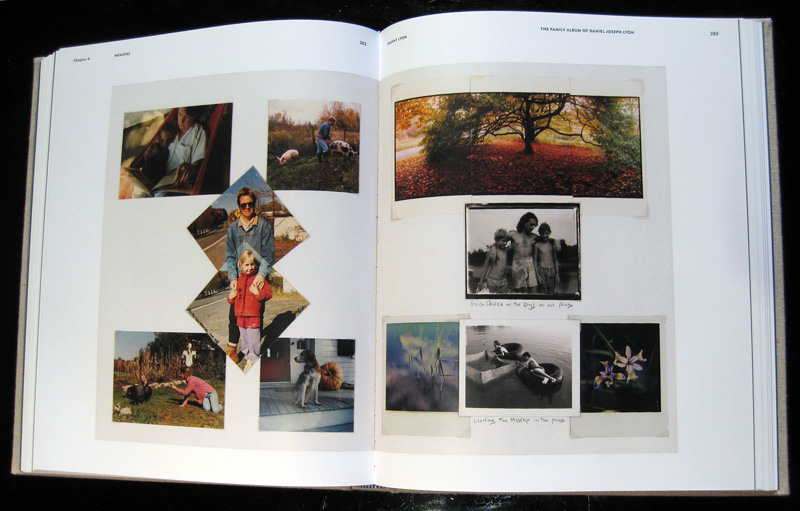
New from Aperture, Photographic Memory: The Album in the Age of Photography, edited by Verna Posever Curtis, is a look into the art of the photo album. Culled from the vast collection of albums in the archives of the Library of Congress, Photographic Memory organizes the 24 featured albums into five categories, Souvenirs & Mementos, Presentations, Documents, Memoirs, Creative Process. The book opens with an essay on the history of the photo album and includes texts on the status of the album in the digital age, the preservation of these precious objects, notes and an index. Each album presentation opens with a photograph of the closed book facing the story of the album and its compiler and how it came to be in the collection of the Library of Congress. The types of albums contained within run the gamut: political mementos from US campaigns, Nazi propaganda, precursors to landmarks in the history of photobooks like Let Us Now Praise Famous Men and notebooks complied from the photographs of Dorothea Lange, documents of expeditions, the personal war album of General Patton, family albums and even a collection of photographs of beautiful, sleek and eerie looking airships.
from Photographic Memory
 The cohesion of this collection is found in the wonderful manner in which the albums are presented. Photographing the books as a whole, the images show full page spreads, allowing the albums to lay open as they would if viewed on a table. Page layouts vary -- some featuring a grid of images while others align the seam of the album with the gutter of the book, making them feel even more alive. This technique has also been employed with much success by the Books on Books series, and is the ideal way to communicate the object beyond the images. Photographic Memory celebrates some of the most resonate qualities of these constructions -- the hand of the maker in the album and the shear physicality of the object. Shown in this manner, the albums appear more tactile and personal, full of handwritten captions, notes and illustrations, discoloration and foxing, photocorners, paper clips and a variety of bindings in an array of conditions.

from Photographic Memory
Some of my personal favorites -- the handwritten narration and illustrations accompanying George F. Nelson's Alaska; the gorgeous detail work and ornamentation in Jean Anthony Varicle's Sketches of the Northland, including the handmade caribou skin cover, complete with magnificent hand lettered titles and bark and real gold embellishments; the stunning and personal family album of Danny Lyons, innovative in its design and reproduced here with the handwritten captions just large enough to be readable; the beautiful images from the private album of Max Waldman called Color Town; the tiny contact prints that make up the almost haphazardly arrangement of images in Alan Lomax's Spanish Photo Notebooks, his first real effort to visually document his historic field-recording trips. Though Photographic Memory only shows a few pages from each of these fascinating volumes, it is a book that encourages return viewings. I would imagine that a number of the albums in this book could do well as full reproductions, and makes the case for the album to be considered a unique genre of book art. -- Sarah Bradley

Purchase a copy of Photographic Memory.
There Was A Forest, Photographs by Loli Kantor.
Published by Loli Kantor with L. Nowlin Gallery, 2010.
There Was A Forest
Reviewed by Richard Gordon
______________________________________
 Loli Kantor There Was A Forest: Jewish Life in Europe Today, 2005-2008.
Photographs by Loli Kantor
L. Nowlin Gallery, 2010. 88pp., illustrated throughout, 6-1/2x8-1/2".

"The critique of culture is confronted with the last stage in the dialectic of culture and barbarism: to write a poem after Auschwitz is barbaric, and that corrodes also the knowledge which expresses why it has become impossible to write poetry today." -- Theodore Adorno

Loli Kantor's There Was A Forest is one more necessary act of reclamation, an act at once deeply intimate and personal, and one that cannot help but be political. This work is one of many from the past thirty years which refutes and consciously or unconsciously confronts Adorno's once famous dictum. Adorno wrote it a few years after the end of WWII and it was not until the voices of survivors had to tell their stories that Adorno's dictum broke down.

The disbelief in the late years of WWII and for some years to come after, the inability to understand the enormity of the factories of death gave breath and life to Adorno's dictum. Sixty or so years ago, the audience for Adorno mostly knew and grew up with the horrors of WWI's trench warfare, the introduction of chemicals to the battlefield, and the cruel extension to the historically ancient practice of rending violence upon civilians by bombing from the air in the Spanish Civil War. The death camps and the wholesale murder by non-industrialized means-shootings in the forests in the lands photographed by Kantor (which is how and where my uncle, his wife and their three children were murdered) raised (or is it lowered?) the bar of inhumanity.

There Was A Forest, by Loli Kantor. Published by Loli Kantor with L. Nowlin Gallery, 2010.
The remaining survivors are now old and very old people. The child of survivors, Loli Kantor is of the generation of the artists who need to make memory tangible. Using different cameras, color as well as B&W (printed in Palladium), she moves between documentary, snapshot and a dream state effectively. The sub-title of the book is Jewish Life in Eastern Europe Today. Without the captions, a fair number of the photographs could as easily be of non-Jewish life in small towns in Eastern Europe. This was so before WWII, and it is not surprising that it is still so. What is a mystery is the continuance of Jewish life in Poland and more broadly, the pale. Kantor also does oral history -- an expanded version of this book would be richer with a CD.

There Was A Forest, by Loli Kantor. Published by Loli Kantor with L. Nowlin Gallery, 2010.
I would wish to see both an expanded version for the documentary value, and I would as well like to see another book which excludes the documentary for the dream-like photographs. Imagine those dancing Rabbis from Drohobych and an introduction made up of quotations from Bruno Schulz's phantasmagoric tales. The forward to the book as it is by Danna Taggar Heller is a good introduction to Kantor and her intentions. As it is, the current book is a welcome addition to the literature of memory.—Richard Gordon

 *Published by Loli Kantor with the generous support of L. Nowlin gallery.


purchase book

_____________________________
Richard Gordon is a photographer who lives in California. His photographs and artist's books are in museum and library special collections from sea to shining see. Photographs from Gordon''s American Surveillance (available from photo-eye) were in the recent, Exposed exhibition at The Tate Modern, and SFMoma.
from the book Supreme Vice
Last week I embarked on a trip through the deserts of Death Valley and Western Nevada. This was my first time in either place and I couldn’t help but think I had been in this God forsaken landscape before. This desolate environment created an otherworldly sense of isolation and paranoia. Sure, it could have been the thousands of acres of underground US military facilities I was driving over and the sporadic black SUVs one would catch a glimpse of from a distant hill that sent chills down my spine in the triple digit heat, but I think it had more to do with the bleak view of this mountainous region that not only felt unfamiliar... there was a sense I had somehow found my way into another dimension.

After finding my way back to reality and settling into the comfort of my book filled office I picked up a copy of Tereza Zelenkova’s Supreme Vice and while absorbing the images had an immediate flashback to last week’s experience. Come to find out, the landscapes in this book were taken in the deserts of the American West, specifically in Death Valley. Zelenkova’s book conveys a detachment from reality that is structured through her desolate depictions of the barren desert. This structure suits the book well given the artist’s vision of weaving her Gnostic view of occult symbolism and mysterious landscapes together. This is a series that uses simplistic imagery in a manner that creates a powerful narrative, a narrative that depicts a deeply rooted undertone of isolation and a sense of spiritual exploration.

from the book Supreme Vice


Supreme Vice is another stunningly printed object published by Morel Books. While modest in design, this book is thoughtfully crafted and tightly edited. In many ways, the editing of this series sharpens the focus of the story Zelenkova has set out to tell. It is a series that grabs at the viewer and forces a connection that transcends multiple levels. Whether it is a connection to the spiritual symbolism of the images or the drastically different depictions of the American West this young Czech photographer has created, this is a book of thoughtful intrigue and beautiful design. -- Antone Dolezal

Purchase a copy of Supreme Vice
One To Nothing, Photographs by Irina Rozovsky .
Published by Kehrer Verlag, Heidelberg, 2011.
One To Nothing
Reviewed by Adam Bell
____________________________________
Irina Rozovsky One To Nothing
Photographs by Irina Rozovsky
Kehrer Verlag, Heidelberg, 2011. Hardbound. 72 pp., 55 color illustrations, 8-1/4x8-1/4".

How does one take a picture of Israel and not account for the conflict? The proverbial elephant in the room? To an outsider, inundated by the news, such an approach seems impossible, or maybe even morally irresponsible. Irina Rozovsky's book One To Nothing examines contemporary Israel as a complex, but contest site - never giving us an answer, but leaving clues throughout. The very title, One To Nothing, suggest a zero sum game, or at the very least a slight edge, but to whom or what? What is refreshing is that the winner never emerges. Is it Israel and Palestine locked in struggle, or man, Arab or Jew, struggling in a land of dust and swelter? Rozovsky's Isreal is a land of modern ruins and ancient mysteries that never offers solutions, only questions and riddles.

One to Nothing, by Irina Rozovsky. Published by Kehrer Verlag, 2011.

Shot with a Hasseblad, the square format images have an inquisitive and evidentiary quality - pointing and forcing you to look. Rozovsky's utilizes a rich, but understated palette of colors. The dry and dusty landscape of the Middle East clashes with the rich colors of night, ancient paintings and the blossoming foliage of gardens and parks. Shot over the course of two years (2008-10), during several road trips in Israel, the book is much more than a road trip or simple travelogue. Paging through the book, I was reminded of Leo Rubinfien's magisterial Map of the East, which uses the 'East' as a starting point to explore a much larger and poignant personal journey. Like Rubinfien's book, Rozovsky does not confuse her subject with meaning, and aims for something deeper.

Fearful that their images will be too explicit, photographers often use claims of ambiguity as a mask for a lack of clarity, editing or intent. Rozovsky's images are surprising and mysterious, but nevertheless grounded. The tensions between past and present are explored in ways that are refreshing and subtle. In one pairing, the photo on the left reveals a crooked painting of Christ hanging above two large ladders (Christ's wrapped body echoing the prone diagonals formed by the two ladders), and to the right is an image of a man squeezing through the fenced turnstile of an ancient rampart. No clue is given to where the painting hangs, where the man is going, or why he needs to circumvent the ramshackle security gate. Throughout the book, the ancient and modern are precariously woven together by fragile filaments - awkwardly cohabitating a space that barely has enough room for the ancient history that hangs heavy over the land.

One to Nothing, by Irina Rozovsky. Published by Kehrer Verlag, 2011.


One of the many pleasures of the book is its intimate scale and brevity. Measuring a small 8.25"x8.25", the book demands to be held close. The book contains a tight edit of images that don't overstay their welcome. Single images grace the cover and back. On the front, two wrestlers grapple - hinting at the book's underlying theme and the larger symbolic conflicts of the area. On the back, an impassive donkey stands in the desert landscape suggesting a loss for words, mute neutrality, or perhaps representing the viewer or photographer. In addition to a few quotes, the book also contains two brief essays by Ilya Kaminsky and Jon Feinstein that examine and contextualize Rozovsky's work.

One to Nothing, by Irina Rozovsky. Published by Kehrer Verlag, 2011.


One to Nothing, by Irina Rozovsky. Published by Kehrer Verlag, 2011.


I first became acquainted with Rozovsky's work a couple of years ago when she entered the 2009 Blurb Photobook Now contest, and subsequently won an Honorable Mention. While I only saw a brief preview online, it is nice to see the book finally find a home and enter the world. Rozovsky has tackled a mercurial, but rich topic, and approaches it with wit, wisdom and subtlety.—Adam Bell
_____________________________
Adam Bell is a photographer and writer based in Brooklyn, NY. He received his MFA from the School of Visual Arts, and his work has been exhibited and published internationally. He is the co-editor and co-author, with Charles H. Traub and Steve Heller, of The Education of a Photographer (Allworth Press, 2006). His writing has appeared in Foam Magazine, Lay Flat and Ahorn Magazine. He is currently on staff and faculty at the School of Visual Arts' MFA Photography, Video and Related Media Department.
Abyss #2 -- Colette Campbell-Jones see and enlargement of the image here


We conclude our series with Colette Campbell-Jones with a few more stories from the underground. In this final installment, Campbell-Jones focuses on a few tales and experiences that inspired Abyss #2, one of her two 120" photographic murals. 

from left to right: A to B, Two and Two, my home is where you are, Oh, So Big

Featured this week on Publisher Direct, two books by photographer John MacLean. The artist's 6th self-published book Two and Two is an endeavor in taking two separate photographs of the same subject, creating a dialogue about the artist's decision making process. MacLean presents these two distinct images side-by-side, aiming to challenge both the viewer and himself in the process of approach when dealing with the language of photography.

MacLean's 7th self-published book A to B was inspired by director Stanley Kubrick's approach to wearing down his actors by shooting up to 30 takes for one scene, forcing the actors into an honest emotional state and new perspective. Similar in approach, MacLean chose two points (A and B) on his map of London to drift back and forth between, recording the walks with his GPS unit and mapping out his meandering. This book became a spontaneous engagement to the photographer’s own photographic process, creating a series of absorbing images.

Filipe Casaca’s my home is where you are is a beautifully designed and printed object that is a reflection of the private life shared between the photographer and his wife. The elusive lighting and rich printing is splendid and further enhances the author's personal insight into an intimacy that can only be portrayed by an individual close to their subject. Limited to 300 signed copies, my home is where you are invites the viewer into a world of deep devotion.

Paula Gillen’s Oh, So Big is a humorous and erotic book about the trends of 1970's soft-core pornography. By cutting and pasting images from three pornographic magazines the artist has created a light-hearted object that also addresses serious issues about pornographic culture with regards to race and the male gaze. Limited to an edition of 100 copies, Oh, So Big is an unusual look into at the peculiar culture of sexual behavior and freedom.

All Publisher Direct titles are available for order through the publisher via a special link within their listing.