PHOTOBOOK REVIEWS, INTERVIEWS AND WRITE-UPS
ALONG WITH THE LATEST PHOTO-EYE NEWS

Social Media

Showing posts with label Jennifer Greenburg. Show all posts
photo-eye Gallery From the Flat Files: Narrative Photography photo-eye Gallery
Photography is a tool that allows us to express concepts and emotions in a purely visual way. The transmission of ideas and feelings becomes even more evident in narrative photography, whether the story conveyed by an image is real or fictional.

Zoë Zimmerman, Her Dream IV, 2014, archival pigment print, 24 x 20 inches, edition of 24, $1500

Photography is a tool that allows us to express concepts and emotions in a purely visual way. The transmission of ideas and feelings becomes even more evident in narrative photography, whether the story conveyed by an image is real or fictional.

This week we share some of our favorite images from our collection that encompass a story. Take a look at our selection below and let us know if you have any questions. Enjoy! 
 

Tom Chambers


Julie Blackmon  

Julie Blackmon, Outing, 2019, archival pigment print, 26 x 41 inches, edition of 10, $4000
» Interview with Julie Blackmon


Mark Klett 


Cig Harvey

Cig Harvey, Emily in the River, archival pigment print, 20 x 16 inches, edition of 10, $3000


photo-eye Gallery From the Flat Files: Staged Photography photo-eye Gallery
Staging a photograph is similar to the process of composing a canvas. Rather than capturing a fleeting moment, artists make specific choices when constructing their images — by intentionally placing elements and arranging compositions, they stage the environments and events.

Julie Blackmon, Snow Days, 2021, archival pigment ink, 22 x 29 inches, edition of 7, $4000

 
With or without snow (and yes it's melting), it seems like we’ve had 350 snow days in a row. I have so much respect for the parents who have spent months upon months nonstop with their kids underfoot. It’s unnatural and next to impossible.

The thing is, too much together time is hard, but too much alone time is, too. The simultaneous desire to connect and disconnect. They're such primal needs — the need to draw close and then to retreat.

— Julie Blackmon

 
Staging a photograph is similar to the process of composing a canvas. Rather than capturing a fleeting moment, artists make specific choices when constructing their images — by intentionally placing elements and arranging compositions, they stage the environments and events. The photographer, in addition to his role as an image-maker, also becomes a director, stage and costume designer, make-up artist and, occasionally, a performer as well.


This week we are thrilled to explore this exciting genre by taking a look at some of our favorite staged photographs from our collection. We start with Julie Blackmon's most recent image, Snow Days (pictured above). Enjoy!


Ernie Button

Ernie Button, Cheeramids #3, 2005, archival pigment print, 11 x 14 inches, edition of 20, $300

 
As part of our video series photo-eye Conversations, photo-eye Gallery Director Anne Kelly interviewed Ernie Button about his photographic practice and his most recent work from the Vanishing Spirits series. Watch their conversation on Vimeo.

» View More Work by Ernie Button


Richard Tuschman

Richard Tuschman, Pondering Life at Age 4, 2016-2020, archival pigment print, 14.5 x 21.5 inches, edition of 5, $2000
 
photo-eye Gallery is currently showing Richard Tuschman's My Childhood Reassembled, an online solo exhibition by the New York-based photographer. Be sure to check it out!

 
To learn more about Carla van de Puttelaar's work, check out the interview she did with photo-eye.
 

Anne Kelly interviewed Carroll about her photographic practice and her book Domestic Demise. This fabulous book comprises the fourth part of Carroll's ongoing photographic series “Anonymous Women.” Watch their amazing conversation on Vimeo.


• • • • •

For more information, and to purchase prints, please contact Gallery Director Anne Kelly or Gallery Assistant Patricia Martin, or you may also call us at 505-988-5152 x202

 
photo-eye Gallery From the Flat Files: Domestic Landscapes photo-eye Gallery
Over the past few months, we have been going through our collection and sharing some of our favorite photographs by the many great artists we represent. This week, for our installment of "From the Flat Files," we introduce a selection of works devoted to life at home.

Over the past few months, we have been going through our collection and sharing some of our favorite photographs by the many great artists we represent. This week, for our installment of "From the Flat Files," we introduce a selection of works devoted to life at home.

While this selection makes no attempt at sociological objectivity, we believe that the many styles it spans have much to say about the different perspectives on the settings, rituals, and moods of the American domestic landscape.

For instance, within this genre, we can find the staged pictures of Julie Blackmon, Jennifer Greenburg, and Patty Caroll. In Blackmon’s Play Group, a mother and her children gather in a chaotic and cramped entryway — toys and children rest equally scattered on the floor. In Napping with Floyd by Greenburg, a woman (the artist in character) naps on a couch with a siamese cat sitting on top of her. In Caroll’s Bookie, a figure poses, engulfed with books in a home library in disarray. Reworking the domestic cliches of popular imagery, these artists examine the role culture, media, and history have in shaping private lives. Although their approach to the domestic landscape is different, they share the conviction that something important is going on — external forces are playing out in the private sphere of the home.
 
Patty Carroll, Bookie, archival pigment ink, 22 x 22 inches, edition of 20, $1500
 
Some of the domestic landscapes we revisited are charged with feeling, such as those captured by Cig Harvey and Keith Carter. In both artists’ work, the domestic experience is described not from the detached viewpoint of the documentarist, but from within. Captivating photographs, such as Red Jacket (Hanging) by Harvey (a bright red jacket hanging from a pink peeling wall) and Ofrenda by Carter (a dreamy photograph of a bird on a plinth, flanked by lamps and heavy curtains), are rendered with an intimacy that only an insider could possess.
 
Keith Carter, Ofrenda, 1998, toned gelatin silver print, 15 x 15 inches, edition of 50, $1800

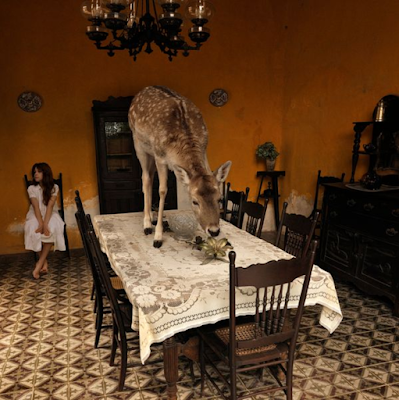
Between these divergent styles, a photographer like Tom Chambers blends reality and fantasy, provoking viewers to imagine the stories behind his pictures. In Chambers’s Glass Flower / Flor de Vidrio, a deer stands on top of a dining table while a young woman seems undisturbed, or not aware, of the surreal scene — our sense that this moment has been concocted only draws us deeper into its drama.
 
Tom Chambers, Glass Flower / Flor de vidrio, archival pigment ink print, 20 x 20 inches, edition of 20, $1200
 
Other artists working within the genre, such as Richard Tuschman, revisit the domestic myth from the perspective of painting, cinema and theatre. In the painterly Woman with Book and Letter (part of the artist's series Hopper Meditations), a woman sits at the edge of a bed absorbed in thought, perhaps thinking about the person who authored the letter. The theatrical and cinematic image, evokes nostalgia, the loss of a time long gone. 

Richard Tuschman, Woman with Book and Letter, 2013, archival pigment ink, 24 x 18 inches, edition of 9, $1500
 
Enjoy our selection! And please contact us if you would like more information about the photographs above.
 
 
• • • • • 


All prices listed were current at the time this post was published.
 
For more information, and to purchase prints, please contact Gallery Director Anne Kelly or Gallery Assistant Patricia Martin, or you may also call us at 505-988-5152 x202


photo-eye Gallery From the Flat-Files: Photomontage photo-eye Gallery
We can discuss photomontage in both its analog and digital versions, its numerous technical possibilities within both these realms, and the issues it faces in contemporary art. This week we feature some of our favorites photomontages from our flat-files.

Jennifer Greenburg, I was a vendor of drink but not love, archival pigment ink, 24 x 30 inches, edition of 3, $3500

 
Popularized by the Dadaists and Constructivism, photomontage has provided artists with the ability to go beyond photography's primal pursuit to represent reality. In an unparalleled way, the technique has offered original, or at least re-interpreted, worlds in photographic form — artworks that seamlessly combine many photographs into one, new vision and idea.

Today, we can discuss photomontage in both its analog and digital versions, its numerous technical possibilities within both these realms, and the issues it faces in contemporary art. 

This week we feature some of our favorite photomontages from our flat-files.


Jennifer Greenburg

Using digital photomontage, Jennifer Greenburg inserts herself into scenes of mid-century America. Her series Revising History, seamlessly incorporates images of Greenburg within the compositions of anonymous vintage photographs. The resulting black and white images look like those found in a family album.

In images like I was a vendor of drink but not love, Greenburg chose an image that depicts a character she can identify with. She researched who the subject was and tried to figure out what her experience was the moment the image was captured. The intention behind the work is to raise a conversation with her audience about how we interpret media and personal memories to establish a collective history.

To learn more about what goes on behind Jennifer Greenbug's images, read our interview with her here

Maggie Taylor


The Harbinger, by Maggie Taylor, combines old photos and illustrations, mainly representing a crow cawing on top of an uncanny flying device and a polar bear placidly swimming across an iceless sea. The resulting artwork is a surrealistic dreamscape that commands careful attention from the viewer to fully grasp.

Taylor's photomontages, a combinatinon of the historical and contemporary, consist of 19th century daguerreotypes, old illustrations, found photographs, and diverse objects and artifacts —all layered together through meticulous digital image editing. You may learn more about her practice here

Chaco Terada

 
Chaco Terada's creative process is meditative and organic, her workflow is purely intuitive, her images are inspired by her daily musings and interactions with her surroundings. A master calligrapher and visual poet, Terada uses multiple layers of silk, images, sumi and pigment inks to create her works.

There is something very "natural" about Terada's photomontages. In Dialogue, somehow the mechanicity often attributed to photomontage — the layering of dissasociated elements — is completely blurred in the misty quality of the work. The delicate brush marks in the foreground and the serene mountaintop in the background, dissolve together in a seamless and harmonious visual dialogue. To learn more about Chaco Terada's work, check out the interview she did with photo-eye.

Tom Chambers


For Tom Chambers, photomontage is a vehicle to combine the diverse ideas stemming from his imagination — a way to make them tangible.
 
To construct his photographs, Chambers usually sketches the concept he has for an image. Sometimes, he will also find an element and photograph it as a starting point. The rest of the magic happens in the digital post-production process. 
 
His photomontage I can touch merges reality and dream, while speaking to the beauty of childhood and the wonder of sea life. It is magical realism at its best. You may learn more about his work here


• • • • •
 

All prices listed were current at the time this post was published.

For more information, and to purchase prints, please contact Gallery Director Anne Kelly or Gallery Assistant Patricia Martin, or you may also call us at 505-988-5152 x202


photo-eye Gallery Interview: Jennifer Greenburg on Revising History Gallery Associate Savannah Sakry interviews Jennifer Greenburg about her series Revising History.

photo-eye Gallery is delighted to have four works currently on view from Jennifer Greenburg's series Revising History above our flat files. These striking images have captivated Gallery visitors all summer with the questions – are these contemporary works, and how on earth does she place herself so seamlessly into a photograph which appears to have been taken decades ago? Gallery Associate Savannah Sakry asked Greenburg to share more on the provoking project and enlighten us on her process. Two new images are making their debut to the series and Greenburg notes her recent direction for the project is "images that are aesthetically beautiful, yet conceptually grotesque..." Works from Revising History are on display through September 9th, 2017.

Savannah Sakry:     When did you first fall in love with photography or decide on the medium?

Jennifer Greenburg:     I grew up around a lot of models, actors, and performers and therefore I grew up around a lot of photography.  I also experienced a lot of loss throughout my childhood due to various factors, including the AIDS crisis of the early 1980’s. I connected with photography because it was a way for me to hold on to those that I had lost.  Whenever I was sad, I would open up one of the many photo albums my mother had painstakingly compiled, and somehow I would feel a lot better after I looked at the photographs of those that I had lost. It was as though the person was there with me again.

I never really “decided” to be a photographer.  It was just something I knew I would do.  I never even talked about it with anyone until I began to apply to study photography in college. There was no choice, as far as I remember.

SS:     Your first project “The Rockabillies” is a thoughtfully composed series of portraits examining today’s rockabilly subculture. Shot in color, and with a 4 x 5 view camera, It’s my understanding the sittings were often a collaboration between you and the subjects, whom you are quite fond of. How did you arrive from “The Rockabillies” to “Revising History”? 

JG:     I began The Rockabillies early in 2001, right after September 11. I embarked on the project in order to discover contemporary methods for building communities that do not rely on birthrights, ethnicity, or station. It was a time when having a community was especially important as the nation forever changed that day and I wanted a way to make sense of a collective new reality.

At that time,  I believed in documentary photography as a method for conveying honest information. I spent ten years on that project, getting to know everyone I photographed in a deep and meaningful way. I collaborated with my subjects in an effort to be as fair and honest as possible. I thought the people and places I interacted with were remarkable. Everyone I photographed was open, honest and trusting.

Ultimately, however, my pictures were taken through the lens of my experience. I saw what I wanted to see. And I questioned if there was a difference between what I had done, and what FOX News does every day. Pictures convince us of truth more than words.

My affection for pre-war and mid-century America was, and is, rooted in clothing, design, and ephemera. The aesthetic rapture caused by the visual record of that time period easily allows us to forget the gender and racial inequality, the Anti-Semitism, and many other injustices. Noticing how easy it is to gloss over those realities when looking at old photographs allowed me to think of Revising History.

I wanted to meet a rich husband, so I modeled in auto shows, 2016 © Jennifer Greenburg | Archival Pigment Print, 24 x 30", Edition of 5


SS:     Your current project is mainly in black and white and you work initially from a found vernacular negative. It’s apparent, (though not actually), you are utilizing a digital technique to its full potential. Was this process or path something you were already exploring or was it a result of the initial conception of “Revising History”?

JG:     I thought of the concept for the project a long time before I knew how to execute the final form. I had the skills to make it happen, but, the complexities of production of Revising History exceed any one skill set. My images go far beyond digital image making. There is a lot involved!

I spent over a year making complete failures before I was able to come up with an acceptable final image. I still make a lot of images that end up being unseen failures, but, I had no successes in that first year. Something Funny Happened in the Kitchen, 2011, was the first image that worked. I am depicted hysterically laughing, in the image, because I was on the verge of a complete mental breakdown. I had been shooting for hours that day, and had shot every day that week. Everything had been garbage and I was at the end of my rope. I was laughing and crying from frustration and I was about to give up the entire endeavor. But I was laughing too hard to stop, and so I kept firing the trigger. Once I was able to review what I had done, I realized the image might work, and I persevered.

Something funny happened in the kitchen, 2011 © Jennifer Greenburg | Archival Pigment Print, 30 x 24", Edition of 4


SS:     While you replace the central figure of the original negative with a photograph of yourself, these works are not autobiographical, correct?

None of my images are self-portraits, however, I choose images that depict a character experiencing something that I find identifiable.  I study each image very closely and I try to figure out who the subject was, and what she was experiencing the moment the image was taken. I transform into the woman who was there, and I become a translation of her. In that, the work is more a performance than any other categorization.

The insurance agent told me to have my father or my husband call him, 2017 © Jennifer Greenburg | Archival Pigment Print, 32 x 40", Edition of 3
SS:     Each image must be very time-consuming. Can you briefly walk me through your process from start to finish? What are the required “ingredients”?

JG:     Each image takes several hundred hours to make after I have done the initial preparation.  The initial preparation takes years.  I have an archive of vernacular images that takes up an entire room in my house and I have to study and consider every frame.  I like to receive images in a big, dirty, box, fresh from a basement or an attic. I do not like anything to have been sorted.  I go through every frame, and put each strip or image into an archival sleeve.  I look for an image that can serve as a punctum and a symbol:  an image that a viewer would find relatable in its narrative. 

The image I choose dictates what happens next.  I could not walk you through my process because I have no process; every single image I have made presents new challenges and requires new solutions. Every time I think I know how to make something, or go in with a shred of self-confidence,  I either fail or the process takes longer than ever before. My newest image officially took longer than any previous image. I am very happy with the results, but I am not sure I would do it again if I had known what I was up against. 

SS:     When you are not in your studio or teaching, you are actively pursuing you first passion - vintage jewelry and clothing. Is it true your extensive collection began at the age of 4?

JG:     Yes, I was 4. My first purchase was made during a neighborhood indoor-yard sale on Astor street in Chicago. The famed Wrigley Mansion had rooms full of toys, but, I was only interested in a pair of 1940’s chandelier earrings, and an oversized rhinestone cocktail ring presented in a red-velvet celluloid box.  My parents asked me multiple times if I really wanted the jewelry, instead of a toy. Then they asked where I was going to wear the jewelry. I don’t remember my answer, but, apparently it was satisfactory because I still have both items.

SS:     In light of Cindy Sherman’s Instagram account recently going public (I see we are mutual followers) is her work inspirational to you? Either conceptually or for performative reasons?

JG:     Absolutely. Every photographer born in the latter half of the 20th century, or after,  should be inspired by Cindy Sherman. I remember, vividly, seeing her work for the first time when I was 17.  It was the first project that allowed me to understand what was involved in a contemporary body of work made with a camera.

SS:     Who are your largest influences and inspirations?

JG:     It’s hard for me to make lists and I hate putting things in hierarchies.  How can I choose between Diane Arbus and James Van Der Zee? Measure the personal impact Carrie Mae Weems has had on my work? Nan Goldin? Larry Sultan?  It’s impossible – I love it all.  And it’s all deeply important to me.

I was lucky enough to be friends with Greer Lankton in the last few years of her life, and her work and legacy has been a constant influence. 

I am also influenced by performance artists, writers, and comedians.  I am always trying to sculpt a humorous yet dark narrative in my work, and it is easier to find inspiration in arenas like comedy and performance. I utilize a lot of camp in my work to achieve that balance.  I am a lifelong fan of John Waters, RuPaul, Mae West, Divine, Angelyne, Orlan, Yoko Ono, Cher, Liberace… I could go on forever. 

SS:     Can you touch on your clever titles, and themes you wish to address? As a woman, your work resonates with me on several levels, and is one of the many reasons I fell in love with the project.

Portrait of Greenburg's Grandmother
JG:     My grandmother (pictured left) used to write funny things on the back of photographs.   She and I used to look through her photos together and she would editorialize the images and tell me all about the people and the places in the images.  She was born in 1905-ish and her entire life, in photographs, was one glamourous outfit after another, which is why I was, and still am,  deeply engrossed in looking at her pictures. 

We would come across “defaced” people in her photographs– images that had faces scratched right off the print!  I would ask my grandmother why she had done this and she would usually launch into an interesting story of betrayal and intrigue. I was fascinated that my grandma, who had only ever shown me unequivocal love, had been involved in this type of strive. I was also amused that she had no sense of sanctity for the original image. I am sure there is an obvious connection between her “defacement projects” and Revising History.

I got the initial captioning, and perhaps the underpinnings of the project from her tradition. 

However,  the captioning has evolved as I have grown more bold in my making of Revising History. During the first part of my career, I made joyous images. I did not want to be reminded of horrible things and therefore I only made images that were ebullient. But I was avoiding my reality.

My lifelong study of photography has lead me to conclude that photographs are the primary catalyst in allowing us to rewriting our history. All it takes is that glamourous outfit and a good hair-do to make us say, “Things used to be better!” I spent my childhood thinking that my grandmother had lived in better times.  The truth is that my grandmother had no college education because women, in her day, were not educated.  She experienced painful Anti-Semitism when in non-Jewish environments, and lost most of her cousins in the Holocaust. But she looked good through all of these hardships! And therefore we are duped by her remaining legacy: her photographs. 

My titles serve to peel back the artifice of my pictures. 

I have never been good at handling unwarranted attention, 2015 © Jennifer Greenburg | Archival Pigment Print, 24 x 30", Edition of 3

SS:     Of the four pieces currently on display, which is your favorite image and why?

JG:     I have a hard time picking favorites in any context, as I mentioned before. However, I would probably choose, I have never been good at handling unwarranted attention, 2015. Why? Because I have had a very hard time handling unwarranted attention over the course of my life, beginning when I was a small child. The image is probably the most autobiographical image in the series. I know every woman, and many men,  can relate to the uncomfortable moment depicted in the image. The image is aesthetically beautiful, yet conceptually grotesque. I like that tension and am creating all of my new works under that guise. 

SS:     Would you say this project is nearing an end or is there more history to be revised by Jennifer Greenburg?

JG:     I feel as though I haven’t even gotten started. The new work is more bold, and much darker. I am becoming less apprehensive to discuss challenging cultural realities. Stay tuned!

--------------------------

Installation of Jennifer Greenburg's Revising History at photo-eye Gallery - On view through Sept. 9th, 2017

For more information or to purchase prints, please contact the Gallery Staff at 505.988.5152 x202 or gallery@photoeye.com.