PHOTOBOOK REVIEWS, INTERVIEWS AND WRITE-UPS
ALONG WITH THE LATEST PHOTO-EYE NEWS

Social Media

Showing posts with label From the Flat-Files. Show all posts
photo-eye Gallery From the Flat-Files: Flowers from Jo Whaley and James Pitts Delaney Hoffman
photo-eye Gallery Assistant Delaney Hoffman compares and contrasts works of Jo Whaley and James Pitts

Details from James Ware Pitts' Flower portfolio (2021) and Jo Whaley's Eucalyptus (2012)

Hello one and all! My name is Delaney Hoffman, I’m the Gallery Assistant here at photo-eye and had the pleasure of choosing some work from our flat files to talk about this week. I have always loved photography because it is a medium that lends itself to construction of allegorical meaning in the most slippery way. One can make millions of images over a lifetime that relate not only to the individual photographer’s experience, but also to all of the other images that they have seen and digested. A single symbol can mean one thing for a long time or various things over a varied period of time, but the task of symbolic interpretation ultimately falls upon the viewer.

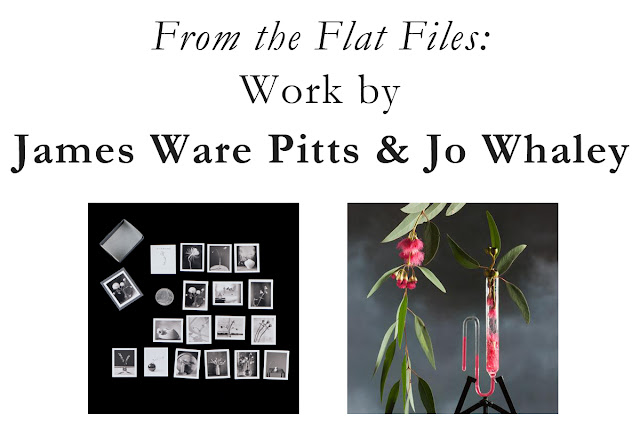
When thinking about symbolic interpretation and representation, I found myself stricken by the very, very small portfolio in the flat file of James Pitts that is simply entitled Flowers. Only 2 x 1.5” large, the portfolio is full to the brim with 55 tiny, beautifully made pigment prints of Pitts’ floral still lifes. Some of these can be seen below:

A selection of images from Flowers, 55 archival pigment prints in handmade box, 2" x 1.5," edition of 18, $250

Unboxing the flower portfolio feels like nothing short of a miracle; there is beauty in endless supply. Independent of how beautiful the images themselves are, their size demands intimate interaction. These pictures command attention through closeness. It is impossible not to be hyperconscious of your own body while going through this work; feeling the roughness of your fingers rock nimbly around the tiny archival pigment prints that maintain the tonal quality of their large format platinum palladium predecessors. 


James Pitts, Bottle with Sharon's Seeds, 1998, platinum palladium print, 8"x10," edition of 25, $2000

The attention this work draws to the viewer’s body strikes me, a young woman author, as coming from a masculine position, regardless of the gender of the artist. If the flower has been so often substituted or used interchangeably with the female form throughout art history, then Pitts’ portfolio is effectively a preservation box. The flower is a collectible beauty that is rendered permanent and static by the photograph — an idea that seems in opposition to the floral representations in Jo Whaley’s Botanical Studies.

The image from Botanical Studies that I feel intensely drawn to is Eucalyptus (2012):

Jo Whaley, Eucalyptus, 2021, archival pigment print, 24" x 19," edition of 25, $2000

Jo Whaley renders her single eucalyptus branch with a similar precision to James Pitts’ flowers, though she seems to be driven by an ulterior motive. The presence of a pooling pink liquid tells us that some sort of extraction has taken place or is in progress; this flowering body is not static but is transitioning into something else. Whaley’s attachment to lighting manifests here with an almost sterile quality being imparted onto the subject by its cool tones and overall sharpness, but the balance that she communicates through the single wire knot at the top of the frame, and through the tangible fragility of her mysterious glass instrument, makes this image curious, uncanny and even humorous.

Whaley’s botanicals are in transition; a state that stands in opposition to the stasis that Pitts situates his own florals. A man watches a woman’s body, the woman lives in the body, and there is a fundamental difference between these two positions. The co-existence of these two works as images (or collections of images) in the same gallery, despite the way that they’re culturally opposed from an analytic perspective, is my favorite part about working in the arts. There are so many objects that give us fodder to think about — whether we agree with them, don’t, or aren’t sure — and in that ambiguity there is always some sort of beauty to marvel at.
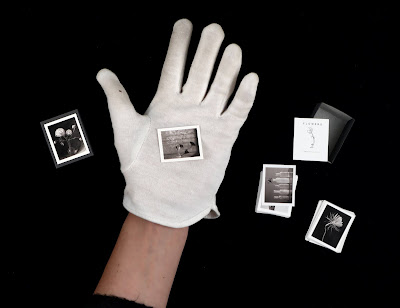

A selection of images from Flowers with the author's hand for scale.
Flowers is 55 archival pigment prints in handmade box, 2" x 1.5," edition of 18, $250


Contact us to purchase prints by Jo Whaley or James Pitts.


• • • • • 


All prices listed were current at the time this post was published.

For more information, and to purchase prints, please contact Gallery Director Anne Kelly or Gallery Assistant Delaney Hoffman, or you may also call us at 505-988-5152 x202


photo-eye Gallery From the Flat Files: Narrative Photography photo-eye Gallery
Photography is a tool that allows us to express concepts and emotions in a purely visual way. The transmission of ideas and feelings becomes even more evident in narrative photography, whether the story conveyed by an image is real or fictional.

Zoë Zimmerman, Her Dream IV, 2014, archival pigment print, 24 x 20 inches, edition of 24, $1500

Photography is a tool that allows us to express concepts and emotions in a purely visual way. The transmission of ideas and feelings becomes even more evident in narrative photography, whether the story conveyed by an image is real or fictional.

This week we share some of our favorite images from our collection that encompass a story. Take a look at our selection below and let us know if you have any questions. Enjoy! 
 

Tom Chambers


Julie Blackmon  

Julie Blackmon, Outing, 2019, archival pigment print, 26 x 41 inches, edition of 10, $4000
» Interview with Julie Blackmon


Mark Klett 


Cig Harvey

Cig Harvey, Emily in the River, archival pigment print, 20 x 16 inches, edition of 10, $3000


photo-eye Gallery From the Flat Files: Cameraless Photography photo-eye Gallery
While a photograph, analog or digital, can be reproduced indefinitely, cameraless photographs are typically one-of-a-kind pieces. This week we explore our favorite cameraless images from our flat files and share them here.

Michael Jackson, Mrs. S, luminogram, 20 x 16 inches, unique, $4000

 
While a photograph, analog or digital, can be reproduced indefinitely, cameraless photographs are typically one-of-a-kind pieces.

These unique images, which do away with the mediation of a camera or a lens, include photograms, photogenic drawings, cyanotypes, luminograms, and chemigrams. All terms that designate the various cameraless processes of those artists who choose to use the primary elements of photography — light, paper, and chemicals — as both their tools and subjects to create the image.

This week we explore our favorite cameraless images from our flat files and share them here. Take a look below.


 VANESSA MARSH


KATE BREAKEY

Kate Breakey, Common Ground Dove, gelatin-silver print, 17 x 14 inches, edition of 7, framed, $1150


To learn more about our cameraless collection and our last show on cameraless photography, take a look at the link below.

» LIGHT + METAL: Closing thoughts from Gallery Director Anne Kelly


• • • • •

For more information, and to purchase prints, please contact Gallery Director Anne Kelly or Gallery Assistant Patricia Martin, or you may also call us at 505-988-5152 x202


photo-eye Gallery From the Flat Files: Domestic Landscapes photo-eye Gallery
Over the past few months, we have been going through our collection and sharing some of our favorite photographs by the many great artists we represent. This week, for our installment of "From the Flat Files," we introduce a selection of works devoted to life at home.

Over the past few months, we have been going through our collection and sharing some of our favorite photographs by the many great artists we represent. This week, for our installment of "From the Flat Files," we introduce a selection of works devoted to life at home.

While this selection makes no attempt at sociological objectivity, we believe that the many styles it spans have much to say about the different perspectives on the settings, rituals, and moods of the American domestic landscape.

For instance, within this genre, we can find the staged pictures of Julie Blackmon, Jennifer Greenburg, and Patty Caroll. In Blackmon’s Play Group, a mother and her children gather in a chaotic and cramped entryway — toys and children rest equally scattered on the floor. In Napping with Floyd by Greenburg, a woman (the artist in character) naps on a couch with a siamese cat sitting on top of her. In Caroll’s Bookie, a figure poses, engulfed with books in a home library in disarray. Reworking the domestic cliches of popular imagery, these artists examine the role culture, media, and history have in shaping private lives. Although their approach to the domestic landscape is different, they share the conviction that something important is going on — external forces are playing out in the private sphere of the home.
 
Patty Carroll, Bookie, archival pigment ink, 22 x 22 inches, edition of 20, $1500
 
Some of the domestic landscapes we revisited are charged with feeling, such as those captured by Cig Harvey and Keith Carter. In both artists’ work, the domestic experience is described not from the detached viewpoint of the documentarist, but from within. Captivating photographs, such as Red Jacket (Hanging) by Harvey (a bright red jacket hanging from a pink peeling wall) and Ofrenda by Carter (a dreamy photograph of a bird on a plinth, flanked by lamps and heavy curtains), are rendered with an intimacy that only an insider could possess.
 
Keith Carter, Ofrenda, 1998, toned gelatin silver print, 15 x 15 inches, edition of 50, $1800

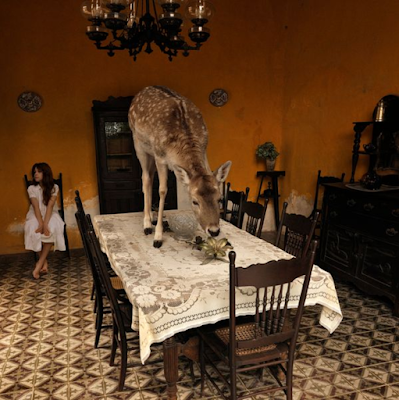
Between these divergent styles, a photographer like Tom Chambers blends reality and fantasy, provoking viewers to imagine the stories behind his pictures. In Chambers’s Glass Flower / Flor de Vidrio, a deer stands on top of a dining table while a young woman seems undisturbed, or not aware, of the surreal scene — our sense that this moment has been concocted only draws us deeper into its drama.
 
Tom Chambers, Glass Flower / Flor de vidrio, archival pigment ink print, 20 x 20 inches, edition of 20, $1200
 
Other artists working within the genre, such as Richard Tuschman, revisit the domestic myth from the perspective of painting, cinema and theatre. In the painterly Woman with Book and Letter (part of the artist's series Hopper Meditations), a woman sits at the edge of a bed absorbed in thought, perhaps thinking about the person who authored the letter. The theatrical and cinematic image, evokes nostalgia, the loss of a time long gone. 

Richard Tuschman, Woman with Book and Letter, 2013, archival pigment ink, 24 x 18 inches, edition of 9, $1500
 
Enjoy our selection! And please contact us if you would like more information about the photographs above.
 
 
• • • • • 


All prices listed were current at the time this post was published.
 
For more information, and to purchase prints, please contact Gallery Director Anne Kelly or Gallery Assistant Patricia Martin, or you may also call us at 505-988-5152 x202
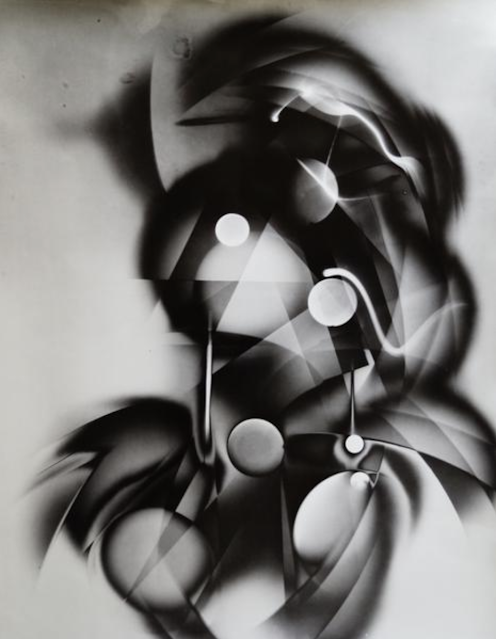


photo-eye Gallery From the Flat-Files: Still Lifes photo-eye Gallery
Flowers, both fresh and dying, fruits and vegetables, burning candles, skulls, books, insects, jewelry, scientific tools, mirrors, bottles, glasses, vases — objects often found in still life photographs. Such objects were also the representative, prominent characteristic of the paintings created by the Dutch and Flemish painters of the 17th century.
Jo Whaley, Analytical Behavior, 1994, archival pigment print, 15.75 x 14 inches, edition of 25, $1800

Flowers, both fresh and dying, fruits and vegetables, burning candles, skulls, books, insects, jewelry, scientific tools, mirrors, bottles, glasses, vases — objects often found in still life photographs. Such objects were also the representative, prominent characteristic of the paintings created by the Dutch and Flemish painters of the 17th century. 

The Golden Age of the Old Masters continues to offer limitless inspiration for contemporary artists. Their artworks remind viewers of the brevity of human life, youthfulness, wealth, power, as well as the triviality of all material things. Through this distinct kind of narrative, these works warn about the irrelevance of all the alluring, earthly pleasures, and provide us with a unique aesthetic that many contemporary still life photographers have embraced.

This week we are thrilled to explore this exciting genre by taking a look at our favorite still life photographs from our flat-files and sharing them on our blog. Take a look below!


Cig Harvey

Cig Harvey, Early Stardrift, archival pigment ink, 20 x 16 inches, edition of 10, $3000


Maggie Taylor

Maggie Taylor, The philosopher's study, 2020, archival pigment ink, 8 x 8 inches, edition of 15, $1500


Kate Breakey

Kate Breakey, Single Rose, Glass Round Bottle, hand colored pigment ink print, 2020, 16 x 16 inches, $1750 (framed)


JP Terlizzi

JP Terlizzi, Villeroy & Boch Artesano with Grapefruit, 2019, archival pigment print, 14 x 21 inches, edition of 10, $1200


• • • • • 


All prices listed were current at the time this post was published.
 
For more information, and to purchase prints, please contact Gallery Director Anne Kelly or Gallery Assistant Patricia Martin, or you may also call us at 505-988-5152 x202


photo-eye Gallery From the Flat-Files: Winter Landscapes photo-eye Gallery
For the photographer, a snow-laden landscape presents an opportunity for extraordinary compositions. A covering of snow transforms a mundane landscape into a canvas of sublime beauty, adding a layer of intrigue to a scene that otherwise, in a warmer month, for instance, could be overlooked.
Cig Harvey, Scout in the Blizzard, 2017, chromogenic print, 14 x 14 inches, edition of 10, $3500

For the photographer, a snow-laden landscape presents an opportunity for extraordinary compositions. A covering of snow transforms a mundane landscape into a canvas of sublime beauty, adding a layer of intrigue to a scene that otherwise, in a warmer month, for instance, could be overlooked.

Winter landscapes are not limited to snow scenes of course. Frost, fog, and mist are also very much features of the colder months. These phenomena can alter the landscape by simplifying elements and allowing for more minimalist images to be created.

This week we are excited feature some of our favorite winter landscape photos from our flat-files. Take a look below!
 

Michael Kenna

 To learn about Michael Kenna's work, read this article about a recent exhibition he had at photo-eye.


Tom Chambers 

You may read about Tom Chambers's work here.


Pentti Sammallahti 

To learn more about Pentti Sammallhati, read this wonderful interview with photographers Mitch Dobrowner and Brad Wilson.


Hiroshi Watanabe 

Hiroshi Watanabe, TDTDC 25 (Persimmoms), 2009, archival pigment print, 9 x 9 inches, $1800
 
If you would like to read about Hiroshi Watanabe's practice, here is a great interview.  


• • • • • 


All prices listed were current at the time this post was published.
 
For more information, and to purchase prints, please contact Gallery Director Anne Kelly or Gallery Assistant Patricia Martin, or you may also call us at 505-988-5152 x202


photo-eye Gallery From the Flat-Files: Photomontage photo-eye Gallery
We can discuss photomontage in both its analog and digital versions, its numerous technical possibilities within both these realms, and the issues it faces in contemporary art. This week we feature some of our favorites photomontages from our flat-files.

Jennifer Greenburg, I was a vendor of drink but not love, archival pigment ink, 24 x 30 inches, edition of 3, $3500

 
Popularized by the Dadaists and Constructivism, photomontage has provided artists with the ability to go beyond photography's primal pursuit to represent reality. In an unparalleled way, the technique has offered original, or at least re-interpreted, worlds in photographic form — artworks that seamlessly combine many photographs into one, new vision and idea.

Today, we can discuss photomontage in both its analog and digital versions, its numerous technical possibilities within both these realms, and the issues it faces in contemporary art. 

This week we feature some of our favorite photomontages from our flat-files.


Jennifer Greenburg

Using digital photomontage, Jennifer Greenburg inserts herself into scenes of mid-century America. Her series Revising History, seamlessly incorporates images of Greenburg within the compositions of anonymous vintage photographs. The resulting black and white images look like those found in a family album.

In images like I was a vendor of drink but not love, Greenburg chose an image that depicts a character she can identify with. She researched who the subject was and tried to figure out what her experience was the moment the image was captured. The intention behind the work is to raise a conversation with her audience about how we interpret media and personal memories to establish a collective history.

To learn more about what goes on behind Jennifer Greenbug's images, read our interview with her here

Maggie Taylor


The Harbinger, by Maggie Taylor, combines old photos and illustrations, mainly representing a crow cawing on top of an uncanny flying device and a polar bear placidly swimming across an iceless sea. The resulting artwork is a surrealistic dreamscape that commands careful attention from the viewer to fully grasp.

Taylor's photomontages, a combinatinon of the historical and contemporary, consist of 19th century daguerreotypes, old illustrations, found photographs, and diverse objects and artifacts —all layered together through meticulous digital image editing. You may learn more about her practice here

Chaco Terada

 
Chaco Terada's creative process is meditative and organic, her workflow is purely intuitive, her images are inspired by her daily musings and interactions with her surroundings. A master calligrapher and visual poet, Terada uses multiple layers of silk, images, sumi and pigment inks to create her works.

There is something very "natural" about Terada's photomontages. In Dialogue, somehow the mechanicity often attributed to photomontage — the layering of dissasociated elements — is completely blurred in the misty quality of the work. The delicate brush marks in the foreground and the serene mountaintop in the background, dissolve together in a seamless and harmonious visual dialogue. To learn more about Chaco Terada's work, check out the interview she did with photo-eye.

Tom Chambers


For Tom Chambers, photomontage is a vehicle to combine the diverse ideas stemming from his imagination — a way to make them tangible.
 
To construct his photographs, Chambers usually sketches the concept he has for an image. Sometimes, he will also find an element and photograph it as a starting point. The rest of the magic happens in the digital post-production process. 
 
His photomontage I can touch merges reality and dream, while speaking to the beauty of childhood and the wonder of sea life. It is magical realism at its best. You may learn more about his work here


• • • • •
 

All prices listed were current at the time this post was published.

For more information, and to purchase prints, please contact Gallery Director Anne Kelly or Gallery Assistant Patricia Martin, or you may also call us at 505-988-5152 x202


photo-eye Gallery From the Flat-Files: Night Photography photo-eye Gallery
The interaction of light, shadow, and extremes of contrast in a night photograph lure in the viewer — when combined with the element of duration, a good night photograph can spellbind the spectator into a magical and mysterious realm.
Linda Connor, March 8, 1936, contact print, gold toned, 10 x 8 inches, $2500

During the daytime, a photograph can be captured in just a small fraction of a second. In contrast, a night photograph may require an exposure to be as long as the night itself. Anything that might pass before the lens is recorded in ways that we cannot see with our own eyes. Someone who walks in front of the camera is recorded as a ghost. Cars drive by, leaving streaks of light from the headlights. The moon glows on the river, but the surface of moving water looks as though it were a sheet of ice. The stars drag across the sky, leaving light trails as the Earth rotates on its axis.
 
The interaction of light, shadow, and extremes of contrast in a night photograph lure in the viewer — when combined with the element of duration, a good night photograph can spellbind the spectator into a magical and mysterious realm.

This week we feature some of our favorites night photos from our flat-files. Take a look below!


Teri Havens

Teri Havens, Moonglow, Walsenburg, Colorado, 2014, platinum/palladium print, 13 x 18 inches, $1200

 
For Teri Havens, photography is primarily a means of exploring and documenting fragments of a vanishing America. In 2012, after years of photographing during the day, Teri started experimenting with night photography. Using moonlight or available streetlight, she began Last Light, a series of landscapes portraying solitary buildings and structures that have maintained their identity despite rapid cultural and urban change (see Moonglow above). To learn more about Teri Havens' work, check out the interview she did with photo-eye.


Julie Blackmon

Julie Blackmon, Garage, archival pigment ink, edition of 15, 22 x 29 inches, $3500
  

Focusing on the complexities of everyday life, Julie Blackmon explores the conflicting demands of parenthood. Her carefully orchestrated narratives walk a darkly humorous line between lightheartedness and the chaos of our modern lives. Garage, for instance, brings forth childhood memories of warm summer nights — roller-skating in the garage — and other night-time adventures. But, at close inspection, anxiety lurks — unsupervised children play in the witching hours, surrounded by dangerous objects.

Julie Blackmon is used to working with little available light; she often works outside, at night, with a pair of studio lights. She finds that using the darkness of the night is easier than painting a room black. You may learn more about her practice here.


Thomas Jackson

Thomas Jackson, Glow Necklaces no. 5, Edisto, SC, 2017, archival pigment print, 20 x 25 inches, edition of 4, $2500
 
Thomas Jackson's whimsical and paradoxical constructions are inspired by self-organizing emergent systems in nature, such as schools of fish. The artist's practice explores ways to juxtapose the man-made against the natural by creating installations that are simultaneously in harmony and in conflict with their environments. To make images like Glow Necklaces no. 5, Jackson first imagines the composition, then constructs large kinetic sculptures from colorful objects (like glow sticks), and finally photographs them, resulting in a still image. To learn more about what goes on behind Thomas Jackson's images, read our interview with him here.


Beth Moon

 Beth Moon, Hydra, archival pigment print, 20 x 30 inches, edition of 15, $2000
 
Humanity's relationship with the wild environment plays an important role in Beth Moon's work. Her striking series Diamond Nights was inspired by scientific studies that connect tree growth with celestial movement and astral cycles. 

For the artist, this work marked the transition from film to digital capture. Previously, the majority of Beth Moon's work was done with a medium format film camera, but the long exposure time that she needed was not possible with film. Thanks to evolving digital technology, captivating images like Hydra are now possible to capture.

Learn more about Beth Moon's process and practice in this conversation between the artist and Gallery Director Anne Kelly. 


• • • • •
 

All prices listed were current at the time this post was published.

For more information, and to purchase prints, please contact Gallery Director Anne Kelly or Gallery Assistant Patricia Martin, or you may also call us at 505-988-5152 x202