PHOTOBOOK REVIEWS, INTERVIEWS AND WRITE-UPS
ALONG WITH THE LATEST PHOTO-EYE NEWS

Social Media

Showing posts sorted by date for query photo objects & small prints. Sort by relevance Show all posts

Maggie Taylor, Invitation to a Dream, 2022, Archival Pigment Print, 15x15", Edition of 15, $3,200

With great pleasure, photo-eye Gallery is delighted to introduce the latest collection of work by renowned artist Maggie Taylor, showcasing her unique style of photomontage! 
  

So sit back, relax, and allow yourself to be transported to the whimsical universe of Maggie Taylor...


Maggie Taylor, The Listening Room, 2022, Archival Pigment Print, 8x8", Edition of 15, $1,700

Maggie Taylor is a contemporary artist who explores the intersection of reality and imagination through her unique digital collages. As an innovative artist and early adopter of Adobe Photoshop, Taylor has taken her art to a new level by incorporating the latest technology into her works, combining elements made using the AI program, Midjourney with her traditional practice that blends vintage photographs and collected elements to create dreamlike scenes.

By using Midjourney, Taylor is able to bring her creative visions to life in a new way and the results are stunning. This group of images features an array of surreal and imaginative scenes, with intricate details and a rich color palette, each one more captivating than the last. These images are also a testament to the power of the artist in collaboration with AI and its ability to enhance the art world in new and exciting ways.

Anne Kelly, photo-eye's Gallery Director, queried Maggie Taylor about her utilization of AI programs in her artistic process. Given that Taylor was a Photoshop pioneer, Anne wanted to understand her thoughts on AI and how it compares to the early days of Photoshop.
I took a look at using the AI program Dall–E last summer. I love the idea of using language to generate imagery, so I was excited to try it out. Crafting the text that will create the image you envision is really difficult. Most of the time you get results that either disappoint or surprise you— and that can be a good thing. I always leave a lot of room in my working process for accidental encounters with the image. I do not start with a preconceived plan of what the finished image is going to be. So, working with some elements created by AI seems like a natural fit to me.

Initially, my biggest concern with the program was the small size of the images that the AI programs generate. I did not see that the quality of the images would be any better than a sketch of an idea for my work. Later on, last fall, I found out about Midjourney and started to create some images from text prompts with that program. I then have to use another program to upscale the images. Then in Photoshop, I use a lot of other layers and elements to build up the image. My newest four images all have at least one AI element in them. The image The Listening Room has quite a few things from different AI images.

When I photograph in the real world I am reacting to things that I see (clouds, art, textures, objects) and collect them with my cell phone camera. Using Midjourney I feel like a set designer or a film director coming up with a concept and trying to articulate it in such a way that it comes to fruition. Then, if I like something that is generated, I collect it– downloading it to a folder on my computer instead of clicking the shutter on my camera. 

Most of the AI elements I have put into my work are either portions of backgrounds or smaller items within the overall image. They are often semi-transparent so that other colors and textures are also visible on them or under them. It is kind of like building a doll house or a stage set and finding some of the items you need from different sources. 

In the early days of Photoshop, there was quite a bit of resistance on the part of galleries and collectors to the idea that a computer could be involved in the artist's process. I suppose AI is meeting even more resistance– and in some cases for good reason. issues of copyright, originality, and ownership are popping up all the time. It will be very interesting to see what transpires in the next 10 years with AI on so many fronts. 

Also in the earlier versions of Photoshop, there was not the fine–tuned control that there is today, and most computers did not have the capacity to produce huge images. The quality of the AI images is getting better with each new iteration of the technology.


Watch the video below to hear more about Maggie Taylor's process with photomontage...


Maggie Taylor, Sailors Delight, 2022, Archival Pigment Print, 15x15", Edition of 15, $3,200


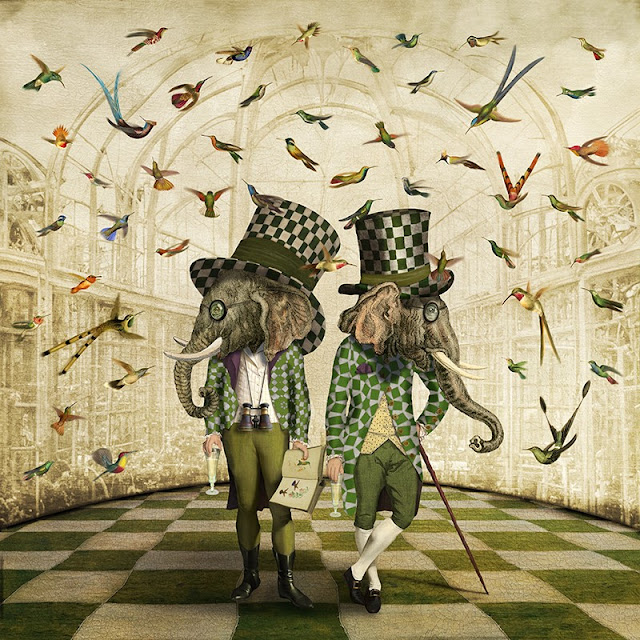
Maggie Taylor, The Bird Watchers, 2022, Archival Pigment Print, 8x8", Edition of 15, $1,700

Maggie Taylor is an artist that lives on the edge of a sun-drenched prairie populated by cows, alligators, and birds on the outskirts of Gainsville, Florida. She was born in Cleveland, Ohio, in 1961, and moved to Florida when she was 11. Her childhood was spent watching countless hours of science fiction and sitcoms on television; in college, she received a philosophy degree from Yale University and a master's degree in photography from the University of Florida. 

Taylor's digital compositions have been widely exhibited, published, and collected by many museums. 

photo-eye Gallery is proud to represent artist Maggie Taylor.

>> See more images by Maggie Taylor <<

>> Buy Maggie Taylor's book Internal Logic <<


*    *    *

The prints from this series are Archival Pigment Prints 

8x8", Edition of 15, Starting at $1,700
15x15", Edition of 15, Starting at $3,200
22x22", Edition of 10, Starting at $5,000
36x36", Edition of 9, Starting at $9,000

(Select images are also available 48x48" as dye sublimation on aluminum for $12,000)
(Select images are also available 58x58" on paper for $15,000)


PRINT COSTS ARE CURRENT UP TO THE TIME OF POSTING AND ARE SUBJECT TO CHANGE.


*    *    *

If you are in Santa Fe, please stop by during gallery hours or schedule a visit HERE.

For more information, and to reserve one of these unique works, please contact
Gallery Director Anne Kelly or Gallery Assistant Jovi Esquivel

You may also call us at (505) 988- 5152 x202


photo-eye Gallery

1300 Rufina Circle, Unit A3, Santa Fe, NM 87507

Tuesday– Saturday, from 10am– 5:30pm


photo-eye Gallery New Work & AI: The Whimsical Universe of Maggie Taylor Jovi Esquivel & Anne Kelly Get ready to be transported into a magical realm as we introduce you to Maggie Taylor's latest creations.

photo-eye Gallery Creation and Destruction: Christopher Colville's Beyond Reckoning Alexandra Jo
Colville's most recent series of unique gunpowder generated silver gelatin prints takes his process a step further, using bullet-riddled targets found on-site in the desert to depict images questioning violence and the residue of American volatility.


The explosive fluidity of Christopher Colville’s work is singular in its ability to shift between image and abstraction. His unique process of igniting gunpowder on silver gelatin paper to capture the simultaneous violence and grace of explosions creates images in-flux. His work evokes a multitude of things including formless atmospheric auras, desolate landscapes, fireworks, constellations, cratered lunar surfaces, and now, the human figure.

Beyond Reckoning, Colville’s most recent series of unique gunpowder generated silver gelatin prints takes his process a step further in specificity. For this body of work, Colville takes used and abandoned practice targets found in the open desert where he works in the darkness of night to create his photographs and uses them as templates for the gunpowder explosions that make his work. The resulting images are haunting, often depicting life-sized human silhouettes riddled with bullet holes and surrounded by a dark, smoky haze.  Colville says of the work:

Christopher Colville, Citizen 9, Unique gunpowder generated
gelatin silver print in direct positive paper,
32 x 24.2 inches, Framed with Optium Plexi, $7,650

Beyond Reckoning is the antiphon to a continuous cycle of violence embedded in American culture, reflecting our polarized population. The images are made with targets I have collected from desert hillsides, abandoned by recreational shooters. The targets include commercially produced bulls-eyes, life size human forms, predators, mannequin heads, and wedding photographs as well as more divisive, crudely drawn political caricatures. These objects are cultural relics of a violent era, reduced to delicate lace by the onslaught of gunfire, revealing complex motives of hero fantasies, fear, frustration and hatred.”


The very materials Colville uses (gunpowder, fire, targets, etc.) point to the presence of violence-as-pastime in America’s current gun culture. The series also includes a few digital photographs of targets and metal debris from the shooting sites. This body of work feels almost like a call to action alongside a thorough, emotionally fraught examination of society’s desensitization to bloodshed and human fragility. Here, there is a juxtaposition of creation and destruction, brutality and beauty, which asks audiences to reexamine our society’s relationship to violence as a whole.

Christopher Colville, Wound, Archival Inkjet Print, 24 x 30 inches, Edition of 15, $1800

Colville says: “Suspended in a state of wonder and dread, my time in the landscape has shifted from a search for transformative experiences to a reckoning with the residue of American volatility[…] I have spent the last year and a half scouring the land surrounding my home, gathering objects and orchestrating nighttime interventions. Engulfed in billowing smoke, I sift through debris, repeating and refining small explosions, layering violence upon violence with the hope of finding clarity.”

Within this layered violence, audiences are invited to take stock of the psychological aspects involved in firing a gun at a human-shaped target or recognizable photograph of a person. The work brings a new perspective to the casual presence of weapons in American everyday life.

Christopher Colville, Target D10, Unique gunpowder generated gelatin silver print,
16 x 20 inches, Framed with Optium Plexi, $4,300


photo-eye is thrilled to add Beyond Reckoning to our website in two brand new portfolios.

Works in the series can be viewed here and here.


»Read photo-eye's interview with Colville 

All prices listed were current at the time this post was published.

For more information, and to purchase artworks, please contact photo-eye Gallery Staff at:
(505) 988-5152 x 202 or gallery@photoeye.com


photo-eye Gallery Gallery Favorites
Christopher Colville – Flux
Anne, Lucas, and Alexandra highlight three notable images from Flux, currently on view at photo-eye Gallery through Saturday June, 22nd.


Christopher Colville’s exhibition of unique, camera-less, gun-powder generated photographs, titled Flux, opened at photo-eye Gallery on April 26th to an intrigued, perplexed, and ultimately enraptured audience. Colville’s one-of-a-kind photographs are enthralling in both their creation and their visual presence. It is easy to get wrapped up in the thrill and mystery of the process when looking at photographs created without a camera by igniting gunpowder directly onto photographic paper onsite in the desert at night. Indeed, understanding that process can be an important aspect of looking at and responding to these explosive abstract images. However, Colville’s work also has the distinct ability to speak directly to individual viewers on a powerful personal level. Each piece uniquely evokes fantastical landscapes, captures bursts of violent action, opens up enigmatic celestial maps, or creates murky, gossamer atmospheric texture in a way that allows each viewer to enter the work in their own way. This week the photo-eye Gallery staff was charged with the seemingly-impossible task of picking a favorite piece out of this compelling and captivating exhibition. Read more on their selections below.


Anne Kelly Selects Dark Hours Horizon 101

Christopher Colville, Dark Hours Horizon 101, Unique Silver Gelatin Print, 3x12" Image, $3,180, Framed


Anne Kelly
Gallery Director
(505) 988-5152 x121
The works by Christopher Colville that are included in our current exhibition Flux are unique photographs that are made without the use of a camera, but with simply the essence of photography–light. Each composition is pure abstraction which is the orchestrated result of tiny gunpowder-fueled explosion on moonless nights in the Arizona desert.  Though the images are abstract, I have noticed that gallery visitors have started to see objects within the imagery like planets, rocket-ships, cactus', and more. The piece that I’ve fallen in love with is Dark Hours Horizon 101, a tiny tryptic that reminds me of a stormy desert landscape. So there you have it, I continue to be attracted to unique, expressive landscapes that connect to my own personal experience. I also love the scale of this piece, it just asks you to slow down and take a closer looks at the surface and beyond. Over the horizon hang stormy clouds where an epic storm is blowing in. The surface of this print almost looks like rusted metal, and on closer inspection, there is just a touch of iridescence, which I recently learned is possible in certain rare clouds. Dark Hours Horizon 101 is a tiny abstracted landscape created by a small explosion–what is not to love?


Lucas Shaffer Selects Fluid Variant 2

Christopher Colville, Fluid Variant 2, 2015, Unique Silver Gelatin Print, 12x15" Image, $3,550, Framed

Lucas Shaffer
Special Projects & Client Relations
(505) 988-5152 x114
Like my colleagues, I had a difficult time highlighting just a single image from Christopher Colville's impressive collection in Flux. This is my favorite type of photography, it's tactile, experimental, material-based, cameraless, and unique. Fluid Variant 2 stands out for me due to its bold design, sense of balance, and expressive nature. A precise, but broken, diagonal, bisects the picture plane perfectly separating light from dark, the concrete from the organic. The effect is striking. A burst of energy erupting from the center dramatically joins these two disconnected planes breaking the diagonal, evenly cutting the image again vertically, and throwing the lighter portion into fluttering chaos. Paired with Colville's rich rust-colored print tone the overarching effect of Fluid Variant 2 is earthly and elemental. More than any other work I've seen recently, Colville's images seem physical, their representations of movement, weight, texture, and material are extraordinary. I've probably already spent hours viewing Fluid Variant 2 delighting in its consummate aesthetic and meditating on its dynamic paradoxes. Overall, the image is enigmatic with an impressive design that leaves room for personal interpretation and reflection.


Alexandra Jo Selects Dark Hours Horizon 87

Christopher Colville, Dark Hours Horizon 87, Unique Silver Gelatin Print, 3.5 x 4.38" $1,280, Framed


Alexandra Jo
Gallery Assistant
(505) 988-5152 x116
In a recent conversation with Christopher Colville, we discussed the writing of Cormac McCarthy, as Colville uses a quote from Blood Meridian in one of his artist statements that happens to be a favorite of mine. In the discussion, we spoke about the landscape of the desert, in which Blood Meridian takes place, and what that specific environment means to each of us. Colville's entire process often takes place outside at night in the open desert. We agreed that there is a violence to that landscape, but also a specific loveliness, and talked about McCarthy’s ability to articulate darkness and beauty simultaneously. For me, Colville’s work is also able to do that; it emphasizes the dichotomy and symbiosis between light and dark, and reveals the allure of the shadow.

Dark Hours Horizon 87 was my favorite work in Flux the instant we pulled it out of its shipping crate. The image is one from Colville’s Dark Hours series, which features mostly smaller works, each resembling desolate and mysterious landscapes. The placement of gunpowder in lines and ridges on the photographic paper implies a physical horizon line when ignited to create the image, allowing these camera-less photographs to obliquely point to the environment in which they were created.

Dark Hours Horizon 87 in particular is only 4 x 5 inches and offers an intimate examination of Colville’s mercurial physical process, drawing the viewer in with flashes of iridescence in the dark, ethereal atmosphere of its “horizon.” The colors of the image range from rust to copper to metallic blues and greens, down through magentas and deepest blacks. The way the smoke and light from this explosion swoops skyward conjures images of ravenous prairie fires, wind-swept cloud formations over vast desert mesas, and the feeling of standing alone and vulnerable in the openness of nature under boundless stars and galaxies. Ultimately for me, the power of this tiny image lies in its ability to evoke the colossal, enduring power and chaos of nature and the cosmos that has always been beyond complete human reckoning.


• • •


Christopher Colville: FLUX
On view through Saturday, June 22nd

For more information, and to purchase prints, please contact Gallery Staff at 505-988-5152 x202 or gallery@photoeye.com.
All works listed were available for at the time this post was published.


photo-eye Gallery New Exhibition
Christopher Colville: FLUX
Opening & Artist Reception: Friday, April 26th, 5–7pm "The photograph is essentially a transformation orchestrated by an artist" is the mantra of Phoenix-based photographer Christopher Colville, and his new solo exhibition Flux at photo-eye Gallery exemplifies the maxim.


Christopher Colville: FLUX 
Opening & Artist Reception: Friday, April 26, 5 – 7 PM
On View: April 26 – June 22, 2019

» View FLUX

ABOUT THE EXHIBITION
“The photograph is essentially a transformation orchestrated by an artist,” is the mantra of Phoenix-based photographer Christopher Colville, and his new solo exhibition Flux at photo-eye Gallery exemplifies the maxim. Enigmatic, emotional, and explosive, Christopher Colville’s unique silver gelatin prints are contemporary in their execution and methodology while their appearance seems timeless. Crafted using controlled gunpowder-based explosions Colville records the blast’s energy as it travels across traditional light-sensitive photographic paper yielding abstract images that are expressive, not descriptive. photo-eye Gallery is proud to welcome Colville as a represented artist, and Flux will open Friday, April 26, 2019, with a reception held from 5–7 pm corresponding with the Last Friday Art Walk in the Railyard Arts District.

ABOUT THE ARTWORK
Christopher Colville, Fluid Variant 2, 2015, Unique Silver-Gelatin Print, 13x15" Image, $3,250
The images in this series meditate on the dual nature of creation and destruction. They are created outdoors at night by igniting a small portion of gunpowder on the surface of silver gelatin paper. In the resulting explosion, light and energy abrade and burn the surface while simultaneously exposing the light-sensitive silver emulsion. I loosely control the explosion by placing objects I have gathered in the field on the paper’s surface, but the results are often surprising and unpredictable as the explosive energy of gunpowder is the true generative force creating the image. I believe that by working in these ways, the images push the material and symbolic limitations of the medium. They turn the photograph inside out while creating something that is both serendipitous and elemental. The images are the residue of both creation and obliteration, generated from a single spark.”  – Christopher Colville

ABOUT THE ARTIST
Christopher Colville, Photograph by Josh Loeser
Born in 1974 in Tucson, Arizona, Christopher Colville received his BFA in Anthropology and Photography from Washington University in St. Louis, Missouri and his MFA in Photography from the University of New Mexico. Chris has taught in multiple institutions including as a visiting Assistant Professor at Arizona State University as well as working as the photography editor for Prompt Press. Christopher’s work has been included in both national and international exhibitions. Recent awards include the Ernst Cabat Award through the Tucson Museum of Art, Critical Mass top 50, the Humble Art Foundations New Photography Grant, an Arizona Commission on the Arts Artist Project Grant, a Public Art Commission from the Phoenix Commission on the Arts and an artist fellowship through the American Scandinavian Foundation. Christopher’s work has been reviewed in national and international publications including Art in America, L.A. Times, Boston Globe, and GUP Magazine. He currently based in Phoenix, Arizona.

• • •

For more information, and to purchase prints, please contact Gallery Staff at 
505-988-5152 x202 or gallery@photoeye.com

All prices listed were current at the time this post was published. Prices will increase as the print editions sell.


photo-eye Gallery Gallery Favorites
Tom Chambers: Tales of Heroines
New Portfolio & Interview
In this new interview with Tom Chambers, Galley Associate Julian Worthington askes the artist about his process and the new series Tales of Heroines.

Tom Chambers, Tea for Two, 2018, Archival Pigment Print, 22x13" Image, Edition of 20, $950
Sally Chambers, Gallery Associate Juliane
Worthington, Tom Chambers
photo-eye Gallery is so proud to be exhibiting Tom Chambers' work in the Hearts and Bones exhibition currently on view through February 16, 2019. I had the opportunity to meet Tom and his beautiful wife Sally the week of the opening. Not only is Tom an extremely talented artist, but he and his wife are very salt-of-the-earth people. It's been a pleasure to represent Tom over the last ten years and watch his career bloom and grow. If you're visiting Santa Fe we hope to see you in the gallery! Chambers' entire portfolio collection, including the brand new series Tales of Heroines, is available to view and purchase online through the photo-eye website.

--Juliane Worthington, Gallery


Tom Chambers, Victory At Sea, 2018 Archival Pigment Print, 22x13" Image, Edition of 20, $950

Juliane Worthington:     You’ve said in past interviews that your process usually begins with a sketch of a vision or idea from which you build the piece. When creating an entirely new series like Tales of Heroines, does your process mimic the individual print composition process or do you have another strategy for birthing a new body of work?

Tom Chambers, Moat Float, 2018 
Archival Pigment Print, 28x29" Image, 
Edition of 10, $2300
Tom Chambers:      I have used my daughter in many of my images and decided that this series would pay homage to strong young women. This latest series, however, evolved a little differently from the rest.  I wanted to take my work in a new direction.  Until recently most of my imagery has been a square format often with the faces hidden.  I had to shake things up in order to keep it interesting, so I established guidelines for myself.  For some time I have been interested in creating a portrait series which would continue to include a storytelling element. I decided to do full-bodied portraits with the subject gazing directly at the camera.  These figures would need to be similar in height within the frame.  The horizon line would be somewhat close to knee level and the overall color muted.  I did not want to give up the narrative aspect of my imagery, so something happens in each image which sparks or initiates a story.

Once I established these parameters, I developed these images in a similar way to my older series.  First, I make a thumbnail sketch of an idea that might pop into my head.  I shoot separately the different elements, including the background, animals or props that appear in the image.  The children are photgraphed outdoors in clothing that supports the story.  I find any clothes or props I need on Etsy or in my overcrowded basement.  After I completed several images, I experimented with adding the arch at the top.  This gave the images a medieval iconic look or a nod to the imagery of the pre-Renaissance period.  It also gives the viewer a feeling that they are looking through a portal into another reality.

Tom Chambers, Lightning in a Jar, 2018, 
Archival Pigment Print, 22x13" Image, 
Edition of 20, $950

JW:      When visitors come to see your work in the gallery often there’s a strong reaction to the background scenery you use. Even though your work is fictional, your fans are always excited when they recognize a part of the scene. How do you go about finding the location that makes the backdrop for your surreal montages?

TC:      I plan my travel around places that provide great backgrounds for images such as Iceland, Italy or the American West.  However, I don't shoot your typical travel shots. Instead, I look for landscapes, structures, or objects that I can use in my imagery.  These would be shots to which I can add a figure or elements to tell a story.  I love overcast days and places like Iceland are quick to supply those cloudy days.

In advance, I typically research an area so that I have some ideas about where I might find photographic material. I don’t enjoy organized tours when traveling and will usually go the car rental route. This requires jumping from the car at a moment’s notice after spotting an interesting scene.


Tom Chambers, Now, Now, 2018 
Archival Pigment Print, 22x13" Image, 
Edition of 20, $950

JW:      What advice would you give to other photographers or students looking to pursue a career in photography?

TC:     I've always felt that having a day job with a guaranteed income is insurance against starvation.  In the field of photography, there are lots of options to find work related to being behind the camera. For many years I worked as a graphic designer and art director. Because I didn't have to rely on photo sales, I was able to create my personal photography without the thought of what might sell.  Although the positive reinforcement of a sale is great, there are other ways to see if your work is viable, including juried art shows. This gives an artist the chance for feedback on his work.

Also, as an artist and photographer, I think it's critical to stay current with what is happening in the different visual arts fields. Looking at other people’s art on the internet, through social media, in magazines and at museums and galleries gets me cranked. Without that kind of input, I would feel stale.

JW:     Where do you get your inspiration from? Are there certain artists or films, musicians or daily practices that keep you motivated to create?

TC:     I have been very influenced by painters and writers.  Having grown up in Southeastern Pennsylvania, I connect with the emotionality of Andrew Wyeth’s imagery and especially his color palette.  Also from the Northeast, Winslow Homer’s pastoral landscapes and Maine coastline images inspire me. The magic realism of Frida Kahlo and photographer Graciela Iturbide have impacted my work.  A more contemporary painter, Odd Nerdrum creates a complex narrative about man’s struggle for survival through his figurative painting set in landscapes. I love the imagery of the painter Andrea Kowich, whose narrative paintings also depict human experiences with the natural world. In the literary world, I have been inspired by the magic realism of Cormac McCarthy, Toni Morrison, and Gabriel Garcia Marquez.

Music is very important to me and I listen to it constantly as a way to relax, as well as for artistic inspiration. Although I grew up listening to the Beatles and The Rolling Stones, now I listen to mostly contemporary music. Some favorites include Neko Case, Laura Veirs, Phosphorescent, Alejandro Escovedo, Bon Iver, and a wide variety of singer-songwriters.

JW:     Many of your compositions take at least a month to make from start to finish, with upwards of
Tom Chambers, Water Is Life, 2019, 
Archival Pigment Print, 22x13" Image,
 Edition of 20, $950
20 photographs pieced together with great care and precision. How do you know when an image is ready? And, how do you feel releasing it after spending so much time with it?


TC:     When I feel like an image is close to completion I will typically sit on it for a week or two.  I’ll continually go back and look at it and maybe make small changes until it feels right.  I'm not anxious realizing new images; I love to have my work out there receiving feedback from the public.  After working as a graphic designer for 35 years I've developed a pretty thick skin.  I love any feedback, whether positive or negative.

JW:     One of the questions gallery visitors ask the most is where you live. My standard answer is that you were born and raised in Lancaster, PA, but now live in Richmond, VA with your wife and daughter. How do you feel your geographical location, now or during your childhood, has influenced your work? And in all your travels have you ever been tempted to live outside of the US?

TC:     My environment during my childhood definitely influenced my work. Until my twenties, I lived on our family farm. My grandparents who also lived on the farm and worked as artists had a major influence on me. My grandfather was a painter and illustrator for magazines, and my grandmother painted watercolors of rural life. On the farm, I spent hours in the woods or fields, caught up in my own imagination.  Like most of the artists who have inspired me, the landscape has always played an important part in my imagery. Currently living in Richmond, I enjoy access to the mountains, rivers, and coastline, where I can hike, kayak, and canoe.

In my early years, I had opportunities to live outside the United States. I spent four years in the Navy traveling to over twenty countries and later I lived in the US Virgin Islands where I met my wife. Currently, I would love to spend a month or two in Portugal or Southern Italy to photograph and soak up the culture. Perhaps that will happen.

Tom Chambers, Nesting With Scissors, 2018Archival Pigment Print, 22x13" Image, Edition of 20, $950

JW:     In the current exhibition of work here in the gallery, which includes pieces you’ve created over the last two decades, there are almost exclusively female subjects. In our current political climate, and considering the historical struggle women have faced, is there an overall theme or message you wish to convey through these young women and girls in your images? And is there any significance most of them are barefoot?

TC:     Great question. My wife and I have a daughter, and as she was growing up I became aware of the many developmental transitions that she experienced. Out of that, I created my Rite of Passage series. My daughter was and still is an animal lover, and as she grew up I noticed the special connection that she shared with domestic and wild animals. Both my daughter and the animals possessed a sense of vulnerability and resilience, and so many of my images contain both girls and animals. And now in my latest series Tales of Heroines that theme of resiliency continues. Each of the girls in this series squarely faces you and directly looks at you.  I hope that I am conveying that strength that I see in girls and women as they face and conquer challenges.

Tom Chambers, Half-noise, 2018 
Archival Pigment Print, 22x13" Image, 
Edition of 20, $950
As far as the shoe question, I have made the decision to reinforce the timeless nature of my images. Shoes and haircuts often give away the time period.

JW:     How have the women in your life contributed to the visions, ideas, and execution of your creative career?

TC:     My life has been filled with strong women, including my paternal grandmother who was a painter and corralled me from the fields on our farm to teach me how to paint. My 92-year-old mother raised five boys all born within a ten year period, and still has deep admiration from all my brothers. My wife and I enjoy traveling together to explore new cultures and learn about their art which also inspires my photography. We both enjoy going to artistic events, museums, and galleries. And when I slow down to construct a photomontage, my wife helps me with some of the administrative aspects of running a photography business. And finally, my daughter has been a joy and inspiration for twenty-nine years.

JW:     Thank you so much, Tom, for sharing your thoughts with us, and we wish you great success with this inspiring new series, Tales of Heroines!

• • • • •

All prices listed were current at the time this post was published. 
Prices will increase as the print editions sell.

For more information, and to purchase prints, please contact Gallery Staff at 
505-988-5152 x202 or gallery@photoeye.com


Tom Chambers:
Hearts and Bones
On view through February 16th, 2019

» View Hearts and Bones

» View Tales of Heroines


» See our Favorites from Hearts and Bones


» Purchase the Monograph 

photo-eye Gallery
541 S. Guadalupe Street
Santa Fe, Nm 87501
–View Map–

photo-eye Gallery LIGHT + METAL:
Nissa Kubly's Unique Wearable Cameras,
Jewelry, and Photographic Sculpture
photo-eye Gallery is proud to work with Kubly for the first time in LIGHT + METAL and have ten of her refined and innovative designs currently on view in the exhibition.

Nissa Kubly's work installed at photo-eye Gallery for LIGHT + METAL
Skilled in metalworking, artist Nissa Kubly crafts an array of unique objects including photographic sculpture, enamel image-based jewelry, and delightful wearable pinhole cameras. With an interest in optics and image creation, Kubly's practice deftly combines form with function to build three-dimensional functioning artworks that take photography off the wall and place it in the hands of the collector. photo-eye Gallery is proud to work with Kubly for the first time in LIGHT + METAL and have ten of her refined and innovative designs currently on view in the exhibition.

We spoke recently with Kubly, and the artist shared a little about her background and how her obsession creating unique physical artworks began. Nissa Kubly's work can be viewed in the gallery as a part of LIGHT + METAL though this Saturday, September 22nd, 2018.

Nissa Kubly, Flagstaff Courthouse, Brass, positive film pinhole image, glass, 3.5x4" ImageUnique, $800

photo-eye:     What inspired you to create the pieces included in LIGHT + METAL?

Nissa Kubly:     These pieces in the gallery show started as work in graduate school when the history of photography professor assigned us a challenge to make our own camera and test it to see if it worked.  I was in the fine art department studying metals and didn't quite understand the camera obscura so I decided to try it out, making a small scale camera in copper and brass. I cut a little piece of photo paper, inserted it into the camera and lined it up to take an image of a bike on campus, quickly went into the darkroom to develop and was amazed when it actually worked! I loved that I could create a very basic machine and get a result that would be permanent. A lesson in form follows function!

Nissa Kubly, Round Pinhole Ring II, 2008, Sterling Silver, Brass, 2x2" Object, Unique, $2500

pe:     What type of work did you make prior to the work you are making today, and if the work was different, what inspired the change?

NK:     I loved my beginning/undergraduate work in formal metalsmithing at the University of Wisconsin-Madison. Here we were making hollowware, functional tableware like chalices, hand raised bowls, serving utensils and custom rings in sterling silver, pewter and copper. I guess I've always liked functional work that is beautiful as an object and well constructed.
Nissa Kubly, St Mary's Basilica, Phoenix 
(Pinhole Image) on Camera #9, 
Pinhole image on Positive Film, 
Brass, Magnifying Lens, Sterling Silver,
 6x3" Object, Unique, $2700

pe:    Can you tell us about creating one of the works included in  LIGHT + METAL?

NK:     The wearable cameras started in graduate school also, when I made a belt buckle camera. It was a small rectangular brass box I could load with film and take images (incognito) of party-goers! So, I wanted to continue this idea and next, I made a Pinhole camera bracelet in sterling silver, which I loved, but it sold to a collector. (Now in the Racine Art Museum collection). I liked the idea of functional, spy-like objects that could be worn and it was important the pieces be one of a kind. So I continued with the fabrication of the pinhole rings; they are hollow constructed from silver sheet, formed and soldered. Some patterning comes from etched designs on the sides. I added brass details which are turned on my mini-lathe in the studio and soldered onto the piece. I enjoy the process so much—designing, creating and experimenting. The constructed camera gives me all these opportunities.

Nissa Kubly
Nissa Kubly received her B.S. in Fine Art from the University of Wisconsin-Madison. She continued her studies at the University of Wisconsin in Art Education, where she was awarded a teaching degree. Ms. Kubly later earned a Masters of Fine Art in Metals from Arizona State University, Tempe. Her thesis, "Macchine di Luce," was an exploration of  the optics of the pinhole camera in functional metal fabrication. Kubly was awarded a residency at Anderson Ranch Art Center, Aspen, CO to work in sculpture and photography studios, constructing cameras and experimenting in film. She has been awarded grants from the Phoenix Art Museum and 3M Corporation, and her work has been included in publications such as Design & Architecture and public and private collections around the world. In 2014, Ms. Kubly was included in the largest pinhole collection in the world with numerous cameras and images added to the New Mexico History Museum's permanent collection in Santa Fe. The summer of 2017 took Ms. Kubly on a residency with Biomimicry at the Tempe Center for the Arts, where she researched butterfly optics and vision, consulting with Dr. Ron Rutowski, a professor in life sciences at ASU.
–––


LIGHT + METAL has been extended at photo-eye Gallery 
through Saturday, September 22nd, 2018. 

For additional information on Nissa Kubly's work, 
and to purchase prints, please contact Gallery Staff at 
505-988-5152 x202 or gallery@photoeye.com.