Book Review Puglia: Tra albe e tramonti Photographs by Luigi Ghirri Reviewed by Brian Arnold "When I teach beginning photography, I try to emphasize the importance of curiosity. I tell my students that an insatiable sense of curiosity is just as important as equipment or tools. This doesn’t exclude any conceptual or critical rigor, but in my mind, it is still the most essential characteristic of any good photographer..."
Puglia
Tra albe e tramonti
Photographs by Luigi Ghirri
MACK, London, UK, 2021. In English/Italian. 288 pp., 8¾x10".
“Luigi would often stop in silence...It was not just a place where he could rest a little, but one where he perhaps felt and acknowledged himself finally empty and ready to experience the wonder of being there in the world, in the world where ‘there is nothing old under the sun.’”
— Gianni Leone
When I teach beginning photography, I try to emphasize the importance of curiosity. I tell my students that an insatiable sense of curiosity is just as important as equipment or tools. This doesn’t exclude any conceptual or critical rigor, but in my mind, it is still the most essential characteristic of any good photographer. Wonder and curiosity are enough to drive a lifelong investigation of the medium, especially when combined with a strong literary, historical, psychological, or philosophical sensitivity. A deep love of photographic craft can still make the world feel surprising; a camera in the right hands can also lead to a deeper understanding of how much love and humanity still exist in this discordant and confusing world.
Italian photographer Luigi Ghirri provides a perfect example of how much can be discovered if you approach the world with enough curiosity, and
Puglia, his new book with MACK, provides remarkable evidence of such. My first time through this book reminded me of my first experiences with
John Szarkowski’s books about Eugene Atget, providing a feeling of profound photographic discovery and affirmation. Like these Atget books, each page of
Puglia feels like a masterpiece of modernist photography – characterized by a remarkable attention to formal and technical details, and a patient, humble, and caring approach to the landscapes and people around him.
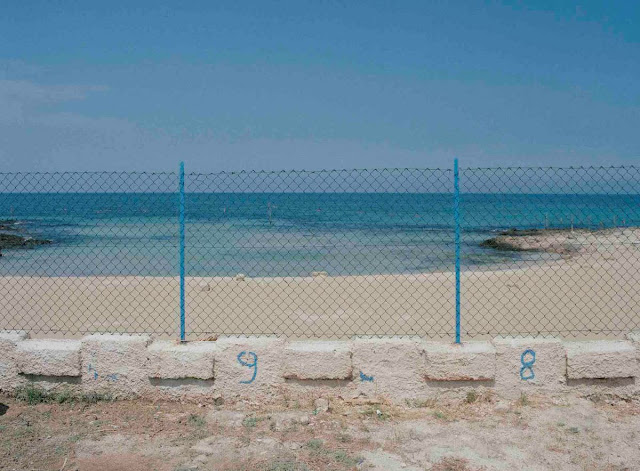
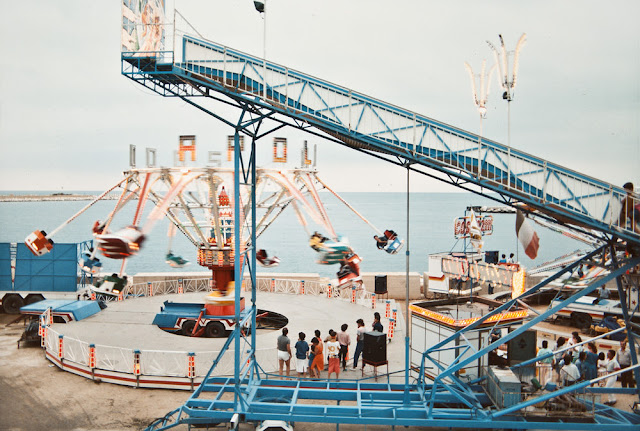
Located along the Adriatic coast, Puglia is not as well documented or touristed as Rome, Venice, Cinque Terra or Tuscany, but is nevertheless full of a rich cultural history. For close to 10 years, Ghirri explored the totality of Puglia with his cameras, but many of the pictures were made in Bitonto, a small city or commune within the larger city of Bari. Like many Italian cities, Bitonto is filled with brick streets and buildings that appear hundreds of years old. Walking these streets, Ghirri focused on the residential and daily life, looking at the people and the landscapes that seamlessly integrate the past and present (in the accompanying texts, the phrase
there is nothing old under the sun comes up time and again), reminding us that the they are one and the same. Ghirri successfully embraces sentimentality without falling for anything saccharine or nostalgic, instead representing a place full of love and humanity, simplicity and humility, and somehow effortlessly existing outside of time, being contemporary and full of presence while evoking a rich history that imbibes the simplicity of the pictures with an historic grandeur.
Throughout
Puglia, we often see multiple views of the same scene. In one photograph Ghirri shows us a sleepy store front with one man sitting alone out front, in the next frame he’s joined by his friends for conversation and coffee. We see children acting out a wedding procession on a street corner, with the next frame showing the same corner emptied. Other times he shows us multiple views of the same architecture, changed by the shadows or his walking of the landscape. Collectively, this approach lends the book a delightful cinematic quality, breaking free of the decisive moment and instead showing a more animated interpretation of an ongoing presence. The book does provide some quotes from Ghirri in which he shares some of his working strategies and philosophies, substantiating this cinematic quality as an essential part of the photographer’s vision:
“My way of interpreting through telling a story is simply that of managing to work with stronger images, so that some points are more evident and others less so; a method that is very close to literature, but also to cinema. Cinema has moments of greater overall intensity with more narrative moments or with pauses, which are nevertheless necessary for the comprehension of the film. Translated into photography, it can be a sequence, or shots of different distance, or different moments of approach…Images conceived to strengthen another, or offset another, or contrast with another, so that the narrative is not dull and lifeless.”
Coupled with this narrative approach, Ghirri brings an incredible understanding of photographic form, using light and shadow to create photographs that are deceptively simple, truly complex, and dynamic arrangements that reveal an incredible understanding of shape, balance, depth, and form. Indeed, Ghirri uses an original approach for understanding the play of shadow on architecture which ultimately make many of the spaces he photographs appear so much more elusive, all grounded with an incredible sensitivity to light. Page after page of
Puglia, Ghirri demonstrates a remarkable ability to organize pictures, playing with light, shadow, color and shape in ways that appear simple but are clearly the result of patience, mastery, and an infectious love of photography.
The most exciting and innovative aspect of Ghirri’s photographs is his use of color; I cannot think of another color photographer who sees and understands white like Ghirri. The best comparison I think of is Rauschenberg’s
White Paintings, which provide a remarkable meditation on degrees. While working with a broader palette than Rauschenberg’s paintings, Ghirri’s pictures nevertheless have a similar richness in their subtleties and embrace white like no other color photographer.
Puglia is divided into three basic sections. The bulk of the book is composed of Ghirri’s pictures, with around 200 photographs made between 1982-1990, printed just one per page. After the photographs are the accompanying texts, three different pieces that help contextualize Ghirri’s pictures and accomplishments. The final section is a series of 100 thumbnails which show the photographer’s original edit of his pictures from the region for an early exhibition of the work. Seeing Ghirri’s original sequencing of the photographs is interesting and presents a more narrative approach to the pictures than offered in this publication, and a very sharp acumen for developing visual relationships and ideas.
 |
|
 |
|
In the book’s final essay, “Ghirri: Fotografia, Sturttura, Romanzo (Ghirri: Photographs, Structure, Novel),” is by renowned Italian art historian Arturo Carlo Quintavalle, who provides a rich and insightful look at Ghirri’s work, career, and photographic philosophies. Quintavalle breaks down Ghirri’s work by first looking at his theories about images and narrative, citing the photographer’s own writings (from the beginning of his career, Ghirri wrote prolifically about photography): “I tried to construct and design whole works, and constructing whole works or projects meant thinking about a form of narrative through images, rather than a construction of single images.” He then looks at the evolution of Ghirri’s visual vocabulary over time, looking at the evolution of works as different and innovative as
Kodachrome and
Cardboard Landscapes, all leading to Quintavalle’s remarks on
Puglia. He closes this essay with a close reading of the pictures, presented with important background information to help contextualize and understand Ghirri’s photographs from Puglia. Quintavelle walks us through the book, almost page-by-page, looking at the individual pictures, sequencing, and some of the ideas behind the book’s design. He points out the technical challenges and discoveries Ghirri confronted making these photographs (the white walls and the harsh sun of southern Italy, specifically), explains the sophisticated compositional and conceptual strategies the photographer developed while picturing the people and architecture of the region, and addresses the narrative strategies at play in book.
For those already familiar with Luigi Ghirri,
Puglia provides incredible insight into his work and career, highlighting a body of work that further solidifies him as an essential contributor to the development of photography in Italy. For those not yet familiar with his work, this book is a wonderful introduction into the pictures, strategies, and theories of an innovative, imaginative, disciplined, and insightful photographer. With a substantial collection of photographs created across
Puglia, and the insight of the accompanying texts, Puglia provides an incredibly thorough look at Ghirri and how he engaged a landscape and community.
Purchase Book
Read More Book Reviews
Brian Arnold is a photographer, writer, and translator based in Ithaca, NY. He has taught and exhibited his work around the world and published books with Oxford University Press, Cornell University, and Afterhours Books. Brian is a two-time MacDowell Fellow and in 2014 received a grant from the Henry Luce Foundation/American Institute for Indonesian Studies.


+black+backgroung+alta+T.jpeg?format=2500w)
+T.jpeg?format=2500w)
+T.jpeg?format=2500w)