PHOTOBOOK REVIEWS, INTERVIEWS AND WRITE-UPS
ALONG WITH THE LATEST PHOTO-EYE NEWS

Social Media

Showing posts sorted by relevance for query photo objects & small prints. Sort by date Show all posts

photo-eye Gallery Photo Objects & Small Prints: Julia Barello & Chris McCaw Comments on the work of Julia Barello & Chris McCaw currently in photo-eye Gallery's Photo Objects & Small Prints exhibition.
In addition to the many unique photographic pieces in our current exhibition, Photo Objects & Small Prints, we also teamed up with Mary Anne Redding to present REDD: a pop-up jewelry installation featuring the work of Julia Barello and Rachelle Thiewes. We asked Thiewes to speak about her work last week, which you can read here. This week, I've asked Mary Anne Redding to contribute her thoughts on Barello's work. I've also asked Chris McCaw to discuss his Sunburn series. Read the previous posts on our Photo Objects & Small Prints show here.

Mary Anne Redding on Julia Barello's work

Julia Barello, Necklace made from dyed MRI & X-ray film
$900
"I have known Julia Barello for over ten years. We first met in 2003 when I was the Director of the New Mexico State University Art Gallery in Las Cruces, where I had the opportunity to work with Julia closely over the course of three annual faculty shows. Julia’s artwork is exquisitely crafted, beautiful in conception and execution. I believe she is working with materials and ideas that reach beyond our typical notion of jewelry or body art. Working with X-ray and MRI film, she first used images of the interior of the body to adorn the exterior of the body. She has now moved beyond individual bodies, taking her material from the intimate to the universal and onto walls, ceilings and floors. I support her desire to make the next transition from objects in a space to objects that create a space where the viewer participates in a more visceral experience of her work." –Mary Anne Redding

Watch the short video on Instagram of Julia Barello's Bluster wall installation

photo-eye Gallery Photo Objects & Small Prints: David Emitt Adams, Kevin O'Connell & Zoë Zimmerman David Emitt Adams, Kevin O'Connell & Zoë Zimmerman discuss their work in photo-eye Gallery's Photo Objects & Small Prints exhibition.

For the last month, we have been highlighting the work of three artists in our current exhibition, Photo Objects & Small Prints. You can read about the work in the show in the artists' own words here, here and here. This week I have asked David Emitt Adams, Kevin O'Connell and Zoë Zimmerman to elaborate on their pieces in the show.

David Emitt Adams, Saguaro #11
Tintype on found object
David Emitt Adams
"Never have I known the Arizona desert without roads, homes, buildings or urban sprawl. As long as people have been in the American West, we have found its barren desert landscapes to be an environment perfect for dumping and forgetting. I have explored this landscape with an awareness of the photographers who have come before me, and this awareness has led me to pay close attention to the traces left behind by others. For this body of work, I collect discarded cans from the desert floor, some over four decades old, which have earned a deep reddish-brown, rusty patina. This patina is the evidence of light and time, the two main components inherent in the very nature of photography. I use these objects to speak of human involvement with this landscape and create images on their surfaces through a labor-intensive 19th century photographic process known as wet-plate collodion. The result is an object that has history as an artifact and an image that ties it to its location. These cans are the relics of the advancement of our culture, and become sculptural support to what they have witnessed."–David Emitt Adams


photo-eye Gallery Photo Objects & Small Prints: David H. Gibson, Rachel Phillips & Curtis Wehrfritz David H. Gibson, Rachel Phillips & Curtis Wehrfritz discuss their work in photo-eye Gallery's Photo Objects & Small Prints exhibition.
For our third installment, we're featuring the works of three photographers in our current exhibition at photo-eye Gallery, Photo Objects & Small Prints. This week, I've asked David H. Gibson, Rachel Phillips and Curtis Wehrfritz to discuss their work in the show. Read more about the work in this show here and here and stay tuned for more next week.


David H. Gibson
Cypress Island, Village Creek, Texas
Gelatin Silver Print
David H. Gibson
"The photographs in exhibition are made in the moments before sunrise - or just after. I am drawn to the edges of ponds, lakes, and streams when the warm water interacts with cool morning air. This condition produces wispy mist, rising fog, or sometimes a blanket of fog. Atmospheric forms evolve in unexpected ways from quiet movements in the air. The tonal range is continuous, with even transitions from the very lightest areas to those of greatest contrast. The light is quiet, and the mist and fog add a comforting presence. This is where I find poetry and magic in the land."
–David H. Gibson


photo-eye Gallery Photo Objects & Small Prints: Kate Breakey, James Pitts and Rachelle Thiewes Kate Breakey, James Pitts and Rachelle Thiewes discuss their work in photo-eye Gallery's Photo Objects & Small Prints exhibition.
This week I've asked Kate Breakey, James Pitts and Rachelle Thiewes to offer some insight into their working processes behind their pieces in our current exhibition, Photo Objects & Small Prints. Other features from this show can be found here, here, here and here.

Kate Breakey, Desert Cottontail
Hand-colored silver gelatin print, Edition of 7
$1080 framed
Kate Breakey
In 1834, William Henry Fox Talbot (1800–1877) saw that silver salts darkened in the sun and invented a photographic process he called “photogenic drawing” — in which images were made without a camera, the subject simply laid on chemically treated paper and exposed to light. This is the archaic process I use to make Las Sombras. These are the remains of living things — plants, reptiles, mammals, insects, and birds. They make their own image, a kind of shadow, which will last long after they are gone. Their ghostly imprints, are burned directly onto paper with light and with love to make a permanent record. I've made these ‘photograms’ of everything I find dead — from deer and coyote to bees and moths — as well as flowers and weeds from my back yard, in an attempt to document and chronicle the natural world which is my endless inspiration as an artist.
Opening to some great feedback, Photo Objects & Small Prints is currently on view at photo-eye Gallery. The exhibition includes work from twenty-one different artists, including two jewelers, all working in the photographic medium in unique and interesting ways. Over the course of the exhibition, we are going to highlight the work of two to three artists every week. Each artist will offer some words about their piece(s) included in the show.  –Erin Azouz

Laurie Tümer
Laurie Tümer
Left: Laurie as Desert Bird of Paradise, 7"x10"
Archival Pigment Print, Edition of 20
Right: Works on Rock, Various sizes
Each rock is unique
"Works on Rock, silver prints on rock surfaces were inspired after a trek to a remote area in north Africa to see the legendary rock art of the Tassili. My rock surfaces were coated with light sensitive chemistry and processed like paper in the darkroom. The round rocks are from a single negative of me. The botanicals (from my garden) on pavers are photograms. I no longer make these, and what you see are the last of hundreds made over a 10 year period.

This week, we're highlighting the works of three photographers included in our current exhibition at photo-eye Gallery, Photo Objects & Small Prints: Linda Connor's beautiful archival print on silk; Jo Whaley's exquisite, colorful botanical studies; and Ryan Zoghlin's whimsical orotone and silvertone photographs of hot air balloons printed on glass lenses of various sizes.


Linda Connor
O'hia, Hawaii, 1997
Archival Print on Silk, 60x40" Edition of 5


Linda Connor
"I first thought about doing my photographs on silk a number of years ago when I had the opportunity to have a show in Bali. The idea of sending large framed pieces to Indonesia was out of the question, and generally works on paper do poorly there due to the humidity. So, I experimented with images on silk, which I feel works very well with certain images of mine." –Linda Connor


photo-eye Gallery photo-eye Gallery News photo-eye Gallery news with updates from Jamey Stillings, Luigi Fieni, Adam Jahiel, Jo Whaley and more.

# 5871, 11 April 2012 -- Jamey Stillings
Jamey Stillings was recently featured on the NMPBS program ¡COLORES!. Stillings discusses his project on the Ivanpah Solar installation. He's interviewed in the first 10 minutes of the show.

Read Stillings' comments on Invanpah Solar here

View Stillings' work on photo-eye Gallery

Exhibition runs Friday, December 6th through January 2014.
Opening & Artist Reception Friday, December 6th, 5-7 pm
photo-eye Gallery is located at 376-A Garcia Street, Santa Fe, NM 87501


photo-eye Gallery is pleased to announce an exhibition of photographic objects and small prints from a wide range of artists working with photography in a variety of ways. We are also pleased to partner with Mary Anne Redding to present REDD: a pop-up experience with 2 contemporary art jewelers engaging with the photographic medium.


photo-eye Gallery Portfolio and Interview: Rachel Phillips – Divinations photo-eye Gallery is excited to publish Divinations a series by California based photographer Rachel Phillips on the Photographer's Showcase. Divinations layers new black-and-white imagery on top of antique ephemera lending old objects new context, meaning, and aesthetic. Phillips combines imagery based on divinations, styles of fortune-telling, with 19th Century cabinet card portraits in, as the artists describes, a "playful and poignant attempt at using the proverbial crystal ball to see into the lost past, rather than the unknown future."

Divination by Cards, 2015, and Divination by Double Take, 2015 © Rachel Phillips
Displayed in Stands Made by the Artist 

photo-eye Gallery is excited to publish Divinations a series by California based photographer Rachel Phillips on the Photographer's Showcase. While Divinations is Rachel's first portfolio on the Photographer's Showcase, a selection of prints from her Field Notes series were on view in our 2014 Photo Objects and Small Prints exhibition. Like Field Notes, Divinations layers new black-and-white imagery on top of antique ephemera lending old objects new context, meaning, and aesthetic. Phillips combines imagery based on divinations, styles of fortune-telling, with 19th Century cabinet card portraits in, as the artists describes, a "playful and poignant attempt at using the proverbial crystal ball to see into the lost past, rather than the unknown future." The result is a unique and sumptuous object filled with whimsy, intrigue, and a touch of mystery. Selections from Divinations are currently on view at photo-eye Gallery alongside Michael Kenna: A Retrospective, and Lucas Shaffer spoke with Rachel Phillips to learn more about how the series came to be.

photo-eye Gallery From the Flat Files: Chris McCaw & David Emitt Adams Materials have meaning. photo-eye's Lucas Shaffer highlights Chris McCaw and David Emitt Adams, who each forge robust and sculptural photographs with entirely unique results.

Chris McCaw,Sunburned GSP #691 (Anza Borrego), 2013

Chris McCaw, Sunburned GSP #687 (Pacific Ocean), 2013
Materials have meaning. This axiom has a long and storied history among photographers, and has prompted countless discussions about the implications of paper type, printer brand, or chemical developer upon image outcome and overall viewer perception. I myself have clear memories from my own photographic education justifying paper and developer combinations to instructors while dissecting the subtle nuances of print tone and patina amidst classmates. This week, however, I’d like to showcase two Gallery artists whose implement of photographic materials transcends those more common usages. Chris McCaw and David Emitt Adams forge robust and sculptural photographs with entirely unique results.

Perhaps photographer Chris McCaw doesn’t need an introduction. His ongoing project Sunburn has caught fire in recent years, and McCaw’s work exhibits internationally, including: the Getty museum in LA, the Somerset House Trust in London, and right here at photo-eye Gallery in the 2012 exhibition Solar. Using giant homemade large format cameras, McCaw exposes antique and obsolete silver gelatin enlarging paper to direct sunlight for up to twenty-four hours. The effect is incredible. Over the duration of the extended exposure the paper solarizes, forming a visual positive, and the sun literally burns a hole in its jagged arching wake. These scenes are a dark and primordial expression of time, entropy, and the cyclical process of creation and destruction. Currently photo-eye Gallery has five of these one of a kind images on hand.

photo-eye Gallery Creation and Destruction: Christopher Colville's Beyond Reckoning Alexandra Jo
Colville's most recent series of unique gunpowder generated silver gelatin prints takes his process a step further, using bullet-riddled targets found on-site in the desert to depict images questioning violence and the residue of American volatility.


The explosive fluidity of Christopher Colville’s work is singular in its ability to shift between image and abstraction. His unique process of igniting gunpowder on silver gelatin paper to capture the simultaneous violence and grace of explosions creates images in-flux. His work evokes a multitude of things including formless atmospheric auras, desolate landscapes, fireworks, constellations, cratered lunar surfaces, and now, the human figure.

Beyond Reckoning, Colville’s most recent series of unique gunpowder generated silver gelatin prints takes his process a step further in specificity. For this body of work, Colville takes used and abandoned practice targets found in the open desert where he works in the darkness of night to create his photographs and uses them as templates for the gunpowder explosions that make his work. The resulting images are haunting, often depicting life-sized human silhouettes riddled with bullet holes and surrounded by a dark, smoky haze.  Colville says of the work:

Christopher Colville, Citizen 9, Unique gunpowder generated
gelatin silver print in direct positive paper,
32 x 24.2 inches, Framed with Optium Plexi, $7,650

Beyond Reckoning is the antiphon to a continuous cycle of violence embedded in American culture, reflecting our polarized population. The images are made with targets I have collected from desert hillsides, abandoned by recreational shooters. The targets include commercially produced bulls-eyes, life size human forms, predators, mannequin heads, and wedding photographs as well as more divisive, crudely drawn political caricatures. These objects are cultural relics of a violent era, reduced to delicate lace by the onslaught of gunfire, revealing complex motives of hero fantasies, fear, frustration and hatred.”


The very materials Colville uses (gunpowder, fire, targets, etc.) point to the presence of violence-as-pastime in America’s current gun culture. The series also includes a few digital photographs of targets and metal debris from the shooting sites. This body of work feels almost like a call to action alongside a thorough, emotionally fraught examination of society’s desensitization to bloodshed and human fragility. Here, there is a juxtaposition of creation and destruction, brutality and beauty, which asks audiences to reexamine our society’s relationship to violence as a whole.

Christopher Colville, Wound, Archival Inkjet Print, 24 x 30 inches, Edition of 15, $1800

Colville says: “Suspended in a state of wonder and dread, my time in the landscape has shifted from a search for transformative experiences to a reckoning with the residue of American volatility[…] I have spent the last year and a half scouring the land surrounding my home, gathering objects and orchestrating nighttime interventions. Engulfed in billowing smoke, I sift through debris, repeating and refining small explosions, layering violence upon violence with the hope of finding clarity.”

Within this layered violence, audiences are invited to take stock of the psychological aspects involved in firing a gun at a human-shaped target or recognizable photograph of a person. The work brings a new perspective to the casual presence of weapons in American everyday life.

Christopher Colville, Target D10, Unique gunpowder generated gelatin silver print,
16 x 20 inches, Framed with Optium Plexi, $4,300


photo-eye is thrilled to add Beyond Reckoning to our website in two brand new portfolios.

Works in the series can be viewed here and here.


»Read photo-eye's interview with Colville 

All prices listed were current at the time this post was published.

For more information, and to purchase artworks, please contact photo-eye Gallery Staff at:
(505) 988-5152 x 202 or gallery@photoeye.com


photo-eye Gallery LIGHT + METAL:
Nissa Kubly's Unique Wearable Cameras,
Jewelry, and Photographic Sculpture
photo-eye Gallery is proud to work with Kubly for the first time in LIGHT + METAL and have ten of her refined and innovative designs currently on view in the exhibition.

Nissa Kubly's work installed at photo-eye Gallery for LIGHT + METAL
Skilled in metalworking, artist Nissa Kubly crafts an array of unique objects including photographic sculpture, enamel image-based jewelry, and delightful wearable pinhole cameras. With an interest in optics and image creation, Kubly's practice deftly combines form with function to build three-dimensional functioning artworks that take photography off the wall and place it in the hands of the collector. photo-eye Gallery is proud to work with Kubly for the first time in LIGHT + METAL and have ten of her refined and innovative designs currently on view in the exhibition.

We spoke recently with Kubly, and the artist shared a little about her background and how her obsession creating unique physical artworks began. Nissa Kubly's work can be viewed in the gallery as a part of LIGHT + METAL though this Saturday, September 22nd, 2018.

Nissa Kubly, Flagstaff Courthouse, Brass, positive film pinhole image, glass, 3.5x4" ImageUnique, $800

photo-eye:     What inspired you to create the pieces included in LIGHT + METAL?

Nissa Kubly:     These pieces in the gallery show started as work in graduate school when the history of photography professor assigned us a challenge to make our own camera and test it to see if it worked.  I was in the fine art department studying metals and didn't quite understand the camera obscura so I decided to try it out, making a small scale camera in copper and brass. I cut a little piece of photo paper, inserted it into the camera and lined it up to take an image of a bike on campus, quickly went into the darkroom to develop and was amazed when it actually worked! I loved that I could create a very basic machine and get a result that would be permanent. A lesson in form follows function!

Nissa Kubly, Round Pinhole Ring II, 2008, Sterling Silver, Brass, 2x2" Object, Unique, $2500

pe:     What type of work did you make prior to the work you are making today, and if the work was different, what inspired the change?

NK:     I loved my beginning/undergraduate work in formal metalsmithing at the University of Wisconsin-Madison. Here we were making hollowware, functional tableware like chalices, hand raised bowls, serving utensils and custom rings in sterling silver, pewter and copper. I guess I've always liked functional work that is beautiful as an object and well constructed.
Nissa Kubly, St Mary's Basilica, Phoenix 
(Pinhole Image) on Camera #9, 
Pinhole image on Positive Film, 
Brass, Magnifying Lens, Sterling Silver,
 6x3" Object, Unique, $2700

pe:    Can you tell us about creating one of the works included in  LIGHT + METAL?

NK:     The wearable cameras started in graduate school also, when I made a belt buckle camera. It was a small rectangular brass box I could load with film and take images (incognito) of party-goers! So, I wanted to continue this idea and next, I made a Pinhole camera bracelet in sterling silver, which I loved, but it sold to a collector. (Now in the Racine Art Museum collection). I liked the idea of functional, spy-like objects that could be worn and it was important the pieces be one of a kind. So I continued with the fabrication of the pinhole rings; they are hollow constructed from silver sheet, formed and soldered. Some patterning comes from etched designs on the sides. I added brass details which are turned on my mini-lathe in the studio and soldered onto the piece. I enjoy the process so much—designing, creating and experimenting. The constructed camera gives me all these opportunities.

Nissa Kubly
Nissa Kubly received her B.S. in Fine Art from the University of Wisconsin-Madison. She continued her studies at the University of Wisconsin in Art Education, where she was awarded a teaching degree. Ms. Kubly later earned a Masters of Fine Art in Metals from Arizona State University, Tempe. Her thesis, "Macchine di Luce," was an exploration of  the optics of the pinhole camera in functional metal fabrication. Kubly was awarded a residency at Anderson Ranch Art Center, Aspen, CO to work in sculpture and photography studios, constructing cameras and experimenting in film. She has been awarded grants from the Phoenix Art Museum and 3M Corporation, and her work has been included in publications such as Design & Architecture and public and private collections around the world. In 2014, Ms. Kubly was included in the largest pinhole collection in the world with numerous cameras and images added to the New Mexico History Museum's permanent collection in Santa Fe. The summer of 2017 took Ms. Kubly on a residency with Biomimicry at the Tempe Center for the Arts, where she researched butterfly optics and vision, consulting with Dr. Ron Rutowski, a professor in life sciences at ASU.
–––


LIGHT + METAL has been extended at photo-eye Gallery 
through Saturday, September 22nd, 2018. 

For additional information on Nissa Kubly's work, 
and to purchase prints, please contact Gallery Staff at 
505-988-5152 x202 or gallery@photoeye.com.


photo-eye Gallery New Exhibition
Christopher Colville: FLUX
Opening & Artist Reception: Friday, April 26th, 5–7pm "The photograph is essentially a transformation orchestrated by an artist" is the mantra of Phoenix-based photographer Christopher Colville, and his new solo exhibition Flux at photo-eye Gallery exemplifies the maxim.


Christopher Colville: FLUX 
Opening & Artist Reception: Friday, April 26, 5 – 7 PM
On View: April 26 – June 22, 2019

» View FLUX

ABOUT THE EXHIBITION
“The photograph is essentially a transformation orchestrated by an artist,” is the mantra of Phoenix-based photographer Christopher Colville, and his new solo exhibition Flux at photo-eye Gallery exemplifies the maxim. Enigmatic, emotional, and explosive, Christopher Colville’s unique silver gelatin prints are contemporary in their execution and methodology while their appearance seems timeless. Crafted using controlled gunpowder-based explosions Colville records the blast’s energy as it travels across traditional light-sensitive photographic paper yielding abstract images that are expressive, not descriptive. photo-eye Gallery is proud to welcome Colville as a represented artist, and Flux will open Friday, April 26, 2019, with a reception held from 5–7 pm corresponding with the Last Friday Art Walk in the Railyard Arts District.

ABOUT THE ARTWORK
Christopher Colville, Fluid Variant 2, 2015, Unique Silver-Gelatin Print, 13x15" Image, $3,250
The images in this series meditate on the dual nature of creation and destruction. They are created outdoors at night by igniting a small portion of gunpowder on the surface of silver gelatin paper. In the resulting explosion, light and energy abrade and burn the surface while simultaneously exposing the light-sensitive silver emulsion. I loosely control the explosion by placing objects I have gathered in the field on the paper’s surface, but the results are often surprising and unpredictable as the explosive energy of gunpowder is the true generative force creating the image. I believe that by working in these ways, the images push the material and symbolic limitations of the medium. They turn the photograph inside out while creating something that is both serendipitous and elemental. The images are the residue of both creation and obliteration, generated from a single spark.”  – Christopher Colville

ABOUT THE ARTIST
Christopher Colville, Photograph by Josh Loeser
Born in 1974 in Tucson, Arizona, Christopher Colville received his BFA in Anthropology and Photography from Washington University in St. Louis, Missouri and his MFA in Photography from the University of New Mexico. Chris has taught in multiple institutions including as a visiting Assistant Professor at Arizona State University as well as working as the photography editor for Prompt Press. Christopher’s work has been included in both national and international exhibitions. Recent awards include the Ernst Cabat Award through the Tucson Museum of Art, Critical Mass top 50, the Humble Art Foundations New Photography Grant, an Arizona Commission on the Arts Artist Project Grant, a Public Art Commission from the Phoenix Commission on the Arts and an artist fellowship through the American Scandinavian Foundation. Christopher’s work has been reviewed in national and international publications including Art in America, L.A. Times, Boston Globe, and GUP Magazine. He currently based in Phoenix, Arizona.

• • •

For more information, and to purchase prints, please contact Gallery Staff at 
505-988-5152 x202 or gallery@photoeye.com

All prices listed were current at the time this post was published. Prices will increase as the print editions sell.


photo-eye Gallery How It's Made:
The 14 Techniques Used in LIGHT + METAL
Gallery Director Anne Kelly introduces a brief overview of the 14 photographic processes used in our current group exhibition, LIGHT + METAL

LIGHT + METAL Installation View, West Wall
Left to Right: Julie Weber, David Emitt Adams & Claire A. Warden, Heather Oelklaus, Anne Arden McDonald
Historically, the key elements to any photographic image have been light and metal, and while the photographers in our LIGHT + METAL exhibition all use traditional materials, none of them are creating entirely traditional works. These artists are experimenting, pushing the materials to make original, unique physical objects that return to the medium's original magic. Most photographers who came up working in the darkroom recall the delight and fascination of developing a photograph for the first time and watching as an image slowly appeared in the tray. They were hooked. That is how I fell in love with photography – I used to spend hours in the darkroom after school contact printing images over and over,  just doing things to see what the results might look like.

The introduction of digital technology dramatically altered the photographic landscape and created an approachable, flexible, and prolific means of creating images in the 21st century. For the most part, I think the digital process is excellent, high-definition capture is more portable than ever, and images can be printed in the light on a heroic scale. While digital technology is complex, its practice is understandable and doesn't elicit the same sense of wonder as chemical photography.

In reaction to, and in some cases liberated by, the elevation of digital photography, the artists in LIGHT + METAL are a part of a resurgent movement playfully exploring the possibilities of traditional processes like cyanotype, platinum, silver gelatin, and wet-plate collodion, among others. Here, we've constructed a process glossary for the myriad techniques seen in the exhibition in order to explain more about how the works were made. In the following weeks, we'll be delving deeper into the artists' specific contribution to the show, revealing more about their practices and intentions.

LIGHT + METAL is a passion project, and we are extraordinarily proud of the exhibition. The work is installed at photo-eye Gallery through September 15, 2018; please feel free to contact the Gallery if you have any questions regarding the artists, artworks, or techniques used in the show.
– Anne Kelly, Gallery Director

LIGHT + METAL installation view

Cameraless  – (Anne Arden Mcdonald) A cameraless image is produced on photographic material without the aid of a camera or lenses.

Chemigram – (Anne Arden McDonald, Heather Oelklaus) A Chemigram, from "chemistry" and gramma – Greek for "things written," is a photographic practice where an image is made by painting with chemicals directly on light-sensitive paper. In LIGHT + METAL, both artists pre-coat the paper in varnish to prevent chemical action, subsequently scraping away at layers of the varnish to allow areas of the paper to develop. Chemigrams were invented in the 1950s by Belgian artist Pierre Cordier.

Collage (Vanessa Woods) Collage (from the French: coller, "to glue" is a technique where a new image is created from an assemblage of different forms, such as vintage photographs.

Cyanotype(Meghann Riepenhoff) Cyanotype is a photographic printing process that produces a cyan-blue print. The process uses two chemicals: ferric ammonium citrate and potassium ferricyanide, and uses water as a developer.

Meghann Riepenhoff's Dynamic Cyanotypes, courtesy of EUQINOM Gallery, 
and Kevin O'Connell's Platinum Printsinstalled for LIGHT + METAL


Digital Enamel Transfer – (Nissa Kubly)
A digital enamel transfer is an image printed on a clear substrate in archival pigment and placed
directly on top of an enamel, at which point it is heated up to 150° F., at which point the enamel liquefies
and absorbs the pigment.

Encaustic Print (Kate Breakey, Lori Vrba) Encaustic printing employs the addition of heated beeswax, and occasionally pigment, to the prepared surface of a photographic print, giving the object a unique tone and texture.

Hand-colored (Kate Breakey, David Emitt Adams & Claire A. Warden) In a hand-colored image, paint, pencils, and pigment are typically applied to a processed black-and-white photograph to add color and texture.

Lumen Print –  (Vanessa Marsh, Anne Arden McDonald)
A printing process using traditional silver gelatin paper, heat, and sunlight to expose the paper. Gold toner is used as a fixer instead of traditional sodium thiosulfate.

Vannessa Marsh's Lumen Prints Installed for LIGHT + METAL

Luminogram – (Michael Jackson)
A cameraless process pioneered by László Moholy-Nagy in 1922, the Luminogram is simply light, directed onto photo paper in the darkroom. Using their hands, a Luminographer uses gestures and intensities that yield a direct result of their actions on the paper, molding light as a sculptor might mold clay. Gottfried Jäger described it as "the result of pure light design; the rudimentary expression of an interaction of light and photosensitive material… a kind of self-representation of light."

Photogram – (Julie Weber, David Ondrik
A photogram is a cameraless photographic image made by placing objects directly onto the surface of a light-sensitive material, such as photographic paper, and then exposing the material to light.

Pinhole Camera – (Nissa Kubly)
A pinhole camera is a simple camera without a lens, but with a tiny aperture, a pinhole – effectively a light-proof box with a small hole in one side. Light from a scene passes through the aperture and projects an inverted image on the opposite side of the box, which is known as the camera obscura effect. These cameras can take nearly any form.

Michael Jackson's Luminograms installed at photo-eye Gallery for LIGHT + METAL.


Platinum Print  (Kevin O'Connell)
Platinum/Palladium is a black-and-white contact printing process in which the image is formed of metallic platinum or palladium in the fibers of the paper (instead of an emulsion coating on the surface). The hand-coated images are known for their luminosity, extraordinary detail, beautifully rich tonal range, permanence, and stability. Platinum and Palladium printing has enjoyed a revival in recent years as well.

Positive Film – (Nissa Kubly)
In LIGHT + METAL, positive film refers to a silver-nitrate-based black-and-white emulsion suspended on a celluloid base, yielding a unique direct positive image

Wet-Plate Collodion – (David Emitt Adams)
The collodion process, mostly synonymous with the "wet-plate collodion," requires the photographic material to be coated, sensitized, exposed, and developed within the span of about fifteen minutes, necessitating a portable darkroom for use in the field. In photography, collodion is a syrupy solution of nitrocellulose, alcohol, ether, and silver nitrate, used for coating things, chiefly in surgery and in a former photographic process. The emulsion is typically applied to a prepared glass or metal plate.

Over the next seven weeks, we will continue to explore the work included in LIGHT + METAL.  

LIGHT + METAL is currently on view at photo-eye Gallery through September 15, 2018.

For additional information regarding the artists in LIGHT + METAL, or to inquire about purchasing artwork, please contact Gallery Staff at:
505.988.5152 x202 or gallery@photoeye.com.

» VIEW our Gallery of Installation Images

» VIEW Artwork from LIGHT + METAL

» READ a write-up of LIGHT + METAL published in Pasatiempo

» VISIT photo-eye Gallery

    541. South Guadalupe Street
    Santa Fe, NM 87501
    (click for map)


Maggie Taylor, Invitation to a Dream, 2022, Archival Pigment Print, 15x15", Edition of 15, $3,200

With great pleasure, photo-eye Gallery is delighted to introduce the latest collection of work by renowned artist Maggie Taylor, showcasing her unique style of photomontage! 
  

So sit back, relax, and allow yourself to be transported to the whimsical universe of Maggie Taylor...


Maggie Taylor, The Listening Room, 2022, Archival Pigment Print, 8x8", Edition of 15, $1,700

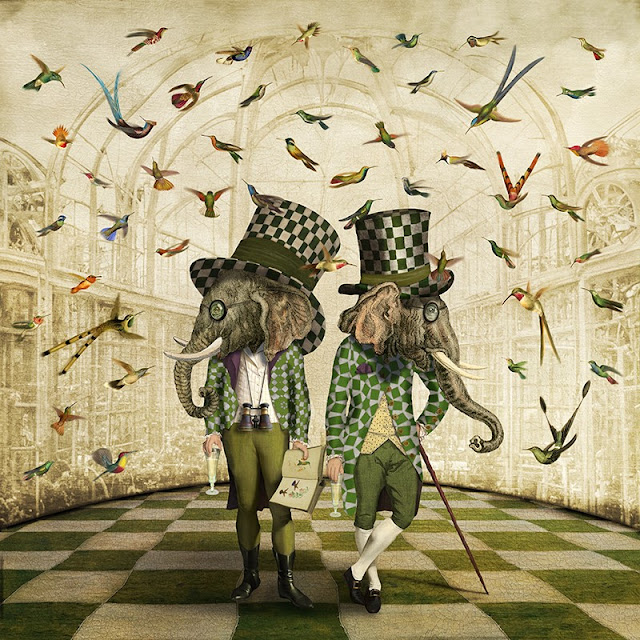
Maggie Taylor is a contemporary artist who explores the intersection of reality and imagination through her unique digital collages. As an innovative artist and early adopter of Adobe Photoshop, Taylor has taken her art to a new level by incorporating the latest technology into her works, combining elements made using the AI program, Midjourney with her traditional practice that blends vintage photographs and collected elements to create dreamlike scenes.

By using Midjourney, Taylor is able to bring her creative visions to life in a new way and the results are stunning. This group of images features an array of surreal and imaginative scenes, with intricate details and a rich color palette, each one more captivating than the last. These images are also a testament to the power of the artist in collaboration with AI and its ability to enhance the art world in new and exciting ways.

Anne Kelly, photo-eye's Gallery Director, queried Maggie Taylor about her utilization of AI programs in her artistic process. Given that Taylor was a Photoshop pioneer, Anne wanted to understand her thoughts on AI and how it compares to the early days of Photoshop.
I took a look at using the AI program Dall–E last summer. I love the idea of using language to generate imagery, so I was excited to try it out. Crafting the text that will create the image you envision is really difficult. Most of the time you get results that either disappoint or surprise you— and that can be a good thing. I always leave a lot of room in my working process for accidental encounters with the image. I do not start with a preconceived plan of what the finished image is going to be. So, working with some elements created by AI seems like a natural fit to me.

Initially, my biggest concern with the program was the small size of the images that the AI programs generate. I did not see that the quality of the images would be any better than a sketch of an idea for my work. Later on, last fall, I found out about Midjourney and started to create some images from text prompts with that program. I then have to use another program to upscale the images. Then in Photoshop, I use a lot of other layers and elements to build up the image. My newest four images all have at least one AI element in them. The image The Listening Room has quite a few things from different AI images.

When I photograph in the real world I am reacting to things that I see (clouds, art, textures, objects) and collect them with my cell phone camera. Using Midjourney I feel like a set designer or a film director coming up with a concept and trying to articulate it in such a way that it comes to fruition. Then, if I like something that is generated, I collect it– downloading it to a folder on my computer instead of clicking the shutter on my camera. 

Most of the AI elements I have put into my work are either portions of backgrounds or smaller items within the overall image. They are often semi-transparent so that other colors and textures are also visible on them or under them. It is kind of like building a doll house or a stage set and finding some of the items you need from different sources. 

In the early days of Photoshop, there was quite a bit of resistance on the part of galleries and collectors to the idea that a computer could be involved in the artist's process. I suppose AI is meeting even more resistance– and in some cases for good reason. issues of copyright, originality, and ownership are popping up all the time. It will be very interesting to see what transpires in the next 10 years with AI on so many fronts. 

Also in the earlier versions of Photoshop, there was not the fine–tuned control that there is today, and most computers did not have the capacity to produce huge images. The quality of the AI images is getting better with each new iteration of the technology.


Watch the video below to hear more about Maggie Taylor's process with photomontage...


Maggie Taylor, Sailors Delight, 2022, Archival Pigment Print, 15x15", Edition of 15, $3,200


Maggie Taylor, The Bird Watchers, 2022, Archival Pigment Print, 8x8", Edition of 15, $1,700

Maggie Taylor is an artist that lives on the edge of a sun-drenched prairie populated by cows, alligators, and birds on the outskirts of Gainsville, Florida. She was born in Cleveland, Ohio, in 1961, and moved to Florida when she was 11. Her childhood was spent watching countless hours of science fiction and sitcoms on television; in college, she received a philosophy degree from Yale University and a master's degree in photography from the University of Florida. 

Taylor's digital compositions have been widely exhibited, published, and collected by many museums. 

photo-eye Gallery is proud to represent artist Maggie Taylor.

>> See more images by Maggie Taylor <<

>> Buy Maggie Taylor's book Internal Logic <<


*    *    *

The prints from this series are Archival Pigment Prints 

8x8", Edition of 15, Starting at $1,700
15x15", Edition of 15, Starting at $3,200
22x22", Edition of 10, Starting at $5,000
36x36", Edition of 9, Starting at $9,000

(Select images are also available 48x48" as dye sublimation on aluminum for $12,000)
(Select images are also available 58x58" on paper for $15,000)


PRINT COSTS ARE CURRENT UP TO THE TIME OF POSTING AND ARE SUBJECT TO CHANGE.


*    *    *

If you are in Santa Fe, please stop by during gallery hours or schedule a visit HERE.

For more information, and to reserve one of these unique works, please contact
Gallery Director Anne Kelly or Gallery Assistant Jovi Esquivel

You may also call us at (505) 988- 5152 x202


photo-eye Gallery

1300 Rufina Circle, Unit A3, Santa Fe, NM 87507

Tuesday– Saturday, from 10am– 5:30pm


photo-eye Gallery New Work & AI: The Whimsical Universe of Maggie Taylor Jovi Esquivel & Anne Kelly Get ready to be transported into a magical realm as we introduce you to Maggie Taylor's latest creations.